
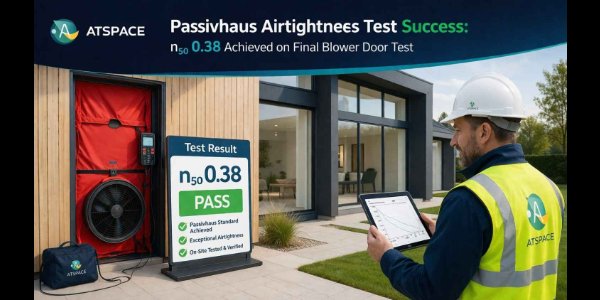
The Result
A Passivhaus home achieved n50 0.38 on the final blower door test, comfortably inside the 0.6 n50 certification limit. ATSPACE supported the project with Passivhaus air leakage testing, leak finding, and a practical close‑out plan that maintained airtightness continuity through the most complex junctions. Certification evidence was delivered without disruption or retest pressure.
Project Snapshot
Service: Passivhaus air leakage testing
Client: Developer‑led self‑build & principal contractor partnership
Site: Cedar View House, 18 Fernbank Lane, Hebden Bridge HX7 6QT
Building type: Single dwelling (Passivhaus intent)
Construction: Timber frame, wood fibre insulation, airtight membrane + tapes, MVHR
Programme stage: Final finishes complete, certification window
Performance target: n50 ≤ 0.6
ATSPACE delivery: Readiness check, diagnostic leak finding, final blower door test, certification‑ready reporting
Engineers: ATSPACE airtightness engineer + compliance coordinator (no names published)
Why This Was High Risk (Even on a Good Build)
Passivhaus failures rarely happen due to poor workmanship — they happen when details slip late in the programme.
Three real‑world risks affected this project:
1. Multiple airtightness layers converging at junctions
Membranes, tapes, window interfaces, internal services and plant penetrations must all align perfectly. Continuity is the challenge.
2. Late penetrations
Even small late changes (data runs, kitchen tweaks, electrical changes, MVHR adjustments) can reopen sealed layers.
3. Complex service zones
Plant rooms and utilities contain dense penetrations and overlapping trades — a known Passivhaus weak point.
The client wanted margin, not a borderline pass.
What a Passivhaus Airtightness Test Measures
A Passivhaus blower‑door test reports n50, meaning air changes per hour at 50 pascals.
In simple terms:
- Lower n50 = less uncontrolled air leakage
- Passivhaus requires n50 ≤ 0.6
- A lower result provides greater confidence in long‑term airtightness performance
ATSPACE focuses on airtightness as built, not just airtightness on test day.
What ATSPACE Was Asked to Do
The project team asked ATSPACE to:
- verify the home was genuinely ready for certification testing
- identify & prioritise leak routes affecting the final n50
- support practical close‑out
- deliver the final blower‑door test & certification‑ready reporting
What ATSPACE Did On Site
Step 1: Pre‑test readiness check
We walked the entire airtightness line, focusing on typical Passivhaus risk areas:
- window & door tapes/returns
- service penetrations in the membrane
- loft/ceiling penetrations
- plant room ductwork & pipework
- thresholds & balcony interfaces
- meter/service entries
- airtightness continuity behind kitchens/utility zones
We also confirmed test conditions to avoid surprises on test day.
Step 2: Diagnostic leak finding under controlled pressure
With the building under pressure, we traced airflow at the highest‑risk interfaces, ranking findings by:
- impact on n50
- access difficulty
- likelihood of recurring
- robustness of proposed fix
Step 3: Close‑out plan with clear ownership
To prevent issues bouncing between trades, the plan included:
- exact leak location
- why it mattered
- what “good” looks like
- which trade owned the fix
- what required rechecking
Step 4: Verification check before the test
We rechecked key areas after close‑out to protect the final test slot.
Step 5: Final blower‑door test & certification reporting
We completed the final test under controlled conditions and issued certification‑ready evidence.
The Issues We Found (That Could Have Risked the Result)
Issue 1: Plant room penetrations
A few pipe/cable routes were sealed but not as a continuous airtight layer.
Why it matters: Plant rooms accumulate leakage quickly.
Fix: Reinstate continuous airtight layer behind collars/trims.
Issue 2: Window return transitions
Most window tapes were excellent; a few transitions had minor discontinuities.
Why it matters: Window perimeters are long junction lines.
Fix: Reinstate tape continuity and ensure correct substrate bonding.
Issue 3: Ceiling service penetrations
Inconsistent sealing approach at some penetrations.
Why it matters: Ceiling paths can connect to large voids and amplify leakage.
Fix: Standardise sealing and confirm membrane continuity.
Issue 4: Threshold detailing
A small discontinuity where two materials met.
Why it matters: Thresholds are direct exterior connections.
Fix: Reinstate continuity at the frame–threshold line.
The Final Outcome
The final blower‑door result was:
✅ n50 0.38 (Passivhaus requirement ≤ 0.6)
What the project gained:
- certification‑ready airtightness evidence
- reduced risk of future draft/comfort issues
- confidence in airtight layer robustness
- repeatable close‑out detail for future Passivhaus builds
What This Proves
Passivhaus airtightness success depends on:
- controlling interfaces
- protecting the airtight layer late in programme
- verifying continuity before testing
The best Passivhaus projects don’t gamble — they verify.
CTA
If you are delivering a Passivhaus project and you need the final blower‑door test to land cleanly, ATSPACE can support with:
- Passivhaus airtightness testing
- diagnostic leak finding
- readiness checks protecting your certification window
- close‑out plans with clear trade ownership
Frequently Asked Questions
What is the Passivhaus airtightness limit?
n50 ≤ 0.6.
When should we book the final test?
When the airtightness line is complete and protected — ideally after a readiness check.
Why do Passivhaus projects fail airtightness?
Interface issues: penetrations, window returns, thresholds, plant/utility zones.
Can diagnostic testing improve the final n50?
Yes — by finding the leak routes that materially affect the result.
