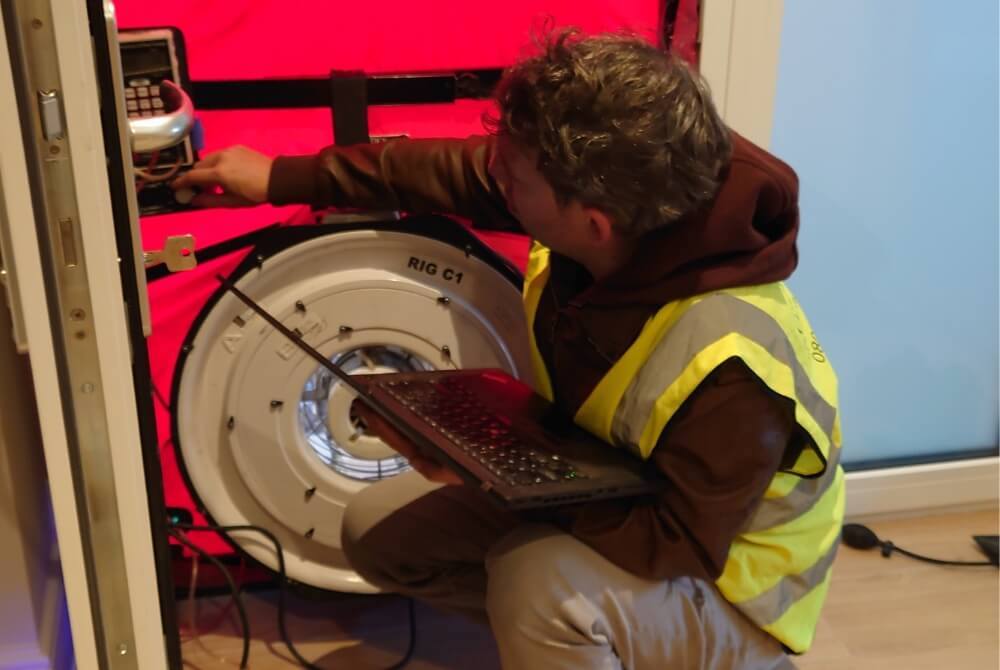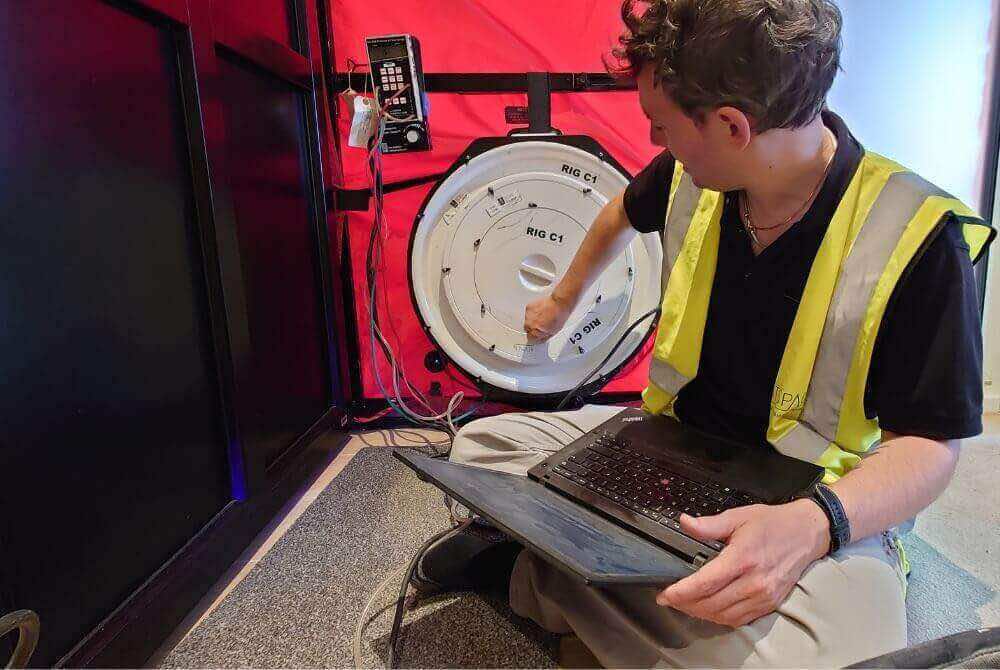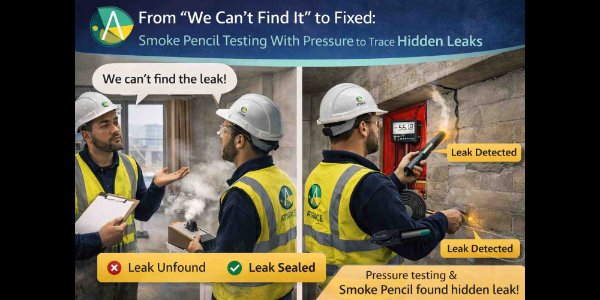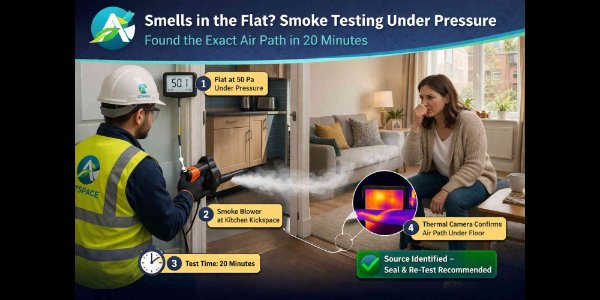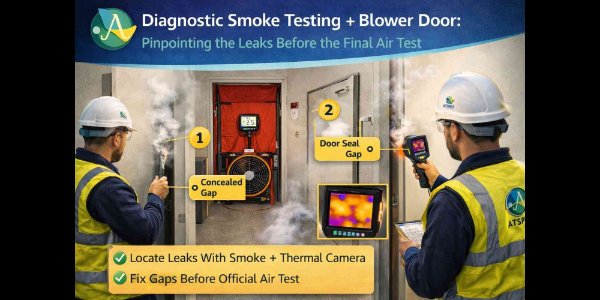

Diagnostic smoke testing is a leak-finding method used alongside air pressure testing to show exactly where uncontrolled air is moving through the building envelope. A blower door or similar fan creates a pressure difference, and smoke pencils or larger smoke generators make the airflow visible so the team can trace the leakage path rather than just read a final number.
Diagnostic smoke testing works because air pressure testing creates the pressure difference that makes hidden leakage paths obvious. During airtightness testing, usually under depressurisation, air is pulled faster through cracks and gaps, so smoke becomes a visual indicator of where the building is actually leaking. In simple terms, the pressure test gives you the condition; the smoke helps you see the cause.
Not exactly. Diagnostic air leakage testing is the wider fault-finding process, while smoke testing is one of the main tools used within it. Good diagnostics often combine smoke with thermal imaging, vane anemometers, noise detection and hands-on inspection while the building is under pressure. Smoke is usually the clearest visual tool, but it is not the whole process on its own.
No. A formal air pressure test measures the building’s airtightness result for compliance or certification, while diagnostic smoke testing is there to find the leakage paths that sit behind that result. TM23 covers the formal measurement of building air leakage, whereas smoke diagnostics are the practical site tool that helps the team understand why the building is leaking.
No, not by itself. The pass or fail result comes from the formal air pressure test or certification test, not from the smoke. Diagnostic smoke testing is there to identify where air is escaping or entering so remedials can be targeted properly. It supports the compliance test, but it does not replace the measured airtightness result needed for sign-off.
No. Part L requires formal pressure testing in the situations set out in Approved Document L, but diagnostic smoke testing itself is a support service rather than a standalone regulatory requirement. In practice, it is used because it helps teams pass the formal test, avoid late failures and understand the real leakage routes before Building Control paperwork becomes critical-path.
Use it when you need to see where the building is leaking, not just how much it is leaking. That usually means before the formal test to improve first-time pass chances, after a failed test to guide remedials, during retrofit planning, or on live buildings with draught and comfort complaints. The earlier it is used, the easier the fixes normally are.
Yes, and that is one of its best uses. Interim testing guidance says the building should be checked while most of the air barrier is still accessible so remedial works can be undertaken properly. Using smoke at that stage helps the site team find the real weak points before plasterboard, ceilings, joinery or fit-out hide the problem and make the final test harder to recover.
Yes. After a failed air test, smoke diagnostics are one of the quickest ways to move from a bad result to a workable remedial plan. Instead of sealing randomly, the site team can see the main leakage paths and fix the defects that are actually hurting the number. Where a formal retest is required, smoke testing helps make that next visit far more focused.
Yes. That is exactly when it delivers the most value. Passivhaus Trust guidance says interim testing should happen when most of the air barrier is still accessible, so remedial works can be carried out before later trades conceal the detail. On real projects, that is the difference between a clean fix and opening completed work back up.
Usually, yes. Good-practice guidance says the pressure differential imposed on a building, usually during depressurisation testing, accelerates airflow through leakage points and makes them easier to identify. That is why many airtightness technicians prefer depressurisation for leak finding. It gives clearer visual movement and often makes hidden leakage paths easier to trace back to source.
Yes. While depressurisation is often the preferred way to find leaks, pressurisation can also be useful because smoke can be released indoors and watched as it exits through gaps in the envelope. The practical choice depends on the detail being investigated, the access available and whether the team is trying to follow air leaving the building or being pulled into it.
The core setup is usually a blower door or similar fan system plus smoke pens or a larger smoke generator. On better investigations, that is supported by thermal imaging, vane anemometers, noise detectors and physical inspection while the building is under pressure. The aim is to build a reliable picture of the leakage path, not rely on one tool in isolation.
A smoke pencil is a handheld diagnostic tool that releases a small, controlled plume of visible smoke so local airflow can be seen around cracks, junctions and penetrations. During air pressure testing it helps the engineer confirm whether a visible gap is genuinely connected to a lower-pressure zone, which is why it is widely used for fine leak tracing around openings and interfaces.
A smoke pencil is for fine, local leak tracing, while a smoke machine is used when you need to flood a larger area or hidden void with visible smoke. BRE’s airtightness guide notes that for very leaky buildings, or early-stage EnerPHit-style refurbishment work, larger smoke machines can be useful because smoke emerging externally can reveal bigger hidden leakage routes.
When carried out properly by a competent specialist, the smoke used for airtightness diagnostics is normally a non-toxic diagnostic smoke intended for leak detection rather than fire simulation. Even so, occupied buildings still need planning around alarms, access and ventilation settings, because the point is to make leakage visible without creating unnecessary disruption on site.
You can sometimes spot obvious draughts with smoke alone, but the fan-created pressure difference is what makes leak finding repeatable and much more effective. Guidance repeatedly links leak detection to the pressure differential imposed during airtightness testing, because that is what accelerates airflow through leakage points and makes the movement easier to read.
Yes, on some projects they can. Passivhaus Trust guidance says it is possible to rent fans and train site operatives in leak checking, which can give more flexibility and save money on larger sites. That does not replace the formal compliance test, but it can be a very practical way to keep leakage checking active between official visits.
No. BRE’s airtightness guide points out that not all visible gaps necessarily correspond to a true leakage path through the envelope. A finish layer may look open, but the air barrier deeper in the construction may still be intact. What matters is whether the smoke movement shows that the opening is actually connected to a lower-pressure zone or the exterior.
Yes, very often. Passivhaus Trust guidance notes that wherever there are voids, complex connecting air paths can form, allowing leakage to show up in surprising locations. That is why diagnostic smoke testing needs interpreting by someone who understands building fabric and junctions. The point you see smoke is not always the point where the original defect started.
The usual culprits are service penetrations, window and door interfaces, thresholds, loft hatches, sockets, meter boxes, dry-lining edges, poor masonry details and awkward junctions. Recent DESNZ research also says airtightness failure points typically relate to the air barrier, junctions, window seals and door seals, with poor sealing and poor workmanship making things worse.
Because every penetration breaks the continuity of the air barrier unless it is designed and sealed properly. DESNZ’s 2025 research identifies service penetrations as a typical airtightness failure point, and site experience shows they often arrive late in the programme, after the envelope looked finished. Smoke testing is useful here because it quickly shows which penetrations are actually connected to the outside.
These finishes can conceal voids that connect several leakage routes together behind the visible surface. Passivhaus Trust guidance specifically flags hidden voids as a reason leakage can appear in surprising locations, and ATTMA’s readiness guidance warns that calling the tester too early or too late both create problems. Once the area is closed up, diagnosis becomes slower and remedials become more disruptive.
Yes. Window and door interfaces are one of the best uses for smoke diagnostics because the smoke shows whether the weakness is in the frame-to-wall junction, the opening sash, the threshold detail or the surrounding finish. BRE’s guide specifically highlights smoke pencils and thermography for tracing these leakage paths during pressure testing.
Yes. These small-looking details are common sources of disproportionate leakage, especially where they connect into larger hidden voids. Passivhaus Trust guidance lists loft hatches, meter boxes, sockets, doors and thresholds among the places where leakage is commonly found in new and existing housing, which is exactly why smoke diagnostics are so useful before the formal test result suffers.
Yes. For new dwellings, the formal air pressure test is part of the Part L process, and diagnostic smoke testing is a practical way to protect that result before it becomes a handover issue. It is especially useful on self-build and one-off plots where a hidden defect around windows, service entries or loft details can be hard to recover once finishes are complete.
Yes, but the pressure boundary has to be agreed properly first. Approved Document L Volume 1 applies to the dwellings, while Volume 2 applies to the non-dwelling parts, and Approved Document F Volume 2 also covers shared communal rooms and non-dwelling spaces in blocks of flats. Smoke diagnostics are useful here because they help confirm where leakage is actually crossing those boundaries.
Yes. CIBSE TM23 covers both dwellings and non-domestic buildings, so the same basic pressure-and-diagnostics logic applies across commercial projects as well as homes. On offices, warehouses, schools and retail space, smoke diagnostics are often most valuable at repeated interfaces, service penetrations and façade junctions where a design detail can be repeated hundreds of times.
Yes, and on very airtight buildings it is often essential. Passivhaus Trust guidance says interim testing is essential for airtight buildings and explicitly recommends smoke pens or thermal cameras to aid leak detection while the air barrier is still accessible. On low-leakage projects, diagnostic smoke testing is one of the main ways to turn a tight target into a buildable site process.
Yes. Approved Document F says expert advice on existing dwellings may include carrying out an air permeability test, and it also notes that following PAS 2035 is considered an adequate means of demonstrating compliance for ventilation in existing dwellings. Diagnostic smoke testing then helps translate that airtightness evidence into a practical map of where the building is actually leaking before retrofit sealing work is planned.
Yes. Approved Document F Volume 2 applies to buildings other than dwellings, including existing buildings, and specifically recognises that work such as replacing windows or doing energy-efficiency work can increase airtightness and affect ventilation. Smoke diagnostics are useful on these projects because they show where leakage is still occurring after refurbishment and where tighter fabric may alter the ventilation picture.
No. Smoke and thermal imaging are complementary, not competing, tools. Guidance from BRE and the Passivhaus Trust lists smoke, thermography, vane anemometers and other methods together because each shows something slightly different. Smoke is excellent for visualising airflow; thermal imaging is better at showing the temperature effects of leakage and missing continuity when conditions allow.
No. Where a formal compliance test is required, diagnostic smoke testing helps you find and fix the leakage paths, but the building still needs the valid retest result for compliance. Diagnostic smoke is the investigation stage; the formal air pressure test is still the measured result Building Control or the certifier will rely on.
Yes, and that combination is often one of the most effective diagnostic setups. The smoke shows the direction and route of airflow, while thermal imaging can help confirm where cold air is tracking through the envelope or where warm air is escaping. Used together under pressure, they usually reduce guesswork and make remedial advice far more targeted.
Yes. BRE’s airtightness guide says that for very leaky buildings, or as part of preliminary investigation before major refurbishment, larger-scale smoke machines can be helpful because they can fill large voids with smoke. Standing outside, the team can then see smoke emerging through the fabric and pinpoint where more serious sealing work is needed.
The building needs the same sort of practical readiness as any meaningful airtightness visit: access, closed external openings as instructed, prepared ventilation settings, filled water traps where needed, and clear access to the areas being investigated. Historic England notes that airtightness testing requires a high degree of preparation, and ATTMA’s readiness guidance makes clear that poor timing is a common reason tests go wrong.
Yes, often they can, but they need more planning than empty sites. Historic England notes that airtightness testing may need sealing preparation, filled water traps and sometimes out-of-hours working. In occupied buildings you also need to think about access, alarms, ventilation settings and how the smoke diagnostics will be carried out without causing unnecessary disruption.
Yes, because smoke diagnostics tied to air pressure testing are only as reliable as the pressure conditions behind them. BRE’s airtightness guide says testing should not be undertaken when wind speeds are above 6 m/s, and Passipedia’s checklist also notes that natural pressure will usually be outside acceptable ranges above that sort of wind level. If the pressure conditions are poor, the smoke behaviour is harder to trust.
There is no single fixed duration. A quick smoke-pencil investigation around a few suspect details can be relatively short, while a full-building diagnostic visit using a fan setup, larger smoke generation and multiple checks will take much longer. In practice, the time is driven more by scope, access and how many areas need tracing than by the smoke itself.
Cost is mainly driven by scope. A focused visit to trace one recurring defect is very different from a staged investigation covering multiple zones, larger smoke generation, thermal imaging, occupancy constraints and same-day rechecks after remedials. The real commercial question is usually not the cheapest visit, but the level of diagnostic support needed to avoid rework and repeated failed tests.
You should expect practical findings rather than just a vague verbal comment. A useful output is a clear explanation of the main leakage paths, likely causes, photographs or marked-up observations where relevant, and a prioritised remedial list. Existing-building consultancy services commonly structure this as a site visit followed by a report with photographs, which is the kind of output teams can actually act on.
Use a competent airtightness specialist who understands both air pressure testing and building defects. The formal pressure test itself should be carried out by someone with appropriate training and registration for that class of building, and the same practical standard matters for diagnostics. The right engineer is not just someone who can produce smoke, but someone who can interpret what the smoke is really showing.
Sometimes, yes, but only for the right reasons. ATTMA’s temporary sealing guidance says extra sealing may be used to prove or disprove the impact of a single component, for research, or during early-stage testing, but temporarily sealing broken or missing components should only be an exception. In short, temporary sealing can help diagnostics, but it should not be used to fake a real pass.
No. Diagnostic smoke testing in relation to air pressure testing is a building-fabric leakage tool. Smoke shaft testing and smoke-control system testing are fire-safety services dealing with smoke ventilation shafts, ducts and life-safety systems under a different standards framework. They may both involve “smoke”, but they are not the same discipline and should not be confused in the specification.
Yes. That is one of its biggest commercial benefits. Passivhaus Trust guidance is blunt that interim testing should happen while the air barrier is still accessible so remedials can be done properly, and ATTMA’s readiness note warns that poor timing creates failure risk. Smoke diagnostics move the problem forward to a stage where it is still cheaper and faster to fix.
Yes. Smoke diagnostics are one of the most practical ways to improve first-time pass performance because they help the team find and fix real leakage paths before the formal test. Good-practice guidance says interim testing is essential for airtight buildings and recommends smoke pens or thermal cameras to support leak detection while the air barrier is still accessible.
Yes, and that is exactly why it is worth doing. DESNZ’s recent airtightness research highlights recurring failure points such as service penetrations, junctions and window or door seals, so a good smoke diagnostic visit helps the team focus on the defects that are actually driving leakage rather than applying blanket mastic and hoping for the best.
Yes, often they can. Passivhaus Trust guidance says the fan equipment can be used to check the effectiveness of remedial sealing works once repairs have been made. That is a major advantage on live sites because the team can confirm whether the fix has worked there and then, instead of waiting for a later test to discover the defect is still open.
Yes. Approved Document F for dwellings and buildings other than dwellings warns that reducing infiltration can affect ventilation performance, and recent DESNZ research makes the same basic point: airtightness improvements are only safe when ventilation is considered at the same time. Smoke diagnostics help identify where air is still getting in or out so ventilation decisions are based on evidence, not assumption.
Use it early, use it under meaningful pressure, and use it while the air barrier is still accessible. The strongest process is interim air pressure testing, smoke-based leak tracing, targeted remedials and then formal verification once the defects are fixed. That approach gives the clearest route to first-time pass success, lower rework and a cleaner handover.
Videos for diagnostic smoke testing
Explore our videos for quick, engaging insights on building compliance. From step-by-step guides to expert advice, our video library simplifies complex topics, making it easier for you to take action and stay informed. Perfect for when you need clarity in minutes!