
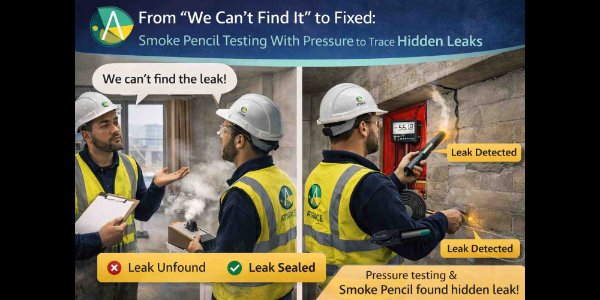
The Result
A contractor had a plot showing persistent leakage, but repeated snagging didn’t reveal anything obvious. Time was being lost, confidence was fading, and every fix felt like guesswork.
ATSPACE carried out smoke pencil testing under controlled pressure, traced the real hidden leak routes through connected voids, and produced a short, targeted remedial list.
The fixes worked because they stopped the actual air paths — not just the visible gaps.
Project Snapshot
Service: Diagnostic smoke testing
Client: Principal contractor (new build housing)
Site: The Willows, Plot 31, 5 Alderbrook Drive, Milton Keynes MK10 7AZ
Building type: New build 3‑bed semi‑detached
Programme stage: Pre‑test snagging
Compliance driver: Approved Document Part L
ATSPACE delivery: Controlled pressure setup, smoke tracing, leak‑path mapping, remedial plan, verification before airtightness testing
Engineers: ATSPACE accredited test engineer + compliance coordinator
The Situation on Plot 31
Plot 31 wasn’t failing — but it wasn’t predictable. The team felt the airtightness result was at risk because:
- earlier plots of the same type had inconsistent outcomes
- a busy understairs service zone contained multiple penetrations
- bathroom/kitchen boxing reduced access to key voids
- late service adjustments created new openings
- the plot still felt draughty even after standard snagging
The site manager needed a fast, practical answer:
Where is the leakage route we are missing?
Why Hidden Leaks Are Hard to Find Without Smoke
Traditional snagging focuses on visible gaps.
Hidden leaks are different — they usually run through connected voids:
- understairs voids
- service routes behind kitchen units
- intermediate floor penetrations
- loft interfaces and ceiling penetrations
- meter box and incoming services
Sealing the visible edge does nothing if the void path remains open.
Smoke pencil testing with controlled pressure shows:
- where air is actually moving
- the direction of travel
- whether voids connect to external pathways
This is what reveals the real leakage routes.
What ATSPACE Did
Step 1: Confirm likely leak zones
Based on the house type, we prioritised the usual problem areas:
- understairs/service zones
- meter area
- bathroom boxing
- ceiling/loft interfaces
- thresholds
Step 2: Apply controlled pressure
Stable pressure ensures smoke behaves clearly and does not mislead.
Step 3: Smoke pencil tracing — structured, not random
Zones tested included:
- meter cupboard + service entries
- understairs penetrations + boxing
- kitchen/utility service routes
- soil stack penetration (floor + ceiling)
- bathroom boxing penetrations
- loft hatch compression + ceiling penetrations
- external door thresholds + frames
Step 4: Follow the air path back to source
Smoke shows where it appears, not always where it originates.
We traced each path back to the actual leakage source.
Step 5: Provide a targeted remedial list
We issued a short set of high‑impact actions and verified the fixes before the airtightness test.
What Snagging Missed — The Hidden Leak Routes
Hidden Route 1: Understairs void → incoming service path
Why it mattered:
Sealing skirtings does nothing — the leak was through a connected void.
Fix:
Seal service entry properly and close void interfaces.
Hidden Route 2: Soil stack penetration at intermediate floor
Why it mattered:
Intermediate floor penetrations often act as multi‑storey void routes.
Fix:
Seal the floor‑zone penetration and ensure continuity around the stack.
Hidden Route 3: Ceiling penetration into loft zone
Why it mattered:
Loft interfaces become large leakage volumes under pressure.
Fix:
Standardise sealing, check loft hatch compression, confirm closure pressure.
Hidden Route 4: Meter cupboard rear interface
Why it mattered:
A very common leak point — often falling between trades.
Fix:
Seal the rear interface and all service entries consistently.
The Outcome
The key benefit was speed and confidence.
The site team gained:
- clear evidence of the actual leaks
- a short remedial list that worked
- reduced risk of wasting the airtightness test slot
- repeatable learning for future plots
- far less time wasted on guesswork
What This Proves
When a team says “we can’t find it,” the leak is almost always in a connected void path, not a visible gap.
Smoke pencil testing with controlled pressure is one of the fastest, most reliable ways to trace hidden air‑leakage routes and fix them properly.
Common Mistakes This Project Avoided
- adding more sealant to visible trims without tracing the source
- spending time on low‑impact gaps while missing connected void paths
- booking an air test without verifying dominant leaks
- treating meter cupboards/understairs zones as minor details
- allowing late penetrations without immediate reseal
CTA
If you have a plot behaving unpredictably and snagging isn’t finding the cause, ATSPACE diagnostic smoke testing will trace the hidden air path and give you a targeted remedial plan that works.
Ask for:
- smoke pencil testing with controlled pressure
- diagnostic leak tracing for Part L
- prioritised remedial actions
- verification before final airtightness testing
Frequently Asked Questions
What is a smoke pencil used for on site?
To visualise airflow and trace hidden leakage routes through voids and gaps.
Does smoke testing replace an airtightness test?
No. It is a pre‑test diagnostic tool that increases your chance of passing first time.
When is the best time to use smoke testing?
Before final finishes, ideally just before the airtightness test window.
Can smoke testing identify leaks behind boxing and units?
Often yes. Controlled pressure helps identify connected air paths even when the source is hidden.
