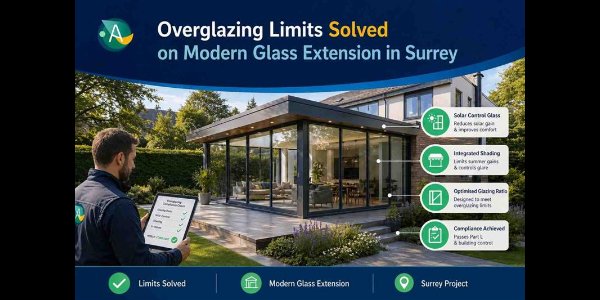
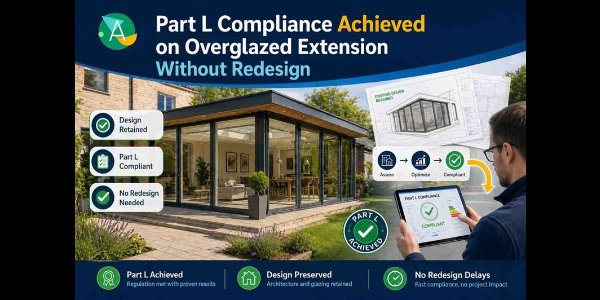
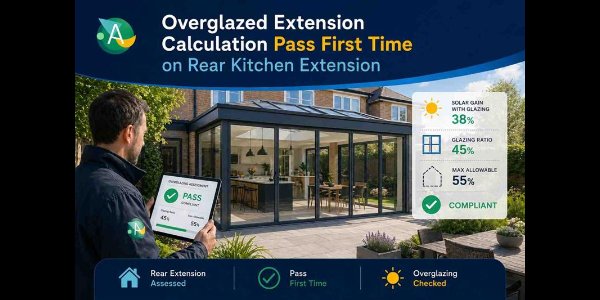
Overglazed extension calculations are the Part L compliance calculations used when a domestic extension has more glazing than the default guidance allows. In practice, they show Building Control that the extra glass is being compensated for properly, either through a U-value trade-off route or a SAP / benchmark extension route, depending on the project and the jurisdiction.
An overglazed extension is a domestic extension where the total area of the relevant external glazed openings goes beyond the default Part L opening-area limit. In practical site language, it usually means a rear extension with lots of bifolds, sliders, roof glazing or a lantern roof that needs a calculation rather than a simple elemental sign-off.
The 25% rule is the default Part L limit on the opening area of a domestic extension. In England, the total area of windows, roof windows, rooflights and doors in the extension should not exceed 25% of the floor area of the extension, plus the area of any openings that no longer exist or are no longer exposed because of the extension. In Wales, the wording is very similar but uses 25% of the internal floor area of the extension.
Yes. This service is aimed at extensions to existing dwellings where the design is more glazed than the default Part L route comfortably allows. It is not the normal service for a new dwelling and it is not the non-domestic SBEM / BRUKL route used on commercial buildings.
Yes, broadly. Both England and Wales start from the same idea: once a domestic extension becomes more glazed than the default limit, you need a compensating route. The detail differs slightly, though. England uses the 25% of the floor area of the extension wording and offers an area-weighted U-value route or a SAP / notional extension route, while Wales uses 25% of the internal floor area and offers two Section 13 optional approaches.
The calculation is about the relevant external openings in the extension envelope. In England, the rule expressly refers to windows, roof windows, rooflights and doors. In Wales, the extension limit is framed around windows and doors, while rooflights are separately treated as controlled fittings with their own standards. On highly glazed designs, the safe approach is to treat all major glazed openings in the extension envelope as part of the compliance exercise.
Yes. If they are external doors forming part of the extension envelope, they count. The approved guidance is not interested in the sales name of the product; it is interested in whether the opening is part of the external glazed/door area of the extension. Large bifolds and sliders are one of the main reasons schemes tip into overglazed-calculation territory.
In England, yes, expressly. Paragraph 10.7(d) includes roof windows and rooflights within the opening-area check. In Wales, rooflights are clearly controlled fittings with their own U-value limits, and on roof-heavy extension designs the safest route is usually to run the compensatory calculation rather than assume the basic opening-area rule will be accepted without question.
Usually not as part of the extension’s external opening-area allowance, because the rule is about the extension envelope and controlled fittings separating heated space from the external environment, the ground, or unheated / differently heated spaces. The real compliance issue with internal glazed doors is whether they are being retained as the thermal separation line, especially on conservatory-style schemes.
In England, the guidance says 25% of the floor area of the extension. In Wales, it says 25% of the internal floor area of the extension. In practical design work, that means the allowable opening area is driven by the extension’s size, not by the whole existing house.
Yes. Both England and Wales allow you to add the area of openings that no longer exist or are no longer exposed because of the extension. This is a key point many teams miss. If the extension covers over a large rear elevation with existing doors and windows, that lost opening area can materially increase the glazing allowance available to the new extension.
No. It is the default guidance limit, not an absolute ban. Both England and Wales provide alternative approaches that allow more glazing if the design is compensated properly. That is exactly why overglazed extension calculations exist in the first place.
Yes, potentially. The issue is not whether a lot of glass is banned, but whether the extension can still be shown to perform no worse than the relevant benchmark or compliant extension. In real project terms, fully glazed or near-fully glazed designs usually mean you need the compensating-calculation route, tighter product choices and a more disciplined spec.
In England there are two main alternative routes. The first is the area-weighted U-value route for all thermal elements in the extension. The second is the SAP / notional extension route, where the dwelling plus proposed extension is compared against the dwelling plus a compliant notional extension. Which one works best depends on how far over the default glazing limit the design has gone.
In Wales, Section 13 gives two optional routes for more design flexibility. The first is the U-value trade-off approach. The second is the Equivalent Primary Energy and Carbon Emissions Target approach, which uses SAP 10 and a fully compliant benchmark extension or conversion. Those are the two live Welsh routes when the default extension rules are too restrictive for the design.
It is the trade-off method that compares the average thermal performance of the proposed extension against a compliant benchmark extension of the same size and shape. In England, the extension’s area-weighted U-value must not exceed that of an extension complying with paragraph 10.7. In Wales, the U-value trade-off approach requires the proposal’s area-weighted average U-value to be no greater than that of a fully compliant benchmark.
It is the whole-dwelling calculation route used to show that the dwelling plus proposed extension performs no worse than the dwelling plus a compliant benchmark or notional extension. In England, this route checks the dwelling primary energy rate, dwelling emission rate and dwelling fabric energy efficiency rate. In Wales, the equivalent primary energy and carbon route compares the proposal against a fully compliant benchmark extension or conversion.
A simple U-value trade-off is often enough where the design is only moderately over the default glazing limit and the compensation is mainly in the extension fabric itself. Once the design becomes heavily glazed, relies on wider whole-house improvements, or needs more flexibility around services and performance trade-offs, the SAP / benchmark extension route is usually the more robust choice.
Sometimes, but not always. Better-performing glazing can help a lot, especially under the area-weighted U-value route, but once the glazed area is very large, the design often needs stronger roof, wall or floor performance as well. On very glazed extensions, relying on the window spec alone is often where projects start to run out of room.
Yes. That is one of the main purposes of the trade-off route. England’s area-weighted U-value method and Wales’s U-value trade-off approach both allow better-performing opaque elements to offset more glazed area, provided the overall benchmark comparison is still met. This is often the cleanest way to rescue a design without redrawing the façade.
Sometimes, yes. In Wales, the guidance is explicit that compensatory insulation improvements to the existing dwelling can form part of the comparison under Section 13. In England, the whole-dwelling SAP comparison also means the existing dwelling’s performance matters within the benchmark exercise. In practical terms, this can help where the extension design is fixed and the best-value improvement sits elsewhere in the house.
In Wales, yes, explicitly under the Equivalent Primary Energy and Carbon Emissions Target approach, where the performance of fixed building services can help compensate. In England, the SAP/notional extension route checks whole-dwelling primary energy and emissions, so services performance can affect those results, although it does not remove the need to satisfy the fabric side of the comparison as well.
Yes. They remain the reference point. In Wales, the guidance expressly says that even where U-values are relaxed under the trade-off route, no individual thermal element should be worse than the limiting values needed to control condensation and mould risk. In England, the compliant/notional extension benchmark is still built from the normal extension guidance and Table 4.2 standards.
For current extension work in England, the main Table 4.2 values are roof 0.15, wall 0.18, floor 0.18, window 1.4 or WER Band B, rooflight 2.2, door with more than 60% glazed area 1.4 or DSER Band C, and other doors 1.4 or DSER Band B. These are the baseline standards the extension or benchmark extension is built around.
For current extension work in Wales, the key Table 10.1 standards are windows and roof windows 1.4 or WER Band B, rooflights 2.2, doors with more than 60% glazed area 1.4 or DSER Band C, and other doors 1.4 or DSER Band B. These are the live fitting standards the extension or benchmark extension is judged against.
In England, the guidance is explicit: where the performance of elements of the existing dwelling is unknown, SAP Appendix S data should be used to estimate it for the benchmark comparison. In practical terms, that avoids the project stalling just because nobody has reliable historic U-value data for the old house.
Yes, if you are using the SAP / benchmark extension route. In England, the comparison checks the dwelling primary energy rate, dwelling emission rate and dwelling fabric energy efficiency rate for the dwelling plus proposed extension. In Wales, the equivalent primary energy and carbon emissions route does the same kind of performance-based comparison against the benchmark.
No. They may use SAP as one optional route, but they are not the same service as full new-dwelling SAP compliance. A domestic extension calculation is testing the existing dwelling plus extension against a benchmark extension, not producing a full new-dwelling Part L submission in the normal way.
No. An EPC is an energy-performance certificate. Overglazed extension calculations are a Building Regulations Part L compliance exercise for extension design. They sit earlier in the process and answer a different question: whether the proposed extension can be justified from an energy-performance point of view.
Yes, in practical terms that is the whole point of the exercise. These calculations are normally prepared to support the Building Regulations application and to show Building Control that the extension still complies even though the glazing exceeds the default guidance. Without that evidence, a highly glazed design is much harder to sign off cleanly.
They should be done before the glazing package, roof build-up and structural openings are fixed. On live projects, the worst time to discover the extension is too glazed is after the doors, lantern and specification are already ordered. Early calculation gives you room to adjust the design without expensive redesign or delay.
At minimum, the assessor needs the extension plans, sections, opening sizes, proposed glazing and door schedule, roof build-up, wall and floor build-ups, and enough information on the existing dwelling to run the chosen comparison route. If the SAP/benchmark method is used, the existing dwelling’s performance data also becomes important.
Yes. A bigger slider, a different lantern, a downgraded glass spec or a changed door set can all move the result. On overglazed extensions, late product swaps are one of the most common reasons compliance has to be re-run just when the job is supposed to be closing out.
Most failures are not because glass is banned; they happen because the opening area has been miscounted, the “lost openings” allowance has been missed, or the compensating spec is not strong enough to match the benchmark extension. On site, the fail usually starts much earlier—when the glazing is designed before the calculation is done.
Yes. A single change to a window, rooflight, glazed door or opaque element can be enough to move the area-weighted result or the SAP comparison the wrong way. On overglazed schemes, there is often much less margin for “near enough” substitutions than site teams expect.
Yes, but it is controlled flexibility, not a free pass. England’s guidance says new extensions to historic and traditional dwellings should still comply fully unless there is a need to match the external appearance or character of the host building, in which case the work should comply to the extent that is reasonably practicable.
Wales is explicit that where special consideration applies, or there is a need to maintain the character of the façade, a greater total area of windows and doors may be acceptable. The guidance then says performance should be improved where practicable or compensating improvements undertaken using one of the Section 13 alternative approaches.
Yes. Wales says it is advisable to ensure the total area of windows and doors in the extension is not less than 20% of the internal floor area, because otherwise the extension and the part of the existing building it abuts may experience low daylight and increased use of electric lighting. This is useful because it shows the guidance is trying to balance heat loss and daylight, not just suppress glass.
Not always. Conservatories and porches have their own Part L treatment. In England, a qualifying ground-floor conservatory or porch under 30m² can be exempt if it remains thermally separated and the house heating is not extended into it. Wales has a similar exemption structure. Once that exempt/thermally separated position is lost, the scheme is much more likely to be treated as an extension.
In England, if the thermal separation is removed or the dwelling’s heating system is extended into the conservatory or porch, it should be treated as an extension and the normal extension guidance followed. Wales says much the same: if the proposed addition is not thermally separated, it should be treated as an extension and follow the extension guidance including the opening-area limit.
Not in the same way. In England, where the conservatory or porch is not exempt from the energy-efficiency requirements but remains thermally separated, the guidance says the limitations on area of windows, doors and rooflights in paragraph 10.7(d) do not apply. Wales says the same basic thing for non-exempt, thermally separated conservatories and porches.
That usually changes everything. England’s exemption for a conservatory or porch depends on retaining the separation line or replacing it appropriately, and paragraph 10.12 says once thermal separation is removed, the space should be treated as an extension. In practical terms, removing those doors can turn a previously exempt glazed room into a full Part L extension problem.
Yes. Internal bifolds themselves are not the usual external opening being measured, but if they are the line that keeps a conservatory or glazed room thermally separate from the dwelling, removing or bypassing that separation can force the whole space into the extension route. This is one of the most common “it looked minor on site” mistakes on glazed projects.
It is a Building Regulations Part L issue, not a planning-permission test in itself. You may be under permitted development for planning and still need Building Regulations approval for the extension. In other words, a scheme can be lawful in planning terms and still need overglazed extension calculations for Building Control.
Yes. Permitted development does not remove Building Regulations requirements. Government’s householder permitted development technical guide says PD rights do not remove other regimes such as the Building Regulations, and Planning Portal says most extensions require Building Regulations approval. So a PD glazed extension can still need Part L glazing calculations.
In practice, they are usually prepared by a Part L / SAP / building-compliance specialist who understands the extension benchmark routes properly. That matters because the job is not just measuring glass; it is selecting the right compliance route, building the benchmark correctly and giving Building Control a defensible calculation pack.
There is no single fixed timescale. A simple U-value trade-off on a settled design is quicker than a whole-dwelling SAP comparison with multiple revisions or uncertain existing-house data. In practice, the biggest driver is not the maths itself; it is how complete and stable the information is.
Cost is mainly driven by the route and the complexity. A modest overglazed extension that can be solved with a simple trade-off is a different job from a heavily glazed design needing a whole-dwelling SAP comparison, existing-house upgrades and multiple revisions. The more design changes and product uncertainty there are, the more time the calculation service usually takes.
They move the problem forward to design stage, while there is still time to change the glazing split, the lantern size, the door spec or the opaque build-ups. On glazed domestic projects, that usually means avoiding late Building Control queries, avoided reordering of doors or rooflights, and a much cleaner route to sign-off.
Design the glazing with the calculation in mind from the start. Measure the opening area properly, count any lost openings correctly, choose the right compliance route early, and lock the glazing and build-up specifications before orders are placed. The jobs that go smoothly are usually the ones where the calculation leads the design, not the ones where the calculator is asked to rescue it afterward.
Videos for overglazed extension calculations
Explore our videos for quick, engaging insights on building compliance. From step-by-step guides to expert advice, our video library simplifies complex topics, making it easier for you to take action and stay informed. Perfect for when you need clarity in minutes!