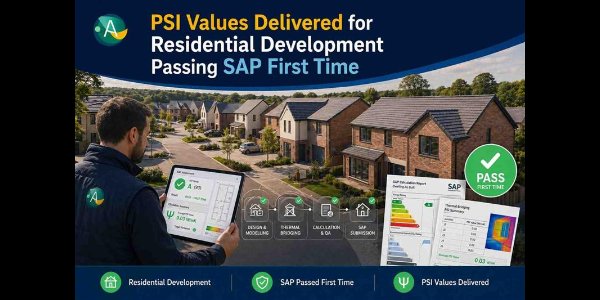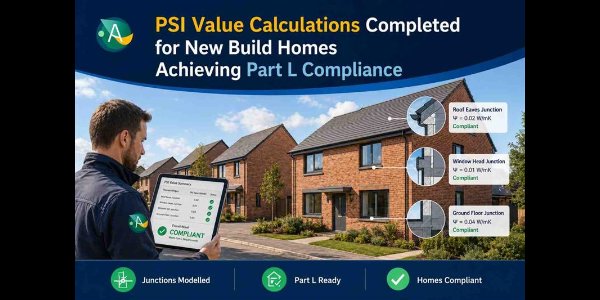

Need a PSI Value? We offer a fast, reliable, and nationwide service with unmatched expertise. Compliance and quality assurance made easy, hassle-free, and efficient.
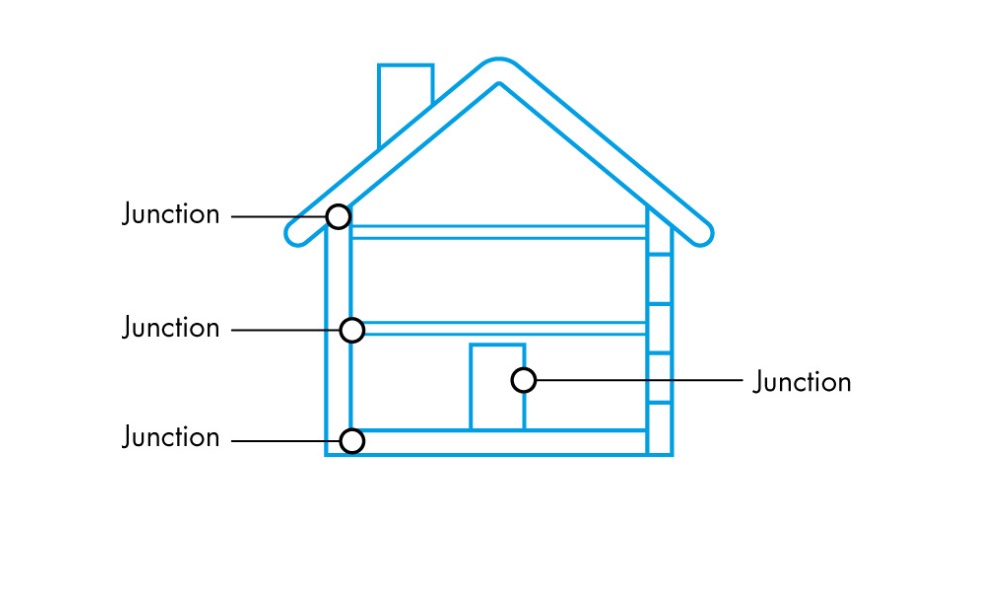
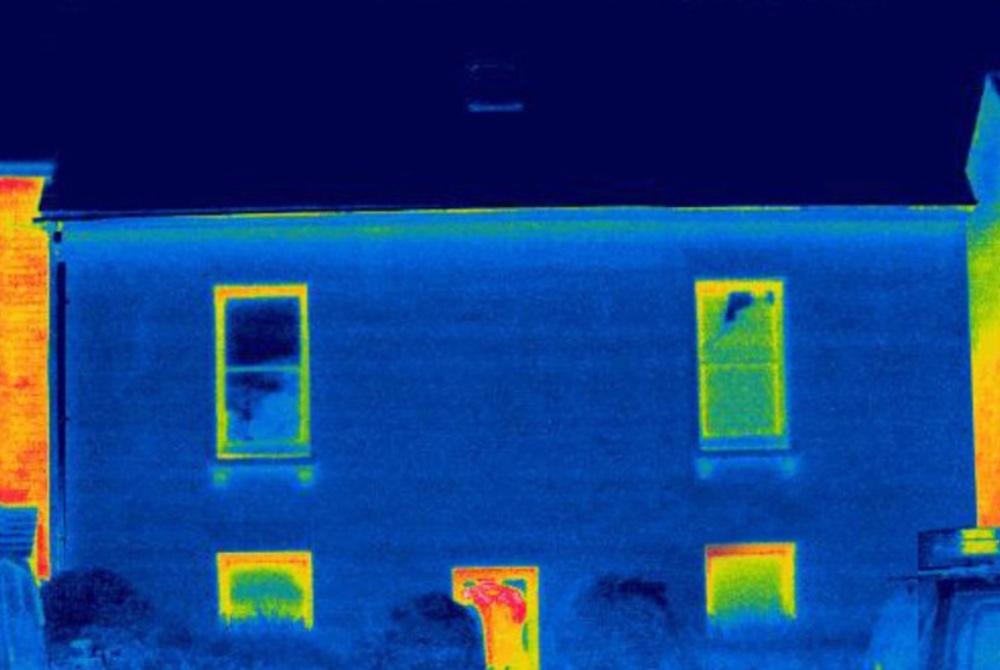
PSI values are linear thermal transmittance values used to quantify the extra heat loss at a junction that is not already included in the plane-element U-values. In practical terms, they tell you how much additional heat is escaping where walls, floors, roofs and openings meet. That is why PSI values sit at the centre of thermal-bridge calculations for Part L, SAP and BRUKL work.
A U-value describes heat loss through a plane element such as a wall, roof or floor. A PSI value describes the extra heat loss at a junction between elements or around openings. BR 443 makes that split clear: repeating thermal bridges are dealt with in the U-value of the element, while non-repeating junction losses are dealt with separately using linear thermal transmittance values.
A PSI value is the heat-loss figure for one specific junction, expressed in W/m·K. A y-value is an area-normalised thermal-bridging factor, expressed in W/m²K, derived by spreading the total junction heat loss across the exposed area of the dwelling. SAP explains that where a y-value is used, it is derived by dividing the calculated thermal-bridge heat loss by the total exposed area.
Yes. Current Approved Document L guidance in England and Wales says thermal bridging should be reasonably limited, and both routes provide recognised ways to assess it. In practical terms, PSI values are part of showing that the building fabric is continuous, heat loss is being controlled at junctions, and the design is not quietly losing performance where the main U-values look good on paper.
Yes. SAP Appendix K says non-repeating thermal bridges are not included in the element U-values and should therefore be explicitly included in the heat-loss calculation using either Σ(L × Ψ) or a suitable y-value method. On domestic projects, this means PSI values directly affect the dwelling’s heat-loss picture and therefore the wider SAP result.
Yes. Current non-domestic Part L guidance says thermal bridging should be addressed in the design and construction of a building, and that suitable junction details can then be used in the building primary energy rate and building emission rate calculations. So on commercial jobs, PSI values feed directly into BRUKL/SBEM performance, not just into a separate detail pack.
Yes. Current England and Wales dwelling guidance both allow more than one route: bespoke BR 497 calculations, independently assessed detail libraries, the default SAP Table K1 values, or a default y-value route. That means you do not always need bespoke modelling on every dwelling, but you do need to choose a recognised route and apply it correctly.
The default y-value in current England and Wales dwelling guidance is 0.20 W/(m²K). Both live dwelling routes state that this can be used as the default whole-dwelling thermal-bridging allowance where more detailed junction inputs are not being used. It is simple, but it is also usually conservative compared with a well-detailed bespoke design.
Current non-domestic guidance does not mirror the dwelling four-way route exactly. Approved Document L Volume 2 says thermal bridging should be addressed either by using construction joint details calculated by a suitably competent person following BR 497 and a defined process flow sequence, or by using generic IP 1/06 values increased by 0.04 W/(m·K) or 50%, whichever is greater. That is the current live non-domestic position.
Start early, model the real junctions rather than idealised ones, make sure the details are actually buildable, and keep the site team working to the same junction package that fed the SAP or BRUKL. Current Part L guidance in England and Wales keeps repeating the same message: drawings, buildability, inspection and correct methodology all matter. The projects that avoid rework are the ones that treat thermal bridging as a live design-and-site issue, not a spreadsheet exercise at the end.
Videos for PSI Values
Explore our videos for quick, engaging insights on building compliance. From step-by-step guides to expert advice, our video library simplifies complex topics, making it easier for you to take action and stay informed. Perfect for when you need clarity in minutes!