Baseline Testing Before Your Pre-Completion Sound Testing
Need Pre-improvement Sound Insulation Testing? We offer a fast, reliable, and nationwide service with unmatched expertise. Compliance and quality assurance made easy, hassle-free, and efficient.
There are many terms that relate to the same thing when it comes to pre-improvement sound insulation testing. Whatever you call it, we’ve got you covered.
Pre improvement sound insulation testing
Pre improvement sound testing
Existing sound insulation test
Sound test before works
Pre refurbishment sound test
Baseline sound insulation test
Choose the best
What makes us great?
Same-day quotes*
Get your pricing fast and hassle-free.
Covering England & Wales
Service wherever your project takes you.
Your own dedicated account manager
Personalised support every step of the way.
Next-day certification
Compliance documents delivered fast.
Unbeatable market pricing
Quality service at the most competitive rates.
Established in 2008
Over 15 years of trusted expertise.
Multi-disciplined engineers
Expertise across all aspects of compliance.
Special introductory offers
Ask a member of the team about our current promotions.
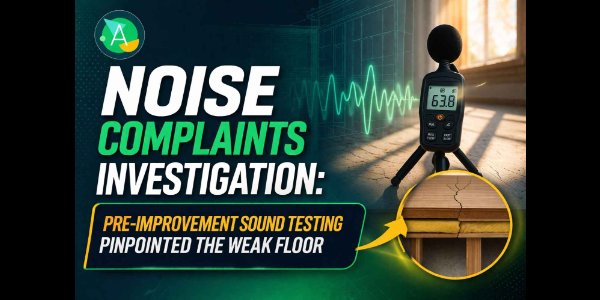
Pre-improvement sound insulation testing is a baseline acoustic test carried out before upgrade works to measure how much sound currently passes through an existing wall or floor. In practical terms, it tells you the starting performance of the separating element so the upgrade can be designed around real evidence rather than guesswork. It is especially useful on existing flats, floor upgrades and conversion projects where the original construction is uncertain.
Pre-improvement testing is diagnostic and design-led; pre-completion testing is formal compliance testing after the works. Approved Document E says sound insulation testing for compliance with Requirement E1 is carried out on site as part of the construction process and refers to that as pre-completion testing. Pre-improvement testing happens earlier to benchmark the existing condition and reduce the risk of designing the wrong upgrade.
No, not in itself. The legal requirement under Part E is normally the post-works route: either appropriate pre-completion testing or, in eligible new-build cases, the Robust Details route. Pre-improvement testing is optional, but it is a very practical way to inform design and avoid failed final tests on conversions and upgrades.
Yes. Conversions are one of the strongest use cases because Approved Document E applies to dwellings and rooms for residential purposes formed by material change of use, and ANC guidance says indicative testing may be carried out before work starts if the existing building is sufficiently intact. It gives the design team a realistic baseline before the final Part E strategy is fixed.
For separating elements between dwellings and flats, Approved Document E Table 0.1a sets 45 dB DnT,w + Ctr and 62 dB L’nT,w for purpose-built dwellings, and 43 dB DnT,w + Ctr and 64 dB L’nT,w for dwellings formed by material change of use. For rooms for residential purposes, Table 0.1b uses 43 dB for walls and 45/62 or 43/64 for floors depending on whether the building is purpose built or formed by change of use.
No. It improves certainty, but it does not guarantee success. ANC guidance says early indicative testing and expert advice help maximise the likelihood of passing later sound tests, but final performance still depends on the detailed upgrade, flanking control and workmanship. Pre-improvement testing is there to reduce risk, not replace proper design and proper post-works verification.
Flanking transmission is sound travelling around the main separating wall or floor rather than straight through it. Approved Document E warns that extensive remedial work to reduce flanking may be needed in conversions, and ANC gives typical examples such as continuous ceilings, floors, voids and lined external walls undermining an otherwise good separating element. In acoustic upgrade work, flanking is often the difference between a pass and a fail.
Yes. It is particularly useful where an upper-flat floor is being upgraded and you need to understand the existing airborne and impact performance before specifying the new build-up. Published acoustic guidance for pre- and post-works floor testing treats the pre-works test as the baseline stage that informs the necessary soundproofing measures, which is exactly the commercial value of the service on live apartment refurbishments.
No. Pre-improvement sound insulation testing is mainly about how sound passes through the building fabric, whereas BS 8233 and BS 4142 are used to assess external or environmental noise conditions in different ways. ANC’s conversion guidance treats these as related but distinct workstreams: one for the internal separation strategy and one for the wider acoustic environment affecting the development.
Use it before the upgrade design is locked, while the existing construction is still intact enough to tell you something useful. The strongest route is baseline testing or inspection, then acoustic design focused on the real weak points, then final post-works testing to verify the completed build. That sequence gives the design team evidence, reduces guesswork and makes first-time pass success far more realistic.
Videos for pre-improvement sound insulation
Explore our videos for quick, engaging insights on building compliance. From step-by-step guides to expert advice, our video library simplifies complex topics, making it easier for you to take action and stay informed. Perfect for when you need clarity in minutes!