
The result
A residential block was experiencing ongoing noise complaints — mainly footfall, chair movement and other impact sounds. Snagging attempts had not improved the situation because the real acoustic weakness had not been proven.
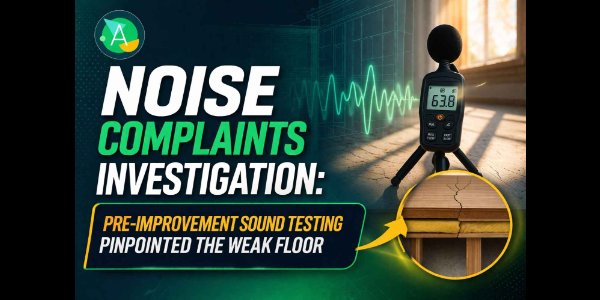
ATSPACE carried out pre‑improvement sound insulation testing to identify the weakest floor build‑up and confirm the exact transmission route.
The outcome was a targeted upgrade plan focused on the floor build‑up driving most complaints, plus the flanking routes amplifying the issue.
Project snapshot
Service: Pre‑improvement sound insulation testing
Client: Housing association + maintenance contractor
Site: Linden House, 5 Station Lane, Croydon CR0 2BX
Building type: 5‑storey residential block, 40 flats
Construction: Concrete floors, mixed floor finishes, historic refurbishment by vertical stack
Programme stage: Complaint investigation + pre‑upgrade planning
Compliance driver: Part E improvement intent + resident comfort
ATSPACE delivery: Complaint‑led test selection, airborne/impact testing, route diagnosis, priority fix plan, reporting for residents + contractor
Engineers: ATSPACE acoustic engineer + compliance coordinator
What residents were reporting
The pattern was clear and consistent:
- heavy footfall noise from above
- chair scraping and dropped‑item noise transferring strongly
- worst in living room + hallway
- complaints clustered around two vertical stacks
This indicated an impact‑noise problem, but testing was needed to confirm the exact route and cause.
Why quick fixes were not working
The site team had already tried:
- sealing at skirtings
- adjusting door closers
- patching ceiling defects
These do nothing for impact noise because the transmission is structural and driven by:
- floor finish type
- resilient layer effectiveness
- perimeter junction continuity
- void pathways and flanking routes
The client needed evidence so the next round of work actually moved the outcome.
What ATSPACE did
Step 1: Complaint mapping + targeted test selection
We mapped complaints by stack and selected test pairs that represented worst‑performing and average‑performing conditions.
No random testing — only tests with diagnostic value.
Step 2: Pre‑improvement airborne + impact testing
We tested selected flats and compared results across stacks to locate outliers.
Step 3: Link results to installed conditions
We inspected each tested dwelling to understand why results differed.
We checked:
- hard flooring presence + installation quality
- underlay type and perimeter detailing
- ceiling condition, downlighters, access hatches
- service penetrations + boxing
- presence/absence of resilient ceilings
Step 4: Identify the weak floor build‑up
The failing stack had a different finish build‑up, creating a direct impact‑sound route.
Better‑performing stacks had stronger finish strategies + better perimeter control.
Step 5: Create a targeted upgrade plan
We produced a practical, minimally disruptive plan prioritising measures that actually move impact sound performance.
What the investigation revealed
The slab itself was not the issue.
The weak floor failed because of:
- hard flooring with poor‑quality underlay
- missing or inconsistent perimeter isolation
- ceiling penetrations and access hatches acting as flanking paths
In the better‑performing stack:
- floor‑finish strategy was better
- perimeter detailing was controlled
- ceiling penetrations were closed out properly
Thus, identical slabs resulted in very different acoustic outcomes depending on fit‑out quality.
The upgrade plan recommended
Priority actions
- correct hard‑floor strategy in the failing stack (underlay + perimeter detail)
- close out ceiling penetrations acting as flanking routes
- seal service penetrations connecting voids
Secondary actions
- consider ceiling upgrades only if floor improvements alone are insufficient
- standardise detail across similar units to prevent repeating the issue
The plan focused on practical improvements for occupied buildings.
Outcomes
The client gained:
- clarity on the true weak floor build‑up
- evidence to support resident communication
- a targeted scope instead of broad, unnecessary works
- reduced risk of spending money on ineffective measures
- a clear route to verify improvement after upgrades
Common mistakes this project avoided
- treating impact‑noise complaints as general snagging
- upgrading ceilings everywhere instead of addressing floor build‑ups
- ignoring perimeter detailing and flanking routes
- applying one solution across all flats without diagnosis
- committing to remediation without proving the root cause
CTA
If you are dealing with noise complaints and need to know which element is actually failing, ATSPACE pre‑improvement sound insulation testing pinpoints the weak floor and the flanking routes driving the problem — giving you a clear upgrade scope and a way to prove improvement after works.
Ask for:
- complaint‑led airborne + impact sound testing
- diagnosis of weak floor build‑ups + flanking routes
- targeted upgrade plans aligned with Part E
- verification testing after improvements
Frequently asked questions
Can you investigate noise complaints in occupied flats?
Yes — with planned access and minimal disruption.
What’s the difference between airborne and impact noise?
Impact = footfall/dropped items.
Airborne = speech/TV transmitted through floors or walls.
Why do some stacks perform worse than others?
Variations in floor finish, underlay quality, perimeter detailing, ceiling penetrations and historic upgrades.
Do you provide an upgrade plan after testing?
Yes — with clear priorities and practical actions based on measured evidence.
