
Sound Insulation Testing:
Covering England and Wales
Need Sound Insulation Testing? We offer a fast, reliable, and nationwide service with unmatched expertise. Compliance and quality assurance made easy, hassle-free, and efficient.
Sound insulation testing is the on-site measurement of how much sound passes through a separating wall or floor between dwellings or rooms for residential purposes. In practical terms, it tells you whether the completed partition is stopping enough airborne noise and, where relevant, impact noise to satisfy the required standard. On UK projects, this is the Part E acoustic test most developers mean when they ask for a sound test.
Sound insulation testing is required because Part E is there to ensure reasonable resistance to the passage of sound between homes and similar residential spaces. Approved Document E says compliance with Requirement E1 is normally demonstrated through on-site pre-completion testing carried out as part of the construction process. In simple terms, the design may look fine on paper, but the test proves what was actually built.
No, not every plot is tested individually in the usual Part E route. Approved Document E uses sample testing, with one set taken on the first plots completed in each group or sub-group and then at least one further set for every ten dwellings, flats or rooms for residential purposes in that group or sub-group, assuming there are no failures. So the real issue is not every plot, but every construction group.
Yes, but only in the limited cases the scheme allows. Approved Document E and Robust Details both make clear that the Robust Details route is the alternative to routine pre-completion sound testing for new adjoined dwellings where the plots are correctly registered and built strictly to the approved detail. If those conditions are not met, the normal testing route still applies.
No. Robust Details is for new adjoined dwellings, not conversions, building refurbishments or home extensions. Robust Details says this very clearly in its guidance, which is why conversion and change-of-use projects normally still rely on proper acoustic design plus formal post-works sound insulation testing. It is a common misunderstanding on mixed project portfolios, so it is worth fixing early.
For purpose-built dwelling-houses and flats, the usual field targets are 45 dB DnT,w + Ctr minimum for walls, 45 dB DnT,w + Ctr minimum for floors and stairs with a separating function, and 62 dB L’nT,w maximum for impact sound through floors and stairs. These are the main benchmarks developers are working to on new-build housing.
For dwelling-houses and flats formed by material change of use, the usual field targets are 43 dB DnT,w + Ctr minimum for walls, 43 dB DnT,w + Ctr minimum for floors and stairs with a separating function, and 64 dB L’nT,w maximum for impact sound. The conversion targets are slightly less demanding than purpose-built new build, but they are still easy to miss if flanking and retained fabric are not controlled.
No. Approved Document E is clear that the performance values already include a built-in allowance for measurement uncertainty, so if a test misses the relevant value by any margin, it is a fail. That is a crucial point for developers and contractors: there is no informal pass zone just under the line.
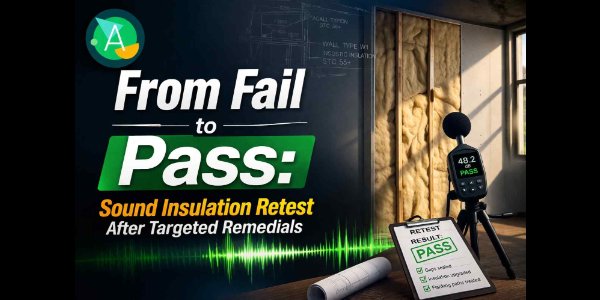
If any individual airborne or impact result in a set misses the relevant standard, the set has failed. Approved Document E says remedial treatment should then be applied to the rooms that failed, and the developer must satisfy Building Control that the issue has been addressed. That is why a failed sound test is rarely just one room’s problem.
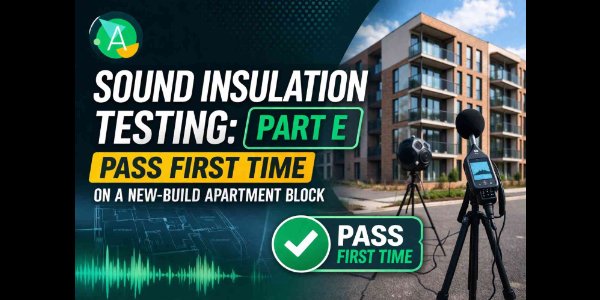
Book early, group the plots properly, get the acoustic design right before site locks the details in, control flanking routes, and only test when the plots are genuinely ready. ANC says the best way to maximise the chance of passing is to seek expert guidance before construction starts, and Approved Document E says specialist advice should be sought early where extra guidance is needed. The projects that pass first time usually treat acoustics as a package, not a late certificate.
Videos for sound insulation testing
Explore our videos for quick, engaging insights on building compliance. From step-by-step guides to expert advice, our video library simplifies complex topics, making it easier for you to take action and stay informed. Perfect for when you need clarity in minutes!