Residential air leakage testing is a pressure test that measures how much uncontrolled air escapes through the envelope of a dwelling. The result is reported as air permeability in m³/(h·m²) at 50Pa, which is the standard Part L measure used for new homes in England and Wales. In practical terms, it tells the builder, SAP assessor and Building Control whether the finished house or flat is as airtight as the design assumed, or whether hidden leakage is likely to cause compliance, comfort and energy-use problems.
Yes. In UK residential work, airtightness testing, air leakage testing, air pressure testing and blower door testing usually describe the same fan pressurisation method. A calibrated fan is fitted into an external opening, the dwelling is pressurised or depressurised, and the airflow needed to maintain the test pressure is used to calculate leakage. The wording changes from one contractor or consultant to another, but the core test method is the same.
A residential air test is required because Part L is not just about insulation on paper; it is about proving the built home limits uncontrolled heat loss in reality. The measured result is used to demonstrate compliance with the air permeability requirement and to support the final dwelling energy calculations. On site, that means the air test is not a box-ticking extra. It directly affects whether the plot is ready for final compliance paperwork and sign-off.
Yes. Under the current dwelling guidance in both England and Wales, an air pressure test should be carried out on every new dwelling. That is the key shift many site teams still miss: the old sample-testing mindset is no longer the safe assumption for new homes. If you are building a house, bungalow or flat as a new dwelling, the working assumption should be that each one needs its own compliant residential air test result.
Yes, in current practice you should assume every plot needs its own test result. The guidance for new dwellings in both England and Wales says an air pressure test should be carried out on every dwelling, which means each house or flat needs to stand on its own result rather than relying on an old representative sample approach. For developers and site managers, that makes plot readiness and sequencing far more important than they used to be.
The key requirement is that the completed dwelling must meet the airtightness backstop and still comply with the SAP-based energy calculation using the measured result. In both England and Wales, the limiting air permeability for a new dwelling is 8.0 m³/(h·m²) at 50Pa, but the measured value must also not push the dwelling’s final energy metrics beyond the approved target values. In other words, passing the backstop alone is not always enough.
Limiting air permeability is the worst value the regulations allow, design air permeability is the target set at design stage, and assessed air permeability is the value used for final compliance based on the dwelling actually tested. That difference matters because a plot can beat the legal backstop and still miss the design value assumed in SAP. For site teams, the number that matters day to day is the design target, not just the absolute limit.
It means the volume of air leaking through the dwelling envelope, per hour, per square metre of envelope area, when the building is tested at a pressure difference of 50 pascals. In plain English, lower numbers mean a tighter home. The 50Pa pressure gives a standard way to compare one dwelling with another, which is why it is the normal reporting metric for Part L residential air testing.
A good result is one that comfortably beats the plot’s SAP design target, not one that merely scrapes under the legal limit. The regulatory backstop is 8.0 m³/(h·m²) at 50Pa, but current reference specifications point much tighter than that, with England’s notional dwelling and Wales’s elemental specification both using 5.0. In practice, a “good” result gives enough margin to protect compliance and avoid last-minute ventilation or SAP headaches.
Not always. A dwelling can meet the 8.0 backstop and still fail the overall Part L compliance check if the measured result is worse than the design value used in the final SAP calculation and the finished energy metrics end up outside target. That is why experienced developers do not treat 8.0 as the real target. On most sites, it is a backstop, not a sensible aim.
Yes. The measured air permeability is used in the final compliance calculation for the dwelling, so the air test result directly affects whether the as-built home still meets its approved energy targets. That is why residential air testing and SAP cannot be treated as separate workstreams. If the tested result comes out worse than expected, the assessor has to rerun the final numbers and the plot can fall out of compliance.
Yes. On a new dwelling, SAP is used both for Part L compliance and for producing the home’s EPC, so the final measured airtightness can influence the energy rating that ends up on the certificate. That makes the air test commercially important as well as regulatory. A weaker-than-expected result can affect the final paperwork handed to buyers, lenders and Building Control, not just the site file.
Residential air testing sits under Approved Document L Volume 1 and SAP, while commercial air testing sits under Volume 2 and non-domestic methods such as SBEM. Dwellings are self-contained residential units, so the compliance route, terminology and supporting paperwork are different from office, retail or warehouse projects. For builders, the practical difference is simple: houses and flats are assessed as dwellings, not as non-domestic buildings with a residential label stuck on.
A residential air pressure test should be carried out by someone who has appropriate training and is registered to test that class of building. The guidance also allows Building Control bodies to accept a certificate from an authorised registered person as evidence that the testing procedure has been followed properly. In practice, most developers and self-builders look for testers registered with a recognised scheme such as ATTMA or Elmhurst.
ATTMA residential air testing usually means the test is being carried out by an ATTMA-registered tester under ATTMA technical standards. For typical homes and other simple buildings, ATTMA TSL1 is the standard commonly used, and it defines a simple building as including single dwellings and small buildings up to 4000m³ tested as a single entity with one blower door fan. In everyday terms, it is a recognised competence route for home air testing.
As at March 2026, England’s approved methodology notice for new dwellings has been updated from SAP 10.2 to SAP 10.3, while Wales continues to use SAP 10.2 under its current approval. That matters because the measured air test result is entered into the approved dwelling energy methodology, so assessors need to be working to the right version for the jurisdiction. The site testing method itself does not suddenly change, but the compliance modelling around it can.
The tester measures and certifies the result, but Building Control signs off the overall compliance evidence. In practice, the air test certificate is reviewed alongside the SAP and other completion information, and the building control body decides whether the plot has the evidence needed for compliance. That is why a fast certificate matters, but accurate reporting matters even more. The number alone is not the whole sign-off.
Book the residential air test as soon as the build programme and likely completion window are clear, then lock in the exact slot once the plot is genuinely close to ready. Leaving it until the last minute is one of the easiest ways to create avoidable delays. Providers commonly offer quick appointments and fast certificates, but late booking gives the site team no breathing space for remedials, retesting or final SAP updates.
A house should be air tested when the airtight layer is complete and the plot is genuinely ready, not when the site is hoping it is ready. Windows and external doors need to be properly fitted, penetrations need sealing, and the common leakage points hidden behind boxing, dry-lining or bathroom units need to be dealt with before the tester arrives. Calling the tester too early is one of the biggest causes of failed first visits.
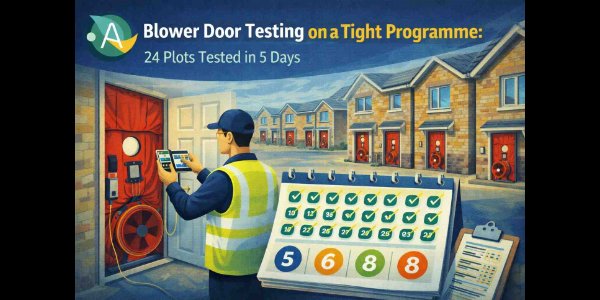
A standard residential air test usually takes around 45 minutes on a ready plot, although you should allow extra time for setup, access, site briefing and any diagnostic work. The test itself is not normally the slow part. Delays usually come from unfinished plots, missing components, poor access or remedials that have to be done while the tester is on site. On a well-prepared house, it should be a quick job rather than a day-long problem.
For a straightforward new dwelling, published UK pricing suggests a typical residential air test is often marketed from around £95 to £200+VAT for a single plot, with much lower per-plot rates available on multi-unit sites. The final number depends on location, plot type, travel, urgency and whether retesting or diagnostics are needed. For developers, the cheapest quote is not always the cheapest outcome if it leads to rework or handover delay.
Many UK providers advertise certificates within 24 hours, and some promote same-day issue when the plot passes. That speed matters because the certificate is often needed straight away for final SAP and Building Control paperwork. The regulations also require the results to be given to the local authority within a defined timeframe, so dependable reporting is part of keeping completion moving, not just a nice extra.
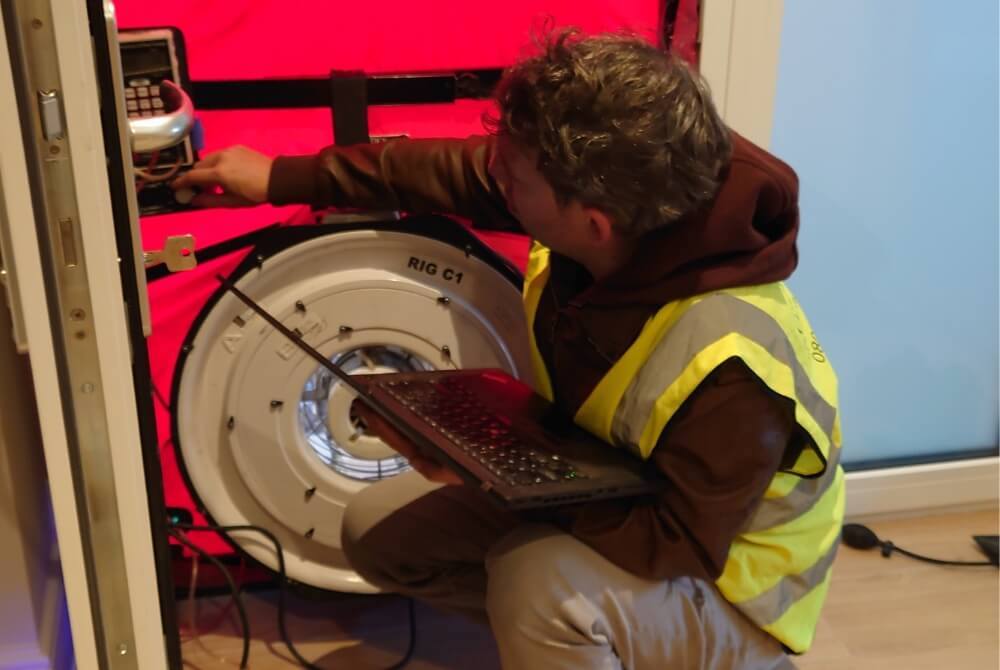
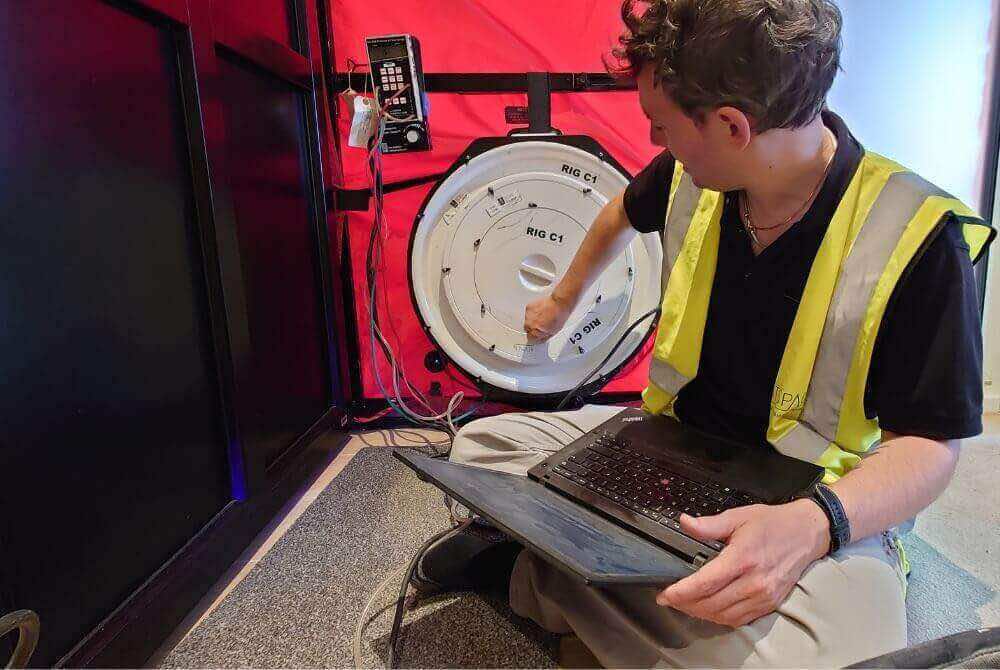
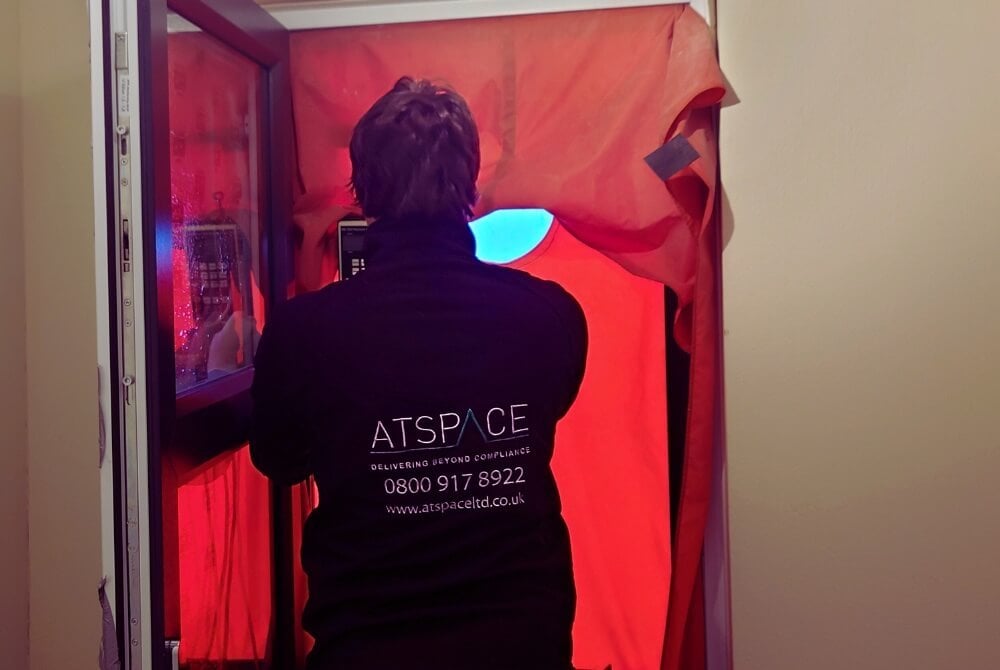
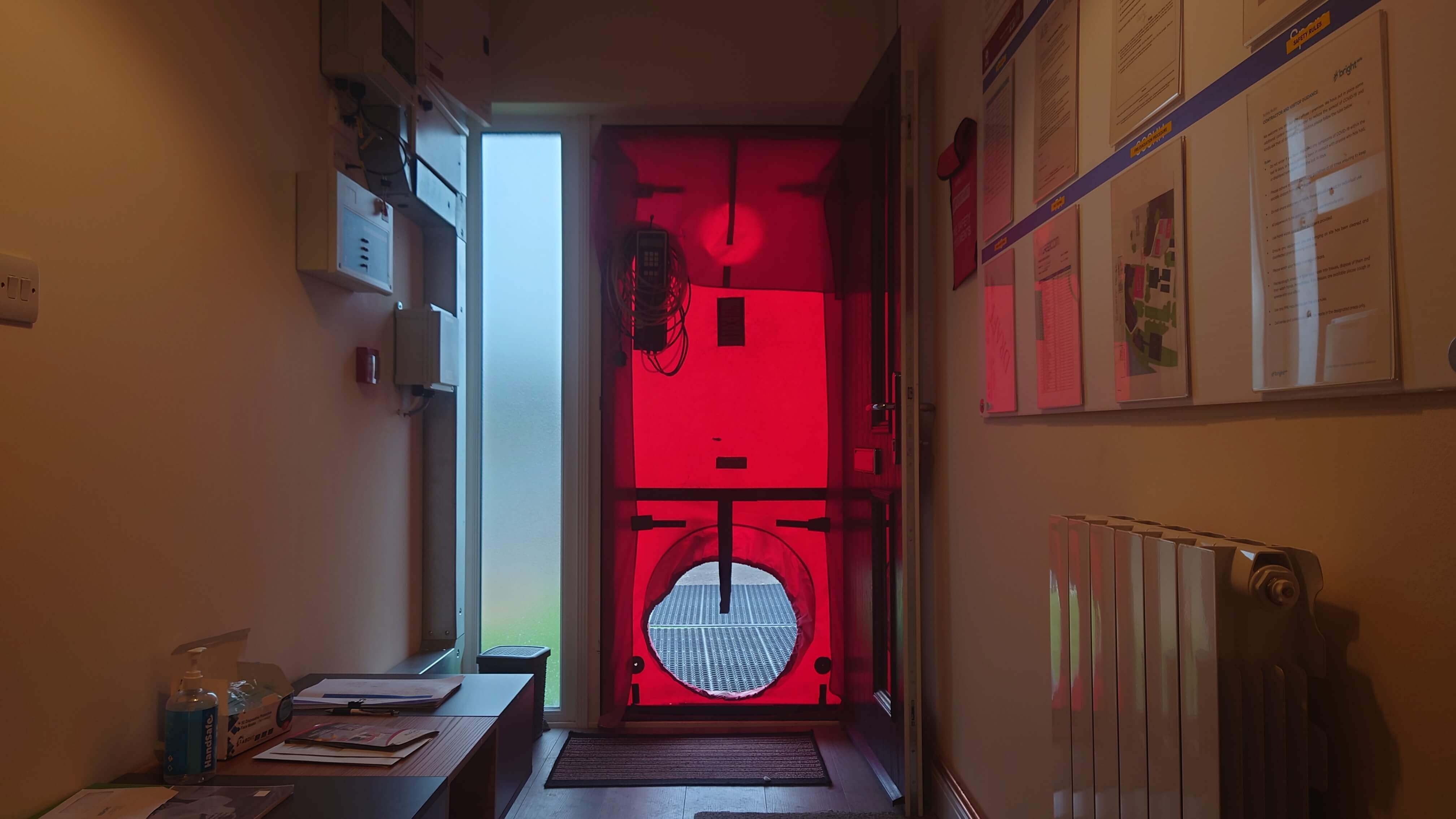
On test day, the engineer fits a calibrated fan into an external opening, prepares the dwelling in line with the approved method, runs the pressure test and calculates the air permeability result at 50Pa. If the plot is close to target or fails, many testers will also help identify leakage paths so the site team can fix the right issues instead of guessing. The aim is not just to produce a number, but to produce a usable compliance result.
Before the tester arrives, the plot should have fitted windows and external doors, sealed penetrations, installed sockets and switches, working power, and accessible rooms and cupboards. Common problem areas such as bath panels, loft hatches, access doors and service holes should already be sorted. The more a site relies on snagging airtightness on the morning of the test, the more likely it is to waste time, miss target or need a retest.
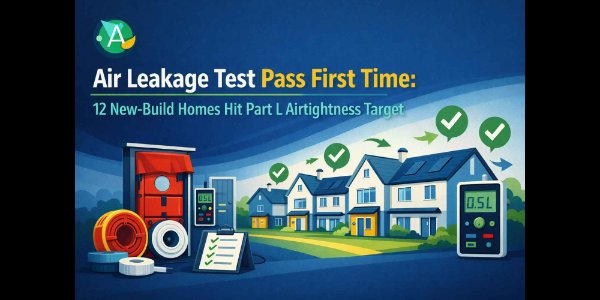
You pass a residential air test first time by treating airtightness as a design-and-build issue, not a mastic exercise at the end. Define the air barrier early, brief every trade that penetrates it, inspect dry-lining and service routes before they are covered up, and use an early pre-test or advisory visit if the target is tight. The plots that pass first time are usually the ones with controlled details, not the ones with the biggest panic on test day.
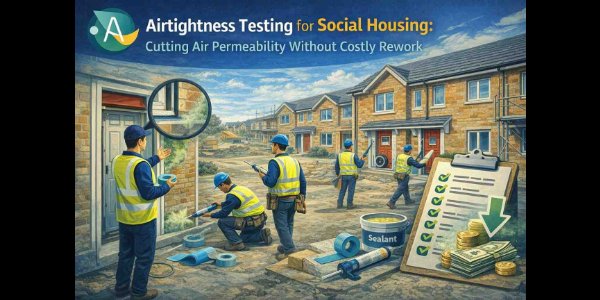
New homes usually fail air tests because of ordinary leakage points that were missed or left too late: poorly sealed penetrations, leaky windows and doors, gaps behind dry-lining, downlights, bathroom boxing, loft access details and weak junctions around skirtings or reveals. The main problem is normally build quality and coordination, not the test itself. Most failures are predictable once you know where leakage tends to appear on a plot.
If a dwelling fails, the air permeability has to be improved and the home retested until it meets the relevant criteria. The guidance also says all pressure test results, including failures, should be reported to the building control body. In practical terms, that means extra sealing work, lost time, another test fee and potential delay to final SAP, EPC and handover. Failing is recoverable, but it is never programme-neutral.
That depends on what is leaking, but many residential failures can be turned around quickly when the leakage paths are diagnosed properly on the day. Straightforward sealing issues around penetrations, loft details or windows can often be fixed fast, while hidden problems behind finishes take longer. The quickest route is usually a tester who can help pinpoint the real faults straight away, so the site team is not burning a day on guesswork.
Yes, especially on larger plots, tighter targets or sites with repeated failure risk. An early diagnostic visit helps identify obvious leakage paths while the trades still have access to fix them properly. That is usually far cheaper than failing the formal test, rebooking the engineer and holding up SAP and Building Control paperwork. For developers chasing first-time pass rates, pre-test advice is often one of the best-value steps on the job.
Yes. Smoke testing is one of the quickest ways to show where air is escaping from a plot, especially when the leak path is not obvious by eye. It is useful around service penetrations, dry-lined walls, loft details, window interfaces and boxed-in bathroom areas. On a failed or borderline plot, smoke turns a vague problem into a clear remedial list, which is why it is commonly paired with airtightness testing.
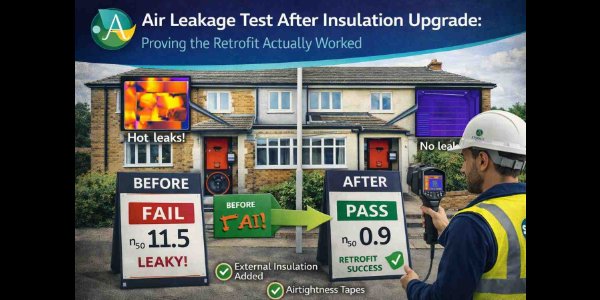
Yes, provided there is enough temperature difference to make the leaks visible. Thermal imaging does not replace the formal air test, but it is a very useful diagnostic tool for tracking down cold air paths, missing insulation continuity and weak details that are hard to spot otherwise. Used alongside pressurisation or depressurisation, it can help the site team fix the real causes of draughts rather than sealing randomly and hoping for the best.
Yes. Detached houses and bungalows are straightforward residential air testing work and fall squarely within normal dwelling testing practice. ATTMA’s simple-building standard includes single dwellings, and current Part L guidance says every new dwelling should be pressure tested. The real challenge is not whether they can be tested, but whether the plot has been detailed and built tightly enough to hit the SAP design target without last-minute patching.
Yes. A flat is still a dwelling, so it can be air tested in the same way as a house, using the dwelling air pressure testing route rather than the commercial one. What changes is usually access, sequencing and interface control. Flats often have more service penetrations, tighter programmes and more coordination risk between trades, so plot readiness and consistent detailing matter even more than on a simple house build.
Yes, the current dwelling guidance points to every dwelling being pressure tested, so each flat should be treated as needing its own result. That is the safe approach for apartment delivery. The flat itself is a dwelling, while common areas are dealt with separately under different guidance depending on whether they are heated or unheated. For developers, that means planning the testing strategy unit by unit rather than assuming the block gets one blanket number.
Heated common areas in buildings containing more than one dwelling are not treated as dwellings for Part L purposes. In England, the guidance says heated common areas should follow Approved Document L Volume 2, while the flats themselves follow Volume 1 as dwellings. That distinction matters on apartment schemes because the residential units and the shared heated corridors or lobbies should not be bundled into one simplified testing assumption.
Yes. A self-build home follows the same new-dwelling airtightness rules as any other new house, so it should be pressure tested and the result fed into the final SAP and compliance process. The difference is usually project style rather than regulation. Self-builders often benefit from earlier advice because one missed detail around windows, loft hatches or service routes can be harder to fix once the finishes are in and there is no big site team behind it.
Yes. The same residential air test method can be used on timber frame, SIPs and masonry homes. What changes is where leakage normally appears and how the air barrier is formed. The dwelling guidance specifically highlights airtightness detailing for cavity walls, timber frame junctions, fixings, windows and doors, which is exactly why build-system-specific detailing matters. The test method is common; the route to passing first time is not.
Not usually. The formal dwelling pressure-testing guidance is tied to a dwelling being erected, while the extension guidance for existing dwellings focuses on thermal elements and services rather than a mandatory pressure test on the whole home. In practice, most ordinary extensions are not booked for a formal Part L air test unless the project is creating a new dwelling or extra evidence is specifically needed. Diagnostic testing can still be useful where draughts or performance are a concern.
Yes. Existing homes can be air tested as a diagnostic exercise even though new-dwelling pressure testing is the main regulatory use people know about. It is useful for tracking down draughts, planning retrofit work, supporting EPC improvement strategies and avoiding guesswork before money is spent on remedials. For homeowners and landlords, that often means finding the real leakage routes instead of assuming the problem is just “poor insulation”.
Yes, it can. A lower air leakage result is usually good for energy performance, but if the dwelling becomes very airtight and the ventilation strategy does not match, indoor air quality can suffer. Approved Document F specifically treats highly airtight dwellings differently, because once infiltration is reduced enough, you can no longer rely on incidental leakage to help the ventilation strategy. Airtightness and ventilation have to be designed together, not as separate afterthoughts.
A highly airtight dwelling is one with a design air permeability below 5 m³/(h·m²) at 50Pa or an as-built air permeability below 3 m³/(h·m²) at 50Pa. That definition matters because the ventilation guidance changes once the dwelling crosses that threshold. For designers and self-builders chasing very low test numbers, this is the point where the ventilation strategy needs real care rather than basic assumptions.
No. Air leakage testing measures uncontrolled leakage through the building envelope, while ventilation commissioning checks whether the installed ventilation system is delivering the required airflow. They are separate compliance tasks with separate notices and evidence. A dwelling can be airtight and still have poorly commissioned ventilation, and a commissioned ventilation system does not prove the plot’s envelope is tight enough for Part L.
Yes. Mechanical ventilation systems in new dwellings must still be commissioned and their airflow rates measured, including intermittent extract and continuous systems such as MVHR. The air test does not replace that requirement. In practice, both pieces of evidence matter: the air test proves the dwelling envelope performance, and the airflow measurements prove the ventilation system is delivering what the design requires.
Yes, in dwellings in England and Wales trickle ventilators should be closed and temporarily sealed for the air test in line with ATTMA guidance. The same guidance also says passive ventilation openings and mechanical ventilation openings should be dealt with appropriately for testing. What matters is that the temporary sealing follows the approved rules and is declared properly, not that the tester hides leakage by making up their own approach on the day.
No, not as a way of manipulating the result. ATTMA’s dwelling guidance states that all internal doors to conditioned areas must remain open during the test. Closing them to create false pressure conditions can invalidate the test. For site teams, this is a useful rule of thumb: if the only way the plot “passes” is by changing the way the building is meant to be tested, it has not really passed.
No. ATTMA’s dwelling guidance is clear that access doors to areas outside the building envelope under test, such as internal doors to garages, loft hatches and storage access doors, should be airtight in their own right and should not be temporarily sealed for the test. If those details leak, they need fixing properly. Trying to mask them on test day is exactly the kind of shortcut that causes rejected results.
Yes. Repeated guidance and site experience point to plug sockets, downlights, skirting junctions, bathroom services, boiler cupboards and general service penetrations as common leakage paths in new homes. These are classic “looks finished but is not airtight” details. They are also the sort of faults that become far harder to fix once joinery, kitchens and sanitaryware are fully in, which is why early checking saves so much time later.
Yes, for a new dwelling the air test is part of the compliance evidence Building Control will rely on. The building control body may accept a pressure test certificate as evidence that the dwelling complies with the testing requirement, and the measured result also feeds the final compliance calculations. In simple terms, no valid plot result usually means no clean route to the final Part L paperwork and sign-off.
The best way is to manage the air test as part of plot delivery, not as a last-day surprise. Book early, keep a clear design target, inspect common fault areas before finishes hide them, and use pre-test advice where the plot type or target is demanding. ATTMA guidance is blunt on this point: many failed dwelling tests happen because testers are called before the plot is truly ready. Good sequencing is what keeps handover on track.
For most England projects, not yet. The new 2026 Approved Document L for dwellings was published in March 2026 but generally takes effect on 24 March 2027, with a later date for work in connection with higher-risk building work. That means most live English residential air testing still sits under the 2021 edition incorporating 2023 amendments for now. Wales is separate again, with its own current dwelling guidance and its own consultation timetable.
Videos for air leakage testing
Explore our videos for quick, engaging insights on building compliance. From step-by-step guides to expert advice, our video library simplifies complex topics, making it easier for you to take action and stay informed. Perfect for when you need clarity in minutes!