
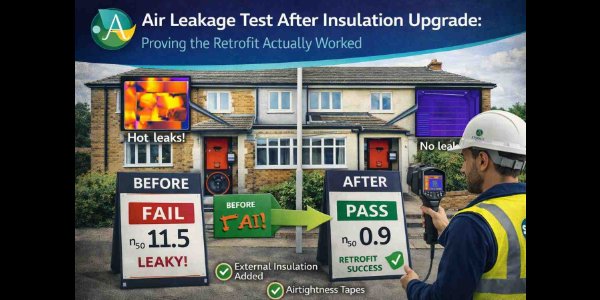
The Result
A homeowner invested in insulation upgrades but wanted evidence that the work delivered real performance improvement. ATSPACE carried out an air leakage test after the upgrade and compared the result to the pre‑works baseline. We also identified the remaining dominant leakage routes so the client could decide whether further improvements were worthwhile.
Measured improvement:
- Before insulation upgrade: 10.2 m³/h·m² @ 50 Pa
- After insulation upgrade: 6.0 m³/h·m² @ 50 Pa
The key point: improvement was measurable, and the remaining leaks were identified, prioritised and easy for the homeowner to understand.
Project Snapshot
Service: Retrofit air leakage testing
Client: Private homeowner + retrofit installer
Site: 41 Brookside Road, Aylsham, Norwich NR11 6GH
Property type: 1980s end terrace
Construction: Cavity walls, concrete ground floor slab, pitched roof
Retrofit works: Cavity wall insulation top‑up, loft insulation upgrade, draught‑proofing, new external doors
Programme stage: Baseline test → verification test
ATSPACE delivery: Baseline blower‑door test, post‑works blower‑door test, diagnostic checks, reporting for homeowner/installer
Why Testing After Insulation Matters
Insulation reduces heat loss — but it does not automatically reduce uncontrolled air leakage.
Many retrofits still feel drafty because air leaks in through:
- gaps
- void pathways
- ceiling penetrations
- service routes
- older door interfaces
Testing after insulation matters because it:
- proves real change instead of guesswork
- supports installer quality assurance
- identifies what is still leaking
- reduces risk of comfort complaints
- helps homeowners understand the difference between insulation and airtightness
This homeowner wanted a clear answer:
“Did the upgrade actually make the home tighter?”
Baseline Issues Before the Upgrade
The homeowner reported:
- drafts around back door/kitchen
- cold movement on the first‑floor landing
- the loft feeling like it was pulling air through the house
- heating struggling to stabilise temperatures in wind
These symptoms often indicate connected air paths between loft, doors, ceilings and service routes.
What ATSPACE Did
Step 1: Baseline blower‑door test
Result: 10.2 m³/h·m² @ 50 Pa
Step 2: Post‑insulation blower‑door test
Result: 6.0 m³/h·m² @ 50 Pa
A strong improvement — proving the retrofit delivered more than just insulation on paper.
Step 3: Identify remaining leak routes
The homeowner wanted to know whether further improvements were worthwhile.
Remaining dominant leak paths:
- back‑door threshold + frame line
- loft hatch and ceiling‑penetration leakage
- kitchen service penetrations linked to external walls
- first‑floor ceiling/loft interface above landing
We explained which fixes were low‑effort “quick wins” and which would be more intrusive.
What Changed Because the Retrofit Was Proven
1. The homeowner gained confidence
The numbers confirmed real performance improvement.
2. The installer gained assurance
The before/after data showed the work delivered measurable benefit.
3. Next steps became obvious
A short, prioritised list replaced vague snagging suggestions.
Practical Takeaways from This Retrofit
Takeaway 1: Insulation ≠ airtightness
You can insulate a home and still leak air badly — testing proves what's actually changed.
Takeaway 2: Doors + loft interfaces are common remaining leaks
Even after insulation, thresholds and ceiling penetrations often remain the biggest leakage points.
Takeaway 3: Verification prevents disappointment
Without a post‑test, the homeowner might still feel drafts and assume the upgrade “did nothing”.
Common Mistakes This Project Avoided
- assuming insulation upgrades automatically fix drafts
- not verifying the final outcome
- spending money on broad snagging instead of targeted fixes
- overlooking door and loft leakage points
- improving airtightness without considering ventilation needs
CTA
If you've completed insulation or energy upgrades and want proof that the retrofit delivered real performance change, ATSPACE provides:
- before + after blower‑door testing
- air leakage testing after insulation
- diagnostic checks to identify remaining leaks
- reporting for homeowner records or installer sign‑off
Frequently Asked Questions
Should I test before and after an insulation upgrade?
Yes — it proves improvement and gives context.
Will insulation always improve airtightness?
Not necessarily — many leaks are at junctions, not in insulated areas.
What if the after‑test result is still high?
We can identify dominant leaks and explain which are worth fixing.
How long does a retrofit blower‑door test take?
Usually a short visit with testing + results discussed on site.
Can airtightness improvements cause moisture issues?
Only if ventilation is ignored — both must work together.
