Need Smart HTC? We offer a fast, reliable, and nationwide service with unmatched expertise. Compliance and quality assurance made easy, hassle-free, and efficient.
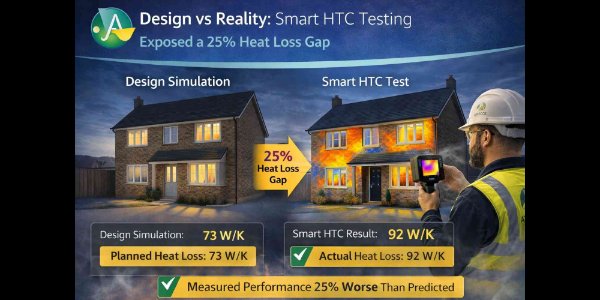
Smart HTC is a data-led way of measuring a home’s real heat loss in use by calculating its Heat Transfer Coefficient from meter data, temperature data and weather data. In practical terms, it tells you how much heat the whole home is losing per degree of temperature difference, based on what is actually happening in the property rather than what a visual survey assumes. It is especially useful for retrofit planning, performance-gap checks and heat pump design.
Not exactly. SMETER is the government umbrella term for technologies that use smart meter and other data to measure the thermal performance of homes, while Smart HTC is the market term many people use for a measured HTC service of that kind. In everyday use they overlap heavily, but SMETER is the broader policy and innovation-programme label.
Smart HTC works by combining measured energy use, internal temperature data and weather data to estimate the home’s in-use Heat Transfer Coefficient. Government describes SMETER methods as analysing the relationship between metered gas and electricity consumption and indoor/outdoor temperature differences, while SmartHTC-type services add practical data collection and processing to turn that into a usable whole-home heat loss result. The key advantage is that the home can usually stay occupied and be monitored as normal.
No, not always. UK policy work on SMETER is built around smart meter and other data, but SmartHTC-type services can also work with manual service-meter readings where the method allows it. In practice, a smart meter usually makes data collection cleaner and less admin-heavy, but it is not the only possible route on every project.
There is no one-size-fits-all “good” Smart HTC number because the result depends on the size, shape and condition of the home. In practice, a good result is one that is lower than the baseline you started with, or one that confirms the home is not losing as much heat as a conventional survey assumed. For comparing different homes, the HLP is usually more useful than raw HTC because it normalises by floor area.
No, not today. Government has explored HTC as a possible fabric metric within EPC reform, but it has also said that directly incorporating SMETER outputs into HEM inputs is not straightforward or appropriate in many cases. So Smart HTC is valuable for design, retrofit and verification work now, but it is not currently a straight substitute for the regulated EPC process.
No. Smart HTC is an in-use measurement method for occupied homes, while co-heating and the newer aggregate heat loss test are standardised tests on unoccupied buildings using installed heaters and fans. Government’s GHG-SMETER work says the in-use HTC includes the occupied home’s actual behaviour and systems, whereas aggregate heat loss testing focuses on standardised fabric performance without deliberate ventilation. They are related, but not interchangeable.
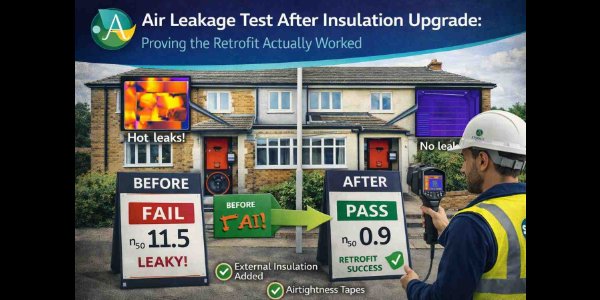
Yes, and it should be where the objective is to prove whether retrofit work has actually improved the home. Government’s GHG-SMETER project was specifically set up to investigate retrofit performance and change in performance using SMETER methods, and it recommends using the same methodology before and after the intervention. That makes Smart HTC a very practical baseline-and-verification tool.
Yes, and this is one of the most commercially useful applications. Government’s Heat Pump Ready case studies show that using measured temperature and smart-meter data to determine a property’s heat-loss characteristics can improve sizing accuracy and support lower upfront and running costs. Smart HTC is especially valuable where conventional survey assumptions are likely to overstate the real heat load.
Use Smart HTC early enough to influence the decision, not after the money has already been spent. The strongest route is to measure the home before major works, combine the result with airtightness, thermography or other diagnostics where needed, and then use the measured heat-loss picture to guide retrofit scope or heat-pump sizing. Government and industry evidence both point the same way: measured performance data reduces assumption risk and makes better decisions more likely.