
The result
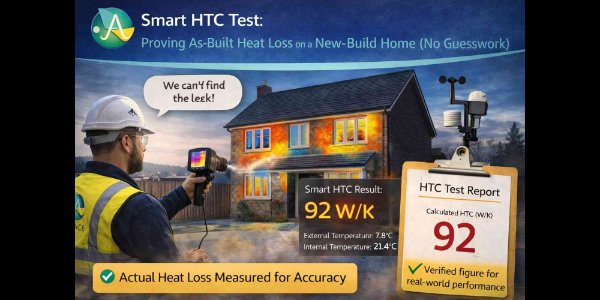
A new build home needed proof of real fabric performance, not just design‑stage assumptions.
ATSPACE delivered a Smart HTC test to measure the as‑built heat loss rate, confirming how the home performed under real conditions.
The result provided clear, practical evidence at handover, reduced performance‑gap risk, and gave the project team confidence that the build quality matched the design intent.
Project snapshot
Service: Smart HTC testing
Client: Regional housebuilder
Site: 8 Alderwood Drive, Wynyard Park, Stockton‑on‑Tees TS22 5QH
Building type: 4‑bed detached, two‑storey new build
Construction: Masonry cavity walls, insulated slab, warm roof, high‑performance glazing, MVHR
Programme stage: Handover readiness, post‑commissioning
Compliance driver: Part L expectations + client QA
ATSPACE delivery: Smart HTC setup, monitoring, analysis, results summary, close‑out notes
Team: ATSPACE building performance engineer + compliance coordinator
Why the client asked for Smart HTC
The client had two concerns that typical sign‑off could not fully address:
- They wanted measured confirmation that on‑site fabric performance matched SAP assumptions.
- They wanted evidence they could show stakeholders — something stronger than “it should perform well.”
Smart HTC was chosen because it provides real‑world heat‑loss measurement rather than theoretical estimates.
What Smart HTC measures (plain English)
Smart HTC estimates a home’s heat transfer coefficient (HTC) — the real‑world heat‑loss rate, expressed in Watts per Kelvin.
In simple terms:
- Lower HTC = better heat retention
- HTC reflects actual fabric + infiltration performance
- It is the clearest way to check whether the delivered home behaves as designed
Smart HTC does not replace SAP — it verifies the as‑built outcome.
The risk on this plot
Although workmanship was strong, this house type included details that often create hidden heat loss:
- slab‑edge + wall‑base junctions
- loft hatch + ceiling penetrations
- service entries at utility/plant zones
- MVHR duct penetrations
- window/door reveal junctions
- thermal discontinuity at garage interface
The home looked complete — but the question was: did it perform as designed?
What ATSPACE did
Step 1: Confirm readiness and test conditions
We ensured:
- stable dwelling conditions for monitoring
- commissioning complete, consistent operation possible
- all openings/interfaces in final state
- site team understood how to manage the building during the test
Step 2: Smart HTC test setup + monitoring
We installed the monitoring setup and captured all required data streams to accurately measure heat‑loss response under controlled heating operation.
Step 3: Analysis + comparison to design intent
We compared the measured HTC with the expected design performance and checked for signs of unusual heat‑loss behaviour.
Step 4: Provide clear actions
Where relevant, we provided simple close‑out notes for the client so the findings could be applied to future plots of the same type.
What the test showed
The measured as‑built HTC was in line with design intent.
The value wasn’t just the number — it was that it was:
- repeatable
- explainable
- aligned with expected performance
Client benefits:
- confidence at handover in real fabric performance
- proof that build‑quality controls were effective
- reduced risk of occupant comfort complaints
- benchmark data to compare future phases
What this proved on site
1. Heat‑loss risk is driven by junctions, not big elements
Thermal bypass often happens at slab edges, service entries and loft interfaces — not main walls/roof.
2. Commissioning + close‑out protect fabric performance
Poorly sealed penetrations during late works can undermine a good design.
3. Measured evidence transforms handover
Data removes debate and vague assumptions.
4. One strong result supports dozens of future plots
The Smart HTC result becomes a benchmark for consistency.
Common mistakes this project avoided
- assuming SAP values reflect real‑world construction
- leaving service‑entry sealing until late snagging
- using visual completion as a proxy for performance
- handing over without measured fabric evidence
- discovering performance issues only after occupation
CTA
If you want proof that your new build homes are performing as built, ATSPACE Smart HTC testing provides measured evidence of heat‑loss performance at handover.
It supports QA, reduces performance‑gap risk and provides clarity for clients and stakeholders.
Ask for:
- Smart HTC testing + reporting for handover
- staged fabric‑performance checks for repeat house types
- diagnostic support when heat‑loss results are off‑target
- practical close‑out notes to protect performance across a site
Frequently asked questions
What does Smart HTC stand for?
A measured method of estimating the heat transfer coefficient — the as‑built heat‑loss rate.
Is Smart HTC required for Part L?
Not usually, but it provides strong supporting evidence for fabric performance and reduces performance‑gap risk.
When should Smart HTC be carried out?
At handover readiness — when the dwelling is complete and stable enough for controlled monitoring.
What causes poor Smart HTC results?
Typical causes include:
- uncontrolled air leakage
- weak junction detailing
- thermal bypass
- poorly sealed service penetrations
