
Passive House Air Leakage Testing:
Covering England and Wales
Need Passive House Air Leakage Testing? We offer a fast, reliable, and nationwide service with unmatched expertise. Compliance and quality assurance made easy, hassle-free, and efficient.
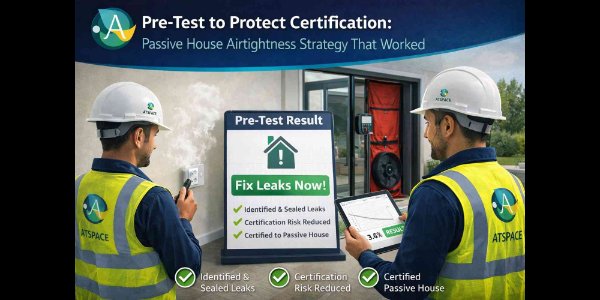
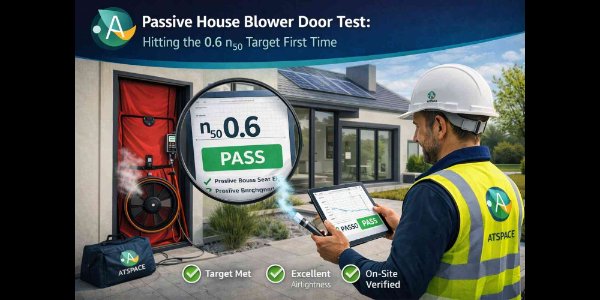
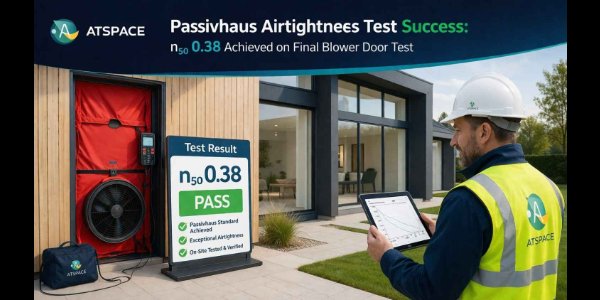
Passive House air leakage testing is a blower door pressure test used to prove how airtight a building really is for Passivhaus certification. The result is reported as n50, which is the number of air changes per hour at a pressure difference of 50 pascals. In practical terms, it tells the project team and certifier whether the built envelope is tight enough to meet the standard, not just whether the design drawings looked good on paper.
Yes. “Passive House” and “Passivhaus” refer to the same building standard developed by the Passive House Institute. In the UK, Passivhaus is usually the preferred spelling because it better reflects the original standard and helps avoid confusion with broader ideas like passive solar design or passive ventilation. For SEO, it is worth targeting both spellings, but technically they mean the same thing here.
The headline Passivhaus airtightness target is n50 ≤ 0.6 air changes per hour at 50Pa. That is the threshold for Passivhaus Classic, Plus and Premium. It is a hard quality benchmark, not a vague aspiration, which is why Passivhaus projects typically plan preliminary tests, tighter site checks and more detailed airtightness coordination than standard compliance-only jobs.
Yes, much stricter. Passivhaus uses n50, based on heated internal volume, while Part L in the UK uses air permeability in m³/(h·m²) at 50Pa, so the numbers are not directly comparable. Even so, Part L’s limiting standard is far looser than Passivhaus. In practice, a building can be perfectly legal under Part L and still be nowhere near good enough for Passivhaus certification.
Yes, often it can. A properly planned final test can usually generate both the Passivhaus n50 result and the UK Building Regulations q50/air permeability result from the same visit, provided the building is essentially complete and the required calculations are available. That is the efficient route on UK projects, but it only works if the tester understands both standards from the start.
Yes. Passivhaus testing generally requires both negative pressure and positive pressure measurements. That is one of the clear differences from a lot of standard UK compliance conversations, where people only focus on “doing an air test” in a generic sense. For Passivhaus certification, both directions improve confidence in the result and are part of the expected method.
Vn50 is calculated as the air volume within the heated building envelope that is actually being heated or cooled. It should be worked out room by room, following the PHI criteria, rather than guessed from a simple gross internal volume. That detail matters because the airtightness result is divided by this volume, so a sloppy Vn50 calculation can distort the headline n50 figure.
If a project misses 0.6 ACH, it does not meet the Passivhaus airtightness criterion and cannot be certified as Passivhaus Classic, Plus or Premium unless the issue is fixed and the building is retested. Depending on the wider project and whether it is new build or retrofit, the certifier may discuss PHI Low Energy Building or EnerPHit as alternatives, but that is not automatic and the rest of the criteria still have to stack up.
Yes, sometimes. Missing Passivhaus does not automatically mean failing UK Building Regulations, because Part L uses a different airtightness metric and a much looser minimum standard. That said, the project still has to satisfy its own Part L design assumptions, so you cannot assume a Passivhaus miss is harmless. It may still pass Part L, but it needs checking properly rather than guessed at.
You pass first time by designing airtightness in early, not by trying to rescue it at the end. Define the air barrier clearly, minimise penetrations, keep services out of the airtight layer where possible, sequence window and junction details properly, run preliminary tests while the layer is still accessible, and fix real defects rather than relying on cosmetic sealing. The projects that pass cleanly are the ones that manage airtightness as a work package from day one.
Videos for passive house air leakage testing
Explore our videos for quick, engaging insights on building compliance. From step-by-step guides to expert advice, our video library simplifies complex topics, making it easier for you to take action and stay informed. Perfect for when you need clarity in minutes!