
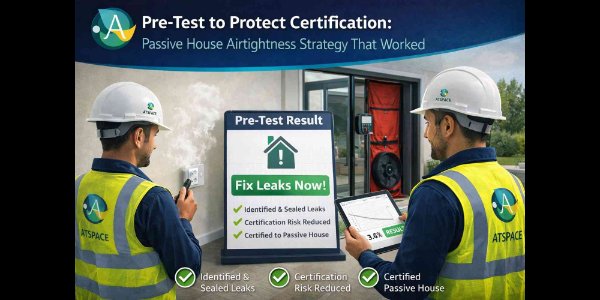
The Result
A Passive House scheme protected its certification programme by using a pre‑test airtightness strategy that reduced leaks early and prevented the common late‑stage failure cycle. ATSPACE supported the project with structured hold points, timed site checks, and diagnostic input where it mattered most. The result was smoother final testing, fewer snags, and stronger confidence in certification evidence.
Project Snapshot
Service: Passive House air leakage testing + pre‑test strategy support
Client: Developer + principal contractor delivering a small Passivhaus scheme
Site: Ashcroft Row, Plots 1–6, 1 Hawthorne Walk, York YO30 6AB
Building type: Six terraced homes, Passivhaus intent
Construction: Timber frame, taped membrane airtight layer, service voids, MVHR
Programme stage: First fix → final test windows
Performance target: n50 ≤ 0.6 on every plot
ATSPACE delivery: Airtightness strategy, staged walkthroughs, diagnostic checks, final blower‑door tests, certification‑ready reporting
Engineers: ATSPACE airtightness engineer + coordination support (no names)
Why a Strategy Was Needed
On small Passivhaus schemes, one failure rarely stays isolated.
If one plot fails, you often see:
- the next plot repeats the same defect
- remedials clash with finishing trades
- access disappears behind kitchens and boxing
- test slots and certification timelines slip
The developer wanted a plan that prevented reactive firefighting and instead created a repeatable routine.
The Passivhaus Airtightness Strategy ATSPACE Put in Place
This was deliberately simple — but disciplined.
1. Define the airtightness line clearly
We worked with the site lead to confirm:
- where the airtight layer sits in the build‑up
- which junctions are critical
- how penetrations will be sealed
- standard details for windows, thresholds and service entries
Any “grey areas” were resolved early so trades weren’t improvising.
2. Introduce hold points at the moments that matter
Hold points were built into the programme so checks happened before access disappeared.
Hold points included:
- pre‑plaster walkthrough on first plot type
- first‑fix penetration close‑out check
- window/door tape inspection before covering finishes
- pre‑second‑fix readiness check in service‑heavy areas
- final readiness check before blower‑door test
3. Use one simple checklist per plot type
Passivhaus does not need a 40‑page checklist — it needs a short list targeting leak routes that actually move n50.
Checklists covered:
- service penetrations through the airtight layer
- plant room + ventilation penetrations
- window and door perimeter continuity
- loft + ceiling penetrations
- thresholds and frame interfaces
- meter/service routes
- any connected void route that could bypass the airtight layer
4. Control late penetrations
One rule saved huge amounts of pain:
If a late penetration is unavoidable, it is sealed immediately and checked the same day — no exceptions.
5. Verify fixes before spending a test slot
Where concerns existed, ATSPACE carried out diagnostic checks to avoid gambling with certification test bookings.
The Real Problems the Strategy Prevented
Prevented issue 1: Repeat service‑void leaks
Early checks stopped a defect from spreading across plots.
Prevented issue 2: Window‑return detail drift
Spot checks kept detail consistent as installers changed or deadlines tightened.
Prevented issue 3: Plant‑room penetration creep
Hold points ensured sealing happened before testing.
Prevented issue 4: Threshold gaps hidden by finishes
Early checks protected airtightness where finishes usually conceal issues.
Outcomes
The scheme gained a calmer route to certification:
- fewer late‑stage airtightness snags
- reduced retest risk across multiple plots
- consistent detailing across all six homes
- stronger confidence in achieving n50 ≤ 0.6
- clear reporting for certification packs
Commercial value: far less time spent chasing hidden leaks after finishes.
What This Proves
Passive House airtightness does not require heroics.
It requires a simple strategy that protects the airtightness line at the exact moments where it is easiest to damage and hardest to fix.
CTA
If you’re delivering Passivhaus homes and want to protect certification without retest disruption, ATSPACE can support with a pre‑test airtightness strategy, staged checks, and Passivhaus blower‑door testing that keeps performance on track.
Ask for:
- Passive House airtightness strategy support
- hold‑point walkthroughs at pre‑plaster + pre‑test stages
- diagnostic checks where plots are at risk
- final blower‑door testing + certification‑ready reporting
Frequently Asked Questions
What is the biggest benefit of a pre‑test strategy?
It prevents repeat defects and reduces retest risk by catching leaks while access is still open.
Do we need to test every plot?
Depends on certification route, but planning testing early avoids last‑minute pressure.
What commonly breaks the airtightness line?
Penetrations, window returns, thresholds, plant rooms, ceiling interfaces, connected void routes.
Can ATSPACE support from design stage through testing?
Yes — from early detailing reviews to staged checks, diagnostics, and final blower‑door testing.
