
Smoke Shaft Air Leakage Testing:
Covering England and Wales
Need Smoke Shaft Air Leakage Testing? We offer a fast, reliable, and nationwide service with unmatched expertise. Compliance and quality assurance made easy, hassle-free, and efficient.
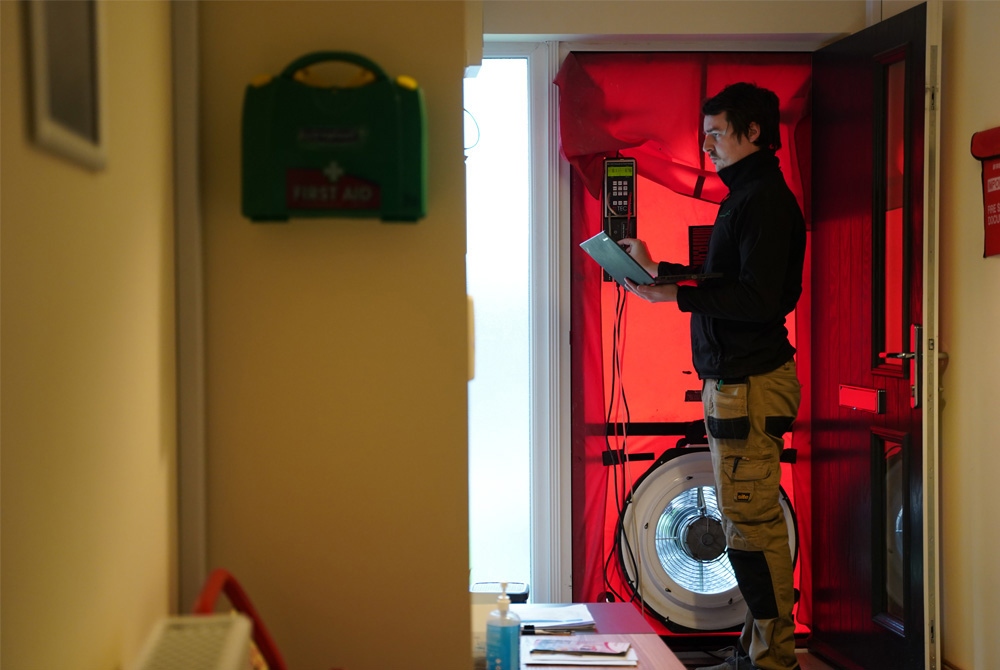
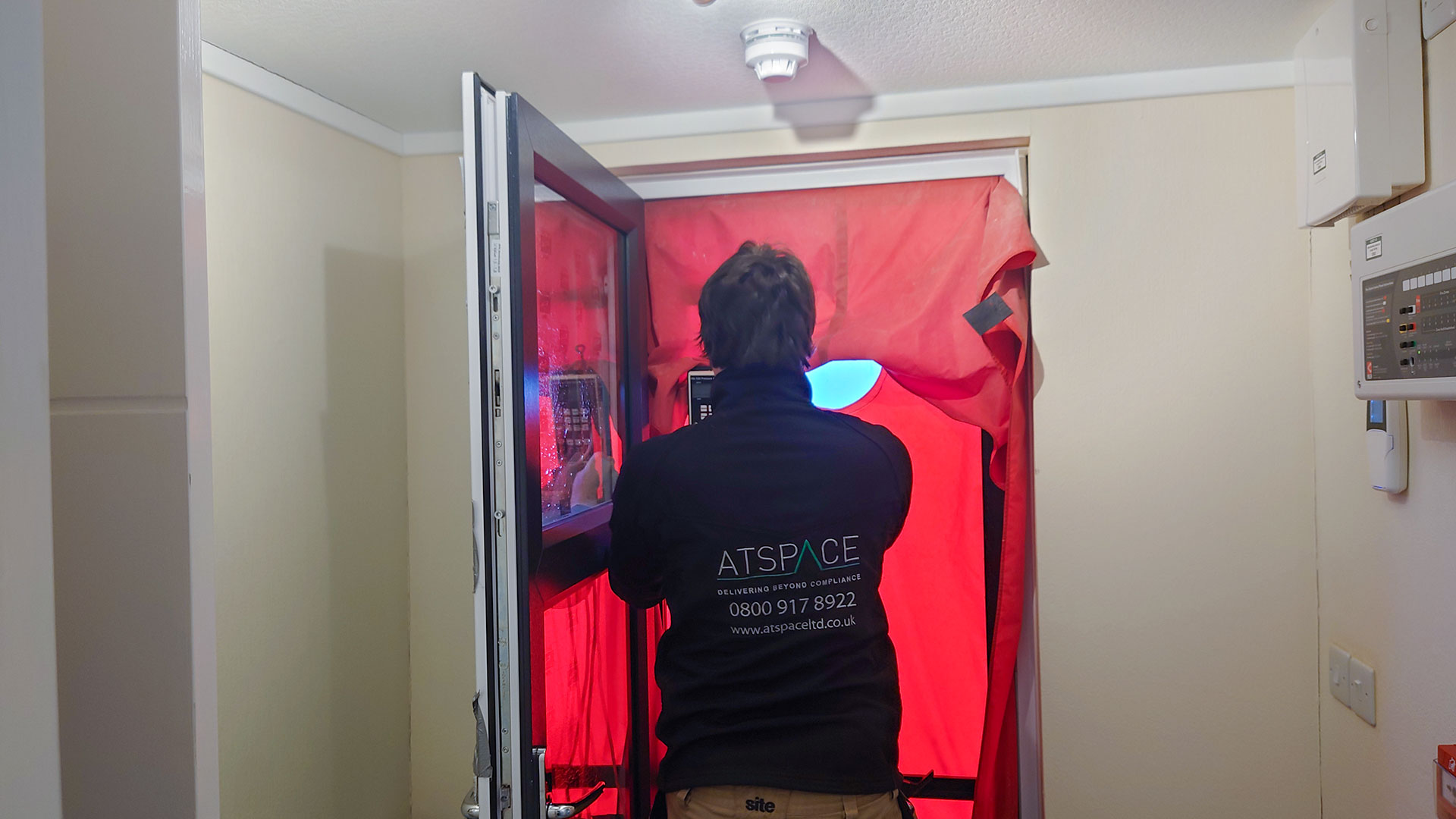
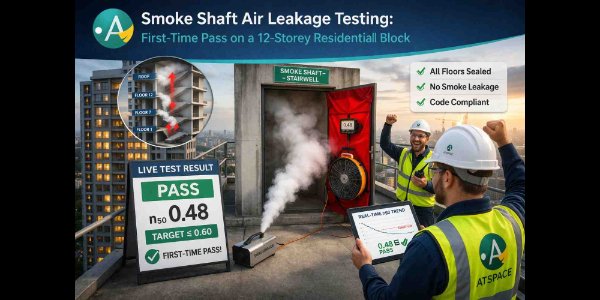
Smoke shaft air leakage testing is a specialist pressure test that checks how airtight the builder’s work smoke shaft really is before the smoke control system is signed off. In practice, it verifies that the shaft will not leak so badly that the smoke ventilation strategy loses performance in a fire. It is a fire-safety test, not an energy-compliance test.
Not as a single standalone line that says “air test the shaft,” but in practice a shaft that forms part of the smoke control strategy is expected to be tested and accepted before handover. Approved Document B requires smoke control to common escape routes and firefighting shafts, and SCA guidance says the installer should test the system and offer it for witness testing to the authority having jurisdiction under BS 7346-8 practice.
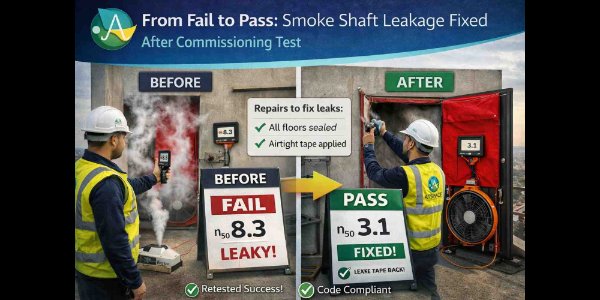
The widely used benchmark is a maximum leakage rate of 3.8 m³/h/m² at 50Pa for the builder’s work shaft. That figure appears in current SCA/LABC guidance and is the number most project teams recognise on site. However, you should still confirm the exact project specification, because some smoke-control designs set their own criteria.
It means the shaft is allowed to leak no more than 3.8 cubic metres of air per hour for every square metre of shaft area when tested at a 50 pascal pressure difference. In plain English, the lower the number, the tighter the shaft. On site, this is the benchmark most teams are trying to beat before smoke-control commissioning moves on.
Test it when the builder’s work shaft is complete and airtight enough to represent the finished shaft, ideally before the smoke-control equipment is installed and certainly before commissioning becomes critical-path. That gives the team a clean read on the shaft itself and keeps remedials far simpler than trying to work around installed dampers, fans and controls later.
Yes, that is best practice. Industry guidance and manufacturer commentary both point to pressure testing the builder’s work shaft before ventilation equipment or dampers are installed, because leaks are easier and cheaper to find at that stage. Once the kit is in, access gets tighter and the fault-finding gets slower.
Most smoke shafts fail because the shaft was never truly airtight in the first place. Typical problems are unfinished builder’s work, poorly sealed AOV frames, unsealed joints, penetrations and awkward interfaces between trades. Smoke control designers work to strict leakage assumptions, so even small defects that look minor to a site team can be enough to blow the result.
If it fails, the leakage paths have to be found, sealed and retested before the shaft can be relied on for smoke-control acceptance. In practical terms that usually means delayed commissioning, more visits, more trade coordination and a risk to handover. The earlier you diagnose the failure, the cheaper it is to recover.
Under BS 9991:2024, yes for protection of stair lobbies. The updated standard says that above 30m only mechanical smoke shafts should be used, either extraction or pressurisation, and natural smoke shafts are no longer acceptable for that residential application. That change has obvious implications for shaft design, leakage control and commissioning.
Treat the shaft as a handover-critical package from day one. Confirm the leakage target early, test the builder’s work shaft before dampers and fans go in, make sure penetrations and AOV frames are properly sealed, and do not wait until final commissioning to discover the shaft leaks. The projects that keep programme intact are the ones that validate the shaft early, not the ones that hope it will be fine.
Videos for air leakage testing
Explore our videos for quick, engaging insights on building compliance. From step-by-step guides to expert advice, our video library simplifies complex topics, making it easier for you to take action and stay informed. Perfect for when you need clarity in minutes!