
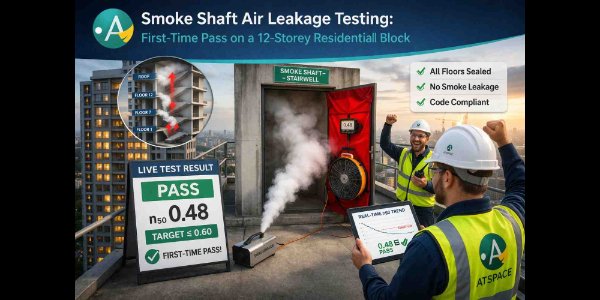
The Result
A 12‑storey residential block achieved a first‑time pass on smoke shaft air leakage testing because leakage routes were controlled before commissioning. ATSPACE completed a readiness review, carried out the smoke shaft leakage test to the project specification, and provided clear close‑out actions for minor issues. The smoke control commissioning stayed on programme and the fire engineer received clean evidence for sign‑off.
Project Snapshot
Service: Smoke shaft air leakage testing
Client: Main contractor delivering a high‑rise residential scheme
Site: Albion Heights, 1 Meridian Square, Salford M5 3AD
Building type: 12‑storey block with central corridor + smoke shaft
Smoke control: Natural shaft with AOV & corridor vents, control interfaces
Programme stage: Practical completion, commissioning phase
Compliance driver: Building Regulations Part B + project fire strategy
ATSPACE delivery: Readiness walkthrough, leakage testing, reporting, minor close‑out support
Engineers: ATSPACE test engineer + compliance coordinator
Why This Test Mattered on a 12‑Storey Block
Smoke shafts are unforgiving: on drawings they work; on site, leakage destroys performance.
Leakage causes:
- insufficient airflow through the shaft
- corridor pressures that do not behave correctly
- commissioning loops, delays and retests
The contractor’s real risk:
- delayed smoke control commissioning
- programme slippage
- expensive remedials at height
- friction across M&E, fire stopping, drylining and door‑set trades
The aim: prove the shaft is tight enough, and do it first time.
What Smoke Shaft Air Leakage Testing Checks
The test verifies whether the shaft + its interfaces are sufficiently airtight for the smoke control system to function safely.
Common leakage points:
- shaft access doors
- AOV frames and roof upstands
- vent/damper frames
- incomplete builders‑work openings
- unsealed service penetrations
- incomplete shaft wall joints
If these are not controlled, commissioning becomes painful.
What ATSPACE Was Asked To Do
- confirm shaft readiness before testing
- deliver smoke shaft leakage testing within the commissioning window
- highlight leak routes that affect performance
- provide clear reporting for the fire strategy evidence
- avoid unnecessary disruption to ongoing commissioning
What ATSPACE Did On Site
Step 1: Pre‑test readiness walkthrough
We inspected all major risk points:
- AOV housing + frame continuity
- corridor vent frame seals
- access‑door seals, latching and closure pressure
- builders‑work openings or temporary holes
- wall joints, corners, structural interfaces
- penetrations that should not exist inside the shaft
This is where first‑time passes are won.
Step 2: Confirm test setup + responsibilities
We agreed:
- who controls access doors
- vent positions during testing
- building configuration to avoid false readings
- how issues would be recorded + resolved
Step 3: Smoke shaft air leakage test
ATSPACE executed the test to project specification and documented the conditions clearly.
Step 4: Minor issue close‑out
A small number of quick‑fix points were identified and converted into precise actions with:
- location
- cause
- what "good" looks like
Step 5: Reporting for sign‑off
A clean, unambiguous test report was delivered for commissioning records and fire‑strategy compliance packs.
The Main Risk Points We Controlled Before Testing
Risk 1: Shaft access doors
Access doors often leak if seals are incomplete or closure pressure is poor.
We checked:
- continuous seals
- alignment + latch engagement
- frame‑to‑structure sealing
Why it matters:
A leaky door is effectively a permanent opening.
Risk 2: AOV frame + roof interface
Roof interfaces often look complete but leak heavily.
We checked:
- continuity around the AOV frame
- seating + closure
- interface seal line
Why it matters:
Roof leakage is high impact and difficult to access later.
Risk 3: Corridor vent interfaces
Vent frames leak if not sealed correctly.
We checked:
- frame seal continuity
- vent seating
- surrounding builders‑work close‑out
Why it matters:
Small gaps repeated across floors add up rapidly.
Risk 4: Builders‑work openings + hidden penetrations
Temporary openings are often overlooked.
We checked:
- unplanned shaft openings
- incomplete closure points
- service routes entering shaft zones
Why it matters:
A single open route can dominate the leakage result.
Outcome
The smoke shaft achieved a first‑time pass.
The project gained:
- commissioning on programme
- fewer late remedials
- clean evidence for the fire engineer
- a repeatable readiness method for future phases
What This Proves
High‑rise smoke shaft success comes down to interface control.
If builders treat the shaft as a finished element and verify key leakage points before the test window, first‑time passes become normal.
Common Mistakes This Project Avoided
- testing before doors/vents were fully sealed
- assuming fire stopping = airtightness
- leaving builders‑work openings unresolved
- discovering roof leaks after access equipment was gone
- allowing uncontrolled access during testing
CTA
If you are approaching commissioning on a residential block and need smoke shaft air leakage testing to land cleanly, ATSPACE can support with:
- readiness walkthroughs
- smoke shaft leakage testing
- remedial guidance
- reporting for handover + fire strategy evidence
Frequently Asked Questions
When should smoke shaft air leakage testing take place?
During commissioning, once all interfaces and openings are closed out.
What usually causes failures?
Door seals, vent frames, AOV interfaces, and unclosed openings.
Can ATSPACE help if commissioning is already under pressure?
Yes — readiness checks and targeted close‑out prevent retest delays.
Do you provide handover‑ready reporting?
Yes — including full documentation of test configuration and results.
