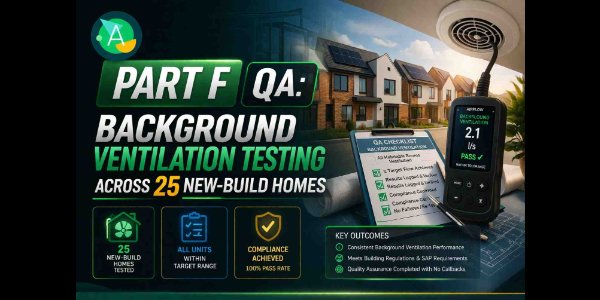
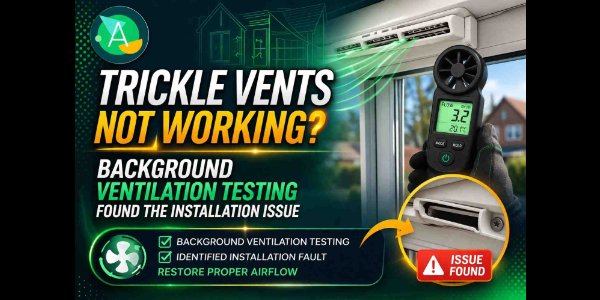
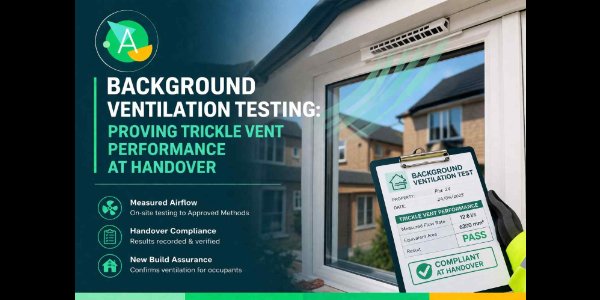
Need Background Ventilation Testing? We offer a fast, reliable, and nationwide service with unmatched expertise. Compliance and quality assurance made easy, hassle-free, and efficient.
Background ventilation testing is a service used to assess whether a dwelling has enough background air provision for healthy ventilation, usually without relying only on assumptions or product brochures. In new-build and replacement-window work, that often means verifying the correct equivalent area and installation of background ventilators. In retrofit, it more often means the IAA / TrustMark-approved dwelling assessment used to judge whether existing infiltration is sufficient or whether extra background ventilators are needed after energy efficiency works.
Background ventilation testing is about the passive provision of outdoor air into the dwelling, while ventilation flow rate testing is about the measured airflow of mechanical fans and systems. Part F requires mechanical airflow measurement for intermittent extract, MEV and MVHR systems, but background ventilators are sized by equivalent area and verified differently. In simple terms, one checks the passive air-in route; the other checks the powered air-movement route.
It is related, but it is not the same thing. Standard Part L airtightness testing is an energy-compliance pressure test typically reported as air permeability at 50Pa, while the IAA / TrustMark background ventilation assessment for existing dwellings uses dwelling-level air-change evidence at 4Pa to help decide whether background ventilator upgrades are needed. The equipment can overlap, but the purpose, thresholds and reporting logic are different.
Yes. TrustMark describes the IAA process as a TrustMark-approved approach to measure and address background ventilation requirements under PAS 2035 pathways, and TrustMark’s 2023 retrofit design guidance recognises the IAA background ventilation assessment as a route for deciding whether background ventilation upgrades are needed. In practical terms, it gives Retrofit Coordinators and Designers evidence instead of guesswork.
TrustMark’s retrofit design guidance says that, to demonstrate there is sufficient air infiltration so that background ventilation upgrades are not warranted, the IAA route requires a whole-house result of at least 1.0 ACH @ 4Pa and bedroom results of at least 1.5 ACH @ 4Pa where the bedroom test is required. These are the key benchmark numbers behind the service.
Yes, that is one of its main commercial benefits. Elmhurst says background ventilation testing helps avoid unnecessary installation of background ventilators, and TrustMark’s retrofit design guidance gives a model wording for the ventilation strategy stating that successful testing demonstrates there is sufficient air infiltration so that background ventilation upgrades are not warranted. That is exactly why the service is attractive on retrofit jobs where extra vents are unwanted.
Yes. Under the current dwelling guidance, natural ventilation with intermittent extract fans — the industry’s old System 1 shorthand — relies on background ventilators plus intermittent extract. The minimum equivalent areas for natural ventilation are set out in Table 1.7 of Approved Document F, so background ventilator sizing is still a core compliance issue on these homes.
Yes. Continuous mechanical extract ventilation — the old System 3 shorthand — still needs background ventilators in habitable rooms. Approved Document F says these ventilators should not be in wet rooms, should provide at least 4,000 mm² equivalent area for each habitable room, and the total number should be the number of bedrooms plus two. So MEV is not a no-trickle-vent system.
No. Approved Document F says background ventilators should not be installed with mechanical ventilation with heat recovery, because they create unintended air pathways. On existing dwellings moving to MVHR, the guidance also says existing background ventilators should be covered or sealed shut. That is one of the clearest differences between MEV and MVHR from a background-ventilation point of view.
Use it early, and use it as evidence for the ventilation strategy rather than as a late argument after works are finished. The strongest route is to assess the existing dwelling before energy-efficiency measures, use the result to decide whether background ventilator upgrades are genuinely needed, and then repeat the required evidence after installation if you are relying on the TrustMark / IAA route. That keeps the retrofit ventilation strategy evidence-led instead of assumption-led.