
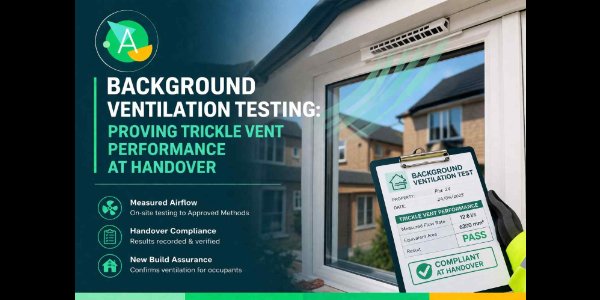
The result
The handover pack was nearly complete, but the client wanted one thing confirmed:
Were the trickle vents actually working, not just installed?
ATSPACE carried out background ventilation testing across the phase, verified vent type and equivalent area, checked airflow paths, confirmed smooth operation, and identified a few repeat installation issues before keys were released.
The outcome was a clean Part F readiness position, fewer future condensation‑related complaints, and a clear evidence trail showing vents were functional, not just fitted.
Project snapshot
Service: Background ventilation testing
Client: Regional housebuilder + main contractor
Site: Alder Brook View, 1–12 Hazel Lane, Solihull B90 2GF
Building type: New build 2‑ and 3‑storey houses
Ventilation strategies: System 1 and System 3 MEV
Programme stage: Handover — final QA
Compliance driver: Approved Document F + quality assurance
ATSPACE delivery: Vent verification, operation checks, airflow‑path checks, repeat‑defect list, handover summary
Team: ATSPACE compliance engineer + site coordinator
Why the client requested background ventilation testing
Extract fans are always tested because they are the obvious Part F requirement.
Trickle vents, however, are often assumed to be fine — a dangerous assumption.
Faulty or obstructed vents cause:
- condensation and mould
- “heavy” air and comfort complaints
- poor extract fan performance
- difficult customer‑care call‑backs
- heating used excessively because rooms feel damp
The contractor wanted proof that vents worked before handing homes to occupants — not learning the hard way after occupation.
What background ventilation testing checks
Background ventilation testing verifies three essential points:
1. The correct vent is installed
Matches window schedule, ventilation strategy and required equivalent area.
2. The vent is functional
Opens and closes smoothly, not jammed by:
- paint
- mastic
- trim
- debris
3. Air can enter through the vent into the room
We check:
- airway not blocked by finishes
- internal frame details not obstructing airflow
- insulation not encroaching
- vent not sealed shut
This is about real airflow, not paperwork.
The site risk profile
The site was well run, but typical handover risks existed:
- multiple window installers over time
- decorators completing late
- snaggers adjusting trims after vents fitted
- vents left closed by default for demo packs
- mixed plot types with different vent quantities
The core question:
Are vents installed, sized and working consistently across the phase?
What ATSPACE did on site
Step 1: Design check by plot type
We reviewed room layouts to confirm required vent positions and quantities, including acoustic‑vent locations.
Step 2: Plot‑by‑plot walkthrough
For each vent we checked:
- correct type and location
- smooth opening/closing
- unobstructed airway
- internal finishes not blocking airflow
- not sealed by paint/mastic
- correct number per room
Step 3: Air‑path checks linked to Part F
We inspected internal transfer routes:
- door undercuts
- restrictors/sliders
- internal pressure dynamics
If vents work but air cannot move through the dwelling, ventilation fails.
Step 4: Repeat‑defect control
When an issue repeated across plots, we:
- identified the pattern
- predicted affected plots
- provided one standard fix
- verified close‑out on a sample
Step 5: Summary for handover file
We documented:
- checks completed
- defects found
- fixes implemented
- controls introduced
What we found and fixed
Finding 1: Vents installed but airway partially blocked
Finish interfaces restricted the slot.
Fixed by: Correcting the interface and clearing the airway.
Finding 2: Paint and mastic affecting operating sliders
Some vents were stiff or jammed.
Fixed by: Freeing components and updating the decorator snag checklist.
Finding 3: Vent quantity mismatch
Window type variations removed vents in some rooms.
Fixed by: Installing missing vents and adding a schedule cross‑check.
Outcome
The development achieved a fully verified Part F position at handover.
Project outcomes
- fewer ventilation‑related snags
- reduced condensation risk
- stronger confidence in Part F compliance
- simple repeatable process for future phases
- clear evidence for handover documentation
Common mistakes this project avoided
- assuming vents are fine because they look fine
- doing visual checks without airflow checks
- letting paint/mastic jam vent sliders
- missing vent‑quantity variation across elevations
- handing plots over with vents closed by default
CTA
If you want to reduce condensation complaints and avoid Part F issues at handover, ATSPACE background ventilation testing ensures your trickle vents are installed, functional and delivering real airflow.
Ask for
- background ventilation testing at handover
- trickle‑vent verification against plot schedules
- snag identification and repeat‑defect plans
- combined testing with Part F airflow measurements
Frequently asked questions
Are trickle vents part of Part F compliance?
Yes — they are essential where the ventilation strategy relies on background air inlets.
Why do trickle vents cause condensation problems?
Missing or blocked vents stop moisture dilution — especially in bedrooms.
Do you verify equivalent area?
Yes — we confirm vents match the schedule and design intent.
When should background ventilation be tested?
At handover, once finishes are complete but before keys are released.
