Retrofit Airtightness Testing to the EnerPHit Target
Need Retrofit Air Leakage Testing? We offer a fast, reliable, and nationwide service with unmatched expertise. Compliance and quality assurance made easy, hassle-free, and efficient.
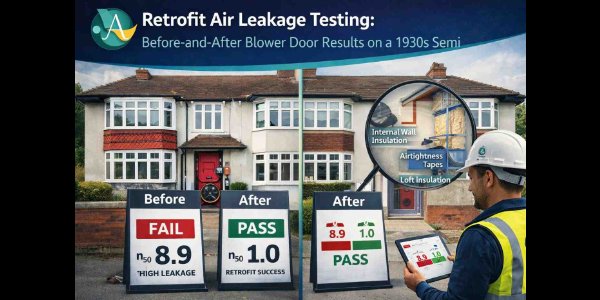
Retrofit air leakage testing is a pressure test used on existing buildings to measure how much uncontrolled air leaks through the envelope before or after improvement works. In practical terms, it gives a measured baseline, helps identify where heat is being lost through draughts and gaps, and shows whether retrofit work has genuinely improved airtightness rather than just looking better on paper.
No, not as a blanket rule. There is no general UK rule saying every retrofit project must have a formal air leakage test in the way new dwellings do. In practice, it becomes valuable where the work is likely to change airtightness materially, where ventilation needs to be reassessed, or where the client wants measured before-and-after evidence instead of relying on assumptions.
Not automatically. Current research for DESNZ notes that existing dwellings do not have a universal air permeability compliance threshold to meet after retrofit, even though new dwellings do. That said, Approved Document F allows expert advice on existing homes to include an air permeability test, so testing is often the smartest way to judge how much the retrofit has changed the building and whether the ventilation strategy still makes sense.
No single universal pass mark applies across retrofit work. Existing-home retrofit currently does not have the same across-the-board airtightness threshold that new-build Part L compliance uses, so the meaningful target is usually project-specific. A good retrofit brief sets a clear aim at the start: diagnose draughts, verify improvement, inform ventilation design, support PAS 2035, or benchmark a portfolio for future works.
A good retrofit result is one that materially improves the home against its own starting point without creating a ventilation problem. Recent DESNZ work found the GB housing stock had a mean air permeability of 8.6 m³/(h·m²) at 50Pa, with a very wide spread, so “good” in retrofit is about meaningful improvement and healthy ventilation, not blindly chasing new-build numbers on an older property.
Yes. PAS 2035 uses a whole-house retrofit process, and Approved Document F says following PAS 2035 is considered an adequate means of demonstrating compliance for ventilation in existing dwellings. A measured air leakage test strengthens that process because it gives the Retrofit Coordinator and designer real evidence about infiltration, likely ventilation impact and whether the retrofit is delivering what the assessment assumed.
Yes. Approved Document F in both England and Wales says many existing dwellings rely on infiltration and that energy efficiency measures may reduce that infiltration enough to cause under-ventilation. Retrofit air leakage testing gives measured evidence of how tight the home has become, which helps decide whether the existing vents and extract are still adequate or whether the ventilation strategy needs upgrading.
Usually, yes, unless you are providing an equivalent ventilation solution. Approved Document F says if the original windows had background ventilators, the replacements should include them, and where windows without vents are replaced the new work should not leave the dwelling worse off for ventilation. The guidance also gives common replacement equivalent areas such as 8,000mm² in habitable rooms and kitchens and 4,000mm² in bathrooms in typical dwelling scenarios.
It can, if the ventilation strategy is not reviewed at the same time. Approved Document F warns that reducing infiltration in an existing dwelling can reduce indoor air quality below the required standard, and the same logic applies to moisture risk. Airtightness improvement is not the enemy; unmanaged airtightness improvement is. The safe retrofit approach is to tighten and ventilate in a controlled way together.
Use it early, use it in stages where needed, and use it alongside ventilation review rather than after the fact. The strongest retrofit process is baseline test, targeted design, interim checks where details are still accessible, then post-works verification to prove the result. That approach reduces wasted remedials, protects indoor air quality and gives the project team evidence they can actually build decisions around.
Videos for retrofit air leakage testing
Explore our videos for quick, engaging insights on building compliance. From step-by-step guides to expert advice, our video library simplifies complex topics, making it easier for you to take action and stay informed. Perfect for when you need clarity in minutes!