
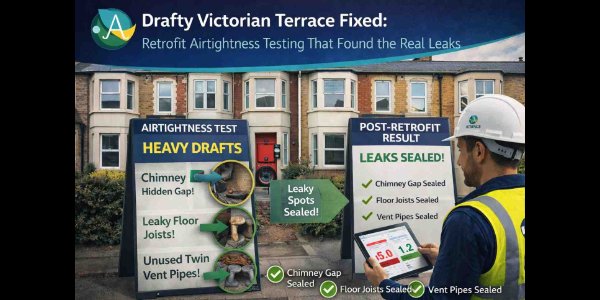
The Result
A Victorian mid‑terrace was renovated and decorated, but the homeowner still experienced persistent drafts and cold spots. Cosmetic sealing didn’t work because the main leaks were hidden. ATSPACE carried out retrofit airtightness testing and diagnostic leak tracing, identified the dominant air paths, and guided targeted remedial sealing. Draft complaints dropped significantly, and measured airtightness improved enough to support the homeowner’s broader upgrade goals.
Measured improvement:
- Before remedials: 14.8 m³/h·m² @ 50 Pa
- After remedials: 8.1 m³/h·m² @ 50 Pa
Project Snapshot
Service: Retrofit air leakage testing
Client: Private homeowner + refurbishment contractor
Site: 9 Marlborough Place, Levenshulme, Manchester M19 2RL
Property type: Victorian mid‑terrace with loft conversion
Construction: Solid masonry, suspended timber floors, chimney breast retained
Works already completed: Plaster repairs, new kitchen, partial windows, loft conversion
Programme stage: Post‑refurbishment, draft complaints
ATSPACE delivery: Diagnostic pressure test, leak mapping, remedial plan, verification test, written close‑out notes
The Problem the Homeowner Could Not Solve
The homeowner described:
- noticeable drafts in hallway and front room
- cold spots around chimney breast and alcoves
- drafts worse on windy days
- home harder to heat after loft conversion
Contractor attempts (sealant, door adjustments, patching cracks) didn’t help — a classic sign that leakage routes are connected and hidden.
Victorian terraces often have complex void networks linking external air directly into rooms.
Why Victorian Terraces Leak the Way They Do
Typical high‑impact leakage patterns:
Chimneys & redundant flues
Even “blocked” fireplaces can act as major air movement drivers.
Suspended floors & underfloor voids
Sub‑floor air travels through perimeter gaps and service penetrations.
Party wall voids
Historic construction leaves connected cavities around stairs, alcoves and chimneys.
Loft conversion junctions
Later additions often leave incomplete airtightness at eaves/ceiling transitions.
The homeowner needed evidence — not guesswork.
What ATSPACE Did
Step 1: Diagnostic pressure test
Baseline result: 14.8 m³/h·m² @ 50 Pa
Step 2: Leak path mapping (not spot sealing)
We traced airflow in the key complaint areas and followed each draft to its source.
Strongest leak routes:
- Chimney breast + fireplace closure
- Underfloor void connection into hallway
- Loft conversion eaves transitions
- Kitchen service penetrations
- Front‑door threshold + frame junction
Step 3: Prioritised remedial plan
Designed to fix the real leak paths without major strip‑out.
Actions included:
- improving chimney closure detailing
- sealing penetrations linking underfloor voids to rooms
- fixing loft conversion eaves transitions
- sealing kitchen service penetrations
- adjusting/sealing front‑door threshold
Step 4: Verification test
Post‑remedial result: 8.1 m³/h·m² @ 50 Pa
What Changed in the Home After Fixes
The homeowner reported:
- significantly reduced hallway drafts
- less cold movement near chimney breast
- more stable upstairs temperatures
- heating felt more effective and controllable
Exactly the outcomes that matter for retrofit comfort.
What This Project Proves
Victorian terrace drafts are rarely fixed by sealing visible gaps.
Dominant leakage routes are usually:
- chimney paths
- underfloor void connections
- party‑wall voids
- loft conversion transitions
- service penetrations
Diagnostic retrofit testing works because it:
- shows where air actually moves
- reveals connected leakage paths
- targets fixes that matter
- proves the improvement
Common Mistakes This Project Avoided
- sealing skirtings instead of tracing the real source
- ignoring chimneys because “they’re blocked”
- assuming loft conversion drafts are normal
- leaving underfloor voids unsealed
- wasting money on broad snagging instead of targeted fixes
CTA
If your older property still feels drafty after refurbishment, ATSPACE retrofit airtightness testing will find the real leak paths and help fix them properly. It’s faster, cheaper and far more effective than repeated guesswork.
Ask for:
- retrofit blower‑door testing
- diagnostic leak tracing
- prioritised remedial plans
- verification tests after fixes
Frequently Asked Questions
Can you test an occupied home?
Often yes, with simple planning.
Why is a Victorian terrace still drafty after refurbishment?
Because major air paths run through chimneys, floors, party‑wall voids, and loft transitions — not visible edges.
Is testing worth it even without compliance targets?
Yes — comfort improvement depends on fixing the real leaks.
Will airtightness improvements cause moisture problems?
Not if paired with suitable ventilation.
Most common leaks in Victorian homes?
Chimneys, underfloor voids, loft transitions, service penetrations and door thresholds.
