
The Result
A developer wanted a simple, measurable QA step to reduce ventilation‑related call backs across an entire phase.
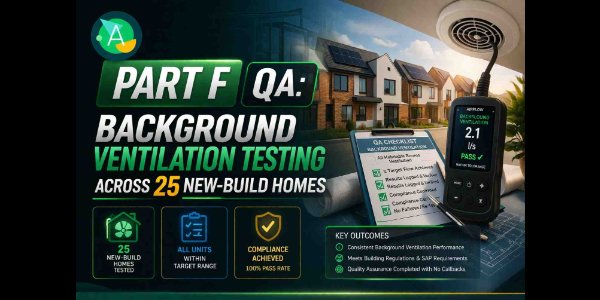
ATSPACE carried out background ventilation testing across 25 new build homes, verifying trickle vent provision, operation and airflow paths by plot type.
Three repeat issues were found early and corrected before they spread further.
A short site checklist was issued so background ventilator checks became part of the handover routine.
The outcome: stronger Part F readiness, fewer condensation risk points and fewer post‑completion snags.
Project Snapshot
Service: Background ventilation testing for Part F QA
Client: Developer + principal contractor
Site: Meadow Lane Quarter, Phase 1, 1–25 Larkspur Walk, Swindon SN3 4RB
Building type: New build houses (detached + semi‑detached)
Ventilation strategies: System 1 and System 3
Programme stage: Rolling completion, QA sampling before mass handover
Compliance driver: Approved Document F + quality assurance to reduce customer‑care load
ATSPACE delivery: Sampling plan, trickle‑vent checks, airflow‑path checks, defect‑pattern analysis, fix plan + verification, handover QA checklist
Engineers: ATSPACE compliance engineer + site coordinator
Why the Developer Treated Background Ventilation as QA
Ventilation call backs are expensive and repetitive.
Typical issues linked to poor background ventilation include:
- condensation and mould complaints
- stale or “heavy” rooms
- residents closing vents due to stiffness, noise or lack of understanding
- extract fans underperforming because make‑up air is restricted
- disputes about whether the home was handed over in the correct condition
The client wanted to control the issue at source by verifying background ventilation provision.
What ATSPACE Checked Across 25 Homes
We applied a consistent, repeatable process so results were meaningful across plot types.
Plot‑level checks
- correct number of trickle vents per room
- correct vent type per schedule
- smooth vent operation
- no paint/sealant/debris restricting movement
- airway clear (no trims, plaster, insulation blocking it)
- external slots unobstructed
Dwelling‑level checks
- internal transfer routes not blocked
- door undercuts consistent with ventilation strategy
- no finishing issues likely to create stale‑air pockets
The goal was not paperwork — it was eliminating repeat defects.
The Three Repeat Issues Found Early
Issue 1: Vents left fully closed at handover
Why it mattered:
Starting closed increases moisture risk immediately, and occupants rarely open them.
Fix:
A handover rule: vents set to intended position at final clean and demonstrated during handover.
Issue 2: Stiff sliders caused by decorating
Why it mattered:
If a vent is hard to move, residents leave it shut.
Fix:
Decorator close‑out included vent operation as a sign‑off item, with spot checks.
Issue 3: Airway restrictions at the window head on one plot type
Why it mattered:
A partially blocked airway reduces background ventilation even when vents are open.
Fix:
A standard correction was rolled out, and the detail was updated for remaining plots.
Outcome
Across all 25 homes, the developer gained:
- consistent background ventilator provision
- reduced condensation and stale‑air risk
- fewer post‑completion snags
- a repeatable checklist for site teams + quality inspectors
- better alignment between Part F fan testing and real‑world airflow
The key value was removing repeat defects before they multiplied.
Common Mistakes This Project Avoided
- focusing only on extract‑fan testing
- assuming vents work just because they’re installed
- handing over with vents shut
- allowing decorating to jam vent sliders
- fixing one plot without addressing phase‑wide repeat issues
CTA
If you want fewer ventilation‑related call backs and stronger Part F readiness across your phase, ATSPACE background ventilation testing provides a fast QA check on trickle‑vent provision, operation, and airflow paths.
Ask for:
- Part F QA background ventilation testing
- trickle‑vent provision & operation verification
- repeat‑defect identification + fix plans
- handover checklists to keep performance consistent
Frequently Asked Questions
Why test background ventilation across multiple plots?
Because ventilation defects repeat. Sampling shows whether issues are isolated or systemic.
Do trickle vents matter if extract fans are strong?
Yes — extract relies on make‑up air. Without background ventilation, the dwelling won’t ventilate as intended.
Most common trickle‑vent issues?
Blocked airways, stiff sliders, vents shut at handover, schedule drift causing missing vents.
Can this be combined with Part F flow‑rate testing?
Yes — together they give a complete picture of real ventilation performance.
