The Result
A smoke shaft was underperforming during commissioning, and the team could not agree what was causing it. ATSPACE carried out a smoke shaft integrity test, identified the six leakage routes that had the biggest performance impact, and provided a targeted close‑out plan. Once fixed, the system stabilised and commissioning proceeded without repeated trial and error.
Project Snapshot
Service: Smoke shaft air leakage testing + integrity investigation
Client: Developer, principal contractor and smoke control contractor
Site: Parkside Quays, 11 Harbour Terrace, Liverpool L3 1HF
Building type: 7‑storey residential block with central corridor + smoke shaft
Smoke control: AOV + multiple corridor vents
Programme stage: Commissioning troubleshooting
Compliance driver: Part B + project fire strategy
ATSPACE delivery: Integrity test, leak identification, prioritised fix plan, verification checks, commissioning‑file documentation
Engineers: ATSPACE test engineer + compliance coordinator
Why the Building Was Struggling
The components were correct, but the system performed inconsistently — a clear sign that leakage was uneven. One or two high‑impact routes can dominate results, and small gaps repeated across floors can drag performance down further.
The contractor needed clarity:
Where are the leaks that matter, and what order should we fix them in?
What ATSPACE Did
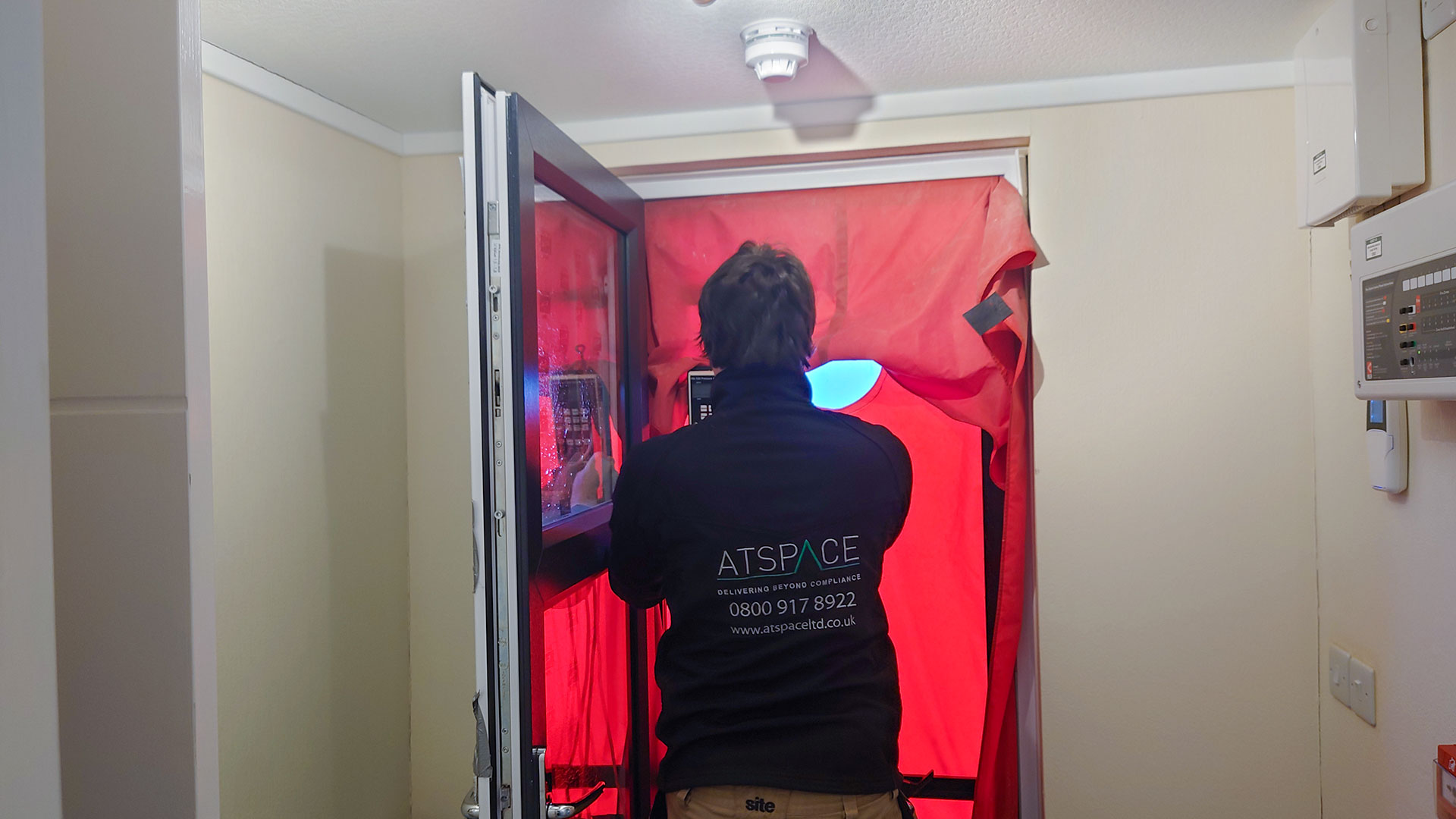
Step 1: Integrity test setup + controlled checks
We applied controlled pressure and inspected the shaft methodically to avoid missed issues.
Step 2: Identify high‑impact leaks (not background leakage)
We focused on leaks that were:
- large enough to move performance
- repeated across floors
- hidden behind finishes
- linked to common interface failures
Step 3: Targeted close‑out plan
For each leak we provided:
- location
- why it mattered
- what “good” looks like
- trade ownership
The 6 Leaks That Were Killing Performance
1. Roof AOV frame‑to‑structure interface
Leakage was present around the AOV frame.
Why it mattered: Roof leakage is high impact and difficult to fix late.
Fix: Continuous sealing around the entire frame + verify seating and closure.
2. Corridor vent frame interface on multiple floors
Several frames lacked continuous sealing.
Why it mattered: Small gaps repeated across floors add up quickly.
Fix: Continuous sealing around the whole perimeter using the same method each floor.
3. Shaft access door seal discontinuity
Seal compression was inconsistent.
Why it mattered: A poorly sealed door behaves like a permanent opening.
Fix: Replace/correct seals, verify compression and latching.
4. Builders‑work opening not closed out
A direct air path was still open.
Why it mattered: One unchecked opening can dominate leakage.
Fix: Full closure and verify continuity of the shaft lining.
5. Unauthorised penetration within shaft zone
A service penetration created an unplanned air path.
Why it mattered: Breaches compartmentation and performance.
Fix: Remove or seal to required standard and verify compliance.
6. Junction line discontinuity at material change
A construction‑change joint had an unsealed break.
Why it mattered: Junctions can act as long continuous leak routes.
Fix: Reinstate seal continuity, verify if repeated elsewhere.
Outcome
Once the six leaks were corrected, the system behaved predictably and commissioning continued without repeated adjustments.
The project gained:
- a short, actionable remedial list
- reduced disruption in finished areas
- clearer trade ownership
- stronger confidence for final sign‑off
- a repeatable method for future blocks
What This Proves
Smoke shaft performance problems aren’t solved by sealing at random.
They’re solved by:
- identifying the leaks that matter
- fixing them properly
- verifying continuity before sign‑off
Common Mistakes This Project Avoided
- chasing minor leaks while missing repeated frame gaps
- assuming access doors have low impact
- ignoring roof‑level interfaces
- treating unclosed openings as minor snags
- allowing unclear responsibility between trades
CTA
If your smoke shaft performance is inconsistent — or you’re approaching sign‑off and need confidence it will pass — ATSPACE can carry out smoke shaft integrity testing, identify high‑impact leak routes, and provide a clear, targeted close‑out plan.
Ask for:
- smoke shaft integrity testing + leak investigation
- smoke shaft air leakage testing for commissioning evidence
- targeted remedial plans + verification checks
- reporting suitable for commissioning files + handover packs
Frequently Asked Questions
What’s the difference between an integrity test and a standard check?
Integrity testing focuses on leakage routes and airtight continuity, not just visual completion.
Most common high‑impact smoke shaft leaks?
Roof AOV interfaces, corridor vent frames, access doors, unclosed openings, repeated interface gaps.
Can leaks be found without stripping finished areas?
Often yes — integrity testing traces the air path to the source.
Do you support remedials + retesting?
Yes — verification and retest support are included.
