
The result
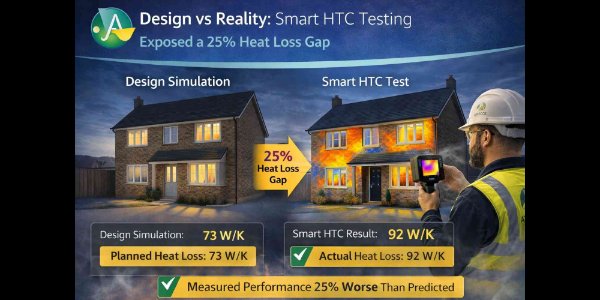
A new build plot was expected to perform well on paper, but Smart HTC testing showed the home was losing heat around 25% faster than the design expectation. ATSPACE used the result to guide a targeted investigation, pinpointed the dominant heat‑loss routes, and provided practical close‑out actions. A follow‑up verification confirmed that performance was brought back toward the design target, reducing comfort‑risk and strengthening the handover position.
Project snapshot
Service: Smart HTC testing and performance‑gap investigation
Client: Developer and principal contractor
Site: Plot 14, 3 Brookstone Mews, Oakhill Park, Milton Keynes MK7 7QF
Building type: 3‑bed end‑terrace new build
Construction: Masonry cavity wall, insulated slab, warm roof, high‑performance glazing, intermittent extract ventilation
Programme stage: Pre‑handover, post‑commissioning
Reason for test: Quality‑assurance sampling across house types
ATSPACE delivery: Smart HTC measurement, design comparison, investigation, close‑out actions, verification support
Team: ATSPACE building performance engineer and compliance coordinator
Why the client needed an answer, fast
The developer wanted to avoid a situation where a home:
- looks complete
- feels cold or draughty in use
- needs more heating than expected
- prompts customer‑care complaints
- raises questions about build quality vs design intent
Plot 14 showed a clear heat‑loss gap. The priority became moving from a number to a cause.
What Smart HTC revealed
The Smart HTC test showed the home was losing heat ~25% faster than design modelling predicted.
This usually indicates one or more of:
- uncontrolled air leakage
- thermal bypass at junctions
- insulation discontinuities
- voids or service penetrations acting as heat‑loss pathways
A targeted, site‑led investigation was required to find the real driver.
What ATSPACE did
Step 1: Compare design intent with as‑built construction
We checked the original fabric strategy against actual on‑site delivery, focusing on high‑risk interfaces:
- slab‑edge and wall‑base continuity
- service entries and meter zones
- loft and ceiling penetrations
- window/door reveals and thresholds
- unheated adjacency (e.g., stores or garages)
- ventilation penetrations and sealing
Step 2: Identify likely heat‑loss drivers
Plot 14’s layout created two known risks:
- a complex understairs service zone
- a junction with an unheated store
These are common sources of thermal bypass or hidden leakage.
Step 3: Targeted checks, not cosmetic snagging
We inspected only the interfaces that meaningfully influence HTC performance — not general finishes.
Because the plot was still accessible, key areas could be checked before they were sealed.
Step 4: Practical, repeatable close‑out actions
We issued a short, focused list of improvements that:
- broke heat‑loss pathways
- reinstated insulation/air‑barrier continuity
- could be repeated across similar house types
Step 5: Verification
A follow‑up test confirmed that performance returned close to the design expectation.
What we found that explained the gap
1. Understairs service zone acting as a bypass route
The void contained service entries and interfaces that allowed connected air movement.
Why it mattered:
Void networks can behave like invisible chimneys, increasing heat loss significantly.
Fix:
Seal service entries and the void boundary to break the pathway.
2. Junction discontinuity at an unheated interface
The unheated store junction showed incomplete continuity between insulation and air‑barrier layers.
Why it mattered:
Even a small weak junction can heavily influence Smart HTC results.
Fix:
Reinstate continuous insulation and airtightness at the interface.
3. Localised leakage at threshold and frame junctions
Several door and frame lines lacked consistent seals.
Why it mattered:
Multiple small external leakage points create meaningful cumulative heat loss.
Fix:
Reinstate seals and verify closure pressure/continuity.
Outcome
The client gained:
- a measured, evidence‑based explanation for the heat‑loss gap
- a targeted remedial plan instead of broad strip‑out
- clear lessons to apply across the remaining house‑type run
- reduced risk of cold‑spots, draughts and performance‑gap complaints
- stronger confidence going into handover
The key win was speed — moving from uncertainty to targeted remediation without wasting programme time.
What this proves
Smart HTC testing converts design assumptions into verify‑able reality. It exposes heat‑loss drift early enough to correct it.
The value is not just the measured number — it is how quickly it leads to:
- a practical diagnosis
- targeted fixes
- learnings applicable across the site
Common mistakes this project avoided
- blaming heating systems before checking fabric
- focusing on visible gaps instead of connected bypass routes
- assuming small discontinuities cannot affect whole‑home performance
- discovering performance gaps after occupation
- fixing one plot without standardising the learning
CTA
If you suspect a design‑versus‑reality performance gap, ATSPACE Smart HTC testing can measure the as‑built heat‑loss rate, diagnose the cause and guide efficient corrective actions. It is one of the fastest ways to protect handover quality.
Ask for:
- Smart HTC testing across representative plot samples
- performance‑gap investigation
- practical close‑out actions
- verification testing after improvements
- reporting for clients and handover packs
Frequently asked questions
What does a heat‑loss gap usually mean?
Often a combination of leakage, junction discontinuity or thermal bypass — not one large defect.
Can a heat‑loss gap be fixed without major rework?
Often yes, if action targets the dominant pathways early.
Is Smart HTC useful even if airtightness results look good?
Yes. Airtightness checks for leaks — Smart HTC checks total heat loss, including hidden bypass routes and junction behaviour.
