
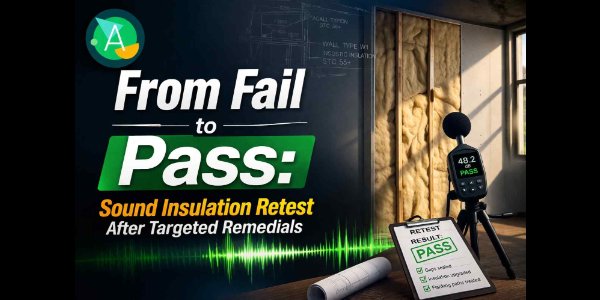
The Result
A new build flat failed its Part E sound insulation test, and initial snagging didn’t improve the result. ATSPACE supported a targeted recovery plan that focused on the dominant weak path, not random fixes.
The contractor applied remedials that addressed the actual transmission route, and the retest passed, protecting programme and restoring confidence for Building Control sign‑off.
Project Snapshot
Service: Sound insulation testing + retest support
Client: Principal contractor
Site: Orchard Wharf, Block B, 2 Riverside Walk, London E14 9QX
Building type: New build apartments, concrete frame
Programme stage: Post‑fail remedials prior to retest
Compliance driver: Approved Document Part E
ATSPACE delivery: Fail‑context review, diagnostic insight, remedial plan support, retest planning, retest testing + reporting
Engineers: ATSPACE accredited acoustic test engineer + compliance coordinator
Why Fails Happen — and Why Random Fixes Waste Time
When a Part E test fails, teams often react by applying multiple fixes without understanding the root cause.
This wastes time because acoustic failures are usually driven by one or two dominant routes, such as:
- impact noise worsened by hard flooring + perimeter detailing
- flanking via ceiling penetrations or access hatches
- discontinuities at floor‑edge junctions
- service penetrations + boxing
- door‑set and corridor junction flanking
If you don’t identify the dominant path, you can spend money and still fail again.
What ATSPACE Was Asked To Do
The contractor needed a controlled route from fail to pass.
ATSPACE was asked to:
- interpret the failure in practical terms
- identify the likely dominant route
- produce a targeted, deliverable remedial plan
- carry out the retest + issue clean, defensible reporting
What ATSPACE Did
Step 1: Review test context + dwelling pair
We reviewed:
- floor finishing + installation method
- ceiling condition + penetrations
- perimeter detailing
- boxing + service routes
- any recent changes that could affect performance
Step 2: Identify the dominant weakness
The failure was driven mainly by impact sound and flanking, not airborne noise.
Evidence pointed to issues with finish build‑up and junction control.
Step 3: Agree targeted remedials
The remedials focused on what would actually move the result:
- correct underlay specification + installation
- closing perimeter lines + removing rigid connections
- addressing ceiling penetrations/access points
- ensuring boxing routes were airtight to avoid void transmission
Measures were chosen to suit access limits on a live site.
Step 4: Retest readiness check
Before booking the slot, we verified all remedials were complete and conditions were stable for a defensible retest.
Step 5: Retest + reporting
ATSPACE carried out the retest and issued clean Part E‑compliant reporting for submission.
Outcome
The retest passed.
The project gained:
- a controlled, predictable recovery
- no repeated trial‑and‑error
- reduced disruption to finished flats
- clear evidence for Building Control
- learning that could be applied to similar units
What This Proves
A Part E failure does not need to create a programme crisis.
The fastest recovery happens when you:
- identify the dominant acoustic path
- apply targeted remedials
- verify readiness before retesting
This avoids expensive, broad, and unnecessary upgrades.
Common Mistakes This Project Avoided
- replacing multiple elements without finding the real cause
- upgrading ceilings everywhere when flooring was the issue
- ignoring perimeter detailing
- booking retests before verifying remedials
- repeating the same poor finish detail across the block
CTA
If you’ve failed a Part E test and need a fast, controlled recovery, ATSPACE can support with retest planning, targeted remedial advice, and clean retesting/reporting to help you achieve sign‑off without weeks of drift.
Ask for:
- Part E sound insulation retesting
- targeted remedial support after a failed test
- readiness checks before retest slots
- Building Control‑ready reporting
Frequently Asked Questions
What is the most common reason for failing Part E?
Impact sound failures linked to floor finishes, underlay issues, perimeter detailing, and flanking via ceilings + services.
Can you fix a failure without major strip‑out?
Often yes — if the remedials target the dominant route.
How do you avoid failing the retest?
By verifying remedials and test conditions before using the retest slot.
