
The result
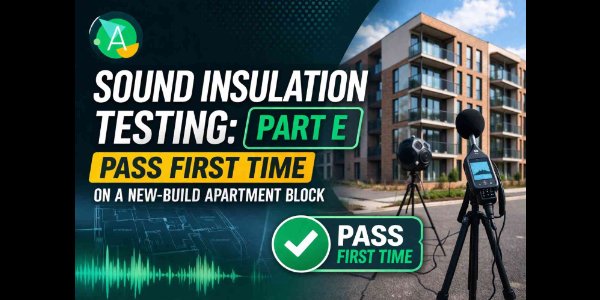
A new build apartment block achieved a first‑time pass for Part E sound insulation testing because testing was treated as a planned, controlled process rather than a last‑minute task.
ATSPACE coordinated readiness with the contractor, selected representative test pairs, completed airborne and impact tests to the required methodology, and delivered clean, defensible reporting for Building Control and handover packs.
The result: no retests, no programme drift, and a clean compliance file ready for sign‑off.
Project snapshot
Service: Sound insulation testing
Client: Main contractor (high‑density residential scheme)
Site: The Maltings, 55 Canal Basin Way, Leeds LS10 1FL
Building type: 8‑storey apartment block, 92 flats
Construction: Concrete frame, concrete floor slabs, drylined walls, mixed corridor partitions
Programme stage: Pre‑completion testing aligned with handover sequencing
Compliance driver: Approved Document Part E
ATSPACE delivery: Test planning, readiness checks, airborne + impact testing, Building Control‑ready reporting
Team: ATSPACE accredited acoustic engineer + compliance coordinator
Why first‑time passes matter on apartment blocks
A Part E fail is never just a fail — it creates a chain reaction of delays and rework, including:
- retest bookings pushing completion dates
- access complications in snagging‑stage or occupied flats
- remedials disrupting ceilings, floor finishes and door sets
- Building Control sign‑off delayed at a critical stage
- trades disputing responsibility for acoustic performance
The client wanted the safest outcome: a first‑time pass backed by a clean evidence pack.
What sound insulation testing checks
Airborne sound insulation
Measures speech/TV/impact of living noise through floors or walls.
Reported as DnT,w + spectrum adjustment.
Impact sound insulation
Measures footfall and dropped‑item noise through floors.
Reported as L’nT,w.
Crucially, Part E performance depends not only on the primary separating elements, but also on:
- workmanship
- ceiling/floor junctions
- service penetrations
- flanking routes
- finishing details
Risk profile on this block
The scheme was well‑managed, but typical apartment‑block risks remained:
- late installation of hard flooring
- ceiling penetrations and access hatches
- riser routes and boxing that create flanking paths
- inconsistent door‑set seals
- variation in layout by stack and flat position
Testing needed to be aligned with the handover sequence to avoid disruption.
What ATSPACE did
Step 1: Test planning aligned to the programme
We coordinated testing with the project’s completion sequencing by:
- selecting representative dwelling pairs by vertical stack
- confirming access and readiness with site management
- ensuring each flat tested was genuinely in a completed state
Step 2: Readiness checks before testing
We carried out readiness checks targeting the most common failure points:
- complete, correctly detailed floor finishes
- no open ceiling penetrations or unfinished hatches
- complete riser and service boxing
- closed‑out perimeter and skirting junctions
- door‑set seals correctly fitted where relevant
This avoided wasted slots and late retest cycles.
Step 3: Airborne and impact sound insulation testing
ATSPACE completed testing to the required Part E methodology, recording all conditions so results were clear, defensible and compliant.
Step 4: Clean reporting for Building Control
We issued a clear pack:
- test pair identification
- airborne + impact results
- testing conditions
- compliance confirmation
Easy for the contractor to submit and simple for Building Control to approve.
What made the difference
1. Floor finishes treated as performance‑critical
Hard flooring was checked for:
- correct underlay
- perimeter isolation
- complete detailing
Even a strong slab can fail impact tests if finishes are poorly installed.
2. Ceiling penetrations controlled
Hatches, downlighters and access points were properly closed out, preventing flanking.
3. Boxing and riser closures treated as acoustic elements
Not cosmetic — these were checked for airtightness and continuity.
4. Intelligent test‑pair selection
We avoided flats still undergoing finishing works and selected proper representative pairs.
Outcome
The apartment block achieved a first‑time Part E pass.
Project gains:
- no retest delays
- reduced disruption to finishing trades
- a clean, ready‑to‑submit evidence package
- predictable compliance supporting the completion programme
Common mistakes this project avoided
- testing flats that were not actually ready
- allowing hard‑flooring changes after readiness checks
- ignoring ceiling access points
- treating boxing as finished when acoustically open behind
- attempting to “squeeze in” testing at the last minute
CTA
If you need Part E sound insulation testing to pass first time on an apartment development, ATSPACE can plan the testing sequence, confirm readiness, and deliver clean reporting that protects handover dates and supports Building Control sign‑off.
Ask for:
- Part E airborne + impact sound insulation testing
- testing programmes aligned to completion sequencing
- readiness checks to avoid failed tests
- Building Control‑ready reporting
Frequently asked questions
When should Part E testing be booked?
As soon as the handover sequence is known — not during the final week.
What causes most new‑build apartment failures?
Impact‑sound issues caused by:
- hard flooring
- perimeter detailing gaps
- flanking routes through ceilings, risers and penetrations
Do you help reduce retest risk?
Yes — readiness checks and close‑out guidance significantly reduce retest risk.
