
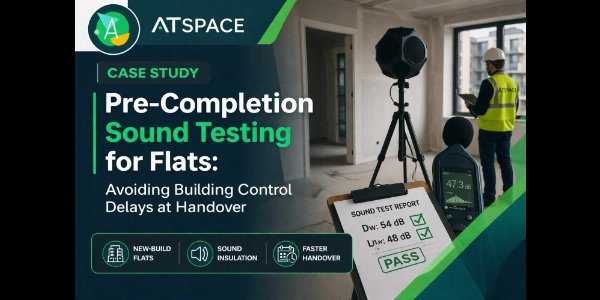
The Result
A flat scheme was approaching handover with multiple moving parts and a tight programme. The contractor needed Part E sound insulation testing completed without becoming the critical path.
ATSPACE planned testing around the handover sequence, carried out readiness checks to prevent wasted test slots, and delivered fast reporting so Building Control submissions stayed on track.
The project avoided the common end‑of‑build issue where acoustic testing becomes a last‑minute bottleneck.
Project Snapshot
Service: Sound insulation testing
Client: Main contractor
Site: Westgate Lofts, 18 Station Approach, Sheffield S1 2GH
Building type: 6‑storey new build apartment block, 68 flats
Construction: Concrete frame, concrete slabs, drylined partitions, mixed floor finishes
Programme stage: Rolling handover across multiple cores
Compliance driver: Approved Document Part E
ATSPACE delivery: Test‑schedule planning, readiness checks, airborne and impact testing, fast Building Control reporting
Engineers: ATSPACE accredited acoustic test engineer + compliance coordinator
Why Pre Completion Testing Is a Programme Tool
Part E testing is one of the easiest ways to accidentally delay a handover — if left too late.
Late testing causes predictable problems:
- flats not consistently ready
- messy access due to snagging, cleaning or client visits
- floor finishes changed after test slots are booked
- remedials disrupting completed areas
- Building Control evidence arriving too late
Pre completion testing avoids this by controlling readiness and sequencing.
What ATSPACE Did
Step 1: Build a test schedule aligned with handover sequencing
We planned testing by core and vertical stack, prioritising flats that were genuinely ready and avoiding units still undergoing finishing works.
Step 2: Readiness checks to prevent wasted slots
We confirmed:
- floor finishes and perimeter detailing complete
- ceilings and penetrations closed out
- service boxing finished and sealed
- access hatches complete
- flat pairs suitable for representative testing
This stopped unnecessary failures and retests.
Step 3: Airborne and impact testing
ATSPACE completed all tests to the required methodology, recording conditions clearly to protect the evidence pack.
Step 4: Fast reporting for Building Control
Reports were issued quickly and formatted for immediate inclusion in Building Control submissions.
What This Prevented On Site
The biggest benefit: no end‑of‑project panic.
This approach prevented:
- retests caused by testing unfinished flats
- programme drift from access problems
- delays waiting for reports during BC submission
- disruption to snagging and cleaning
- repeated failures due to uncontrolled floor‑finish changes
Outcome
The scheme achieved all Part E outcomes without becoming the programme bottleneck.
The project gained:
- controlled testing aligned with handover sequence
- reduced retest risk through readiness discipline
- reporting delivered in time for Building Control
- less disruption to finishing trades
- a calmer, predictable route to completion
Common Mistakes This Project Avoided
- leaving Part E testing to the last week
- testing flats with incomplete finishes
- ignoring floor‑finish changes after readiness sign‑off
- overlooking incomplete ceiling access points
- delaying completion due to slow reporting
CTA
If you need Part E sound testing completed without delays at handover, ATSPACE can plan a pre completion testing programme, carry out readiness checks, and deliver clean reporting that supports Building Control sign‑off and protects your completion dates.
Ask for:
- Part E sound testing for flats and apartments
- test‑programme planning aligned to handover
- readiness checks to avoid wasted test slots
- fast Building Control‑ready reporting
Frequently Asked Questions
When should Part E testing be planned on an apartment scheme?
As soon as the handover sequence is known — early planning prevents testing becoming the critical path.
What causes last‑minute Part E delays?
Unfinished flats, last‑minute floor‑finish changes, access issues and retest cycles.
Can ATSPACE help with access planning and coordination?
Yes — coordinated scheduling is a core part of making flat‑testing predictable on live schemes.
