
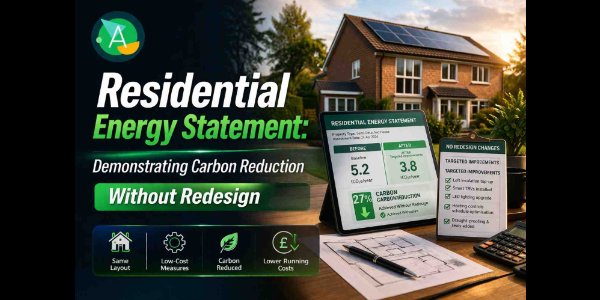
The Result
A residential scheme was asked to demonstrate stronger carbon reduction to satisfy planning policy — but the design was effectively frozen.
The client wanted to avoid a redesign cycle that would delay planning and increase costs.
ATSPACE produced a residential energy statement that delivered the required carbon‑reduction uplift through practical, deliverable strategy adjustments rather than architectural change.
The outcome was a compliant, defensible planning submission with no impact on layouts, elevations or structural decisions.
Project Snapshot
Service: Energy statements
Client: Developer + architect
Site: Orchard Mews, 6 High Street, Hemel Hempstead HP1 3AE
Development: 22 units (houses + apartments)
Stage: Planning response + resubmission
Challenge: Planning requested clearer carbon‑reduction evidence and a more robust strategy
ATSPACE delivery: Updated energy statement, policy response, revised energy assessment outputs, deliverability checks, submission‑ready revisions
Team: ATSPACE energy assessor + building performance lead
What the Planning Feedback Actually Meant
Energy‑related planning comments often sound broad, but usually point to specific gaps:
- unclear baseline vs proposed comparison
- carbon reduction stated but not evidenced
- measures feel aspirational, not deliverable
- statement does not align with local‑policy structure
- energy hierarchy not addressed
- unclear what is planning intent vs detailed design vs as‑built verification
This project had several of these issues.
The team had a strategy in mind — but it wasn’t yet a complete, quantified, policy‑aligned package.
What ATSPACE Was Asked To Do
The client needed a fast, practical response:
- update the energy statement to satisfy planning
- demonstrate carbon reduction clearly and defensibly
- avoid triggering any redesign
- confirm the strategy was deliverable, not optimistic
- set out next steps for technical design and as‑built verification
How ATSPACE Delivered Carbon Reduction Without Redesign
The key is choosing non‑architectural levers that improve performance without altering form.
ATSPACE focused on three proven levers:
Lever 1: Reduce demand through fabric + airtightness targets
We reviewed the design and ensured:
- insulation values were consistent
- thermal‑bridging risks and junction continuity were addressed
- airtightness targets were realistic and clearly stated
- QA measures were explained so targets could actually be met
This strengthened the demand‑reduction narrative and replaced vague claims with deliverable commitments.
Lever 2: Optimise the low‑carbon heat strategy
We clarified:
- heating/hot‑water system type
- suitability for the dwelling mix
- carbon‑reduction impact
- zoning + control assumptions
- what would be fixed at detailed design
This gave planning a confident, realistic system strategy.
Lever 3: Add or optimise on‑site renewables (without redesign)
We assessed roof space and constraints and proposed a realistic PV allowance, described in a deliverable way:
- roof constraints acknowledged
- allowance justified
- final layout to be confirmed at technical design
This demonstrated credible renewable contribution without altering massing.
What ATSPACE Changed in the Document
✅ Clear policy alignment
Structure rebuilt to follow the exact local‑policy requirements.
✅ Clear baseline vs proposed comparison
Presented in a simple, readable format with transparent assumptions.
✅ Clear contribution narrative
Explained what each measure contributed and why it was chosen — no jargon, no unrealistic claims.
✅ Clear delivery plan
Outlined how the strategy will be:
- confirmed at detailed design
- evidenced at as‑built stage
This reduces planning risk because the strategy is shown to be controlled, not speculative.
Problems Encountered — and How We Solved Them
Problem 1: Conflicting specifications across documents
Fix: Reconciled values, agreed a consistent set, ensured the energy statement referenced the correct data.
Problem 2: Concern about committing to specific products
Fix: Used performance‑based commitments, appropriate for planning but flexible for procurement.
Problem 3: Renewables needed to be realistic
Fix: Proposed a deliverable PV solution aligned with roof constraints, not an optimistic allowance.
Outcome
The revised energy statement clearly demonstrated carbon reduction and resolved planning feedback without triggering redesign.
Project outcomes:
- clear, evidenced policy compliance
- quantified carbon‑reduction outputs
- no changes to architecture required
- reduced risk of further planning queries
- stronger foundation for technical design and compliance stages
Common Mistakes This Project Avoided
- adding more text instead of clearer evidence
- claiming carbon reduction without showing the route
- using unrealistic PV allowances
- leaving airtightness/thermal continuity vague
- reopening design unnecessarily when strategy optimisation was enough
CTA
If planning has asked you to improve your energy evidence or demonstrate carbon reduction — and you want to avoid redesign — ATSPACE can strengthen the strategy, quantify the outcome and produce a policy‑aligned, deliverable residential energy statement.
Ask for:
- residential energy statements for planning + responses
- carbon‑reduction strategy optimisation
- local‑policy mapping + evidence‑led revisions
- practical delivery plans for technical design + as‑built verification
Frequently Asked Questions
Can you improve carbon reduction without changing the architecture?
Often yes — by optimising fabric, heat strategy and renewables.
What causes planning energy statements to be challenged?
Unclear baselines, weak evidence, vague measures and poor policy alignment.
Will the planning energy statement help later compliance?
Yes — when written properly, it sets a clear performance pathway into detailed design and as‑built stages.
