
The result
A resident reported persistent smells entering a new flat, strongest in the hallway and bathroom zones. The apartment looked complete, and normal snagging checks didn’t reveal the cause.
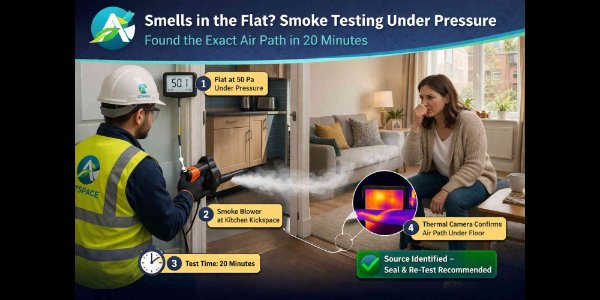
ATSPACE carried out diagnostic smoke testing under controlled pressure and traced the odour pathway within 20 minutes.
The issue was a connected leakage route through a service void and riser interface — not a door‑seal fault.
Targeted sealing stopped the odour transfer without disruptive strip‑out.
Project snapshot
Service: Diagnostic smoke testing
Client: Managing agent + principal contractor (post‑completion)
Site: Harbourline Court, Flat 3.07, 9 Marina Street, Southampton SO14 5QP
Building type: 10‑storey residential building
Programme stage: Post‑completion issue investigation
Key issue: Odour transfer into the flat (hallway + bathroom)
ATSPACE delivery: Controlled pressure setup, smoke‑pencil tracing, air‑path mapping, targeted close‑out actions, verification checks
Engineers: ATSPACE test engineer + compliance coordinator
Why smells and odours are often air‑leakage problems
Odours don’t pass through plasterboard — they travel through air paths.
Common pathways in apartments include:
- leakage routes linked to risers/service cupboards
- bathroom/kitchen extract zones opening into voids
- poorly sealed access panels
- pipe penetrations connecting flats to shared voids
- ceiling void pathways linking corridors, risers and apartments
Cosmetic sealing at skirting or visible edges doesn’t fix these issues — it doesn’t break the actual path.
The client needed a clear answer:
Where is the air coming from — and what fix stops it without tearing the flat apart?
What ATSPACE did
Step 1: Confirm the symptoms and hotspot areas
We walked the flat with the resident and building manager to identify smell concentrations.
Likely routes: hallway services, bathroom boxing, riser interface, ceiling voids.
Step 2: Create controlled pressure conditions
We created a stable pressure difference to force airflow through leakage paths — essential for accurate tracing.
Step 3: Smoke‑pencil tracing
We checked:
- entrance door frame and threshold
- bathroom extract and boxing
- basin/WC service penetrations
- riser cupboard interface
- ceiling line above hallway and bathroom
Smoke revealed not just where the leak appeared, but the direction of travel.
Step 4: Identify the actual pathway
The dominant route was:
- bathroom service zone → connected void → riser interface
Not the front door.
This shifted the fix from “seal visible edges” to “close the connected void system.”
Step 5: Provide targeted close‑out actions
We issued a short, precise action list focusing only on the interfaces driving the problem.
What we found
Finding 1: Bathroom service penetrations connected to shared void
These penetrations opened into a void route feeding odours from adjacent areas.
Why it mattered:
Shared voids transmit smells, drafts and even noise.
Close‑out approach:
Seal penetrations as part of a continuous airtight layer; ensure boxing edges don’t leave bypass gaps.
Finding 2: Riser‑interface gap at service‑cupboard line
A discontinuity allowed air to enter from riser zones.
Why it mattered:
Risers behave like tall chimneys — small gaps pull odours in via stack effect.
Close‑out approach:
Seal frame‑to‑structure interface; check panel closure pressure.
Finding 3: Ceiling void interface above hallway
A small ceiling discontinuity created a secondary air‑transfer route.
Why it mattered:
Ceiling voids link multiple flats and shared corridors.
Close‑out approach:
Localised sealing to reinstate continuity.
The fix and the outcome
The goal wasn’t to seal everything — it was to break the pathway.
Close‑out actions:
- sealed bathroom service penetrations
- closed riser‑interface gap
- checked and improved access‑panel seals
- closed ceiling‑interface discontinuity
Verification:
Smoke tracing confirmed the pathway was eliminated.
The resident reported a clear improvement in normal use.
What this proves
Smell complaints in flats are almost always air‑path issues, not mysterious “ventilation problems.”
Smoke testing under controlled pressure is the fastest, least disruptive way to:
- trace
- confirm
- and eliminate
the real leakage route.
Common mistakes this project avoided
- replacing door seals when the issue was elsewhere
- sealing visible edges but leaving hidden void paths intact
- raising long snag lists instead of identifying the dominant route
- strip‑out without evidence
- ignoring riser interfaces (a major odour‑transfer risk)
CTA
If you have smell complaints, drafts or unexplained air movement in apartments, ATSPACE diagnostic smoke testing will identify the exact air path and provide a targeted fix — without unnecessary disruption.
Ask for:
- smoke testing under controlled pressure
- smoke‑pencil tracing for odour‑transfer mapping
- targeted close‑out action plans
- support for managing agents, contractors and building teams
Frequently asked questions
Can smoke testing be done in an occupied flat?
Yes — with short access windows and low disruption.
Do smells always mean poor ventilation?
Not always. Odours often travel through uncontrolled pathways, not through ventilation systems.
How quickly can an air path be found?
Often within minutes — if the pathway is active under controlled pressure.
What are the most common odour‑transfer routes?
Service penetrations, riser interfaces, ceiling voids, access panels, and poorly sealed boxing.
