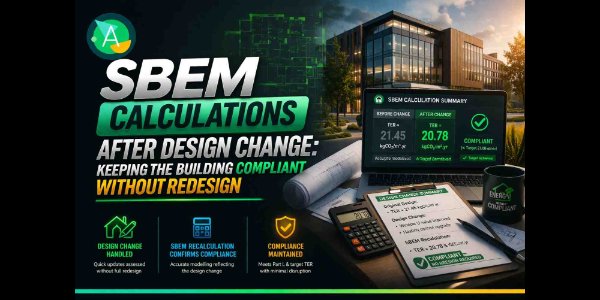
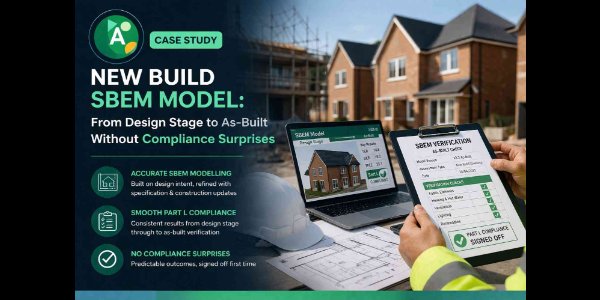
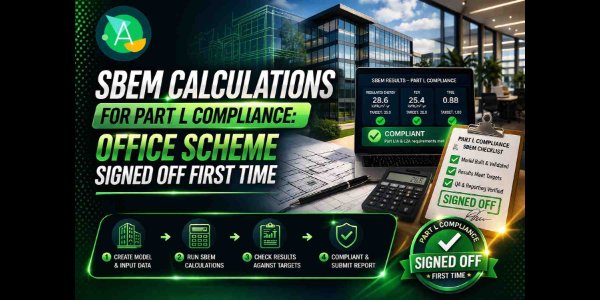
SBEM calculations are the Simplified Building Energy Model calculations used to assess the energy performance of buildings that are not dwellings. In practice, they are used to support Part L compliance, generate BRUKL reports, and feed the non-domestic EPC route where the approved methodology allows it. For most straightforward commercial projects, SBEM is the standard calculation engine behind non-domestic energy compliance.
SBEM stands for Simplified Building Energy Model. Official non-dwelling EPC guidance describes it as a computer program that analyses a building’s energy consumption, is designed for buildings that are not dwellings, and has been adopted by government as part of the UK methodology for non-domestic energy performance calculations.
SBEM calculations are mainly used to show that a non-domestic building meets the relevant Part L targets and to support the energy performance certificate process for buildings other than dwellings. In day-to-day project terms, they are used for design-stage compliance, as-built compliance, BRUKL reporting, and the energy assessment side of many new-build, extension, fit-out and conversion schemes.
Yes. SBEM is for non-domestic buildings, not for dwellings. Official guidance says the tool is designed to cover buildings that are not dwellings, while Approved Document L Volume 2 applies only to buildings other than dwellings. If the project is a house or flat, the domestic route is SAP, not SBEM.
No. SBEM is the calculation engine or approved modelling route, while BRUKL is the standardised Building Regulations UK Part L compliance report produced from the approved software. Approved Document L says SBEM will produce the BRUKL report as a standard output option. In simple terms, SBEM does the maths; BRUKL is the compliance report you hand over.
Not usually. Although the non-domestic EPC regime also uses approved NCM tools on sale or rent, when clients ask for SBEM calculations they usually mean the design and compliance calculation service for new build, extension, shell-and-core, fit-out or conversion work under Part L, rather than a routine EPC refresh for an already existing office, shop or industrial unit.
Yes. New offices, retail units, warehouses, industrial buildings and many other non-domestic schemes sit directly within the NCM / SBEM route. Approved Document L Volume 2 gives the compliance framework for new buildings other than dwellings, and the current methodology notices for England and Wales both recognise SBEM or an approved DSM as the approved implementation route.
Yes, sometimes. Approved Document L Volume 2 allows an approved calculation tool to be used as an alternative way of showing that the existing building plus proposed extension performs no worse than the existing building plus a notional extension. In Wales, very large extensions are expressly treated as new buildings if they are both over 100m² and over 25% of the existing building’s total useful floor area.
Yes. Approved Document L Volume 2 gives guidance for existing buildings, including material change of use and change to energy status, and Section 11 covers the work-to-fabric route for those scenarios. In practice, SBEM calculations are often part of the wider evidence package where a non-domestic building is being converted, reconfigured or materially altered under the Part L framework.
Yes, but only for the non-dwelling parts. Approved Document L Volume 2 says that in a mixed-use development, Volume 1 should be used for each individual dwelling, while Volume 2 should be used for the non-dwelling parts, such as heated common areas and commercial or retail space. In practical terms, mixed-use schemes often need both SAP and SBEM.
Yes. Shell-and-core developments are a classic SBEM use case. The non-dwelling EPC guide says that even where a building is newly constructed on a shell-and-core basis, an EPC can still be required, and the activity should be specified in line with the use class and the most energy intensive fit-out allowed under Part L. On the compliance side, Approved Document L also has dedicated shell-and-core provisions.
Yes. Approved Document L says that where an incoming occupier carries out first fit-out work in a shell-and-core development by providing or extending fixed services such as heating, hot water, air-conditioning or mechanical ventilation, a fresh target/building rate submission is required to demonstrate compliance for that part of the building. This is exactly why shell-and-core is rarely the end of the SBEM story.
Yes. Official non-dwelling EPC guidance explains that the assessment looks at different zones and activities such as retail space, office space, kitchens and storage, and Approved Document L also deals specifically with industrial sites, workshops and non-residential agricultural buildings. In practical terms, offices, shops, storage buildings and many industrial-type projects are standard SBEM territory.
SBEM can still be relevant, but the approach changes. Approved Document L says that for non-exempt buildings with low energy demand, the target and building rates should still be calculated, but the relevant zones are modelled as unconditioned. It also says a separately heated office in an otherwise unheated warehouse should be treated as a separate building or zone and follow the normal compliance procedures.
The National Calculation Methodology (NCM) is the approved framework for calculating the energy performance of buildings other than dwellings. In England, the current approved methodology for all buildings other than dwellings is the NCM in England, 2026 version. In Wales, the current approved methodology is the NCM in Wales, 2022 version. SBEM and approved DSMs are implementations of that methodology.
SBEM is the standard simplified modelling route for many non-domestic buildings, while a DSM is a more detailed Dynamic Simulation Model. Official guidance says DSMs may be used where SBEM is not sophisticated enough to provide an accurate assessment. In practice, straightforward buildings often suit SBEM, while more complex buildings or servicing arrangements may justify DSM instead.
You generally move toward DSM where SBEM is not sophisticated enough to provide a reliable assessment. Official guidance says that in certain situations the simplified building energy model may not be accurate enough, and approved DSMs may then be used. This usually points toward more technically complex non-domestic buildings rather than simple single-use units.
A notional building is the theoretical reference building used to set the performance targets for the real scheme. Approved Document L says the notional building is the same size and shape as the actual building but has standardised properties for fabric and services. In simple terms, SBEM compares the real design against that benchmark to decide whether it complies.
TPER is the Target Primary Energy Rate, and TER is the Target Emission Rate. Approved Document L says the energy performance of the notional building is described using these metrics, with TPER expressed in kWhPE/m² per year and TER in kgCO₂/m² per year. These are the targets the actual building has to meet or beat.
BPER is the Building Primary Energy Rate, and BER is the Building Emission Rate for the actual building. These are the calculated results for the design as proposed or as built. In practical terms, they are the real-building numbers that get compared against TPER and TER to show compliance.
No. Approved Document L says the specification of the actual building may vary from that of the notional building, provided the actual building still meets the target primary energy rate, target emission rate, and the rest of the relevant Part L guidance. That is why compliance is about performance, not cloning the notional recipe detail for detail.
Yes. Approved Document L says the building primary energy rate and building emission rate must not exceed the target primary energy rate and target emission rate respectively. This applies at both the design stage and the as-built stage. If either side drifts the wrong way, the building is not where it needs to be for Part L compliance.
A BRUKL report is the Building Regulations UK Part L compliance report produced from the approved software for a non-domestic building. Approved Document L says it should be provided to the Building Control body and to the building owner to show that the work complies with the energy-efficiency requirements. In practical terms, it is the core Part L reporting output behind commercial compliance.
The design-stage BRUKL records the target/building rates and specification list before works begin. The as-built BRUKL records the final target/building rates and the final specification once the building is complete. Approved Document L requires two versions of the BRUKL report, precisely so the final building can be checked against the original design intent.
It should be done before works begin. Approved Document L says the Building Control body must be notified before work starts of the target and building rates calculated using design values, and that these items may be reported through the design-stage BRUKL report. On live projects, leaving SBEM until site has already fixed the envelope and services is asking for delay.
It should be finalised when the work is complete, using the building as constructed and incorporating any changes made during construction plus the measured air permeability where required. Approved Document L says the Building Control body must then be notified of the as-built target/building rates. This is the stage that shows whether the finished building still complies.
You need enough information to define the building’s zones, dimensions, activities, services, lighting and fabric. The official non-dwelling EPC guide says the assessor will need the internal layout, the designed use of each space, the heating and ventilation services, the lighting and controls, and the fabric performance of the roof, floors, walls and glazing. Better inputs always mean cleaner SBEM outputs.
Usually both at different stages. For design-stage compliance, the work is heavily drawings-and-specification led. The non-dwelling EPC guide says dimensions and building data may be provided from plans, but if plans are not available the assessor must survey the building and gather the information directly. In practice, design-stage SBEM leans on drawings; final as-built work depends on what was actually installed.
Because SBEM does not treat every space in a building the same. The official guide says the assessor has to identify the different zones of the building and understand the designed use of each one, with activities such as retail, office, kitchens or storage affecting the energy demands of that zone. Bad zoning usually means bad modelling.
No. In mixed-use buildings, the dwellings sit under Approved Document L Volume 1 and the domestic SAP route, while the non-dwelling parts such as heated common areas and commercial or retail space sit under Approved Document L Volume 2 and the non-domestic modelling route. In simple terms, flats use SAP; shops and heated cores use SBEM/DSM.
Heated common areas are treated as non-dwelling parts and therefore sit under Approved Document L Volume 2. The English guidance says that if the common areas in a building containing multiple dwellings are heated, the Volume 2 route should be followed. This is why cores, lobbies and similar heated shared spaces often need to be considered in the non-domestic modelling strategy.
Sometimes a representative unit can be used. The official non-dwelling EPC guide says an EPC for a single unit within a building may be based on an assessment of a similar representative unit in the same block. In practice, that works best where the units really are alike in geometry, use and servicing. If the units vary, the shortcut quickly becomes unsafe.
They have to be modelled in line with how the building is actually served. The official guide says that where units have common heating systems or conditioned communal areas, it can be permissible either to provide EPCs for individual parts plus the conditioned communal areas, or one EPC for the whole building, depending on the arrangement. On SBEM jobs, this is a scoping issue you want settled early.
No. SBEM is the calculation engine; the commercial EPC is the certificate output. The official non-dwelling EPC guide says the EPC shows the energy-efficiency rating and recommendations, while separate methodology notices say the underlying energy performance for buildings that are not dwellings is calculated using an approved implementation of the NCM, i.e. SBEM or an approved DSM.
Yes. The methodology notice says that for non-dwellings, where an EPC is required on sale, rent or construction, the energy performance must be calculated using an approved implementation of the NCM, i.e. SBEM or an approved DSM. In practical terms, the SBEM model often becomes the technical backbone of the commercial EPC output.
Yes. The official non-dwelling EPC guide says that where a building is sold or let without fixed services but there is an intention that they will be installed, the EPC should be based on the most energy intensive fit-out adopted in line with Part L. That is why shell-and-core EPCs can feel conservative: they are not based on wishful thinking.
Yes. Approved Document L says that if first fit-out work in a shell-and-core development provides or extends fixed services, a fresh target/building rate submission should be made for the fitted-out part, and it also notes that a new EPC is required for that part of the physical building. This is a major commercial point on landlord-shell and tenant-fit-out schemes.
Yes. Approved Document L says the as-built calculation of the building primary energy rate and building emission rate must incorporate the measured air permeability. It also says the final building rates calculated using the measured air permeability must not be higher than the target rates. That is why SBEM, BRUKL and airtightness testing are tightly linked.
No, but most new non-domestic buildings do. Approved Document L says buildings should generally be pressure tested except for specific routes such as buildings under 500m² using a default air-permeability value, some factory-made modular routes, certain large complex building strategies and representative-area testing for compartmentalised buildings. The safe assumption on a new commercial job is that an air test is likely unless an approved alternative route clearly applies.
Where pressure testing is genuinely impractical because of size or complexity, Approved Document L allows the developer to submit a detailed justification and a detailed strategy showing how a continuous air barrier will be achieved. If the Building Control body accepts that strategy, it may be used in place of a full pressure test. On these buildings, early coordination matters far more than last-minute testing.
Yes. Approved Document L Volume 2 explicitly allows an approved calculation tool to be used as an alternative extension route, demonstrating that the existing building plus proposed extension is no worse than the existing building plus a notional extension. This is especially useful where the straightforward opening-area or elemental route is too restrictive for the design.
Yes. Approved Document L says that when a building undergoes a major renovation, the technical, environmental and economic feasibility of using high-efficiency alternative systems should be considered. That does not automatically mean those systems must be installed, but it does mean the energy strategy for major renovation work should not ignore them.
Yes. The official non-dwelling EPC guide says the energy performance of non-dwellings depends on the energy used for space heating, water heating, ventilation and lighting, less any energy generated from on-site technologies, and it also lists heating, ventilation and lighting among the key inputs the assessor needs for each zone. In practical terms, SBEM is a full fixed-services building model, not just a fabric check.
For formal non-dwelling EPC production, the work must be done by an accredited energy assessor qualified for the building type. For SBEM-based compliance work, the same kind of non-domestic energy specialist is normally used because the modelling has to run through approved software and support BRUKL and EPC outputs. On real projects, the safest route is a competent non-domestic energy assessor or building-compliance consultant.
In England, the owner should receive the as-built BRUKL report and the building log book information, including the inputs used in the target and building calculations and the recommendations report generated with the on-construction EPC. Wales follows the same broad logic, with the as-constructed BRUKL report and building log-book information handed over to the owner.
They usually fail because the final building no longer matches the assumptions used in the earlier model. The common causes are poorer-than-assumed airtightness, late changes to glazing, insulation or plant, and specification drift that was not fed back into the calculation early enough. Approved Document L is built around the as-built check precisely to catch that kind of site drift before completion sign-off.
Yes. Because the as-built BRUKL report has to capture the final specification list and highlight changes from design stage, one late substitution to glazing, fabric, HVAC, controls or lighting can be enough to move the final building rate the wrong way. That is why “minor” substitutions on site are often not minor from a compliance point of view.
Turnaround is usually driven by information quality and complexity, not by the software itself. The assessor needs accurate information on zones, activities, services, lighting, controls and fabric, and the more mixed-use, phased or shell-and-core the building is, the more coordination is needed. In practice, incomplete drawings and late revisions are what usually slow SBEM work down.
Cost is mainly shaped by scope and complexity. A simple single-use unit with straightforward zoning is very different from a mixed-use development, shell-and-core scheme, large extension or phased fit-out project. The more zones, activities, services, revisions and reporting stages involved, the more time the consultant has to spend building and checking the model.
Get the assessor involved early, complete the design-stage BRUKL before works begin, lock the building use and zoning assumptions down early, and keep a live record of every specification change during the build. Approved Document L is built around a design-stage and as-built process for exactly this reason. The projects that pass smoothly are the ones that treat SBEM as a live compliance tool, not a last-week certificate request.
Videos for SBEM calculations
Explore our videos for quick, engaging insights on building compliance. From step-by-step guides to expert advice, our video library simplifies complex topics, making it easier for you to take action and stay informed. Perfect for when you need clarity in minutes!