
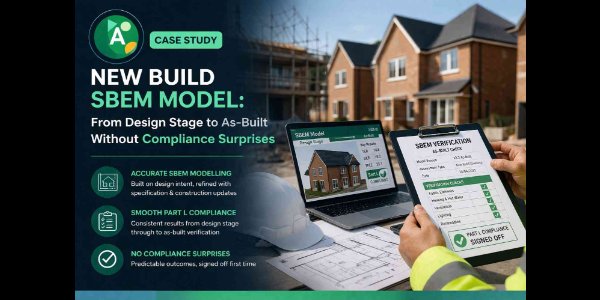
The Result
A new build commercial project moved from design stage to as built without the usual Part L compliance panic because the SBEM model was treated as a live control tool rather than a one‑off calculation.
ATSPACE maintained the model throughout design development, tracked specification changes, and issued final as‑built outputs with a clear evidence trail ready for sign‑off and handover.
Project Snapshot
Service: SBEM calculations
Client: Principal contractor + developer
Site: Northgate Business Campus, Building C, 9 Sterling Way, Milton Keynes MK9 3FF
Building type: New build commercial building (office + flexible workspace)
Floor area: Approx. 10,600 m²
Fabric: High‑performance envelope with solar‑control glazing + upgraded roof insulation
Services: Mixed‑mode HVAC, mechanical ventilation, zone controls
Programme stage: Concept → Practical completion
Compliance driver: Building Regulations Part L (non‑domestic)
ATSPACE delivery: Design‑stage SBEM, iterative updates, change tracking, as‑built confirmation, final BRUKL outputs
Team: ATSPACE building performance engineer + compliance coordinator
Why the Client Wanted Change‑Controlled Modelling
The contractor had two goals:
- protect programme
- avoid redesign late in the project
They had previously experienced the “classic SBEM problem”:
The building is built, commissioning is underway, and then a compliance issue appears because the final installed strategy no longer matches the last compliant model.
This leads to:
- rework under time pressure
- conflict between subcontractors
- last‑minute changes to controls + zoning
- delayed sign‑off
This time, the client wanted the SBEM model to stay aligned all the way through.
How ATSPACE Managed the SBEM Model from Start to Finish
Step 1: Define compliance‑critical assumptions early
We clarified the high‑impact items upfront:
- lighting + controls
- HVAC efficiencies + zoning
- ventilation rates + heat‑recovery intent
- façade performance + solar‑control approach
- metering + BMS strategy
- occupancy schedules suitable for office use
This created a stable baseline and reduced conflict later.
Step 2: Create a change log linked to procurement
Every major change was logged, assessed and applied where needed.
Common changes included:
- AHU substitution due to lead times
- lighting product changes
- revised glazing on one elevation
- zoning strategy clarified during coordination
The goal wasn’t to block change — but to ensure change didn’t quietly break compliance.
Step 3: Quick impact checks to avoid unnecessary re‑modelling
Not every change required a full rebuild of the model.
ATSPACE used rapid compliance‑impact checks to decide when a full update was needed.
This saved time and kept focus on the items that matter.
Step 4: Align the as‑built model with commissioning reality
Near completion, we confirmed:
- plant efficiencies matched what was installed
- control strategy aligned with actual commissioning
- zoning reflected the installed system, not early drawings
- metering + BMS scope properly recorded
- lighting controls installed as described
This prevented end‑stage surprises.
Practical Problems Faced — and How ATSPACE Solved Them
Problem 1: Plant selection changed during procurement
Risk: Different efficiencies could weaken compliance.
Fix: Verified efficiencies + controls of substituted plant → updated model → compliance maintained.
Problem 2: Lighting controls inconsistent across documents
Risk: Optimistic modelling vs minimal installation = compliance drift.
Fix: Reconciled control intent across disciplines → aligned model → ensured installation matched description.
Problem 3: Final zoning decisions made late
Risk: SBEM is highly sensitive to zoning + schedules.
Fix: Updated zoning + schedules during coordination → ensured as‑built model reflected real building operation.
Outcome
The project reached practical completion without SBEM‑driven delays or redesign.
Project outcomes:
- compliance position remained stable
- final as‑built outputs delivered on time
- reduced Building Control queries
- clear evidence trail supporting handover
Common Mistakes This Project Avoided
- running SBEM only at design stage and ignoring delivery
- allowing substitutions with no compliance impact check
- inconsistent drawings causing untraceable assumptions
- optimistic control assumptions not matched on site
- leaving zoning + ventilation definitions too late
CTA
If you want to avoid compliance surprises at the end of a commercial project, ATSPACE can manage SBEM from design stage to as‑built, track changes, and protect the Part L position all the way to handover.
Ask for:
- SBEM modelling + compliance management
- procurement‑stage change‑impact checks
- as‑built SBEM updates + evidence‑pack support
- final BRUKL outputs aligned with practical completion
Frequently Asked Questions
Why do projects get SBEM surprises at the end?
Because the model stays as‑designed while the building becomes as‑built — and no one tracks the gap.
Do you need to update SBEM for every change?
Not always — only when changes affect compliance. The key is having a quick‑impact process.
What evidence is required for as‑built SBEM?
Plant schedules, lighting + controls, ventilation strategy, metering/BMS narratives, glazing and fabric confirmation, and a clear substitution log.
