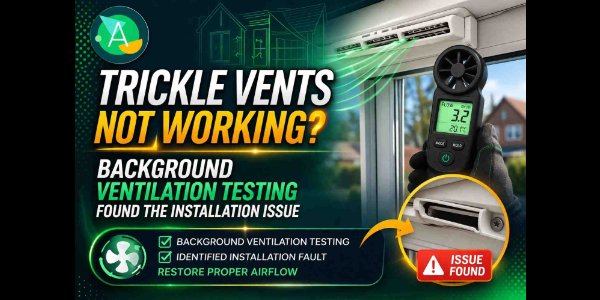
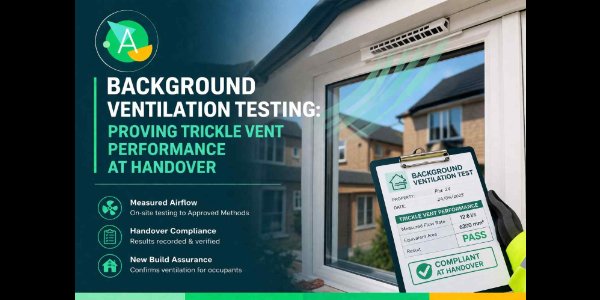
Background ventilation testing is a service used to assess whether a dwelling has enough background air provision for healthy ventilation, usually without relying only on assumptions or product brochures. In new-build and replacement-window work, that often means verifying the correct equivalent area and installation of background ventilators. In retrofit, it more often means the IAA / TrustMark-approved dwelling assessment used to judge whether existing infiltration is sufficient or whether extra background ventilators are needed after energy efficiency works.
Not exactly. Trickle vent testing usually sounds like checking whether the window vents are present, sized correctly and installed properly, while background ventilation testing is broader. Part F allows background ventilation through trickle ventilators or other appropriate ventilators sized by equivalent area, and the retrofit-style background ventilation assessment looks at the dwelling’s overall background ventilation performance, not just one vent in isolation.
Background ventilation testing is about the passive provision of outdoor air into the dwelling, while ventilation flow rate testing is about the measured airflow of mechanical fans and systems. Part F requires mechanical airflow measurement for intermittent extract, MEV and MVHR systems, but background ventilators are sized by equivalent area and verified differently. In simple terms, one checks the passive air-in route; the other checks the powered air-movement route.
It is related, but it is not the same thing. Standard Part L airtightness testing is an energy-compliance pressure test typically reported as air permeability at 50Pa, while the IAA / TrustMark background ventilation assessment for existing dwellings uses dwelling-level air-change evidence at 4Pa to help decide whether background ventilator upgrades are needed. The equipment can overlap, but the purpose, thresholds and reporting logic are different.
Background ventilation matters because it provides the low-level fresh air that helps dilute indoor pollutants and moisture between purge events and fan boost periods. Approved Document F is clear that inadequate ventilation can contribute to mould and indoor air pollution, and it sets background-ventilation standards as part of the route to meeting requirement F1. On real projects, this is not just a comfort issue; it is a health, condensation and compliance issue.
Not as a single universal standalone test in the way Part F fan flow-rate testing is for mechanical systems. What the regulations require is adequate ventilation, and Part F gives sizing, inspection and replacement-window guidance for background ventilators. The IAA / TrustMark background ventilation assessment is an optional recognised process used mainly on existing dwellings and retrofit jobs where the team wants evidence that extra background vents are or are not needed.
It is most useful before or after energy-efficiency works on an existing dwelling, after window replacement, or where a retrofit team wants evidence instead of defaulting straight to more trickle vents. It is also useful on awkward projects where existing ventilation is unclear or where condensation risk, resident complaints or PAS 2035 evidence are driving the brief. The main value is that it can influence the strategy before the wrong solution gets locked in.
Yes, that is where the service is most commonly used. Approved Document F already provides standard equivalent-area guidance for new dwellings, but the IAA / TrustMark background ventilation assessment is specifically framed around existing dwellings and is recognised in retrofit design guidance for determining whether background ventilation upgrades are required. That is why the strongest search intent is usually retrofit, window replacement and existing-home upgrades rather than standard new build.
Yes. TrustMark describes the IAA process as a TrustMark-approved approach to measure and address background ventilation requirements under PAS 2035 pathways, and TrustMark’s 2023 retrofit design guidance recognises the IAA background ventilation assessment as a route for deciding whether background ventilation upgrades are needed. In practical terms, it gives Retrofit Coordinators and Designers evidence instead of guesswork.
Yes, it can. Elmhurst’s published guidance says background ventilation testing is usually used for PAS 2035 retrofit work but can also be used for conversion or extension work, and Approved Document F also contains specific existing-dwelling guidance for replacing windows, adding habitable rooms and adding wet rooms. That makes it a useful service wherever the existing dwelling ventilation picture is changing and needs evidencing.
Background ventilation is the purpose-provided low-level ventilation that supplies outdoor air to the dwelling between purge opening and extract events. In current Part F guidance for dwellings, it normally means trickle ventilators or wall ventilators sized by equivalent area, working alongside purge ventilation and extract ventilation. It is one part of the overall ventilation strategy, not the whole strategy on its own.
A background ventilator is a purpose-provided ventilator intended to give low-level continuous air supply, typically a trickle ventilator in a window or a wall ventilator. England’s official Part F FAQ is explicit that a wall-mounted background ventilator can be an acceptable route to compliance if it provides the required equivalent area. What matters is the performance and location, not whether the vent sits in the frame or the wall.
Equivalent area is the Part F measure used to describe the aerodynamic performance of a background ventilator. It is not just the hole size; it is the area of a sharp-edged circular orifice that would pass the same volume of air under the same pressure difference as the ventilator being assessed. In Approved Document F, background ventilators are sized in mm² equivalent area, not free area.
No. Approved Document F says background ventilators are expressed by equivalent area, not free area, and that distinction matters. Free area is a simple geometric opening measure; equivalent area is a performance-based airflow measure. On site, mixing the two up is one of the easiest ways to under-size vents and still think the job is compliant.
Because Building Control and installers need to be able to verify what has actually been fitted. Approved Document F in both England and Wales says background ventilators should have the equivalent area marked where it is easy to see from inside the dwelling when installed. In practical terms, visible marking is what stops site teams having to guess whether the vent in front of them is the right one.
Yes. England’s official Part F FAQ says ventilation can be provided through any appropriate means, and a wall-mounted background ventilator that provides the required equivalent area can be an acceptable route to compliance. That is useful where frame vents are undesirable, impractical, or acoustically awkward, provided the wall vent is properly sized and positioned.
Not necessarily. England’s official Part F FAQ says that when replacing a window in a room where there is already a wall ventilator that meets the minimum equivalent area in Approved Document F, no further background ventilation needs to be added after the window replacement. The key is whether the existing wall ventilator genuinely meets the required equivalent-area standard.
No. England’s official Part F FAQ says a window locked slightly ajar on the night-latch is not an appropriate background ventilation solution. The reason is straightforward: it is not considered a sufficiently secure means of background ventilation. This is a common misunderstanding on window jobs, and it is not a compliant substitute for a real background ventilator.
No, not automatically. England’s official Part F FAQ says permanently open air vents serving an open-flued appliance are there to satisfy Part J combustion-air requirements and should not be counted as existing Part F background ventilation. In practical terms, a combustion air vent is not a free pass to skip proper background ventilation provision.
Yes, noise-attenuating background ventilators can be used where façade noise is an issue. England’s official Part F FAQ also says ventilation intakes should be located to minimise the intake of external pollutants, including placing trickle ventilators on the less polluted side of the building where possible. So background ventilation still has to work for health and comfort, not just satisfy a size table.
It assesses the requirement for background ventilation only in an existing dwelling. TrustMark’s retrofit design guidance says the IAA has developed a TrustMark-approved process for assessing whether additional background ventilation is required, and that where the route is used the process in the IAA guidance must be followed. It is a targeted ventilation-evidence tool, not a full substitute for the whole dwelling ventilation strategy.
Yes, in the IAA method it does. Elmhurst says the method requires whole-house and bedroom tests, and TrustMark’s retrofit design guidance specifically refers to the whole-house threshold plus bedroom tests in bedrooms without ventilators and/or with mould or condensation concerns. That is why the service is more than a quick visual check of trickle vents.
TrustMark’s retrofit design guidance says that, to demonstrate there is sufficient air infiltration so that background ventilation upgrades are not warranted, the IAA route requires a whole-house result of at least 1.0 ACH @ 4Pa and bedroom results of at least 1.5 ACH @ 4Pa where the bedroom test is required. These are the key benchmark numbers behind the service.
Because the IAA / TrustMark background ventilation assessment is a low-pressure existing-dwelling ventilation method, not a standard Part L compliance test. TrustMark’s guidance frames the result as air changes per hour at 4Pa, and Approved Document L separately shows that airtightness metrics can be expressed at different pressure differentials, including 50Pa or 4Pa, depending on purpose. The important point is not to mix the 4Pa background-ventilation thresholds up with 50Pa energy-compliance results.
Yes, if you are relying on the TrustMark-recognised IAA route in retrofit. TrustMark’s PAS 2035 retrofit design guidance says the testing must be undertaken both pre and post EEM installation and that the evidence must include the fully completed results from both stages. In commercial terms, that is what turns the service into proof rather than a one-off opinion.
Because the method is trying to avoid missed risk in the rooms where people sleep and where local ventilation provision may be weakest. TrustMark’s design guidance says bedroom tests are required where there are no ventilators and/or mould or condensation issues are present. That makes the service more targeted than a blunt whole-house number alone.
If the result is below the threshold, you should not treat the dwelling as having demonstrated enough air infiltration to waive background ventilator upgrades under the IAA / TrustMark route. At that point, the ventilation strategy normally needs more provision, such as properly sized background ventilators or a different system approach, so the dwelling is no worse than before and still achieves adequate ventilation after the works.
Yes, that is one of its main commercial benefits. Elmhurst says background ventilation testing helps avoid unnecessary installation of background ventilators, and TrustMark’s retrofit design guidance gives a model wording for the ventilation strategy stating that successful testing demonstrates there is sufficient air infiltration so that background ventilation upgrades are not warranted. That is exactly why the service is attractive on retrofit jobs where extra vents are unwanted.
Because the IAA method is checking the dwelling’s worst-case background ventilation condition rather than measuring the performance of opened ventilators. Elmhurst says the property is prepared by closing trickle vents and turning off or closing other vents or ventilation systems, but not sealing them, which gives an indication of the building’s worst-case background ventilation. This is one of the clearest differences from a standard fan-flow or everyday-use check.
Yes. Elmhurst says the background ventilation test can be carried out using either Pulse or blower door equipment. That is why the service often sits close to airtightness testing in the market: the equipment family overlaps, even though the purpose and the reporting thresholds are different.
Yes, sometimes. Elmhurst says the method lends itself well to Pulse equipment because it allows testing of bedroom door undercuts in bedroom tests, whereas a blower door would need to be installed in the doorway. On occupied retrofit jobs, that practical difference can make the survey easier to stage and less disruptive.
Not usually. Background ventilation testing and Part L air pressure testing are different services with different objectives and thresholds. That said, where a blower door is used, the visit may overlap technically with airtightness work, and TrustMark’s guidance notes that if you also want to report air permeability results, the dwelling envelope area will need to be measured in addition to the building volume.
The dwelling needs to be accessible, the vents and other ventilation openings need to be in a condition that can be set up correctly for the method, and any other ventilation systems need to be capable of being turned off or closed as required. Elmhurst’s published process notes specifically mention closing trickle vents and closing or turning off other ventilation systems, but not sealing them, before the test starts.
Yes. The service is aimed at existing properties, and Elmhurst’s own training material describes it as assessing air change rate in existing properties for retrofit and PAS 2035 purposes. In practical terms, that means occupied homes are a normal use case, provided access and setup can be controlled properly for the test.
Use a competent tester who understands both airtightness equipment and dwelling ventilation strategy. For the TrustMark-recognised PAS 2035 route, the published guidance expects the process to be followed by a competent person working through the recognised scheme route. On real projects, the right tester is not just someone with a fan, but someone who can explain what the result means for the ventilation upgrade decision.
For the TrustMark-recognised PAS 2035 route, yes, the competency route matters. TrustMark’s retrofit design guidance says testing must be undertaken by a competent person registered with Elmhurst or ATTMA, and TrustMark’s approved-process article also says individuals using the process must be certified by the Elmhurst Air Tightness Scheme. The safest commercial assumption is that background ventilation testing for PAS 2035 should be carried out through the recognised competent-person framework, not informally.
There is no single fixed duration because it depends on the size and complexity of the dwelling and on whether bedroom tests are also required. Elmhurst says quotations vary by building size, complexity and number of tests on the same site, which reflects the real-world pattern: a straightforward house is quicker than a larger dwelling with multiple bedroom checks and awkward access.
Cost is mainly driven by property size, complexity, the number of tests, and whether the job involves a simple one-off check or a PAS 2035-style pre- and post-installation evidence package. Elmhurst is clear that pricing varies from test to test and depends on building complexity and the number of tests carried out on the same site. On portfolio work, scale can change the economics noticeably.
For the TrustMark / PAS 2035 route, the expectation is a completed evidence pack rather than a vague note. TrustMark’s retrofit design guidance says copies of the fully completed pre- and post-installation results must be submitted, together with the evidence listed in the guidance documentation, and it also gives the wording that can be used in the ventilation strategy where the thresholds have been met.
No. It is a tool for the background ventilation part of the problem, not the whole ventilation design. TrustMark’s retrofit design guidance explicitly says the IAA process is for assessing the requirement for background ventilation only, while Approved Document F still requires a complete strategy covering extract ventilation, purge ventilation and, where relevant, mechanical systems. A good result here does not remove the need to get the rest of Part F right.
No. Mechanical extract and MVHR systems still need the proper airflow measurement and commissioning required by Part F. Background ventilation testing is about passive background provision and existing infiltration; it does not replace the measured fan-flow route for intermittent extract, MEV or MVHR systems. In practice, the two services often complement each other rather than compete.
Yes. Under the current dwelling guidance, natural ventilation with intermittent extract fans — the industry’s old System 1 shorthand — relies on background ventilators plus intermittent extract. The minimum equivalent areas for natural ventilation are set out in Table 1.7 of Approved Document F, so background ventilator sizing is still a core compliance issue on these homes.
Yes. Continuous mechanical extract ventilation — the old System 3 shorthand — still needs background ventilators in habitable rooms. Approved Document F says these ventilators should not be in wet rooms, should provide at least 4,000 mm² equivalent area for each habitable room, and the total number should be the number of bedrooms plus two. So MEV is not a no-trickle-vent system.
No. Approved Document F says background ventilators should not be installed with mechanical ventilation with heat recovery, because they create unintended air pathways. On existing dwellings moving to MVHR, the guidance also says existing background ventilators should be covered or sealed shut. That is one of the clearest differences between MEV and MVHR from a background-ventilation point of view.
Yes, storey count matters for natural ventilation. For current new-dwelling natural-ventilation guidance, habitable rooms and kitchens need 8,000 mm² equivalent area in multi-storey dwellings and 10,000 mm² in single-storey dwellings; bathrooms need 4,000 mm² in both. Approved Document F also says the total number of ventilators in habitable rooms and kitchens should be at least four in one-bedroom dwellings and five in dwellings with more than one bedroom.
For replacement windows in existing dwellings, current English guidance says you can demonstrate the ventilation is no worse than before by incorporating background ventilators of at least 8,000 mm² in habitable rooms, 8,000 mm² in kitchens and 4,000 mm² in bathrooms. If the dwelling will have continuous mechanical extract ventilation, the alternative route is 4,000 mm² in each habitable room, not in wet rooms. If full sizes are not technically feasible, the guidance says the equivalent area should be as close to the minimum as feasible.
No. England’s official Part F FAQ says a homeowner disclaimer is not a suitable way of complying with the Building Regulations, and neither is an indemnity policy. The work still has to comply in full, including the requirement that ventilation is not made less satisfactory by the work. This is particularly relevant on replacement-window jobs where installers are under pressure to “leave the vents out.”
Yes. Approved Document F says internal doors should allow air to flow through the dwelling by providing a minimum free area equivalent to a 10 mm undercut in a standard 760 mm door. That matters because background ventilation is about airflow through the whole dwelling, not just at the vent itself. Elmhurst also notes that Pulse can help assess bedroom-door-undercut issues during bedroom tests.
Yes, and that is one of the strongest reasons clients book it. Elmhurst says the service helps avoid unnecessary installation of background ventilators, and TrustMark’s retrofit design guidance explicitly recognises the route where successful testing demonstrates enough air infiltration so that background ventilator upgrades are not warranted. On retrofit projects, that can avoid needless disruption, extra cost and resident objections to more vents.
Use it early, and use it as evidence for the ventilation strategy rather than as a late argument after works are finished. The strongest route is to assess the existing dwelling before energy-efficiency measures, use the result to decide whether background ventilator upgrades are genuinely needed, and then repeat the required evidence after installation if you are relying on the TrustMark / IAA route. That keeps the retrofit ventilation strategy evidence-led instead of assumption-led.

Videos for background ventilation testing
Explore our videos for quick, engaging insights on building compliance. From step-by-step guides to expert advice, our video library simplifies complex topics, making it easier for you to take action and stay informed. Perfect for when you need clarity in minutes!