
The result
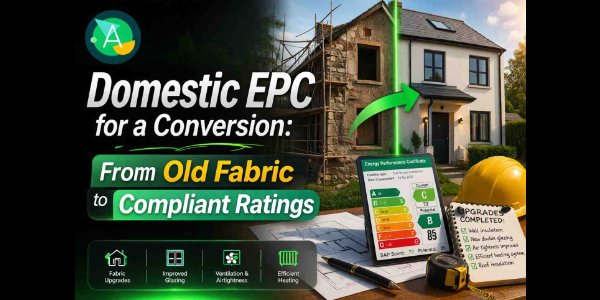
A conversion project needed domestic EPCs that accurately reflected upgraded fabric and services, without being unfairly penalised by assumptions typically applied to older buildings.
ATSPACE assessed the as‑built upgrades, captured the correct evidence, and produced EPCs that reflected real performance — giving the developer compliance confidence and a smooth route to completion.
Project snapshot
Service: Domestic EPC assessment for conversion
Client: Developer and principal contractor
Site address: Foundry House Conversion, 3 Ironworks Lane, Sheffield S3 8QJ
Building type: Conversion into 14 self‑contained dwellings
Existing fabric: Mixed masonry construction with retained elements
Upgrade works: Insulation upgrades, new windows, modern heating and controls, improved ventilation
Programme stage: Practical completion and handover preparation
ATSPACE delivery: As‑built review, evidence capture, SAP‑based EPCs, plot‑level certificates, handover summary
Team: ATSPACE energy assessor team + compliance coordinator
Why conversions are harder than new builds for EPCs
Conversions fail more often due to paperwork and assumptions, not the actual build quality. Challenges include:
- non‑standard existing fabric that doesn’t fit SAP defaults
- retained elements affecting thermal performance
- mid‑build changes due to hidden conditions
- limited space for insulation/services creating design compromises
- the need to prove what was actually installed
The developer wanted EPCs that reflected the investment in upgrades, not conservative assumptions that make conversions appear underperforming.
What ATSPACE was asked to do
- produce domestic EPCs for all converted dwellings
- ensure upgraded fabric and services were captured correctly
- gather as‑built evidence suitable for audit and handover
- prevent completion delays caused by missing information
- provide a summary suitable for marketing and sales packs
What ATSPACE did
Step 1: Evidence first, not assumptions
We gathered only evidence that actually moves EPC results:
- confirmed wall, roof and floor build‑ups
- verified window and door specifications
- confirmed heating system type, emitters and controls
- confirmed hot water system and controls
- confirmed ventilation strategy + commissioning evidence
- recorded constraints created by retained elements
This avoided conservative assumptions that drag down ratings.
Step 2: Plot‑by‑plot approach, not blanket modelling
Conversions vary by unit. Corner flats, roof units and dwellings beside retained fabric behave differently.
We assessed each plot individually to avoid inaccurate “one‑size‑fits‑all” modelling.
Step 3: Close coordination during final changes
Conversion projects evolve late into delivery.
ATSPACE worked closely with site teams so late‑stage service or product changes were captured before the EPC deadline.
Step 4: EPCs issued in line with completion
Certificates were delivered according to the developer’s completion and marketing programme, avoiding delays to sales progression.
The main issues we resolved
Issue 1: Unclear wall build‑ups in retained areas
Older structures had mixed or undocumented build‑ups.
Fix: Used contractor evidence + on‑site checks to confirm what was upgraded vs retained.
Issue 2: Services routed differently in each dwelling
Layouts varied due to constraints.
Fix: Verified every dwelling’s actual system and controls — no assumptions.
Issue 3: Ventilation strategy unclear
Ventilation approaches often change in conversions.
Fix: Confirmed installed strategy + ensured EPC inputs reflected the real solution.
Outcome
The developer received EPCs that properly reflected the upgrade works and supported completion.
Project outcomes
- EPCs issued for all dwellings with no programme drift
- confidence that ratings reflected as‑built performance
- clean, reliable evidence pack for compliance and handover
- fewer last‑minute queries
- smoother progression through completion and marketing
Common mistakes this project avoided
- using conservative defaults when upgrade evidence existed
- modelling all dwellings identically despite conversion variation
- waiting until finishes were complete to gather evidence
- missing late service changes affecting EPC inputs
- delaying completion because EPCs weren’t aligned to programme
CTA
If you are converting an existing building into dwellings and need EPCs that reflect real upgrades, ATSPACE will capture the correct evidence, model as‑built reality properly, and deliver certificates without last‑minute delays.
Ask for
- domestic EPC assessment for conversions
- as‑built evidence‑capture support
- plot‑level EPCs aligned to completion and marketing
- guidance on what information is needed and when
Frequently asked questions
Why do conversion EPCs sometimes come out lower than expected?
Because they use assumptions about old fabric if evidence is missing. Proper evidence ensures upgraded performance is recognised.
Do conversion dwellings need different EPC inputs?
Often yes. Location, retained fabric and service constraints change assumptions plot by plot.
Can EPCs delay completion?
Yes — if evidence is missing or changes aren’t captured early. A structured EPC workflow prevents this.
