
The result
A new residential apartment block had MVHR systems installed throughout, but early signs showed future customer‑care risk: noisy valves, inconsistent airflow and rooms that did not feel properly ventilated.
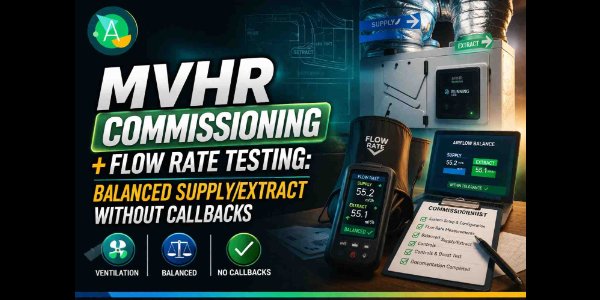
ATSPACE carried out MVHR commissioning support and full ventilation flow rate testing. We balanced supply and extract correctly, set accurate room‑by‑room flows, resolved the causes of noise and under‑performance, and locked in settings to prevent them being altered during snagging.
The scheme met Part F requirements and significantly reduced the risk of post‑handover ventilation issues.
Project snapshot
Service: MVHR commissioning support + ventilation flow rate testing
Client: Developer + principal contractor
Site: Brookline Apartments, 4–28 Station Yard, Oxford OX4 2JT
Building type: Low‑rise apartments, 32 dwellings
Ventilation strategy: MVHR throughout
Programme stage: Commissioning + pre‑completion snagging
Compliance driver: Approved Document F + handover quality assurance
ATSPACE delivery: MVHR flow measurement, balancing, room‑rate verification, commissioning checks, reporting
Team: ATSPACE accredited ventilation test engineer + compliance coordinator
Why MVHR causes callbacks when not balanced properly
MVHR works extremely well when installed and commissioned correctly.
When it isn’t, the problems appear fast — and post‑handover fixes are expensive.
Common MVHR issues include:
- supply and extract out of balance
- incorrect valve inserts or swapped terminals
- unit left on default settings
- faulty or mis‑wired boost controls
- blocked or dusty filters
- high resistance from altered duct runs
- poor transfer paths causing stale rooms
- occupants turning units down because of noise
On this project, the equipment itself was fine. The issue was commissioning quality and consistency.
What ATSPACE was asked to do
- confirm the MVHR systems delivered required airflow rates
- balance supply and extract dwelling by dwelling
- fix room‑rate issues without invasive rework
- reduce valve noise from over‑throttling
- provide clear commissioning and test records for handover
What ATSPACE did
Step 1: Confirm unit setup and installation basics
Before balancing, we checked:
- unit operation, modes and boost functions
- correct, clean filters installed
- no crushed or restricted ducting
- condensate configuration
- correct identification of supply vs extract terminals
Small installation details have a major impact later.
Step 2: Measure room‑by‑room airflow rates
We measured and recorded flows at:
- kitchen extract
- bathroom/en‑suite extract
- utility extract
- living room supply
- bedroom supply
This ensured evidence‑based balancing rather than guesswork.
Step 3: Balance supply and extract
Our balancing approach:
- set unit to correct commissioning mode
- stabilise baseline flow
- adjust extract and supply valves to meet room targets
- confirm total supply/extract balance
- recheck noise levels and comfort risks
Balancing was systematic, not reactive.
Step 4: Fix the real causes behind low or high flows
Where targets couldn’t be achieved straightforwardly, we identified the underlying reason.
Common causes we resolved included:
- swapped terminals
- wrong valve inserts
- duct resistance from routing issues
- boost configuration errors
- filters clogged with site dust
This prevented forcing airflow through over‑tightened valves.
Step 5: Lock in settings and protect them through snagging
We implemented a simple rule:
Once a dwelling is commissioned and tested, settings are not changed unless formally agreed and retested.
This avoided the common scenario where settings are altered during snagging and the dwelling later “fails in use.”
Problems faced and how they were solved
Problem 1: Noise at valves due to over‑throttling
Fix: Redistributed flow through the system and reset valves to achieve targets without noise.
Problem 2: Supply and extract totals mismatched
Fix: Rebalanced dwellings and corrected unit settings to stabilise system pressure.
Problem 3: Boost controls not working
Fix: Confirmed wiring/configuration and ensured boost increased flows correctly.
Problem 4: Filters loaded with site dust
Fix: Ensured clean filters before commissioning and briefed the site team on filter impact.
Outcome
The scheme achieved stable MVHR performance, balanced supply and extract, and fully compliant Part F flow rates.
Project gains
- fewer post‑handover ventilation complaints
- reduced risk of noisy valves
- improved consistency across apartments
- clear commissioning and test evidence for handover
- a repeatable approach for future blocks
Common mistakes this project avoided
- over‑tightening valves to “chase numbers”
- commissioning with clogged or missing filters
- leaving the unit on default settings
- failing to verify boost performance
- allowing settings to be altered after commissioning
- assuming low flow = valve issue (often it’s duct resistance)
CTA
If you need MVHR systems that work in real life, ATSPACE will balance supply and extract properly, verify room‑by‑room rates, and provide clear evidence for compliance and handover.
Ask for
- MVHR commissioning and flow rate testing
- supply/extract balancing and room‑rate verification
- investigation of noisy valves and underperforming rooms
- clear reporting for compliance and handover
Frequently asked questions
Why does MVHR need balancing if installed correctly?
Because duct resistance and valve settings vary — balancing ensures each room receives the intended airflow.
What causes MVHR noise complaints most often?
Over‑throttled valves, high‑resistance duct routes, incorrect inserts and unsuitable fan settings.
Can MVHR be commissioned without disruption?
Yes — with planned access and correct readiness checks.
