
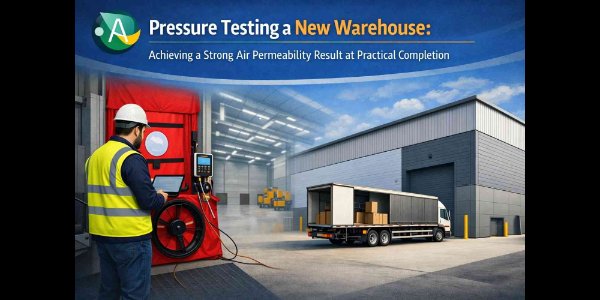
The Headline Result
ATSPACE achieved a strong air permeability result for a new‑build warehouse at practical completion by focusing on the high‑impact leakage routes unique to industrial buildings—dock doors, cladding joints, roof penetrations, smoke vents and service entries—and by running a readiness‑led testing plan that prevented retests.
Project Snapshot
Service: Commercial Air Leakage Testing (Non‑domestic pressure testing)
Client: Developer + design & build contractor – anonymised
Building type: New warehouse with office ancillary
Location: Falcon Logistics Park, Junction Road, East Midlands (address anonymised)
Size: Approx. 18,000 m² warehouse + 1,200 m² offices
Envelope: Metal cladding, rooflights, smoke vents, multiple loading bays
Programme stage: Practical completion window
Compliance driver: Part L non‑domestic performance evidence
ATSPACE team: Accredited Airtightness Test Engineer + Site coordination support
Why Warehouses Are Hard to Airtightness Test
Warehouses commonly fail airtightness tests for predictable, repeatable reasons:
1) The building is huge, so small gaps become big leakage
Large surface area + long junction lines = major leakage opportunity:
- cladding laps and corners
- eaves and ridge lines
- slab‑to‑cladding junctions
- roof penetrations and upstands
2) Dock doors and personnel doors are common weak points
Loading bays are high‑risk because:
- doors are large and mechanically complex
- seals become damaged or unaligned
- thresholds take heavy use during finishing
- multiple bays = multiple failure opportunities
3) Roof penetrations multiply late in the programme
Typical late penetrations include:
- extract fans
- smoke vents / AOVs
- safety line fixings
- comms routes
- PV/plant interfaces (where applicable)
If these aren’t sealed systematically, leakage spikes.
4) A failed test at PC is expensive
Remedials usually require:
- working at height
- access equipment
- out‑of‑hours shutdowns
- long cladding‑line sealing
- retest delays
The commercial impact is immediate.
The Brief to ATSPACE
The contractor needed:
- pressure testing at PC with no programme impact
- practical pre‑test guidance on likely leakage points
- clean compliance evidence for sign‑off
- minimal disruption to snagging/inspections
ATSPACE Approach (How We Made the Result Predictable)
Step 1: Pre‑test readiness walkdown (warehouse‑specific)
Our engineer focused on high‑impact leakage routes:
External envelope / cladding:
- corner details and laps
- base rail junctions
- eaves and ridge details
- penetrations through cladding
Doors and openings:
- loading bay door seals/alignment
- personnel door thresholds
- fire exits
- dock leveller edges (where relevant)
Roof zone:
- rooflight interfaces
- smoke vents and upstands
- roof penetrations and flashings
- plant supports and cable entries
Office ancillary:
- façade junctions
- riser/service entries
- ceiling penetrations
- plant room works
Step 2: Close‑out actions before the test window
We flagged issues that would almost certainly cause a retest:
- incomplete dock door seals
- gaps at slab‑to‑cladding interfaces
- inconsistent sealing around rooflight upstands
- unsealed service penetrations
This avoided the classic warehouse assumption:
“It’ll probably be fine.”
Step 3: Test‑day control (large‑building discipline)
Warehouse testing requires strict control:
- correct building setup
- zone and door position control
- confirming bay doors are fully sealed
- recording conditions accurately
- maintaining workflow despite operational activity
A dedicated site contact controlled access and door status throughout the test.
Step 4: Clear reporting for PC and compliance packs
Delivered documentation that supported:
- practical completion
- compliance submissions
- client handover
Real Problems Encountered (And How We Avoided a Retest)
Problem A: Dock door seals not consistently adjusted
Some seals weren’t fully compressing.
Fix: adjust and confirm full seal contact.
Why it matters: a few leaking dock doors can dominate a warehouse result.
Problem B: Roof penetrations had “nearly finished” sealing
Visually tidy, technically incomplete.
Fix: seal around flashings and upstands.
Why it matters: roof penetrations become major leakage points under pressure.
Problem C: Slab‑to‑cladding interfaces had minor discontinuities
Small gaps along long junction lines add up.
Fix: targeted close‑out during readiness.
Why it matters: long junctions decide pass/fail.
Results
- Strong air permeability result achieved at PC
- No retest required
- Dock doors, cladding junctions and roof penetrations controlled successfully
- Compliance‑ready evidence produced for handover
What This Warehouse Proved
Warehouses don’t pass airtightness tests by chance. They pass when you:
- treat dock doors as performance‑critical
- control roof penetrations and upstands
- close out long cladding junctions early
- run a readiness‑led testing plan
Common Mistakes on Warehouse Airtightness Testing
- leaving dock door adjustments to the last day
- assuming roof penetrations are airtight because they “look tidy”
- forgetting that long cladding junction lines add up
- booking the test before the building is fully closed
- uncontrolled door access during the test window
CTA
If you’re approaching PC on an industrial unit and need a strong air permeability result first time, ATSPACE can support with:
- warehouse‑specific readiness walkdowns
- non‑domestic pressure testing
- targeted troubleshooting and remedial guidance
- compliance‑ready reporting for handover
FAQ
What is warehouse pressure testing used for?
To measure uncontrolled air leakage and provide as‑built performance evidence for compliance, usually linked to Part L.
What are the biggest leakage points on warehouses?
Dock doors, personnel doors/thresholds, roof penetrations, smoke vents/rooflights and long cladding junction lines.
