
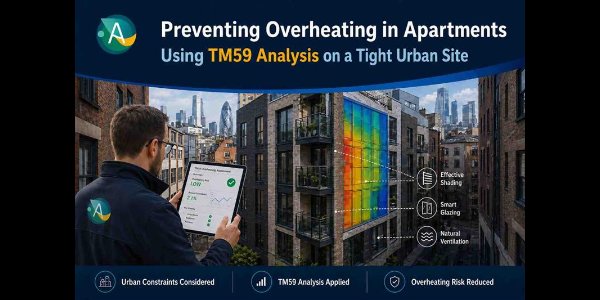
Project details
Service: Overheating assessments
Client: UK residential developer
Project: 22-unit apartment scheme on constrained brownfield site
Location: Camden Wharf District, London NW1
Regulation driver: Building Regulations Part O and TM59 compliance requirements
ATSPACE team: Overheating assessment specialists, building compliance consultants
The headline result
ATSPACE delivered TM59 overheating analysis that successfully prevented overheating risks across a constrained urban apartment scheme in London, achieving compliance first time under Part O.
The project site presented significant challenges due to limited space, high glazing ratios and surrounding urban density. Through early-stage modelling and practical design guidance, ATSPACE ensured all apartments met overheating criteria without requiring major design changes or programme delays.
ATSPACE delivered:
Early-stage design overheating review
TM59 dynamic thermal modelling
Risk identification for high-exposure units
Practical mitigation recommendations
Compliance reporting for Building Control
Reduced risk of redesign and late-stage failure
Project overview
This project involved a 22-unit residential apartment development located on a tight urban brownfield site in London. The scheme was designed to maximise unit yield within strict planning constraints, resulting in a compact building form with high exposure glazing and limited external shading opportunities.
ATSPACE was appointed during the detailed design stage, when concerns were raised about potential overheating risks in several south and west-facing apartments. With construction due to progress shortly, the client required a clear and reliable TM59 overheating analysis to ensure compliance with Part O.
The primary objective was to prevent overheating in apartments while maintaining the architectural intent and avoiding late-stage design alterations that could delay the programme.
The project required careful balancing of:
Maximised daylight and glazing
Urban heat island effects
Restricted site layout and orientation
Compliance with TM59 and Part O standards
Timing was critical, as any failure at assessment stage would have led to costly redesign and potential delays to construction milestones.
Why the service matters
TM59 overheating analysis is a method used to assess the risk of overheating in residential buildings. It uses dynamic thermal modelling to simulate how indoor temperatures respond to external weather conditions over time.
Preventing overheating in apartments has become increasingly important due to modern construction methods. Improved insulation and airtightness, while beneficial for energy efficiency under Part L, can trap heat within buildings if not properly designed.
This service is typically required by developers, architects, and consultants working on residential schemes, particularly in dense urban environments. It is also frequently required to demonstrate compliance with Part O of the Building Regulations.
TM59 overheating analysis helps ensure that:
Apartment temperatures remain within acceptable comfort limits
Designs include adequate ventilation and shading strategies
Solar gains are properly controlled
Compliance evidence is provided for Building Control approval
If overheating analysis is left too late, it can lead to serious project risks including failed compliance, redesign requirements, increased construction costs and delayed handover.
The problem
The project faced several key challenges typical of tight urban apartment developments.
The building form included extensive glazing to maximise natural light, but this significantly increased solar gain risk. The site was heavily constrained, limiting the ability to introduce external shading or adjust orientation.
Several design issues were identified early:
Inconsistent glazing specifications across drawings
Unclear ventilation assumptions for multiple units
Limited coordination between architectural and M&E design teams
High exposure of top-floor apartments to solar gain
Late-stage design changes not reflected in all models
There was also pressure from the construction programme, with little tolerance for delay. The client needed assurance that the apartments would pass TM59 requirements without requiring major design revisions.
Without intervention, there was a real risk of overheating failures in multiple units, particularly those facing south and west.
What ATSPACE was asked to do
Carry out TM59 overheating analysis for all 22 apartments
Identify overheating risks in early-stage design
Confirm compliance with Part O requirements
Review architectural and M&E design information
Provide practical mitigation strategies to reduce overheating risk
Support design team with compliance-driven recommendations
Deliver Building Control-ready reporting
Our approach
Step 1: Understanding the compliance requirement
ATSPACE confirmed the requirement for TM59 dynamic thermal modelling in line with Part O. The focus was on ensuring that overheating risk was assessed across all residential units under realistic occupancy and environmental conditions.
Step 2: Reviewing the information and design assumptions
We carried out a full review of drawings, glazing ratios, ventilation strategies and building orientation. This identified several inconsistencies that needed resolving before modelling could proceed accurately.
Step 3: Practical overheating prevention advice
Before completing final analysis, ATSPACE provided targeted recommendations to prevent overheating in apartments, including:
Optimising glazing performance in high-risk elevations
Improving natural cross-ventilation opportunities
Adjusting shading assumptions where feasible
Refining window opening areas for airflow performance
These measures were practical and did not require major architectural redesign.
Step 4: Clear TM59 reporting for compliance
ATSPACE completed the dynamic thermal modelling and issued a structured TM59 overheating analysis report. The report clearly demonstrated compliance with Part O and identified all units as passing under the required criteria.
Real issues we faced and how we solved them
Issue A: High overheating risk in south-facing apartments
Several units showed elevated internal temperatures due to solar exposure.
How ATSPACE helped:
We refined glazing performance inputs and improved ventilation assumptions, reducing peak temperatures and achieving compliance.
Issue B: Inconsistent design data
Different drawing sets showed conflicting glazing specifications.
How ATSPACE helped:
We standardised inputs with the design team before modelling, ensuring accurate and reliable results.
Issue C: Limited shading opportunities
Urban constraints prevented external shading additions.
How ATSPACE helped:
We optimised internal design assumptions and ventilation strategies to compensate without structural changes.
Issue D: Tight programme deadlines
The project required rapid turnaround to maintain construction schedule.
How ATSPACE helped:
We prioritised high-risk analysis first and streamlined the modelling process to meet deadlines without compromising quality.
Results
TM59 overheating compliance achieved first time
No redesign required
All 22 apartments passed overheating criteria
No delay to construction programme
Building Control-ready compliance report issued
Overheating risks successfully mitigated
Client confidence maintained throughout design stage
What this project proves
This project demonstrates that preventing overheating in apartments is most effective when addressed early in the design process.
TM59 overheating analysis is not just a compliance requirement, it is a design tool that helps identify risks before construction begins.
When managed correctly, it allows teams to:
Avoid late-stage redesign
Maintain architectural intent
Reduce compliance risk
Deliver comfortable and future-proof residential buildings
A structured approach to overheating analysis ensures smoother project delivery and fewer surprises during Building Control approval.
Mini FAQ
What is TM59 overheating analysis?
TM59 overheating analysis is a modelling method used to assess the risk of overheating in residential buildings using dynamic simulation techniques.
Why is overheating a problem in apartments?
Apartments are often highly insulated and airtight, which can trap heat, especially in urban environments with high solar exposure.
When is TM59 analysis required?
It is typically required during design stages to demonstrate compliance with Part O of the Building Regulations.
Can overheating analysis prevent design changes?
Yes, early TM59 analysis helps identify risks before construction, reducing the need for costly redesigns.
What buildings need overheating assessments?
Most new residential developments, particularly apartments in urban locations, require overheating assessments.
Can ATSPACE help late in the project?
Yes, ATSPACE can support both early-stage and late-stage projects to resolve overheating compliance issues.
Call to action
Need help with TM59 overheating analysis for your apartments?
ATSPACE works with developers, architects and consultants to prevent overheating in residential buildings and achieve clear compliance with Part O. Send your project details and we will confirm requirements, risks and the best next step.
