
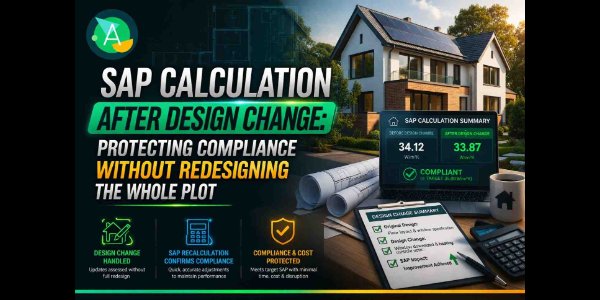
The Result
A late design change risked pushing a house type out of Part L compliance. The client needed to protect the compliance position without redesigning the plot or reopening planning layouts.
ATSPACE reviewed the design change, updated the SAP calculation quickly, identified the real impact on performance, and recommended a small set of practical, low‑disruption adjustments that fully recovered compliance.
Project Snapshot
Service: SAP calculations + compliance recovery
Client: Developer + principal contractor
Site: Kingsmere Walk, Plot 14, 6 Rowan Close, Banbury OX16 1HR
Building type: 3‑bed end terrace
Programme stage: Late technical design → procurement
Design change: Specification alteration affecting fabric + services
Compliance driver: Building Regulations Part L
ATSPACE delivery: SAP recalculation, compliance impact review, recovery options, updated SAP outputs, evidence notes
Team: ATSPACE SAP assessor team + compliance coordinator
Why Design Changes Break Compliance Late in the Day
Late changes are common and usually sensible — driven by supply, cost or coordination.
SAP, however, is highly sensitive to certain specification changes.
Typical high‑impact changes:
- glazing performance
- heating system or emitter changes
- control strategy adjustments
- insulation specification changes
- ventilation strategy updates
- PV capacity changes or roof‑space constraints
In this case, a seemingly small change had a measurable performance impact.
What ATSPACE Was Asked To Do
The client needed fast clarity:
- confirm whether the change affected Part L compliance
- recalculate SAP using new design inputs
- identify practical, low‑disruption recovery measures
- avoid redesign of the house type
- produce a clear evidence trail for compliance sign‑off
What ATSPACE Did
Step 1: Recalculate SAP with new design inputs
We updated SAP using the changed specification and compared:
- previous compliant outputs
- new outputs after the change
This showed exactly how far the plot drifted and which parameters were affected.
Step 2: Identify the simplest recovery route
We avoided long lists or unnecessary redesign.
Recovery options were prioritised based on:
- zero structural impact
- minimal procurement disruption
- measurable SAP benefit
- no negative impact on ventilation or commissioning
Step 3: Provide a small set of practical adjustments
The compliance recovery plan focused on high‑leverage, easy‑to‑deliver measures:
- tightening the airtightness target (within realistic site capability)
- refining heating‑control assumptions to match intended installation
- adjusting PV provision where roof zones allowed
- minor fabric tweaks still achievable at procurement stage
The emphasis: practical measures the site can repeat consistently.
Step 4: Update SAP outputs + issue clear evidence notes
We provided:
- updated SAP results
- a concise note explaining what must be installed
- evidence requirements for as‑built sign‑off
This prevented compliance drift later in the programme.
The Issues We Prevented
Issue 1: A silent performance gap from a small substitution
If the change hadn’t been modelled, it would have caused non‑compliance at handover, when fixes are expensive and disruptive.
Issue 2: Overreaction with redesign
Many teams respond to SAP failures with full redesign proposals.
ATSPACE focused on small, high‑impact adjustments, avoiding cost and delay.
Outcome
The house type regained a stable compliance position without redesign.
Project outcomes:
- compliance impact identified quickly
- recovery measures were practical + programme‑friendly
- updated SAP outputs issued for design sign‑off
- reduced risk of as‑built compliance issues
- repeatable process adopted for future design‑change scenarios
Common Mistakes This Project Avoided
- making design changes without SAP checks
- discovering non‑compliance at handover
- proposing major redesign instead of small fixes
- relying on assumptions about controls or PV that weren’t deliverable
- failing to record what must be evidenced at as‑built stage
CTA
If a design change is putting your Part L position at risk, ATSPACE can update SAP quickly, explain the impact clearly, and provide a practical recovery plan that protects compliance without triggering redesign.
Ask for:
- SAP recalculation after design change
- compliance‑impact review + recovery options
- updated SAP outputs for design sign‑off
- evidence notes for as‑built verification
Frequently Asked Questions
What types of changes affect SAP most?
Glazing, heating systems, controls, ventilation strategy, PV capacity and insulation performance.
Can compliance be recovered without redesign?
Often yes — if identified early and focused on high‑leverage deliverable measures.
When should SAP be updated after a change?
As soon as the change is proposed.
Early checks = cheaper, easier fixes.
