
The result
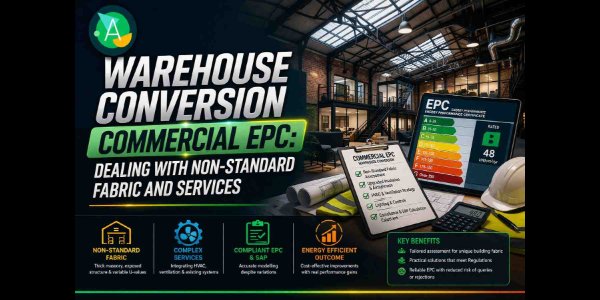
A warehouse conversion needed a commercial EPC — but the building did not fit the neat assumptions most EPC templates rely on.
The fabric was mixed, with retained and upgraded elements, and the services strategy had evolved to suit the new industrial/light‑logistics use.
ATSPACE gathered the correct as‑built evidence, handled the non‑standard fabric transparently, and issued a clean, compliant EPC that supported completion and onward letting without delays.
Project snapshot
Service: New build + conversion commercial EPC assessment
Client: Developer + refurbishment contractor
Site: Falcon Works, Unit A, 4 Foundry Road, Nottingham NG7 2JQ
Building type: Warehouse conversion with light‑industrial + office space
Floor area: Approx. 9,800 m²
Fabric: Retained structure, upgraded roof, selective envelope improvements
Services: Mixed heating strategy, upgraded lighting + controls, ventilation updated for new activity
Programme stage: End of refurbishment, handover readiness
ATSPACE delivery: Evidence review, fabric/services confirmation, EPC modelling, certificate issue, improvement‑options summary
Team: ATSPACE commercial EPC assessor team + coordinator
Why conversions are harder for commercial EPCs
Conversions rarely have complete or consistent documentation. Common issues include:
- retained elements with limited original drawings
- multiple fabric build‑ups across the envelope
- partial upgrades instead of full replacement
- services installed in stages
- changes in activity type affecting compliance modelling
If evidence is incomplete, an EPC can be dragged down by conservative defaults, or delayed altogether.
The client wanted the EPC to reflect the true upgrade works, not generic assumptions.
What ATSPACE was asked to do
- assess the conversion accurately using as‑built evidence
- treat mixed fabric build‑ups transparently
- confirm services and controls to avoid conservative assumptions
- issue the EPC in time for marketing and completion
- provide a clear, auditable evidence pack
What ATSPACE did
Step 1: Identify non‑standard fabric
We divided the building into logical sections based on:
- retained fabric
- upgraded zones
- altered envelope elements
This avoided blanket assumptions and kept the model aligned to reality.
Step 2: Capture the as‑built evidence that matters
On conversions, the most critical evidence includes:
- roof‑upgrade and insulation details
- glazing + door specifications
- upgraded lighting and controls
- heating system type + zoning
- ventilation strategy + control method
- accurate plans/areas for the converted layout
We gathered everything in one clear evidence pack.
Step 3: Confirm services + controls on site
A strong services strategy can be undermined in an EPC if controls aren’t documented.
We verified exactly what was installed, including:
- system types
- efficiencies
- zoning
- control strategy
Step 4: Issue the EPC + practical summary
Once evidence was complete, we:
- lodged the EPC
- issued the compliant certificate
- provided a simple summary for marketing and handover packs
Problems faced and how they were solved
Problem 1: Mixed roof build‑ups across bays
Different roof zones had different upgrade levels.
** fix:** Modelled the building in sections so upgraded areas were represented correctly.
Problem 2: Services installed in phases
Earlier and later phases had different configurations.
** fix:** Verified the final installed configuration, not mid‑programme snapshots.
Problem 3: Limited original fabric documentation
Historic drawings were incomplete.
** fix:** Used refurbishment evidence and site confirmation, keeping assumptions transparent and consistent.
Outcome
The EPC was issued on time, supporting handover and letting.
Project outcomes:
- certificate issued without delaying completion
- robust evidence pack for client records
- non‑standard fabric handled transparently
- reduced risk of EPC defaults dragging down the rating
- clearer view of improvement opportunities
Common mistakes this project avoided
- using conservative defaults when upgrade evidence exists
- treating a mixed‑fabric warehouse as one uniform building
- modelling based on incomplete services information
- delaying letting due to a late EPC
- creating an evidence file that cannot withstand scrutiny
CTA
If you need a commercial EPC for a warehouse conversion — especially one that does not fit standard assumptions — ATSPACE will gather the right evidence, model the real building, and issue the certificate without delaying completion or letting.
Ask for:
- warehouse + industrial commercial EPC assessment
- conversion‑stage evidence capture + site verification
- EPC issue aligned to handover and marketing
- improvement‑options support for stronger ratings
Frequently asked questions
Why are warehouse conversions harder to assess?
Mixed fabric and inconsistent documentation make generic modelling inaccurate.
What evidence helps most?
Roof upgrades, lighting/controls, heating/controls, glazing, doors, and accurate floor‑area plans.
Can an EPC delay handover or letting?
Yes — if evidence is missing or inputs drift.
A controlled evidence process prevents EPC bottlenecks.
