
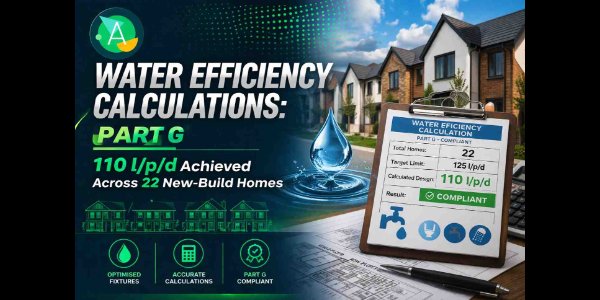
The Result
A 22‑home residential phase needed to meet 110 litres per person per day as required by the planning condition.
ATSPACE completed the water efficiency calculations, confirmed that the installed fittings matched the assumptions, and delivered a clear, defensible evidence pack for Building Control.
The entire phase passed first time — no late substitutions, no recalculation loops, and no handover delays.
Project Snapshot
Service: Water efficiency calculations
Client: Regional housebuilder + principal contractor
Site: Hawthorn Vale, 1–22 Juniper Close, Cheltenham GL51 8PT
Development: 22 new build houses — detached + semi‑detached
Programme stage: Rolling completions and handover packs
Compliance driver: Approved Document G + 110 L/person/day planning requirement
ATSPACE delivery: Water calculations, fittings verification, evidence pack, close‑out notes
Team: ATSPACE compliance assessor + coordinator
Why Water Efficiency Became a Critical‑Path Risk
Water calculations are often left until the last minute, but performance is dictated by product choices made months earlier.
This phase had typical risk factors:
- multiple suppliers providing similar‑looking fittings
- varying bathroom counts across plot types
- substitutions made to maintain programme
- the sales team requiring timely, complete handover packs
The client wanted to avoid a scenario where one tap or shower change pushes a plot over the 110 L target, causing delays and compliance queries.
What Water Efficiency Calculations Measure
Water calculations estimate daily water use based on actual installed fittings, using the recognised Part G water calculator.
Key drivers include:
- WC flush volume
- shower flow rate
- basin tap flow rate
- kitchen tap flow rate
- bath volume
The rule is simple:
👉 If the installed products don’t match the assumptions, compliance can fail and evidence becomes weak.
What ATSPACE Was Asked To Do
- calculate water efficiency for all 22 plots
- verify fittings schedules against installed products
- identify at‑risk plots early
- prepare a Building Control‑ready evidence pack
- align everything with rolling completions
What ATSPACE Did
Step 1: Confirm plot types + bathroom counts
We identified higher‑risk plots (more bathrooms/baths) and ensured each configuration had the correct fittings mapped.
Step 2: Build an accurate fittings schedule
We requested only the information that moves the calculation:
- WC model + flush volume
- shower head flow rate
- basin tap flow rate
- kitchen tap flow rate
- bath volume
Then we aligned the specification to each plot type, ensuring consistency and traceability.
Step 3: Early risk check
We ran calculations early enough to flag risk plots before handover week.
If a fitting was close to the limit, we signalled it so the site did not accidentally swap it and fall out of compliance.
Step 4: Prepare a clean evidence pack
We produced:
- calculation outputs
- referenced fittings data
- a simple list of evidence relied upon
This allowed Building Control to sign off quickly with minimal back‑and‑forth.
Step 5: Plot‑by‑plot close‑out during completions
As each plot completed, we confirmed:
- no late fitting substitutions
- flow rates and WC/bath data still matched assumptions
This prevented last‑minute recalculation cycles.
Problems Faced — and How We Solved Them
Problem 1: Tap specification drift between suppliers
Two suppliers provided similar‑looking taps with different flow rates.
Why it mattered:
A small flow‑rate shift can fail a tight 110 L target.
Fix:
We verified performance and standardised choices across the phase.
Problem 2: Late shower handset substitution
A proposed replacement had a higher flow rate.
Fix:
We flagged the impact immediately and the site selected an alternative that maintained compliance with no programme impact.
Problem 3: Evidence scattered across emails
Product data was spread across procurement and site teams.
Fix:
We consolidated everything into a single plot‑type evidence pack.
Outcome
The development met the 110 litres per person per day requirement across all 22 homes with a clean audit trail.
Project outcomes:
- calculations issued in step with completions
- reduced risk of late non‑compliance
- fewer Building Control queries
- smoother handover packs
- repeatable specification checklist created for future phases
Common Mistakes This Project Avoided
- doing water calculations at the end of the project
- assuming all taps/showers perform the same
- allowing substitutions without checking impact
- submitting calculations without linking inputs to actual products
- treating Part G as “paperwork” instead of specification‑critical control
CTA
If you need to achieve 110 litres per person per day and want a clean, defensible evidence pack with no last‑minute surprises, ATSPACE will keep your water efficiency calculations aligned to the actual specification and protect your handover programme.
Ask for:
- water efficiency calculations for new homes
- fittings verification + risk checks
- Building Control‑ready evidence packs
- support managing substitutions and compliance drift
Frequently Asked Questions
Is 110 litres/person/day always required?
No. The Building Regulations default is higher, but many sites have a planning condition requiring the tighter 110‑L standard.
What fittings influence the calculation most?
WCs, showers and tap flow rates — especially shower flow rates.
When should water efficiency calculations be done?
Early in the programme once fittings are known — not during handover week.
