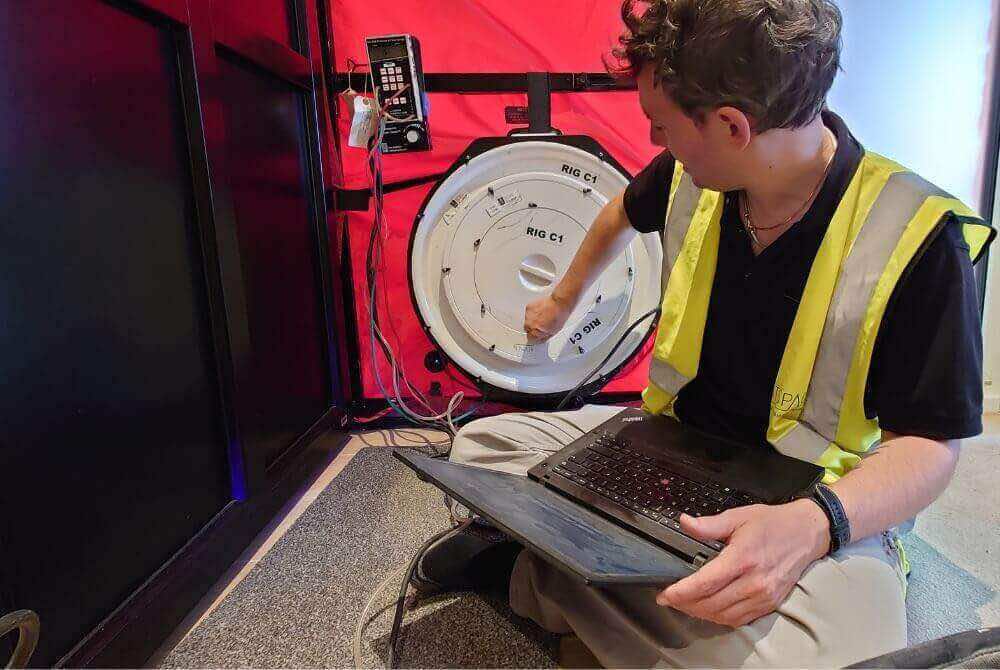
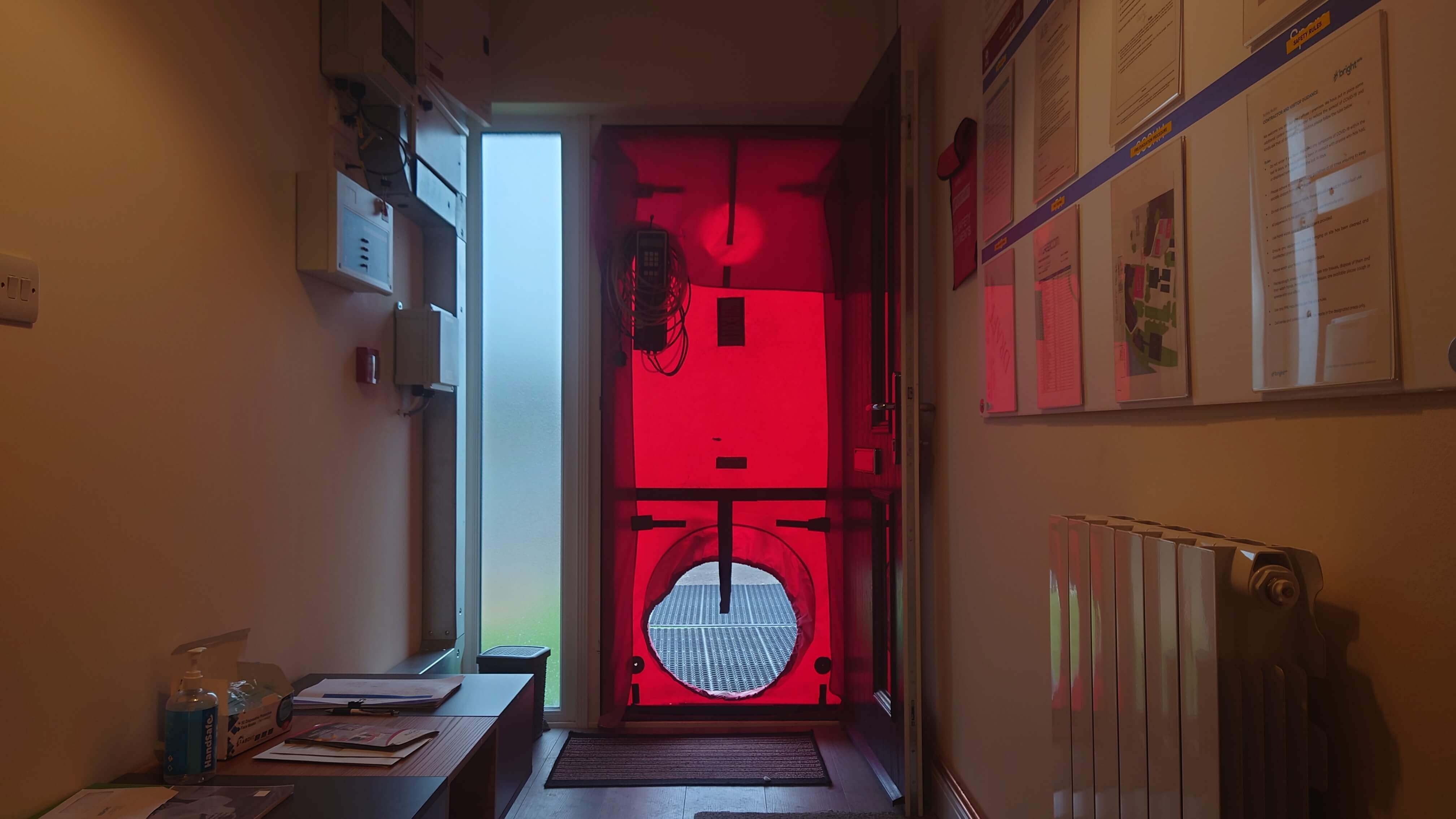
Yes. Our work is carried out by our in house accredited team, giving our clients consistent delivery, clear accountability and reliable technical support throughout the project. We also have coverage across England and Wales, allowing us to support sites nationwide.
Yes. Heated common areas in buildings containing multiple dwellings are treated under Approved Document L Volume 2 as buildings other than dwellings. That means lobbies, corridors and similar shared spaces can sit within the non-domestic air test and compliance strategy even where the main accommodation is residential. On mixed-use schemes, those boundaries need to be fixed early so the right spaces are included in the testing plan.
Yes, strongly. Preliminary tests are one of the best ways to protect a Passivhaus project from a late failure. Passivhaus Trust guidance says final compliance testing should generally be backed up by one or more preliminary tests, because once dry-lining, services and finishes are in, many leaks are far harder and costlier to fix. Pre-tests are where first-time pass rates are really won.
Yes. SBEM is for non-domestic buildings, not for dwellings. Official guidance says the tool is designed to cover buildings that are not dwellings, while Approved Document L Volume 2 applies only to buildings other than dwellings. If the project is a house or flat, the domestic route is SAP, not SBEM.
No. Residential apartment buildings are the most common use case, but the SCA also notes that smoke shafts and smoke control ducts are used in other multi-level buildings, particularly where a firefighting shaft is needed. So while the residential market drives most search intent, the service is not limited to flats alone.
Yes. Repeated guidance and site experience point to plug sockets, downlights, skirting junctions, bathroom services, boiler cupboards and general service penetrations as common leakage paths in new homes. These are classic “looks finished but is not airtight” details. They are also the sort of faults that become far harder to fix once joinery, kitchens and sanitaryware are fully in, which is why early checking saves so much time later.
No. They are closely related, but they are not the same thing. A U-value calculation deals with heat loss; condensation-risk analysis deals with moisture risk in or on the construction. BR 443 says condensation risk should be considered, and local authority guidance also notes that a build-up still has to satisfy other Building Regulations concerns such as condensation risk, not just hit the headline U-value.
No, not automatically. The exemption in Approved Document L is for low-energy-demand industrial sites, workshops and non-residential agricultural buildings, and the wider low-energy-demand guidance still distinguishes between exempt and non-exempt cases. A warehouse with only frost protection may fall into low-energy-demand treatment, but that does not mean every warehouse is exempt, and any normally heated office area inside it should be treated as a separate building or zone under the normal procedures.
Yes, in the normal domestic Part G sense. In England, Requirement G2 applies only when a dwelling is erected or formed by a material change of use within regulation 5(a) or (b). Wales applies the same basic scope. That means the service is mainly for new-build dwellings and qualifying conversion-created dwellings.
Carry out the test when the airtight layer is complete and the building is actually ready to be tested. In practical terms, windows and external doors should be in, penetrations sealed, power available, and access sorted so the engineer is not losing time to unfinished works. On shell-and-core projects, the test should reflect the agreed landlord handover condition, not a moving target halfway through fit-out.
A house should be air tested when the airtight layer is complete and the plot is genuinely ready, not when the site is hoping it is ready. Windows and external doors need to be properly fitted, penetrations need sealing, and the common leakage points hidden behind boxing, dry-lining or bathroom units need to be dealt with before the tester arrives. Calling the tester too early is one of the biggest causes of failed first visits.
Not always. A dwelling can meet the 8.0 backstop and still fail the overall Part L compliance check if the measured result is worse than the design value used in the final SAP calculation and the finished energy metrics end up outside target. That is why experienced developers do not treat 8.0 as the real target. On most sites, it is a backstop, not a sensible aim.
Yes, sometimes. Missing Passivhaus does not automatically mean failing UK Building Regulations, because Part L uses a different airtightness metric and a much looser minimum standard. That said, the project still has to satisfy its own Part L design assumptions, so you cannot assume a Passivhaus miss is harmless. It may still pass Part L, but it needs checking properly rather than guessed at.
No. It improves certainty, but it does not guarantee success. ANC guidance says early indicative testing and expert advice help maximise the likelihood of passing later sound tests, but final performance still depends on the detailed upgrade, flanking control and workmanship. Pre-improvement testing is there to reduce risk, not replace proper design and proper post-works verification.
Yes, that is often the practical route. Official technical notes say EPCs for new dwellings may be lodged earlier based on the planned design, and the EPC guide says an EPC must be commissioned before a building is put on the market where required. In practice, developers often use a design-based EPC first and then update it if the dwelling changes during construction.
Yes, it can. A lower air leakage result is usually good for energy performance, but if the dwelling becomes very airtight and the ventilation strategy does not match, indoor air quality can suffer. Approved Document F specifically treats highly airtight dwellings differently, because once infiltration is reduced enough, you can no longer rely on incidental leakage to help the ventilation strategy. Airtightness and ventilation have to be designed together, not as separate afterthoughts.
Yes. It is best brought in early, but it can still add real value once work has started. Good-practice guidance includes site leakage audits, preliminary testing and localised or partial testing specifically to identify weaknesses while the air barrier is still accessible enough to fix. Even on a live site, a focused review can stop repeated bad details spreading across the rest of the programme.
Yes. It can be valuable on refurbishments involving replacement windows, doors, cladding upgrades, material changes of use or broader energy-efficiency work, especially where infiltration is being reduced. Approved Document F Volume 2 notes that tightening a building can affect indoor air quality, and non-domestic Part L work often still depends on getting continuity, buildability and interfaces right. Early advice reduces the risk of fabric upgrades creating follow-on ventilation or handover issues.
Yes. It is especially useful where you are improving fabric performance, changing windows or carrying out wider retrofit work and want to avoid creating draught, moisture or ventilation issues by accident. Approved Document F for existing dwellings specifically anticipates expert advice and even says that may include an air permeability test. In retrofit, good airtightness advice is about balancing heat loss, buildability and healthy indoor air rather than just chasing a low number.
Yes. The same airtightness principles apply across all of them, but the detail risk changes by build system. Dwelling guidance expects buildable details, continuity and careful treatment of openings, floors, roofs and penetrating elements, while good-practice guidance notes that some timber details and panel joints need particular care to stay robust through construction. The best advice is system-aware rather than generic.
Yes. For dwellings in England, the completion-stage BREL report is submitted together with photographic evidence, and Approved Document L also expects photos of key details during on-site audits. Airtightness advice helps the site team decide which details need recording, when they need photographing and how to avoid missing evidence once work is covered up. It is as much about organised proof as it is about technical fixes.
Yes. In non-domestic projects, the building primary energy rate and building emission rate are calculated at design stage and again as built, with the measured air permeability included at completion. The BRUKL reports are what tie that compliance evidence together. Airtightness design advice helps protect the design assumptions that sit behind the BRUKL, so the finished building is less likely to drift away from the model during construction.
Yes. DESNZ research that revisited homes around ten years after earlier tests found airtightness had deteriorated in seven out of ten cases, with an average worsening of 0.52 m³/(h·m²) at 50Pa. That is why retrofit airtightness should be treated as a durability issue, not just a handover-day number. Good detailing and robust sealing matter more than cosmetic last-minute fixes.
Yes. Approved Document F expressly says expert advice on an existing dwelling may include carrying out an air permeability test following the Approved Document L testing procedures. That is important because it moves retrofit air leakage testing out of the “nice to have” category. On the right project, it is a sensible evidence-based way to decide what airtightness changes have actually happened and what the ventilation response should be.
Yes. We can manage multiple compliance services under one roof, covering design, consultancy, testing and certification across residential and commercial projects. Because we keep our services together, we help reduce delays, improve coordination and make the whole process easier to manage.
Yes, that is one of its main commercial benefits. Elmhurst says background ventilation testing helps avoid unnecessary installation of background ventilators, and TrustMark’s retrofit design guidance gives a model wording for the ventilation strategy stating that successful testing demonstrates there is sufficient air infiltration so that background ventilation upgrades are not warranted. That is exactly why the service is attractive on retrofit jobs where extra vents are unwanted.
Yes. Historic England’s guidance notes that unused or intermittently used chimneys can contribute significantly to draughts and heat loss, while loft hatches and similar small details are often disproportionate leakage points in older buildings. The point is not to block everything blindly, but to deal with these routes in a way that reduces unnecessary heat loss without compromising intended ventilation or combustion safety.
Yes. Commercial air testing is useful well beyond simple Part L sign-off, including diagnostics, refurbishment planning, BREEAM or planning-related evidence, and targeted improvement work on existing stock. A measured air permeability result, especially when paired with smoke testing or thermal imaging, helps owners and project teams identify real leakage paths instead of throwing money at blanket remedials. That makes it valuable for building owners as well as developers.
Yes. If a building is divided into self-contained units with no internal connections, Building Control may accept a pressure test on a representative area as evidence of the building’s air permeability. This can work well on repeated commercial units, some industrial schemes and certain mixed-use layouts. The catch is that the sample has to be genuinely representative, so repeated details and consistent workmanship are essential.
Yes. Current England and Wales dwelling guidance both allow more than one route: bespoke BR 497 calculations, independently assessed detail libraries, the default SAP Table K1 values, or a default y-value route. That means you do not always need bespoke modelling on every dwelling, but you do need to choose a recognised route and apply it correctly.
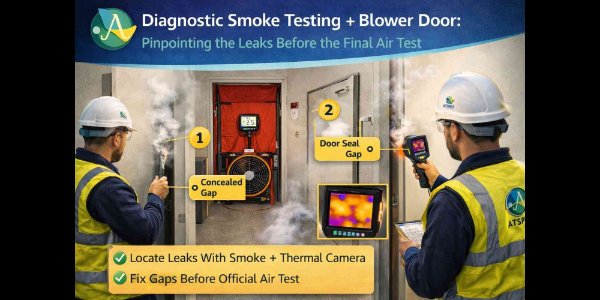
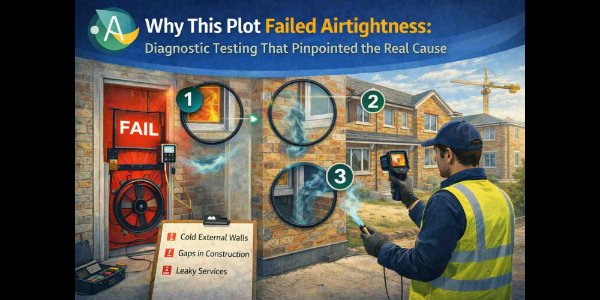
Yes. After a failed air test, smoke diagnostics are one of the quickest ways to move from a bad result to a workable remedial plan. Instead of sealing randomly, the site team can see the main leakage paths and fix the defects that are actually hurting the number. Where a formal retest is required, smoke testing helps make that next visit far more focused.
Yes, and that is one of its best uses. Interim testing guidance says the building should be checked while most of the air barrier is still accessible so remedial works can be undertaken properly. Using smoke at that stage helps the site team find the real weak points before plasterboard, ceilings, joinery or fit-out hide the problem and make the final test harder to recover.
Yes. Interim and diagnostic testing are among the best ways to improve first-time pass performance because they let you find and fix leakage paths before the formal test. Good-practice guidance says interim testing is essential for airtight buildings and should happen while the air barrier is still accessible. That is how projects stop a tight target becoming a late-stage surprise.
Yes, and that is one of the smartest times to use them. Interim testing is most effective when most of the air barrier has been formed but is still accessible enough to repair properly. That lets the site team fix real leakage paths before dry-lining, ceilings, joinery or fit-out hide the problem and before the compliance test becomes a critical-path event.
Yes. After a failed air test, diagnostics are usually the fastest way to move from a fail result to a workable remedial plan. Both dwelling and non-domestic guidance require the building to be improved and retested until it meets the relevant criteria, and all failures still have to be reported to Building Control. A diagnostic visit turns that pressure into targeted action rather than guesswork.
Yes. EnerPHit is PHI’s retrofit standard, and airtightness testing is part of that quality-assurance process. Retrofit projects often need even more planning than new build because existing fabric, hidden defects and sequencing constraints can make airtightness harder to achieve. The test is still essential, but the route to passing is usually more about diagnosis and staged improvement than a single late certificate visit.
Yes. Smoke shaft testing is carried out on both new and existing buildings where there is a need to verify performance, investigate defects or support compliance. On occupied buildings the challenge is usually logistics rather than principle: access, smoke-control coordination, resident or FM liaison, and sometimes out-of-hours working.
Yes. Flats and apartment buildings can be Passivhaus certified and tested, but the pressure boundary has to be agreed properly. On multi-unit projects, the key question is what exactly forms the heated airtight envelope for the part being certified. If that is not nailed down early, testing day becomes a boundary dispute instead of a clean quality check.
Yes. Internal linings, skirtings and floor-edge works can either improve airtightness or hide leakage, depending on how well the interfaces are detailed. On retrofit jobs, these are the places where concealed voids and junction problems often get covered before anyone realises the air path is still open. That is why before-and-after testing and targeted diagnostics are so useful on internal upgrade works.
Yes, potentially. The issue is not whether a lot of glass is banned, but whether the extension can still be shown to perform no worse than the relevant benchmark or compliant extension. In real project terms, fully glazed or near-fully glazed designs usually mean you need the compensating-calculation route, tighter product choices and a more disciplined spec.
No, not as a way of manipulating the result. ATTMA’s dwelling guidance states that all internal doors to conditioned areas must remain open during the test. Closing them to create false pressure conditions can invalidate the test. For site teams, this is a useful rule of thumb: if the only way the plot “passes” is by changing the way the building is meant to be tested, it has not really passed.
Sometimes. If pressure testing is genuinely impractical because of the size or complexity of the building, Approved Document L allows a strategy-based route instead of a full whole-building pressure test. That is not an easy opt-out: the developer needs a detailed justification and a detailed strategy showing how a continuous air barrier will be achieved, and Building Control has to accept it.
Sometimes, yes, but this is a policy-sensitive area. The 13 December 2023 WMS says government does not expect plan-makers in England to set local energy-efficiency standards beyond current or planned Building Regulations unless they have a robust rationale. At the same time, adopted local policies in London and some other authorities still require detailed planning-stage energy strategies. In practical terms, you need to check the live local plan and validation list rather than assume Part L alone will satisfy planning. (parliament.uk , westminster.gov.uk , london.gov.uk)
Yes. Government planning guidance says local planning authorities can set the tighter 110 litres/person/day standard where there is a clear local need, through local plan policy and the planning process. Regulation 36 then makes that optional requirement bite where planning permission specifically includes it as a condition.
No. ATTMA’s dwelling guidance is clear that access doors to areas outside the building envelope under test, such as internal doors to garages, loft hatches and storage access doors, should be airtight in their own right and should not be temporarily sealed for the test. If those details leak, they need fixing properly. Trying to mask them on test day is exactly the kind of shortcut that causes rejected results.
Yes, but only as a last resort. Approved Document O says the building should meet Requirement O1 using passive means as far as reasonably practicable, and that mechanical cooling is expected to be used only where the requirement cannot be met using openings. The GLA cooling hierarchy makes the same point by putting active cooling at the end of the sequence.
Yes. Minor schemes can still need one where the local authority requires it. Haringey says applicants must submit an Energy Statement for minor applications creating 1 to 9 new dwellings or under 1,000m² of new non-residential floorspace, and Merton now has a dedicated minor residential energy assessment template in its planning guidance. So minor does not automatically mean “no energy statement”. (haringey.gov.uk , merton.gov.uk)
Not always, and you should never assume they can. In mixed-use developments, Approved Document L Volume 2 applies to the non-dwelling parts, while Volume 1 applies to the dwellings, so the testing and compliance strategy must follow those boundaries. Retail space, offices and heated common areas sit on the non-domestic side; the flats do not. Getting those zones agreed early avoids late arguments about what was actually tested.
Yes, where the method requires it. On residential Passivhaus projects, the outdoor air and exhaust air openings of the ventilation system are typically sealed for the measurement so you are testing the envelope, not the ventilation ductwork. In non-residential projects with intermittent systems, tightly shutting flaps are important. Either way, the preparation has to follow the method and be documented clearly in the report.
Yes, but careful planning is essential. Live commercial buildings bring extra complexity around access, pressure boundaries, operating ventilation systems and disturbance to occupants. Historic England notes that airtightness testing may need specific preparation and out-of-hours working, while Approved Document F Volume 2 makes clear that changes in airtightness still have to be considered alongside ventilation in existing buildings. That is why occupied retrofit testing works best when it is planned into the programme early.
Yes, often they can, but they need more planning than empty properties. Historic England notes that testing existing buildings can require sealing preparation, filled water traps and sometimes out-of-hours access depending on the building and the brief. On occupied homes, the main issue is coordination: access, ventilation settings, doors, windows and occupant activities all have to be managed so the result is meaningful.
Yes, and on those projects it is often most valuable. Approved Document L Volume 2 says that where pressure testing is impractical due to size or complexity, the developer may submit a detailed strategy showing how a continuous air barrier will be achieved, and expert advice should be sought to confirm that strategy. Large or phased buildings usually need earlier coordination, more interim checks and a tighter testing plan than simple buildings.
Yes. The SCA’s 2024 statement tells designers to consider the material being used for shaft construction because some common constructions provide fire resistance but are not suitable for the leakage, insulation and pressure demands of a smoke shaft. BS 9991:2024 also pushes specialist smoke-vent input earlier on taller buildings. That early coordination is what reduces costly rework later.
Yes. That is one of the main reasons to use it. ATTMA states that the sooner airtightness problems are identified in design, the more cost-effective the remedies are, and official guidance expects on-site audits before details are concealed. In simple terms, early reviews and site checks move failure risk forward to a stage where it can still be fixed properly, instead of leaving everything to the last certificate-critical visit.
No, they should not. The SCA guide says the smoke shaft should only contain equipment directly associated with the smoke ventilation system and that no other building services should be contained within the shaft. The same principle appears in Approved Document B for firefighting shafts. If unrelated services go in, expect trouble later.
Only if the exact system has the right smoke-shaft test evidence. The current SCA position is that smoke shaft materials should be tested to BS EN 1366-8 and classified to BS EN 13501-4, and CIBSE Journal reported that British Gypsum said certain shaft systems were not tested to BS EN 1366-8 or BS EN 12101-3, so no performance claims to those standards could be made. In short, fire resistance alone is not enough.
Yes. It is particularly useful where an upper-flat floor is being upgraded and you need to understand the existing airborne and impact performance before specifying the new build-up. Published acoustic guidance for pre- and post-works floor testing treats the pre-works test as the baseline stage that informs the necessary soundproofing measures, which is exactly the commercial value of the service on live apartment refurbishments.
Yes. Conversions are one of the strongest use cases because Approved Document E applies to dwellings and rooms for residential purposes formed by material change of use, and ANC guidance says indicative testing may be carried out before work starts if the existing building is sufficiently intact. It gives the design team a realistic baseline before the final Part E strategy is fixed.
Yes, very often. Approved Document F notes that replacing existing windows can improve airtightness and therefore reduce adventitious ventilation. That is one reason window upgrades sometimes leave occupants complaining about stuffiness or condensation afterwards. The heat loss may improve, but the background ventilation picture may have changed at the same time, so it is worth measuring the effect rather than assuming the job is neutral.
Yes, and it can be especially useful there, provided the interpretation is sensible. Historic and traditional buildings often behave differently from modern construction, and Welsh guidance also recognises special considerations for permeable fabric and traditional forms. Testing can help establish a real baseline and show where draughts are occurring, but remedial decisions still need to respect breathability, heritage value and moisture risk.
Yes. It is particularly useful on deep retrofit where the building changes in stages and the interaction between measures is not always obvious from drawings alone. Recent staged retrofit case studies used blower door tests at baseline and across retrofit phases to track changes in airtightness. That kind of staged evidence helps the team understand what each intervention is doing rather than waiting until the end and hoping it all adds up.
Yes. A property can have new insulation or windows and still feel draughty if the main air leakage paths were never tackled. Retrofit air leakage testing helps show where air is still moving through the fabric, around junctions and through service penetrations, so the remedial work can be focused on the true cause of discomfort rather than guessed from finishes or product labels.
Yes. Phased or staged testing is one of the best QA tools in retrofit because it shows whether each work package is improving the building or simply hiding leakage behind finishes. Deep-retrofit case studies have used testing at multiple stages, and good-practice guidance supports interim testing while the relevant details are still accessible. That helps catch repeated mistakes before they spread across the rest of the programme.
Yes, when it leads to targeted airtightness improvements done with ventilation in mind. Reducing uncontrolled leakage cuts unwanted heat loss, and DESNZ research highlights sealing openings, windows, doors and service penetrations as effective airtightness measures. The key is targeting the real leakage paths, not sealing blindly, because the best outcome is lower heat loss without creating stale-air or moisture problems.
Yes. Testing gives the team a measured picture of uncontrolled ventilation losses rather than relying entirely on assumptions. Historic England’s building performance work says air tightness testing helps quantify heat loss through air leakage in existing buildings, and recent deep-retrofit case studies used blower door results to estimate ventilation heat loss across retrofit stages. That makes the design and business case more grounded.
Yes, it can help inform that decision. The test does not design the ventilation system on its own, but it gives the designer or assessor evidence about how much incidental infiltration the building still has. Once a retrofit makes the home materially tighter, the case for better extract, continuous mechanical ventilation or a more considered whole-house strategy becomes easier to judge properly.
Yes. Historic England says air tightness testing can quantify heat loss through air leakage in existing buildings and inform both energy baselines and proposed improvement measures. That makes it useful for housing portfolios, public-sector estates and commercial asset strategies where the goal is not just to fix one building, but to prioritise the right upgrades across many buildings with real measured evidence.
No. Robust Details is for new adjoined dwellings, not conversions, building refurbishments or home extensions. Robust Details says this very clearly in its guidance, which is why conversion and change-of-use projects normally still rely on proper acoustic design plus formal post-works sound insulation testing. It is a common misunderstanding on mixed project portfolios, so it is worth fixing early.
Yes. Approved Document L Volume 2 gives guidance for existing buildings, including material change of use and change to energy status, and Section 11 covers the work-to-fabric route for those scenarios. In practice, SBEM calculations are often part of the wider evidence package where a non-domestic building is being converted, reconfigured or materially altered under the Part L framework.
Yes, sometimes. Approved Document L Volume 2 allows an approved calculation tool to be used as an alternative way of showing that the existing building plus proposed extension performs no worse than the existing building plus a notional extension. In Wales, very large extensions are expressly treated as new buildings if they are both over 100m² and over 25% of the existing building’s total useful floor area.
Yes. Schools, leisure buildings and healthcare-type buildings sit within normal non-domestic air testing practice where they are new buildings or relevant new-building work. What changes is not the principle, but the complexity: sports halls, plant-heavy roofs, treatment spaces and multiple interfaces make airtightness coordination more demanding. The earlier airtightness is tied into design, sequencing and site QA, the smoother the compliance process usually is.
Yes. Passivhaus is not just a housing standard. PHI states that the standard can be achieved in residential and most non-residential buildings, including offices, schools and even more specialist uses. The testing approach is still blower door based, but the planning, fan setup, qE50 reporting and airtightness strategy usually need more coordination on non-domestic projects than on a single dwelling.
Yes, but only with very clear boundaries and early certifier agreement. PHI is developing a dedicated Core & Shell certification track for certain non-residential buildings, which shows how important the testing boundary and tenant fit-out assumptions are on these jobs. If the envelope, services scope and future fit-out line are not defined early, airtightness testing becomes messy very quickly.
Yes. Shell-and-core projects need very clear agreement on what the base build is delivering, what assumptions sit in the compliance model and how later fit-out works will connect to the envelope without undermining it. Approved Document L Volume 2 in both England and Wales sets out separate shell-and-core procedures and later first-fit-out requirements. Airtightness advice helps fix those boundaries early, which is exactly where these jobs usually get messy.
Yes, they can. Smoke shaft specialists regularly point out that the accepted leakage target is demanding, and on a small shaft even relatively minor gaps can have a big effect on the result. That is why “it’s only a small shaft” is not a sensible site assumption. Smaller does not mean easier if the detailing is poor.
Yes, and it should be where the objective is to prove whether retrofit work has actually improved the home. Government’s GHG-SMETER project was specifically set up to investigate retrofit performance and change in performance using SMETER methods, and it recommends using the same methodology before and after the intervention. That makes Smart HTC a very practical baseline-and-verification tool.
Yes, and this is one of the most commercially useful applications. Government’s Heat Pump Ready case studies show that using measured temperature and smart-meter data to determine a property’s heat-loss characteristics can improve sizing accuracy and support lower upfront and running costs. Smart HTC is especially valuable where conventional survey assumptions are likely to overstate the real heat load.
Yes. They are some of the most useful diagnostic tools on Passivhaus projects because they show the site team exactly where air is moving under pressure. Passivhaus guidance specifically highlights smoke, thermography, anemometers and similar tools for locating leaks and checking whether remedial works have actually made a difference. That is how you stop a failed test becoming a vague snagging exercise.
Yes, and on live residential or mixed-use sites it often makes sense. Publicly available pricing guidance for smoke shaft testing already treats out-of-hours working as a normal factor because access, resident impact and smoke-control system isolation can be easier to manage outside core building use. It is usually better to plan that early than improvise it late.
Yes, where the fire strategy requires that approach. The SCA notes smoke shafts are used in other multi-level buildings taller than 18m requiring a firefighting shaft, and Approved Document B Volume 2 requires firefighting shafts to have means of venting smoke and heat. Mixed-use schemes just need the boundaries and strategy agreed properly from the outset.
Yes. Smoke testing is one of the quickest ways to show where the shaft is leaking, and thermal imaging can support the diagnosis where conditions allow. Providers specialising in smoke shafts use both methods to locate leakage paths and guide remedial works, which is far more efficient than sealing blindly and hoping the retest improves.
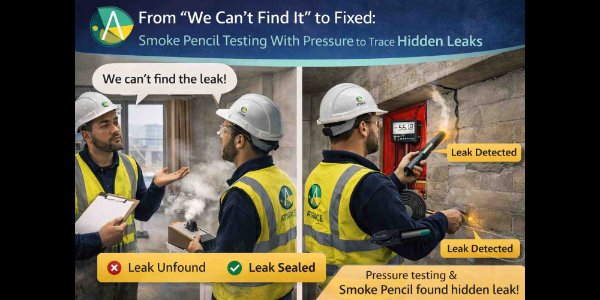
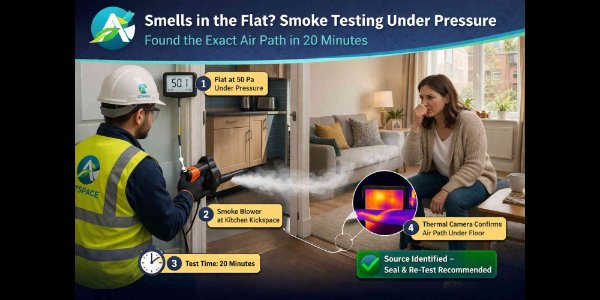
Yes. Smoke testing is one of the clearest ways to show where air is entering or escaping under a pressure difference. On site, it is particularly effective because it turns an invisible problem into something the contractor, site manager and installer can all see immediately. That makes remedials faster, more targeted and far less reliant on “seal everything and hope” thinking.
Yes. Smoke testing is one of the quickest ways to show where air is escaping from a plot, especially when the leak path is not obvious by eye. It is useful around service penetrations, dry-lined walls, loft details, window interfaces and boxed-in bathroom areas. On a failed or borderline plot, smoke turns a vague problem into a clear remedial list, which is why it is commonly paired with airtightness testing.
Yes. Smoke testing is one of the quickest ways to show site teams exactly where air is escaping during or after a commercial air test. It is especially useful around service penetrations, shutters, roof-to-wall junctions and awkward interfaces where the defect is hard to see but easy to demonstrate once the building is under pressure. That turns a vague failure into targeted remedial work.
Yes. Smoke testing is an effective way to make invisible leakage obvious to the site team while the air barrier is still accessible. Good-practice guidance says smoke pens can be used to aid leak detection during interim testing, and ATTMA also highlights qualitative tests of building sections to identify and remediate leakage points. That makes smoke a very useful bridge between design intent and practical remedial action.
Yes. Large-scale retrofit programmes benefit from measured baseline and post-works evidence because repeated dwelling types, repeated defects and repeated details can otherwise hide in plain sight across whole portfolios. Deep-retrofit case studies have used blower door testing at multiple stages to verify improvement, and that same logic is valuable on social housing, apartment and multi-unit upgrade programmes where consistency matters just as much as one-off performance.
Yes. The SCA’s common escape route guidance is explicitly written for apartment buildings and says the same principles can be used for owner-occupied housing, social housing, assisted living, and apartments for short-term rental, including student apartments and apart-hotels, where they are designed and built to the same principles.
Not on the shaft construction itself. Current smoke shaft testing guidance says no temporary seals should be applied to the shaft construction, with temporary sealing only acceptable for items such as dampers, fans and ductwork where the method allows it. In practical terms, taping up builder’s work defects is not a real pass.
Yes, often it can. A properly planned final test can usually generate both the Passivhaus n50 result and the UK Building Regulations q50/air permeability result from the same visit, provided the building is essentially complete and the required calculations are available. That is the efficient route on UK projects, but it only works if the tester understands both standards from the start.
Yes, as a diagnostic tool rather than a substitute for proper airtightness design or formal testing. Good-practice guidance says thermal cameras can be used to aid leak detection during interim testing while the air barrier is still accessible. On site, that is helpful because it gives visual evidence of weak details and helps the team target the real problem areas instead of sealing randomly and hoping the next test improves.
Yes, in dwellings in England and Wales trickle ventilators should be closed and temporarily sealed for the air test in line with ATTMA guidance. The same guidance also says passive ventilation openings and mechanical ventilation openings should be dealt with appropriately for testing. What matters is that the temporary sealing follows the approved rules and is declared properly, not that the tester hides leakage by making up their own approach on the day.
Yes. These projects often have large volumes, repeated interfaces or specialist spaces that make airtightness more dependent on coordination than on any single product. ATTMA’s design-stage guidance highlights spaces with special needs, such as aquatic areas, performance spaces, cold storage and server rooms, as decisions that affect whole-building performance. Early airtightness advice helps those sector-specific demands feed into the enclosure strategy before site works race ahead.
No, not if they are part of the real finished envelope. Passivhaus guidance is clear that temporary sealing around non-designed leakage paths, such as holes in the fabric or gaps around frames, makes the final result invalid. The final test is there to verify the building that actually exists, not the building you wish you had built. If those details leak, they need fixing properly.
Yes. Detached houses and bungalows are straightforward residential air testing work and fall squarely within normal dwelling testing practice. ATTMA’s simple-building standard includes single dwellings, and current Part L guidance says every new dwelling should be pressure tested. The real challenge is not whether they can be tested, but whether the plot has been detailed and built tightly enough to hit the SAP design target without last-minute patching.
Yes. A flat is still a dwelling, so it can be air tested in the same way as a house, using the dwelling air pressure testing route rather than the commercial one. What changes is usually access, sequencing and interface control. Flats often have more service penetrations, tighter programmes and more coordination risk between trades, so plot readiness and consistent detailing matter even more than on a simple house build.
Yes. A retail unit air pressure test is common on single units, shopping parades and shell retail space, and the details that matter most are usually the shopfront, rear service penetrations, roller shutters and back-of-house interfaces. Small units under 500m² may choose the default-value route, but that often gives away too much in compliance terms. For repeated unit types, consistent detailing is what usually drives first-time pass success.
Yes, warehouses and industrial units can absolutely be air tested, and many do need a warehouse air test or industrial air leakage test for Part L compliance or project diagnostics. The main challenge is usually scale: large doors, big envelope areas, roof penetrations and high-level junctions all make detailing more important. On simple units the process is straightforward; on very large sheds or phased industrial projects it often needs a more considered testing strategy.
Yes. Existing homes can be air tested as a diagnostic exercise even though new-dwelling pressure testing is the main regulatory use people know about. It is useful for tracking down draughts, planning retrofit work, supporting EPC improvement strategies and avoiding guesswork before money is spent on remedials. For homeowners and landlords, that often means finding the real leakage routes instead of assuming the problem is just “poor insulation”.
Yes, office air tightness testing is routine under non-domestic Part L. Offices often look simple on paper but become tricky on site because curtain wall interfaces, risers, suspended ceilings, landlord-and-tenant boundaries and late M&E penetrations can all undermine the airtight layer. On shell-and-core offices, the key is agreeing the base-build boundary early so the test supports handover rather than becoming an argument at the end.
Yes. A self-build home follows the same new-dwelling airtightness rules as any other new house, so it should be pressure tested and the result fed into the final SAP and compliance process. The difference is usually project style rather than regulation. Self-builders often benefit from earlier advice because one missed detail around windows, loft hatches or service routes can be harder to fix once the finishes are in and there is no big site team behind it.
Yes. The same residential air test method can be used on timber frame, SIPs and masonry homes. What changes is where leakage normally appears and how the air barrier is formed. The dwelling guidance specifically highlights airtightness detailing for cavity walls, timber frame junctions, fixings, windows and doors, which is exactly why build-system-specific detailing matters. The test method is common; the route to passing first time is not.
Yes, and that is one of the strongest uses of retrofit air leakage testing. Recent deep-retrofit case studies used blower door testing at baseline and again after retrofit stages to show how airtightness changed and to estimate the effect on ventilation heat loss. That kind of before-and-after evidence is far more useful for quality control than trying to judge success by feel alone.
Yes, but only in the limited cases the scheme allows. Approved Document E and Robust Details both make clear that the Robust Details route is the alternative to routine pre-completion sound testing for new adjoined dwellings where the plots are correctly registered and built strictly to the approved detail. If those conditions are not met, the normal testing route still applies.
Yes. The final SAP calculation has to incorporate the measured air permeability. Approved Document L in England says the dwelling primary energy rate, dwelling emission rate and fabric energy efficiency rate must be recalculated using the measured air permeability, and the Welsh guidance says the same basic thing. That is why air testing and SAP should never be treated as separate workstreams.
Yes. Approved Document L says the as-built calculation of the building primary energy rate and building emission rate must incorporate the measured air permeability. It also says the final building rates calculated using the measured air permeability must not be higher than the target rates. That is why SBEM, BRUKL and airtightness testing are tightly linked.
No, not always. Straightforward extensions can often comply by following the standard elemental route in Approved Document L, but SAP-style calculations become useful where the design needs more flexibility, such as higher glazing or compensation elsewhere in the build-up. In other words, not every extension needs a full SAP trade-off, but plenty do.
Yes, in practical planning terms they do. The GLA says an energy assessment is required for all major planning applications, and London Plan Policy SI 2 says major development proposals should include a detailed energy strategy showing how the zero-carbon target will be met through the energy hierarchy. That is why a London major application without a proper Energy Statement is usually heading straight for validation or officer-query problems. (london.gov.uk , london.gov.uk)
Yes. The GLA Energy Assessment Guidance says London Plan Policy SI 4 requires all major development proposals to undertake dynamic overheating modelling. It also says this dynamic modelling is required at the planning application stage, regardless of which method may later be used to demonstrate compliance with Approved Document O.
No, but most do. In both England and Wales, buildings other than dwellings generally have to be pressure tested unless they fall into a specific permitted route, such as the sub-500m² default-value route, a large complex building strategy, or representative-area testing for compartmentalised buildings. The safest assumption on a new commercial project is that an air test will be needed unless the compliance route has been agreed early.
Yes. Under the current dwelling guidance in both England and Wales, an air pressure test should be carried out on every new dwelling. That is the key shift many site teams still miss: the old sample-testing mindset is no longer the safe assumption for new homes. If you are building a house, bungalow or flat as a new dwelling, the working assumption should be that each one needs its own compliant residential air test result.
No, but most new non-domestic buildings do. Approved Document L says buildings should generally be pressure tested except for specific routes such as buildings under 500m² using a default air-permeability value, some factory-made modular routes, certain large complex building strategies and representative-area testing for compartmentalised buildings. The safe assumption on a new commercial job is that an air test is likely unless an approved alternative route clearly applies.
No, not every plot is tested individually in the usual Part E route. Approved Document E uses sample testing, with one set taken on the first plots completed in each group or sub-group and then at least one further set for every ten dwellings, flats or rooms for residential purposes in that group or sub-group, assuming there are no failures. So the real issue is not every plot, but every construction group.
If you are following BS 9991:2024, yes. The standard now recommends that buildings above 18m use natural or mechanical smoke shafts, and direct-to-outside AOVs are no longer the recommended route for those residential situations. That is a meaningful design change, so it needs to be picked up early, not at technical submittal stage.
Under BS 9991:2024, yes for protection of stair lobbies. The updated standard says that above 30m only mechanical smoke shafts should be used, either extraction or pressurisation, and natural smoke shafts are no longer acceptable for that residential application. That change has obvious implications for shaft design, leakage control and commissioning.
Yes, under BS 9991:2024 they do. Cundall’s summary of the updated standard notes that for buildings more than 60m high, a mechanical smoke extract system needs to be designed to the principles in BS EN 12101-13, specifically Annex D. On these projects, smoke shaft testing is even less of a “nice to have” and more of a validation step in a complex engineered system.
Not always. For a non-domestic building with less than 500m² total useful floor area, the developer can avoid testing if the compliance calculation uses an air permeability of 15 m³/(h·m²) at 50Pa. That sounds convenient, but 15 is a weak default and can make SBEM compliance harder, so small offices, retail units and light industrial shells are often better off being tested properly. There is also a separate data-based route for some factory-made modular buildings under 500m².
Yes, where the end result is a building other than a dwelling and the project falls into the construction or qualifying-modification route. The non-domestic EPC guide also makes clear that a modified building requires an EPC where it ends up with more or fewer parts designed for separate occupation and the modification includes the provision or extension of fixed services such as heating, air conditioning or mechanical ventilation.
Sometimes. A commercial extension is treated as a new building, and therefore follows the new-building route, if its total useful floor area is both greater than 100m² and greater than 25% of the total useful floor area of the existing building. Once it is treated as a new building, the normal pressure-testing rules apply unless a specific alternative route is accepted. Smaller extensions still need Part L compliance work, but they are not all treated the same way.
Yes, where the conversion creates a dwelling that falls within the relevant material-change-of-use route. England’s Approved Document G applies G2 where a dwelling is formed by material change of use under regulation 5(a) or (b), and Wales does the same. In practice, a qualifying conversion still needs a Part G water-use calculation.
Yes. Official EPC guidance treats new dwellings as including new builds, conversions and change of use of existing properties. If the work creates a new dwelling unit, SAP is the correct domestic calculation route rather than the ordinary existing-house EPC method. That makes SAP calculations a core service on conversion-led residential projects.
Often, yes. New fabric elements in existing dwellings, including those constructed as part of an extension, must meet the relevant limiting standards, and highly glazed or unusual extensions often need a calculation route rather than a simple rule-of-thumb specification. On extension projects, U-value calculations are especially useful where glazing, lantern roofs or awkward existing conditions make the default route too blunt.
No. They usually sit on top of those calculations rather than replacing them. Haringey’s guidance for minor developments expressly requires SAP/BRUKL output sheets to be submitted alongside the Energy Statement, and the GLA guidance expects the energy assessment to demonstrate compliance using the appropriate modelling. In simple terms, the Energy Statement is the planning narrative and strategy document; SAP, SBEM and BRUKL are part of the technical evidence underneath it. (haringey.gov.uk , london.gov.uk)
Not as a default every time, but you should not ignore airtightness on commercial refurbishment. Approved Document F Volume 2 says that where work to an existing building is likely to increase airtightness, it should be demonstrated to Building Control that the ventilation requirements are still met. In real project terms, that makes air leakage testing a very practical tool on refurbishment, façade replacement and major service-upgrade jobs.
Not as a blanket rule. Approved Document L Volume 2 covers both new buildings and work to existing buildings, but the main mandatory air testing provisions sit around buildings treated as new buildings, including qualifying extensions. Outside that, existing commercial buildings are often tested voluntarily for diagnostics, retrofit planning or refurbishment risk reduction. The real question is what regulated work is being done and what evidence the project needs.
Not automatically. Current research for DESNZ notes that existing dwellings do not have a universal air permeability compliance threshold to meet after retrofit, even though new dwellings do. That said, Approved Document F allows expert advice on existing homes to include an air permeability test, so testing is often the smartest way to judge how much the retrofit has changed the building and whether the ventilation strategy still makes sense.
Yes. Mechanical ventilation still needs proper commissioning and, where the regulations require it, airflow measurements and handover information. That applies in dwellings and also in non-domestic settings where new or altered systems are part of the work. A tighter envelope does not remove that duty. In fact, once infiltration has been reduced, correct ventilation commissioning becomes even more important.
Yes. Mechanical ventilation systems in new dwellings must still be commissioned and their airflow rates measured, including intermittent extract and continuous systems such as MVHR. The air test does not replace that requirement. In practice, both pieces of evidence matter: the air test proves the dwelling envelope performance, and the airflow measurements prove the ventilation system is delivering what the design requires.
Yes, the current dwelling guidance points to every dwelling being pressure tested, so each flat should be treated as needing its own result. That is the safe approach for apartment delivery. The flat itself is a dwelling, while common areas are dealt with separately under different guidance depending on whether they are heated or unheated. For developers, that means planning the testing strategy unit by unit rather than assuming the block gets one blanket number.
Not usually. The formal dwelling pressure-testing guidance is tied to a dwelling being erected, while the extension guidance for existing dwellings focuses on thermal elements and services rather than a mandatory pressure test on the whole home. In practice, most ordinary extensions are not booked for a formal Part L air test unless the project is creating a new dwelling or extra evidence is specifically needed. Diagnostic testing can still be useful where draughts or performance are a concern.
Yes, in current practice you should assume every plot needs its own test result. The guidance for new dwellings in both England and Wales says an air pressure test should be carried out on every dwelling, which means each house or flat needs to stand on its own result rather than relying on an old representative sample approach. For developers and site managers, that makes plot readiness and sequencing far more important than they used to be.
Yes, for a new dwelling the air test is part of the compliance evidence Building Control will rely on. The building control body may accept a pressure test certificate as evidence that the dwelling complies with the testing requirement, and the measured result also feeds the final compliance calculations. In simple terms, no valid plot result usually means no clean route to the final Part L paperwork and sign-off.
Usually, yes, unless you are providing an equivalent ventilation solution. Approved Document F says if the original windows had background ventilators, the replacements should include them, and where windows without vents are replaced the new work should not leave the dwelling worse off for ventilation. The guidance also gives common replacement equivalent areas such as 8,000mm² in habitable rooms and kitchens and 4,000mm² in bathrooms in typical dwelling scenarios.
Often, yes. Approved Document L says U-values should be assessed using the methods and conventions in BR 443, so where the construction is bespoke, traded off, or not covered cleanly by a simple product certificate, Building Control will usually expect proper evidence. On straightforward jobs that may be simple; on unusual details it becomes a core part of the compliance package.
Usually, yes. Good products help, but airtightness is lost at buildable interfaces, not because a tape brochure was weak. Approved Document L says junctions should be reviewed to check they are buildable and that construction sequencing is properly considered, and ATTMA’s design-stage guidance focuses on whether the wall air barrier actually joins the roof and floor assemblies. Robust junction design beats heroic product use every time.
Yes. For buildings with Vn50 ≥ 1500m³, both n50 and qE50 should be reported. That is a key point on schools, offices and other bigger projects. Passivhaus Trust guidance also flags that large buildings need more careful airtightness planning and early certifier discussion because the geometry and testing strategy can become more demanding than on a straightforward house.
Yes. SAP remains the approved methodology for new dwellings, and government guidance says it is used to demonstrate compliance of new homes with Part L. Whether the project is a single self-build house or a multi-flat scheme, the domestic dwellings sit on the SAP side of the regime.
Yes. New buildings other than dwellings sit under Approved Document L Volume 2, and the limiting performance of roofs, walls, floors, windows, doors and rooflights depends on correct U-values. Those figures then feed the SBEM/DSM model and the BRUKL report, so on commercial jobs the U-value work is part of the wider compliance model, not a stand-alone afterthought.
Yes. New dwellings fall directly within the Part G water-efficiency regime. In England, that means complying with the 125 litres/person/day standard unless the optional 110 litres/person/day requirement has been imposed. In Wales, newly erected dwellings are set at 110 litres/person/day.
Yes. Passivhaus testing generally requires both negative pressure and positive pressure measurements. That is one of the clear differences from a lot of standard UK compliance conversations, where people only focus on “doing an air test” in a generic sense. For Passivhaus certification, both directions improve confidence in the result and are part of the expected method.
Yes. Current Approved Document L guidance in England and Wales says thermal bridging should be reasonably limited, and both routes provide recognised ways to assess it. In practical terms, PSI values are part of showing that the building fabric is continuous, heat loss is being controlled at junctions, and the design is not quietly losing performance where the main U-values look good on paper.
Yes. SAP Appendix K says non-repeating thermal bridges are not included in the element U-values and should therefore be explicitly included in the heat-loss calculation using either Σ(L × Ψ) or a suitable y-value method. On domestic projects, this means PSI values directly affect the dwelling’s heat-loss picture and therefore the wider SAP result.
Yes. Current non-domestic Part L guidance says thermal bridging should be addressed in the design and construction of a building, and that suitable junction details can then be used in the building primary energy rate and building emission rate calculations. So on commercial jobs, PSI values feed directly into BRUKL/SBEM performance, not just into a separate detail pack.
Yes. The official non-dwelling EPC guide says that where building units are let as bare structures without services, but there is an expectation they will be fitted out and energy will be used to condition the indoor climate, an EPC should still be provided. Approved Document L also has dedicated shell-and-core provisions for the design-stage and as-built Part L calculations.
Yes. Current SCA guidance says a builder’s work smoke shaft should be smooth internally. That matters because rough, irregular or incomplete internal surfaces make leakage harder to control and can undermine both air tightness and clean commissioning. It is a simple requirement that still gets missed on live sites.
Yes. Under the current dwelling guidance, natural ventilation with intermittent extract fans — the industry’s old System 1 shorthand — relies on background ventilators plus intermittent extract. The minimum equivalent areas for natural ventilation are set out in Table 1.7 of Approved Document F, so background ventilator sizing is still a core compliance issue on these homes.
Yes. Continuous mechanical extract ventilation — the old System 3 shorthand — still needs background ventilators in habitable rooms. Approved Document F says these ventilators should not be in wet rooms, should provide at least 4,000 mm² equivalent area for each habitable room, and the total number should be the number of bedrooms plus two. So MEV is not a no-trickle-vent system.
Yes. Water traps should be filled before the test, or temporarily sealed if water is not present yet. This is standard test preparation because open drainage routes can distort the result and send the team chasing the wrong problem. It is a small detail, but on a low-leakage building, small details are exactly what matter.
No, not always. UK policy work on SMETER is built around smart meter and other data, but SmartHTC-type services can also work with manual service-meter readings where the method allows it. In practice, a smart meter usually makes data collection cleaner and less admin-heavy, but it is not the only possible route on every project.
Yes, on most projects you do. Hold points are the moments where airtightness work must be checked before follow-on trades cover it up. The Passivhaus Trust’s guidance says airtightness workshops should discuss hold points and the testing regime so sealing works are checked before hidden areas are allowed to proceed. On real sites, hold points are what stop airtightness becoming somebody else’s problem later in the programme.
You do not always need one formally named, but in practice a clear airtightness lead is a very good idea. Good-practice guidance says an airtightness specialist or airtightness champion should review continuity across work packages so responsibilities do not fall between contracts, and toolbox talks are ideally delivered by that person. On busier sites, having no owner for airtightness is usually the fastest route to gaps and finger-pointing.
Yes, on most UK projects you effectively do. Passivhaus certification needs the airtightness result in n50, while Building Regulations compliance is usually judged using air permeability under Part L. The smart move is to plan one certifier-ready test strategy that satisfies both, rather than treating Passivhaus and Part L as separate last-minute exercises.
Yes. A tighter home changes the ventilation assumptions, so the ventilation strategy should always be checked alongside the fabric strategy. Approved Document L tells designers to consider infiltration and follow Approved Document F, and the natural ventilation guidance in Approved Document F is only intended for less airtight dwellings. That is why airtightness advice on housing sites should never stop at tapes and membranes.
Yes. Approved Document F Volume 2 says reducing infiltration in an existing building can reduce indoor air quality below the performance standards. Where building work affects ventilation, the building should either meet the relevant standards or be no less satisfactory than before. On commercial refurbishments, that means airtightness upgrades, replacement façades and door changes should be reviewed with the ventilation strategy, not treated as isolated fabric work.
Yes. Approved Document F is explicit that reducing infiltration in an existing dwelling can reduce indoor air quality below the required standard. It also says the assessment may involve expert advice and can include an air permeability test following Approved Document L procedures. So on retrofit and upgrade work, airtightness advice should look at ventilation impact at the same time as heat loss reduction, not months later when condensation complaints start.
Yes. Official EPC guidance says new dwellings include conversions and change of use, and the glossary also says SAP is the approved methodology for producing an EPC for a newly constructed dwelling, while RdSAP is for existing dwellings. That is the clearest regulatory reason this service is the right one for conversions creating dwellings.
Yes. The final airtightness test is part of the certification evidence, so a failed result can hold up certification until remedials are done and the building is retested. On live jobs, that can also affect practical completion, employer’s requirements and handover documents if the project was sold internally or externally as Passivhaus. The later the failure is discovered, the more painful that usually becomes.
Yes, that is the current direction of the guidance. Approved Document B says smoke shafts in the common escape route arrangement should be constructed from Class A1 material, and the SCA’s 2024 statement says smoke shaft and duct materials should be Class A1 reaction to fire as a minimum. This is not a detail to leave vague in the spec.
Yes. Approved Document L says U-values should be assessed for the whole fabric element, and BR 443 explains that for windows and roof windows the U-value is that of the complete unit, including the glazing, frame and the junction effects between them. That is why centre-pane values alone are not enough for compliance.
Yes. Part L compliance depends on more than a final test number, and airtightness design advice helps the team build what the compliance model assumed. In dwellings, the final energy calculation uses the measured air permeability; in non-domestic buildings, the as-built calculation also uses the measured result. Good on-site advice helps protect that design target by dealing with air barrier continuity and workmanship before defects become compliance failures.
Yes. Apartment and mixed-use schemes need airtightness boundaries to be agreed properly because dwellings, heated common areas and commercial space are not all treated under the same guidance. Approved Document L Volume 1 applies to the dwellings, while heated common areas and commercial or retail space fall under Volume 2. Good airtightness advice helps teams avoid blurred boundaries that later confuse testing, evidence and sign-off.
Yes, it should. Airtightness, insulation continuity and thermal bridging overlap at the same junctions, so separating them too rigidly usually creates problems. Approved Document L for both dwellings and non-domestic buildings links continuous insulation, limited thermal bridging and buildable details, with on-site audits before details are concealed. Good airtightness advice should therefore review leakage risk and thermal continuity together, especially at floors, openings and roof edges.
Yes. Airtightness and ventilation have to be designed together, not as separate workstreams. Approved Document L explicitly says infiltration should be considered when specifying purpose-provided ventilation and directs users to Approved Document F. If a building is tightened without thinking about the ventilation strategy, you can solve one problem and create another. Good advice keeps the fabric target and ventilation design aligned from the start.
Yes. We are proud that 91% of our business comes from returning clients and that we have an 87% first pass rate across all services. Those figures reflect the trust our clients place in us and our focus on getting things right first time wherever possible.
Yes. TrustMark describes the IAA process as a TrustMark-approved approach to measure and address background ventilation requirements under PAS 2035 pathways, and TrustMark’s 2023 retrofit design guidance recognises the IAA background ventilation assessment as a route for deciding whether background ventilation upgrades are needed. In practical terms, it gives Retrofit Coordinators and Designers evidence instead of guesswork.
No. A commercial building can beat 8.0 and still fail the overall Part L compliance check if the measured air permeability is worse than the value assumed in the as-built model and the BER/BPER ends up above the target. This is a common commercial trap: the air test looks acceptable in isolation, but the full compliance package still fails. Always check the SBEM/BRUKL target, not just the limiting standard.
Usually, yes. Good-practice guidance says the pressure differential imposed on a building, usually during depressurisation testing, accelerates airflow through leakage points and makes them easier to identify. That is why many airtightness technicians prefer depressurisation for leak finding. It gives clearer visual movement and often makes hidden leakage paths easier to trace back to source.
Yes. A final airtightness test is part of the evidence required for Passivhaus certification. Passivhaus Trust guidance is clear that compliance tests are required on completion, and its airtightness guidance also notes that Passivhaus expects testing across all builds, including refurbishment projects aiming for certification. On a real project, the final test is not optional admin; it is part of sign-off.
On a new-build handover, the safe assumption is yes if the shaft forms part of the smoke control strategy. SCA guidance treats testing and witness acceptance as fundamental, and current market practice also extends smoke shaft testing to existing buildings where evidence is needed after alterations, remedials or compliance concerns. Waiting until someone asks for proof is usually what creates delay.
It can, if the ventilation strategy is not reviewed at the same time. Approved Document F warns that reducing infiltration in an existing dwelling can reduce indoor air quality below the required standard, and the same logic applies to moisture risk. Airtightness improvement is not the enemy; unmanaged airtightness improvement is. The safe retrofit approach is to tighten and ventilate in a controlled way together.
Yes, in current England guidance it does. Approved Document O says the guidance applies to new residential buildings only. The same core position exists in Wales, where the current Approved Document O says it applies when a new residential building is erected. That makes Part O a new-build residential overheating regime, not a blanket rule for all building work.
No, not currently in England. The official England FAQ says Part O does not apply to buildings undergoing a change of use, and the 2023 consultation documents also state that MCU dwellings are currently outside scope. In Wales, the current Approved Document O applies when a new residential building is erected, so the live Welsh scope is also not a blanket change-of-use route.
Yes. Approved Document F in both England and Wales says many existing dwellings rely on infiltration and that energy efficiency measures may reduce that infiltration enough to cause under-ventilation. Retrofit air leakage testing gives measured evidence of how tight the home has become, which helps decide whether the existing vents and extract are still adequate or whether the ventilation strategy needs upgrading.
Yes. PAS 2035 uses a whole-house retrofit process, and Approved Document F says following PAS 2035 is considered an adequate means of demonstrating compliance for ventilation in existing dwellings. A measured air leakage test strengthens that process because it gives the Retrofit Coordinator and designer real evidence about infiltration, likely ventilation impact and whether the retrofit is delivering what the assessment assumed.
Yes. PAS 2038 is the recognised route for non-domestic retrofit, and airtightness evidence can be very useful where commercial refurbishment is likely to change infiltration, comfort and ventilation performance. Approved Document F Volume 2 makes clear that increased airtightness in existing non-domestic buildings has to be considered alongside ventilation, so measured testing can reduce risk on offices, public buildings and other live refurbishment projects.
No. Air leakage testing tells you how much uncontrolled air is moving through the fabric, but it does not prove the ventilation system is delivering the airflow rates it should. Those are separate questions. On retrofit, the biggest mistake is to assume a tighter building automatically means a properly ventilated one. It does not. Airtightness evidence and ventilation commissioning need to work together.
No, not today. Government has explored HTC as a possible fabric metric within EPC reform, but it has also said that directly incorporating SMETER outputs into HEM inputs is not straightforward or appropriate in many cases. So Smart HTC is valuable for design, retrofit and verification work now, but it is not currently a straight substitute for the regulated EPC process.
No. It is one critical part of smoke-control verification, but it does not replace full commissioning. BS 7346-8 is the recognised code of practice for commissioning and acceptance testing, and SCA guidance treats testing of the smoke control system against the design criteria as a broader process than just measuring shaft leakage.
Yes. Smoke is one of the quickest ways to show where air is moving through gaps, cracks and junctions during a retrofit air leakage survey. It is especially useful in older buildings and occupied properties because the leakage path becomes visible to the installer, project manager and client at the same time. That usually makes remedials faster and more precise.
Yes, often it does. The official non-domestic EPC guide says that if a building is modified so it will have more or fewer parts designed to be used separately, and the modification includes the provision or extension of fixed services for heating, hot water, air conditioning or mechanical ventilation, an EPC is required when the work is complete. That is a classic trigger on subdivision and reconfiguration jobs.
Yes. System 1 still includes mechanical extract fans, so the airflow from those fans has to be checked. Approved Document F says airflow testing applies to intermittent extract fans as well as continuous systems, and that the readings must be recorded on the commissioning sheet. The fact that the whole system is “natural plus intermittent” does not take the fan testing out of scope.
Yes. System 3 is a continuous mechanical system, so airflow measurement and balancing are central to commissioning it properly. Approved Document F says continuous mechanical extract systems should be balanced to achieve design airflow rates at each room terminal, and the measured flows should be recorded. On a live site, System 3 is not something you just power up and assume is fine.
No. Approved Document F says background ventilators should not be installed with mechanical ventilation with heat recovery, because they create unintended air pathways. On existing dwellings moving to MVHR, the guidance also says existing background ventilators should be covered or sealed shut. That is one of the clearest differences between MEV and MVHR from a background-ventilation point of view.
Yes, absolutely. MVHR is a whole-house mechanical system, so both the extract and supply sides need proper airflow measurement and commissioning. Approved Document F treats continuous supply fans and terminals, and MVHR-type systems, as part of the flow-testing regime. In practice, System 4 is the route where poor commissioning is most likely to waste the benefit of a good design.
Often, yes. If the occupier’s first fit-out provides or extends heating, hot water, air-conditioning or mechanical ventilation into that space, a new Part L submission is required for the relevant part of the building. Even where those systems are not extended, other compliance obligations can still apply. That is why shell-and-core air testing, landlord assumptions and tenant fit-out scope all need to line up before anyone starts relying on the original paperwork.
Yes. The measured air permeability is used in the final compliance calculation for the dwelling, so the air test result directly affects whether the as-built home still meets its approved energy targets. That is why residential air testing and SAP cannot be treated as separate workstreams. If the tested result comes out worse than expected, the assessor has to rerun the final numbers and the plot can fall out of compliance.
Yes. On a new dwelling, SAP is used both for Part L compliance and for producing the home’s EPC, so the final measured airtightness can influence the energy rating that ends up on the certificate. That makes the air test commercially important as well as regulatory. A weaker-than-expected result can affect the final paperwork handed to buyers, lenders and Building Control, not just the site file.
Yes. The SCA warns that increased leakage and pressure drop can drive the need for larger fans and higher negative pressures, and smoke-control manufacturers also note that keeping shaft leakage within the accepted limit helps the design extract rates be achieved without oversizing the system. A leaky shaft is not just a paperwork problem; it changes how the system performs.
Yes. For natural smoke shafts, Approved Document B sets out minimum geometric criteria such as 1.5m² shaft area and 1m² free-area vents, and testing checklists also require drawings because the leakage rate depends on the shaft envelope area. If the shaft dimensions are unclear or the geometry changes late, the testing and the smoke-control design both become harder to trust.
Not by itself. The leakage test focuses on the shaft envelope, while the wider smoke-control commissioning process also has to prove system operation, cause-and-effect and, for mechanical systems, extract rates. SCA guidance is clear that BS 7346-8 governs commissioning and acceptance testing, and that extract rates on mechanical systems should also be proven.
Yes. Passivhaus testing is not just “a normal air test with a tighter target”. The tester needs to understand Vn50, dual-direction testing, large-building qE50 reporting, temporary sealing rules and the level of documentation a certifier will expect. A tester who only thinks in basic Part L terms can still produce a result, but not always one that survives Passivhaus certification scrutiny.
Yes. Thermal imaging is a very useful diagnostic tool for identifying areas affected by air leakage, especially when used alongside a pressure difference. It does not replace proper airtightness testing, but it can help the team spot weak details, track leakage paths and focus remedials more efficiently than visual inspection alone. Used properly, it speeds up diagnosis and reduces unnecessary rework.
Yes. Thermal imaging is a very useful companion to retrofit air leakage testing because it helps show where cold air paths and weak details are affecting the thermal envelope. Used alongside a pressure difference, it can reveal leakage routes that are hard to identify by eye alone. That makes it valuable for diagnosis, staged retrofit quality checks and explaining problems clearly to building owners.
Yes, thermal imaging can be very effective, especially when there is a usable temperature difference between inside and outside. It does not replace the formal air permeability test, but it is a strong diagnostic tool for tracing leakage paths and insulation discontinuities before or after a failed test. On large commercial envelopes, combining thermal imaging with pressure testing usually speeds up remedials because the sealing team can see where to focus.
Yes, provided there is enough temperature difference to make the leaks visible. Thermal imaging does not replace the formal air test, but it is a very useful diagnostic tool for tracking down cold air paths, missing insulation continuity and weak details that are hard to spot otherwise. Used alongside pressurisation or depressurisation, it can help the site team fix the real causes of draughts rather than sealing randomly and hoping for the best.
No. This service is for new-build commercial buildings and commercial buildings created or reconfigured through conversion or qualifying modification, not the ordinary EPC route for an existing office, shop, warehouse or industrial unit being re-let or sold in its existing form. If the premises is simply an existing non-domestic property on the market, that is a different EPC workflow.
No. This service is for new-build dwellings and new dwellings created by conversion or change of use, not for standard existing-house EPCs. Official guidance is clear that RdSAP is the simpler method used for existing dwellings, whereas SAP is the approved methodology for a newly constructed dwelling.
Yes. Wind and large natural pressure differences can affect the reliability of the measurement. That is true on any blower door test, but it becomes even more important when a project is chasing Passivhaus-level airtightness or when the building is tall or exposed. Good testers do not just look at the fan number; they also check the weather and the natural pressure conditions behind it.
They need to be handled explicitly, not assumed away. In UK Building Regulations, heated common areas and non-dwelling parts of a mixed-use building follow the non-domestic route, not the dwelling route. Passivhaus testing has to respect those boundaries too. If residential units and commercial or communal areas are thermally and airtightness-separated, they may need separate testing and separate compliance thinking.
You pass a commercial air test first time by treating airtightness as a build-quality issue, not a last-day certificate issue. Set a realistic design target in SBEM, define the air barrier early, brief every trade that penetrates it, inspect sealing before finishes hide defects, and use a pre-test check before the formal visit. The sites that “get it right first time” are usually the ones that control interfaces and late changes, not the ones that rely on panic sealing at the end.
You pass a residential air test first time by treating airtightness as a design-and-build issue, not a mastic exercise at the end. Define the air barrier early, brief every trade that penetrates it, inspect dry-lining and service routes before they are covered up, and use an early pre-test or advisory visit if the target is tight. The plots that pass first time are usually the ones with controlled details, not the ones with the biggest panic on test day.
Pass first time by treating the shaft as a specialist work package, not a generic riser. Confirm the target early, build the shaft to the correct material and fire-separation standard, seal AOV frames and penetrations properly, and test the builder’s work shaft before the smoke-control kit goes in. Sites that leave it to the last week usually create their own rework.
Prepare it exactly as the tester instructs, but expect the basics to include controlled access, closed windows and doors, attention to ventilation settings, filled water traps and clear access to key areas. Historic England notes that preparation may also require sealing certain openings and, on some buildings, carrying out the survey out of hours. Good preparation is what stops a retrofit test from becoming a wasted visit.
Choose someone who understands both compliance and buildability, has experience on your building type, and can talk comfortably to designers, façade teams and site managers. For testing, the regulations expect appropriate training and registration for the relevant class of building, and ATTMA also distinguishes between simple, non-simple and large or complex buildings. For design advice, the same principle applies: pick someone who has done your kind of job before.
Choose a specialist who understands smoke control, not just generic building air tests. SCA guidance recommends competent organisations with appropriate smoke-control expertise, and broader industry competency work stresses that competent people are needed at design, installation, commissioning and handover stages. In simple terms, pick a team that can work with the fire engineer, smoke control contractor and Building Control without guessing.
You pass first time by designing airtightness in early, not by trying to rescue it at the end. Define the air barrier clearly, minimise penetrations, keep services out of the airtight layer where possible, sequence window and junction details properly, run preliminary tests while the layer is still accessible, and fix real defects rather than relying on cosmetic sealing. The projects that pass cleanly are the ones that manage airtightness as a work package from day one.
Pass first time by treating ventilation as a commissioned system, not a last-day certificate. Make sure the right system type was chosen for the dwelling airtightness, install the terminals and ductwork properly, leave background ventilators in the correct state for the system, balance System 3 and System 4 properly, and only book the test when the plot is genuinely ready. The projects that pass cleanly are usually the ones that coordinate Part F, airtightness and handover from the start.
Diagnostic smoke testing works because air pressure testing creates the pressure difference that makes hidden leakage paths obvious. During airtightness testing, usually under depressurisation, air is pulled faster through cracks and gaps, so smoke becomes a visual indicator of where the building is actually leaking. In simple terms, the pressure test gives you the condition; the smoke helps you see the cause.
SBEM is the compliance calculation method behind many commercial Part L submissions, so the air permeability target in the model and the result from the site test have to align. The design-stage value affects the early BRUKL, and the measured result from the finished building is then used in the as-built BER/BPER calculation. That is why commercial air leakage testing should never be treated as a last-minute bolt-on; it needs to be coordinated with the energy assessor from the start.
Smart HTC works by combining measured energy use, internal temperature data and weather data to estimate the home’s in-use Heat Transfer Coefficient. Government describes SMETER methods as analysing the relationship between metered gas and electricity consumption and indoor/outdoor temperature differences, while SmartHTC-type services add practical data collection and processing to turn that into a usable whole-home heat loss result. The key advantage is that the home can usually stay occupied and be monitored as normal.
They are separate tests, but they are closely linked. Air pressure testing measures uncontrolled leakage through the building fabric, while ventilation flow rate testing measures the purpose-provided ventilation system. Approved Document F uses airtightness thresholds to decide whether natural-ventilation guidance is appropriate, and it also notes that MVHR efficiency improves as the dwelling becomes more airtight. Build tight, ventilate right is not just a slogan; it is how the two compliance strands fit together.
We work hard to keep your project moving, which is why we aim to return certificates before 12pm the next day. Fast certification is a key part of our service and helps our clients avoid unnecessary delays at handover stage.
Air leakage on-site design advice is prevention; an air leakage test is verification. The advice happens earlier and focuses on drawings, sequencing, interfaces and site quality checks, while the formal test measures the finished building’s air permeability and feeds the compliance process. One helps you avoid problems; the other proves what was actually built. The strongest projects use both, not one instead of the other.
It is related, but it is not the same thing. Standard Part L airtightness testing is an energy-compliance pressure test typically reported as air permeability at 50Pa, while the IAA / TrustMark background ventilation assessment for existing dwellings uses dwelling-level air-change evidence at 4Pa to help decide whether background ventilator upgrades are needed. The equipment can overlap, but the purpose, thresholds and reporting logic are different.
Background ventilation testing is about the passive provision of outdoor air into the dwelling, while ventilation flow rate testing is about the measured airflow of mechanical fans and systems. Part F requires mechanical airflow measurement for intermittent extract, MEV and MVHR systems, but background ventilators are sized by equivalent area and verified differently. In simple terms, one checks the passive air-in route; the other checks the powered air-movement route.
Commercial air testing is more model-driven and more varied in methodology than residential air testing. Non-domestic projects use Approved Document L Volume 2 and SBEM or other approved NCM software rather than SAP, and they can involve routes such as large complex building strategies or representative-area testing for compartmentalised buildings. On site, commercial testing is also more likely to involve multi-fan setups, shell-and-core boundaries, phasing and live-trade coordination.
Diagnostic air leakage testing is for fault-finding; a formal air test is for compliance. A diagnostic visit is there to locate leakage paths, explain why the building is leaking and guide remedial works. A formal Part L pressure test is the one used to produce the measured air permeability result for compliance and Building Control evidence. The two work best together: diagnostics help you fix the problem, and the formal test proves the finished result.
n50 is based on the heated internal air volume, while q50 or UK air permeability is based on the area of the building envelope. That is why Passivhaus teams talk about air changes per hour, while Part L teams usually talk about m³/(h·m²) at 50Pa. The same test data can often produce both numbers, but only if the volume and envelope area have been calculated properly.
Pre-improvement testing is diagnostic and design-led; pre-completion testing is formal compliance testing after the works. Approved Document E says sound insulation testing for compliance with Requirement E1 is carried out on site as part of the construction process and refers to that as pre-completion testing. Pre-improvement testing happens earlier to benchmark the existing condition and reduce the risk of designing the wrong upgrade.
Residential air testing sits under Approved Document L Volume 1 and SAP, while commercial air testing sits under Volume 2 and non-domestic methods such as SBEM. Dwellings are self-contained residential units, so the compliance route, terminology and supporting paperwork are different from office, retail or warehouse projects. For builders, the practical difference is simple: houses and flats are assessed as dwellings, not as non-domestic buildings with a residential label stuck on.
Vn50 is calculated as the air volume within the heated building envelope that is actually being heated or cooled. It should be worked out room by room, following the PHI criteria, rather than guessed from a simple gross internal volume. That detail matters because the airtightness result is divided by this volume, so a sloppy Vn50 calculation can distort the headline n50 figure.
A straightforward commercial air pressure test often takes around 2 to 4 hours on site, but large or complex buildings can take much longer. The real time driver is not just the pressure sequence itself; it is access, fan setup, zoning, temporary sealing, diagnostics and any remedial work carried out during the visit. Simple units can be quicker, while warehouses, offices and multi-fan jobs can take much of the day.
There is no single fixed duration. A compact dwelling can be relatively quick, but Passivhaus tests often take longer than a basic compliance-only visit because they require both pressurisation and depressurisation, Passivhaus-specific reporting, and often some level of leak checking or discussion with the site team. Simple projects are fast; complex or large-volume projects need more time and more control.
A standard residential air test usually takes around 45 minutes on a ready plot, although you should allow extra time for setup, access, site briefing and any diagnostic work. The test itself is not normally the slow part. Delays usually come from unfinished plots, missing components, poor access or remedials that have to be done while the tester is on site. On a well-prepared house, it should be a quick job rather than a day-long problem.
There is no single fixed duration. A simple existing-home blower door test can be relatively straightforward once the property is prepared, but occupied buildings, diagnostics, smoke work, thermography and multi-zone refurbishment all take longer. On retrofit jobs, preparation is often the real time driver: access, sealed openings, water traps, ventilation settings and coordination with occupants or site teams can matter as much as the fan test itself.
It depends on shaft size, height, access and whether diagnostics are needed. Published guidance from testing providers suggests a smaller single shaft may take around 1 to 2 hours, while larger buildings or multiple shafts often take 2 to 4 hours or more, and full site attendance is commonly longer once setup and investigation are included.
Commercial air test cost in the UK depends mainly on size, complexity and how much equipment or labour the building needs. Published provider pricing shows simple single-fan commercial tests starting from around £450 + VAT, while larger or more complex buildings are often priced per engineer per day, with examples around £650 to £850 per engineer per day. Pre-test inspections, diagnostics, travel, out-of-hours work and retests usually change the number.
For a straightforward new dwelling, published UK pricing suggests a typical residential air test is often marketed from around £95 to £200+VAT for a single plot, with much lower per-plot rates available on multi-unit sites. The final number depends on location, plot type, travel, urgency and whether retesting or diagnostics are needed. For developers, the cheapest quote is not always the cheapest outcome if it leads to rework or handover delay.
There is no fixed national rate for Passivhaus air leakage testing. In practice, it is usually quoted individually because the scope varies: preliminary tests, final certification testing, Vn50 calculations, large-building qE50 reporting, diagnostics and travel all change the job. The real cost risk on Passivhaus projects is rarely the test itself; it is late failures, rework and retesting when airtightness has not been managed properly.
After handover, the smoke-control system needs routine testing and maintenance, not just a one-off memory of the construction test. Industry guidance tied to BS 7346-8, BS 9999 and the BS EN 12101 family points to weekly and monthly checks with annual competent-person servicing, and more detailed periodic testing depending on the system. A fresh shaft leakage test is sensible after major alterations, damage or repeated faults.
We understand how quickly programmes can change, which is why we focus on fast response times and practical support. We offer same day email responses, a 48 hour lead time emergency booking service, and where needed, we can put urgent enquiries straight through to a technical expert.
That depends on what is leaking, but many residential failures can be turned around quickly when the leakage paths are diagnosed properly on the day. Straightforward sealing issues around penetrations, loft details or windows can often be fixed fast, while hidden problems behind finishes take longer. The quickest route is usually a tester who can help pinpoint the real faults straight away, so the site team is not burning a day on guesswork.
That depends on what is leaking, but many commercial failures can be turned around quickly if the leakage points are diagnosed properly on the day. Straightforward issues around penetrations, shutters or perimeter seals can sometimes be fixed during the visit or shortly after, while bigger envelope defects take longer. The quickest route is a tester who can diagnose and guide remedials, not just read out a fail number and leave site.
That depends on what is leaking, but many residential failures can be turned around quickly when the leakage paths are diagnosed properly on the day. Straightforward sealing issues around penetrations, loft details or windows can often be fixed fast, while hidden problems behind finishes take longer. The quickest route is usually a tester who can help pinpoint the real faults straight away, so the site team is not burning a day on guesswork.
Many UK providers advertise certificates within 24 hours, and some promote same-day issue when the plot passes. That speed matters because the certificate is often needed straight away for final SAP and Building Control paperwork. The regulations also require the results to be given to the local authority within a defined timeframe, so dependable reporting is part of keeping completion moving, not just a nice extra.
Many UK providers advertise certificates within 24 hours, and some offer same-day issue when needed. That speed matters because the result often feeds straight into the final Part L paperwork and practical completion process. On a live commercial site, the real win is dependable turnaround: clear onsite feedback, a certificate that arrives when promised, and no chasing when the energy assessor needs the final number.
No. In England, 110 litres/person/day is an optional requirement, not the national default. The live national standard is 125 litres/person/day, and the tighter 110 only applies where planning permission specifically requires it as a condition.
It is best treated as the accepted industry benchmark, not a magic number you assume without checking the fire strategy. The SCA guide says it is derived from leakage data for walls in BS EN 12101-6 and used to set a benchmark for the shaft, while other industry sources note that individual projects can specify different limits.
No. A commercial EPC is an asset rating based on the building’s calculated energy performance, while a DEC is an operational rating based on the actual energy consumption of certain public buildings. The official DEC guide says a DEC reflects actual metered use over the previous 12 months, whereas the approved methodology notice for EPCs describes the EPC route as an asset-rating calculation.
No. The EPC is part of the overall energy-performance picture, but it is not the whole Part L evidence package on its own. For new dwellings, Approved Document L also relies on the relevant BREL or BRWL compliance report and associated evidence to show that what was designed is what was built. So the EPC matters, but it is not the only Part L document.
No. A pulse test is a different airtightness measurement method that works at much lower pressure, while a blower door test uses sustained fan pressurisation or depressurisation. Both can be useful in retrofit, but a blower door test is still the more familiar route when you need detailed leakage diagnosis and a conventional air permeability result for comparison.
No. Air leakage testing measures uncontrolled leakage through the building envelope, while ventilation commissioning checks whether the installed ventilation system is delivering the required airflow. They are separate compliance tasks with separate notices and evidence. A dwelling can be airtight and still have poorly commissioned ventilation, and a commissioned ventilation system does not prove the plot’s envelope is tight enough for Part L.
No. It is just as useful on straightforward Part L projects as it is on low-energy or Passivhaus schemes. Approved Document L already expects clear air barrier drawings, continuity of insulation, buildable junctions and on-site audits before details are concealed, so even “standard” projects still need airtightness thinking. The service becomes more valuable as targets tighten, but it is not only for specialist buildings.
No. There is not one blanket national rule saying every planning application in England or Wales must include an Energy Statement. In practice, the requirement usually comes from local planning policy and the local validation list. That is why some councils require them for all major schemes, while others also ask for them on specific minor developments. (broxtowe.gov.uk , westmorlandandfurness.gov.uk , westminster.gov.uk)
Yes. Current official technical notes say it is a legal requirement for all new build domestic dwellings in England and Wales to have an EPC once completed. That is the baseline rule. In practice, developers may also lodge one earlier on the planned design and then update it later if the dwelling changes during construction.
Not always. A Part O assessment is specifically the Building Regulations route for qualifying new residential buildings. An overheating assessment can also be a planning-stage exercise, especially in London, where dynamic modelling is required on major developments even if the design team later uses a different compliance route for Building Regulations.
Yes, in most UK commercial contexts, commercial airtightness testing and a blower door test mean the same basic fan pressurisation method. On larger buildings, the setup may use multiple fans and a more involved testing strategy, but the principle is unchanged: create a pressure difference, measure air flow, and calculate leakage through the building envelope. The test checks uncontrolled leakage, not the performance of the planned ventilation system.
No. Part L requires formal pressure testing in the situations set out in Approved Document L, but diagnostic smoke testing itself is a support service rather than a standalone regulatory requirement. In practice, it is used because it helps teams pass the formal test, avoid late failures and understand the real leakage routes before Building Control paperwork becomes critical-path.
No. A formal air pressure test measures the building’s airtightness result for compliance or certification, while diagnostic smoke testing is there to find the leakage paths that sit behind that result. TM23 covers the formal measurement of building air leakage, whereas smoke diagnostics are the practical site tool that helps the team understand why the building is leaking.
No. Diagnostic smoke testing in relation to air pressure testing is a building-fabric leakage tool. Smoke shaft testing and smoke-control system testing are fire-safety services dealing with smoke ventilation shafts, ducts and life-safety systems under a different standards framework. They may both involve “smoke”, but they are not the same discipline and should not be confused in the specification.
No. Building Control sign-off depends on a valid formal pressure test result and the associated compliance evidence, not on a diagnostic survey alone. Diagnostic fans and interim leak-finding tools are useful for identifying problems, but they are not a substitute for a compliant final test result. In plain terms, diagnostics help you get the pass, but they are not the pass.
Yes, usually, but it should be selective and informed. Historic England is clear that draught-proofing can be beneficial, but older buildings often rely on certain ventilation routes, and some spaces such as roof voids, subfloors and rooms with combustion appliances should not simply be sealed up. On traditional buildings, the smart approach is controlled draught reduction, not blanket closure of every air path.
In most cases, yes. ATTMA states plainly that the sooner airtightness problems are identified in the design phase, the more cost-effective the remedies are. Once the issue is hidden behind finishes, fit-out or repeated façade works, every fix costs more in labour, access, rework and programme disruption. Early advice is not an added burden on a healthy job; it is often what keeps remedials from becoming expensive.
Yes, especially where the project relies on repeated façade details, unfamiliar interfaces or large areas of the same build-up. ATTMA recommends observing mock-up tests as early as possible and applying the findings going forward, and good-practice guidance for more complex projects also recognises partial, preliminary and localised testing or mock-up delivery as useful verification. It is far cheaper to prove one detail early than to rework a whole elevation later.
Yes. Passive House air leakage testing uses the same core fan pressurisation method that most people call a blower door test. The difference is not the fan itself, but the standard, the reporting and the level of scrutiny. A Passivhaus test has to follow the right procedure, use the correct reference volume, and produce results the certifier can rely on for certification.
Yes. “Passive House” and “Passivhaus” refer to the same building standard developed by the Passive House Institute. In the UK, Passivhaus is usually the preferred spelling because it better reflects the original standard and helps avoid confusion with broader ideas like passive solar design or passive ventilation. For SEO, it is worth targeting both spellings, but technically they mean the same thing here.
No, not in itself. The legal requirement under Part E is normally the post-works route: either appropriate pre-completion testing or, in eligible new-build cases, the Robust Details route. Pre-improvement testing is optional, but it is a very practical way to inform design and avoid failed final tests on conversions and upgrades.
No. Pre-improvement sound insulation testing is mainly about how sound passes through the building fabric, whereas BS 8233 and BS 4142 are used to assess external or environmental noise conditions in different ways. ANC’s conversion guidance treats these as related but distinct workstreams: one for the internal separation strategy and one for the wider acoustic environment affecting the development.
Yes. In UK residential work, airtightness testing, air leakage testing, air pressure testing and blower door testing usually describe the same fan pressurisation method. A calibrated fan is fitted into an external opening, the dwelling is pressurised or depressurised, and the airflow needed to maintain the test pressure is used to calculate leakage. The wording changes from one contractor or consultant to another, but the core test method is the same.
No, not as a blanket rule. There is no general UK rule saying every retrofit project must have a formal air leakage test in the way new dwellings do. In practice, it becomes valuable where the work is likely to change airtightness materially, where ventilation needs to be reassessed, or where the client wants measured before-and-after evidence instead of relying on assumptions.
Yes, in most UK retrofit projects, retrofit air leakage testing and a blower door test mean the same fan pressurisation method. The building is put under a controlled pressure difference and the airflow needed to maintain that pressure is measured. On retrofit jobs, the difference is usually in the purpose: the test is often being used for diagnosis, baseline evidence and before-and-after comparison, not just formal compliance.
Yes. Government has updated the approved methodology from SAP 10.2 to SAP 10.3, and its SAP guidance says SAP 10.3 will initially be the sole approved methodology while the Home Energy Model is delayed. At the same time, the wider 2026 Future Homes Standard regulations generally take effect from 24 March 2027, so project timing and transitional arrangements still matter.
No. SBEM is the calculation engine or approved modelling route, while BRUKL is the standardised Building Regulations UK Part L compliance report produced from the approved software. Approved Document L says SBEM will produce the BRUKL report as a standard output option. In simple terms, SBEM does the maths; BRUKL is the compliance report you hand over.
No. Smart HTC is an in-use measurement method for occupied homes, while co-heating and the newer aggregate heat loss test are standardised tests on unoccupied buildings using installed heaters and fans. Government’s GHG-SMETER work says the in-use HTC includes the occupied home’s actual behaviour and systems, whereas aggregate heat loss testing focuses on standardised fabric performance without deliberate ventilation. They are related, but not interchangeable.
Not exactly. SMETER is the government umbrella term for technologies that use smart meter and other data to measure the thermal performance of homes, while Smart HTC is the market term many people use for a measured HTC service of that kind. In everyday use they overlap heavily, but SMETER is the broader policy and innovation-programme label.
Not as a single standalone line that says “air test the shaft,” but in practice a shaft that forms part of the smoke control strategy is expected to be tested and accepted before handover. Approved Document B requires smoke control to common escape routes and firefighting shafts, and SCA guidance says the installer should test the system and offer it for witness testing to the authority having jurisdiction under BS 7346-8 practice.
No. A whole-building air test is about overall building airtightness, usually for Part L energy compliance, while smoke shaft testing is about the shaft envelope meeting the smoke-control leakage target written into the fire strategy or smoke-control design. One checks energy performance of the building; the other checks life-safety performance of the shaft.
It is a Building Regulations Part L issue, not a planning-permission test in itself. You may be under permitted development for planning and still need Building Regulations approval for the extension. In other words, a scheme can be lawful in planning terms and still need overglazed extension calculations for Building Control.
No. It is the default guidance limit, not an absolute ban. Both England and Wales provide alternative approaches that allow more glazing if the design is compensated properly. That is exactly why overglazed extension calculations exist in the first place.
No. The air test is essential, but it is only one part of Passivhaus certification. PHI and the Passivhaus Trust both make clear that certification also depends on the PHPP model, design and planning documents, connection details, ventilation commissioning evidence, contractor declarations, photographic records and independent third-party review. The air test proves airtightness; it does not prove the whole Passivhaus standard on its own.
No. The EPC is part of the overall energy-performance package, but it is not the same thing as full Part L compliance evidence. For non-domestic new buildings, Approved Document L requires design-stage and as-built BRUKL reports, target and building primary energy and emission rates, plus supporting specification lists. The EPC matters, but it is not the only document Building Control relies on.
Yes. The Passivhaus airtightness result is normally taken as the average of the pressurisation and depressurisation results. That matters because a big gap between the two directions can point to testing issues, wind effects or a weak detail behaving differently under positive and negative pressure. A clean, believable average is what the certifier wants to see.
Yes, much stricter. Passivhaus uses n50, based on heated internal volume, while Part L in the UK uses air permeability in m³/(h·m²) at 50Pa, so the numbers are not directly comparable. Even so, Part L’s limiting standard is far looser than Passivhaus. In practice, a building can be perfectly legal under Part L and still be nowhere near good enough for Passivhaus certification.
No single universal pass mark applies across retrofit work. Existing-home retrofit currently does not have the same across-the-board airtightness threshold that new-build Part L compliance uses, so the meaningful target is usually project-specific. A good retrofit brief sets a clear aim at the start: diagnose draughts, verify improvement, inform ventilation design, support PAS 2035, or benchmark a portfolio for future works.
No. Approved Document E is clear that the performance values already include a built-in allowance for measurement uncertainty, so if a test misses the relevant value by any margin, it is a fail. That is a crucial point for developers and contractors: there is no informal pass zone just under the line.
No, not automatically. PHPP contains different reference volumes for different purposes, and the blower door test uses the specific Vn50 reference volume for airtightness. Teams sometimes blur these numbers together, especially on bigger or more complex projects, but the certifier will expect the dedicated test volume to be calculated correctly rather than lifted from a rough model assumption.
Yes, on most projects you do. Hold points are the moments where airtightness work must be checked before follow-on trades cover it up. The Passivhaus Trust’s guidance says airtightness workshops should discuss hold points and the testing regime so sealing works are checked before hidden areas are allowed to proceed. On real sites, hold points are what stop airtightness becoming somebody else’s problem later in the programme.
Yes. That is exactly when it should be checked. Approved Document L requires on-site audits before elements are concealed by subsequent work, and those audits should confirm the designed details have actually been built. Once dry-lining, ceilings, joinery or fit-out cover the problem, the same defect becomes slower, messier and more expensive to fix. This is one of the biggest “get it right first time” moments on site.
Yes, on most commercial projects a pre-test inspection is worth it. It gives the site team a chance to spot obvious leakage paths, incomplete sealing and coordination issues before the formal air permeability test becomes a critical-path event. On offices, warehouses, retail units and mixed-use schemes, that early check is often cheaper than a failed test, a retest fee and a handover delay.
Yes, especially on larger plots, tighter targets or sites with repeated failure risk. An early diagnostic visit helps identify obvious leakage paths while the trades still have access to fix them properly. That is usually far cheaper than failing the formal test, rebooking the engineer and holding up SAP and Building Control paperwork. For developers chasing first-time pass rates, pre-test advice is often one of the best-value steps on the job.
Yes. Internal doors should generally be wedged open so pressure can equalise through the tested volume. That helps the test reflect the whole heated envelope rather than a set of disconnected pockets. Closing doors to manipulate pressure conditions is not smart site practice; it just makes the result less believable and less useful.
Yes, wherever practical. The cleanest airtightness details usually come from keeping services out of the airtight layer rather than trying to seal dozens of late penetrations through it. The Passivhaus Trust specifically recommends minimising interactions between the air barrier and services and notes that a service void can help achieve that. It is a simple move that reduces both workmanship risk and remedial cost.
Yes, that is best practice. Industry guidance and manufacturer commentary both point to pressure testing the builder’s work shaft before ventilation equipment or dampers are installed, because leaks are easier and cheaper to find at that stage. Once the kit is in, access gets tighter and the fault-finding gets slower.
These are classic high-risk areas and usually deserve focused review. ATTMA’s design-stage guidance asks how the wall air barrier joins the roof and floor and whether materials and sealants are compatible, while good-practice airtightness guidance repeatedly highlights interface continuity and sequencing. Façade packages often look complete in isolation but still leak where they meet the rest of the envelope. That is why pre-installation coordination matters so much.
Heated common areas in buildings containing more than one dwelling are not treated as dwellings for Part L purposes. In England, the guidance says heated common areas should follow Approved Document L Volume 2, while the flats themselves follow Volume 1 as dwellings. That distinction matters on apartment schemes because the residential units and the shared heated corridors or lobbies should not be bundled into one simplified testing assumption.
Cost is mainly driven by building height, number of shafts, size and complexity of each shaft, access, and whether the test has to be done out of hours or with diagnostics. That is why a quick single-shaft visit is a different price from a high-rise scheme with multiple shafts, live-site constraints and remedial support built in.
Cost is mainly driven by scope and complexity. A simple one-off site review is very different from a full package covering design review, workshops, repeated site visits, evidence strategy, preliminary testing and support on a large or phased building. The more interfaces, unusual details, fit-out uncertainty and interim checks a project needs, the more involved the advice becomes. The right question is usually not “what is the cheapest visit?” but “what level of support avoids rework?”
Cost is driven by scope more than by the fan itself. A single baseline blower door test on one property is a very different job from a staged retrofit package covering pre-works testing, post-works verification, smoke, thermography and reporting across occupied units. Size, access, number of visits, diagnostics and the level of evidence you need for design or asset planning are usually the biggest price drivers.
The headline airtightness target for EnerPHit is n50 ≤ 1.0 ACH @ 50Pa. That is less strict than full Passivhaus, which reflects the practical limits of many retrofit projects, but it is still a demanding airtightness standard by mainstream UK expectations. On site, it still needs careful detailing, smart sequencing and usually some diagnostic support to get there reliably.
The headline airtightness target for PHI Low Energy Building is also n50 ≤ 1.0 ACH @ 50Pa. PHI developed this standard for buildings that either deliberately target that level or come close to Passivhaus but miss the full Passivhaus benchmark. It is not the same badge as Passivhaus, but it is still a structured, evidence-based certification route with meaningful quality assurance behind it.
Overglazed extension calculations are the Part L compliance calculations used when a domestic extension has more glazing than the default guidance allows. In practice, they show Building Control that the extra glass is being compensated for properly, either through a U-value trade-off route or a SAP / benchmark extension route, depending on the project and the jurisdiction.
PSI values are linear thermal transmittance values used to quantify the extra heat loss at a junction that is not already included in the plane-element U-values. In practical terms, they tell you how much additional heat is escaping where walls, floors, roofs and openings meet. That is why PSI values sit at the centre of thermal-bridge calculations for Part L, SAP and BRUKL work.
SAP calculations are the Standard Assessment Procedure calculations used to assess the energy performance of dwellings. In practice, they are used to show that a new home or newly created dwelling meets the relevant energy targets and to support the EPC route for that dwelling. They are the core Part L domestic calculation method, not just an admin extra at the end.
SBEM calculations are the Simplified Building Energy Model calculations used to assess the energy performance of buildings that are not dwellings. In practice, they are used to support Part L compliance, generate BRUKL reports, and feed the non-domestic EPC route where the approved methodology allows it. For most straightforward commercial projects, SBEM is the standard calculation engine behind non-domestic energy compliance.
The biggest mistakes are sealing without checking ventilation, relying too heavily on secondary sealants, and treating retrofit airtightness as a snagging issue rather than a design-and-delivery issue. DESNZ research highlights overreliance on secondary sealing as poor long-term practice, and Approved Document F is clear that tightening an existing building can reduce ventilation below a satisfactory level if nobody checks the outcome.
For the current live England dwelling guidance, the limiting values in Table 4.1 are 0.16 for all roof types, 0.26 for walls, 0.18 for floors, 1.6 for windows, 2.2 for rooflights and 1.6 for doors. Those are only the limiting values, though. The notional new-dwelling specification used for target setting is tighter again, with 0.18 walls, 0.13 floors, 0.11 roofs and 1.2 windows/glazed doors.
The key requirement is that the completed dwelling must meet the airtightness backstop and still comply with the SAP-based energy calculation using the measured result. In both England and Wales, the limiting air permeability for a new dwelling is 8.0 m³/(h·m²) at 50Pa, but the measured value must also not push the dwelling’s final energy metrics beyond the approved target values. In other words, passing the backstop alone is not always enough.
In Wales, Section 13 gives two optional routes for more design flexibility. The first is the U-value trade-off approach. The second is the Equivalent Primary Energy and Carbon Emissions Target approach, which uses SAP 10 and a fully compliant benchmark extension or conversion. Those are the two live Welsh routes when the default extension rules are too restrictive for the design.
In England there are two main alternative routes. The first is the area-weighted U-value route for all thermal elements in the extension. The second is the SAP / notional extension route, where the dwelling plus proposed extension is compared against the dwelling plus a compliant notional extension. Which one works best depends on how far over the default glazing limit the design has gone.
For System 1 intermittent extract, the key minimum rates are 30 l/s for a kitchen where the cooker hood extracts outside, 60 l/s where it does not, 30 l/s for a utility room, 15 l/s for a bathroom and 6 l/s for sanitary accommodation. These are the baseline Part F numbers the fan test is checking against for intermittent operation.
The usual culprits are service penetrations, window and door interfaces, thresholds, loft hatches, sockets, meter boxes, dry-lining edges, poor masonry details and awkward junctions. Recent DESNZ research also says airtightness failure points typically relate to the air barrier, junctions, window seals and door seals, with poor sealing and poor workmanship making things worse.
The most common leakage points are usually service penetrations, weak junctions, openings around windows and doors, loft hatches, chimneys, and areas where old and new work meet badly. DESNZ research also points to careless interaction with the primary air barrier and poor workmanship as repeated causes of leakage. In other words, retrofit failures are usually about interfaces and execution, not a lack of sealant.
The usual culprits are service penetrations, window and door interfaces, meter boxes, junctions at roof and floor level, internal walls crossing the air barrier, and any detail where one trade assumes another trade has sealed it. Dwelling guidance also flags penetrating elements such as steel beams and incoming services, while good-practice guidance repeatedly points to internal wall junctions and penetrations as high-risk areas.
The common leakage points are usually junctions, joints, frames and architraves around AOV openings, cable penetrations, conduits and other service interfaces. Several specialist testing sources also flag the shaft head, base and access door interfaces as repeat offenders. These are exactly the details that cause pain at handover if nobody checks them early.
The key Part L requirement is that the completed building must meet both the airtightness backstop and the project’s energy model. For new buildings other than dwellings, the limiting air permeability is 8.0 m³/(h·m²) at 50Pa, but the measured result must also keep the as-built BER/BPER no worse than the target rates in the final SBEM/BRUKL submission. As of March 2026, England is still working to Approved Document L Volume 2, 2021 edition incorporating 2023 amendments, while Wales uses its own Volume 2 guidance.
U-value calculations are the thermal calculations used to show how much heat passes through a building element such as a wall, roof, floor, window or door. In practical terms, they are used to support Part L compliance, SAP, SBEM, BRUKL, extension trade-offs, and many Building Control submissions where the build-up is bespoke and the thermal performance needs to be evidenced properly.
Water efficiency calculations are the Part G calculations used to show that a dwelling’s proposed sanitary fittings and relevant appliances do not exceed the permitted water-use limit. In practical terms, they prove whether the design of the home’s cold and hot water systems complies with the approved water-efficiency standard for that dwelling.
For this route, a compartmentalised commercial building is one split into self-contained units with no internal connections between them. Think repeated retail units or similar business units where one tested area can fairly represent the next. If the internal layout changes, the details vary, or the units connect internally, representative testing becomes harder to justify and Building Control may want a different approach.
In England, the NPPF says major development means 10 or more homes, or a site of 0.5 hectares or more where the number of homes is unknown. For non-residential development, it means 1,000m² or more of additional floorspace, or a site of 1 hectare or more. That definition matters because many Energy Statement requirements, especially in London and in local validation lists, are triggered at the “major” threshold. (assets.publishing.service.gov.uk)
For EPC purposes, official guidance says new dwellings cover new builds as well as conversions and change of use of existing properties. The glossary gives examples such as converting a house into self-contained flats or changing a church into a dwelling. So the key question is whether you are creating a new dwelling unit, not simply working on an old house.
You should get more than just a headline number. A useful retrofit air leakage report normally gives the measured result, explains what that means for the building, and where relevant identifies the main leakage paths and likely next steps. On before-and-after retrofit work, the real value is the evidence it creates for design decisions, ventilation review, QA and proving whether the upgrade actually worked.
It means the shaft is allowed to leak no more than 3.8 cubic metres of air per hour for every square metre of shaft area when tested at a 50 pascal pressure difference. In plain English, the lower the number, the tighter the shaft. On site, this is the benchmark most teams are trying to beat before smoke-control commissioning moves on.
In London major development, it means the scheme must achieve a minimum on-site reduction of at least 35% beyond Building Regulations. Policy SI 2 also says residential development should achieve 10% through energy efficiency measures and non-residential development should achieve 15% through energy efficiency measures within that hierarchy. This is one of the core numbers most London planning officers look for first. (london.gov.uk)
A proper review usually includes air barrier drawings, key junctions, service penetrations, product compatibility, sequencing, hold points, installer responsibilities, evidence capture and the testing plan. On larger projects it can also include site management procedures, a roles matrix, training needs and interim testing or leakage investigation strategy. The point is to turn airtightness from a vague aspiration into a controlled build process.
It means the volume of air leaking through the dwelling envelope, per hour, per square metre of envelope area, when the building is tested at a pressure difference of 50 pascals. In plain English, lower numbers mean a tighter home. The 50Pa pressure gives a standard way to compare one dwelling with another, which is why it is the normal reporting metric for Part L residential air testing.
It means the volume of air leaking through the building envelope, per hour, per square metre of envelope area, when the building is tested at a pressure difference of 50 pascals. In plain terms, lower numbers mean a tighter building. The 50Pa test pressure gives a consistent basis for comparing results and is the standard reporting method used for non-domestic Part L air testing.
It means the volume of air leaking through the dwelling envelope, per hour, per square metre of envelope area, when the building is tested at a pressure difference of 50 pascals. In plain English, lower numbers mean a tighter home. The 50Pa pressure gives a standard way to compare one dwelling with another, which is why it is the normal reporting metric for Part L residential air testing.
n50 means the number of times the air inside the heated envelope would be replaced in one hour when the building is tested at 50 pascals. It is a volumetric airtightness metric, so it reflects the relationship between leakage airflow and the building’s test volume. Lower is better. On a Passivhaus job, that single figure becomes one of the most watched numbers on the whole project.
Review all drawings that affect the envelope, not just one “airtightness detail” sheet. Approved Document L expects drawings to clearly identify the position, continuity and extent of the air barrier, and it also expects insulation layers and junction details to be checked for continuity, buildability and sequencing. In practice, that means plans, sections, wall types, roof details, window interfaces, penetrations and service routes all need reviewing together.
The main equipment is a fan pressurisation system, usually called a blower door, used to create a pressure difference across the building envelope. On retrofit projects that core setup is often supported by smoke, thermal imaging and other diagnostic tools so the survey does more than produce a number. The aim is to find where air is leaking and why, not just confirm that leakage exists.
Keep the air barrier drawings, key detail drawings, installation photos before concealment, site audit records, specification changes and the final compliance reports. For dwellings in England that means the BREL report and photographic evidence; for non-domestic projects it means the BRUKL reports and supporting specification lists. Good practice also supports retaining sign-off records, installer evidence and photos linked to hold points and site leakage audits.
If a project misses 0.6 ACH, it does not meet the Passivhaus airtightness criterion and cannot be certified as Passivhaus Classic, Plus or Premium unless the issue is fixed and the building is retested. Depending on the wider project and whether it is new build or retrofit, the certifier may discuss PHI Low Energy Building or EnerPHit as alternatives, but that is not automatic and the rest of the criteria still have to stack up.
If it fails, the leakage paths have to be found, sealed and retested before the shaft can be relied on for smoke-control acceptance. In practical terms that usually means delayed commissioning, more visits, more trade coordination and a risk to handover. The earlier you diagnose the failure, the cheaper it is to recover.
The shaft may need remedial sealing or further investigation before it can be signed off.
The result can guide further investigation into fabric heat loss, air leakage or upgrade priorities.
If any individual airborne or impact result in a set misses the relevant standard, the set has failed. Approved Document E says remedial treatment should then be applied to the rooms that failed, and the developer must satisfy Building Control that the issue has been addressed. That is why a failed sound test is rarely just one room’s problem.
If the test volume is wrong, the n50 result is wrong. That can make a building look tighter or leakier than it really is and can create unnecessary arguments with the certifier later. On a Passivhaus project, this is not a minor admin detail. If the denominator is wrong, the flagship airtightness result is wrong as well, which is why room-by-room volume work needs to be taken seriously.
If you fail a commercial air test, the building air permeability has to be improved and the building retested until it meets the required criteria. Approved Document L also requires the results of all pressure tests, including failures, to be reported to Building Control. In real project terms, that can mean remedial sealing, delayed paperwork, disrupted handover and extra cost, so fast diagnosis matters just as much as the retest itself.
If a dwelling fails, the air permeability has to be improved and the home retested until it meets the relevant criteria. The guidance also says all pressure test results, including failures, should be reported to the building control body. In practical terms, that means extra sealing work, lost time, another test fee and potential delay to final SAP, EPC and handover. Failing is recoverable, but it is never programme-neutral.
The engineer sets up a fan arrangement to seal and pressurise or depressurise the shaft, measures the airflow needed to maintain the test pressure, and calculates the leakage rate against the shaft area. If the result is close or the shaft fails, smoke and sometimes thermal imaging are then used to show the site team where the leakage paths actually are.
On the day, the engineer installs one or more calibrated fans in an external opening, prepares the building in line with the approved method, runs the pressure sequence and calculates the resulting air permeability at 50Pa. On commercial projects, the visit often also includes site checks and leakage diagnostics if the result is close or the building fails. The aim is not just to produce a number, but to produce a result that stands up for compliance.
On test day, the engineer fits a calibrated fan into an external opening, prepares the dwelling in line with the approved method, runs the pressure test and calculates the air permeability result at 50Pa. If the plot is close to target or fails, many testers will also help identify leakage paths so the site team can fix the right issues instead of guessing. The aim is not just to produce a number, but to produce a usable compliance result.
For the continuous systems, the minimum high-rate extract figures are 13 l/s for a kitchen, 8 l/s for a utility room, 8 l/s for a bathroom and 6 l/s for sanitary accommodation. These are the same high-rate wet-room benchmarks used for both continuous mechanical extract ventilation and MVHR-type systems. They are the key room-by-room boost numbers the commissioning process checks.
Approved Document L provides a route for that. If Building Control agrees that sealing off and testing the extension separately is impractical, a large extension can be treated as a large complex building and follow the strategy-based route instead. The important part is agreeing that approach early, with evidence, rather than discovering too late that the extension cannot be isolated for testing.
That can create a ventilation issue as well as a compliance question. Approved Document F says that where a naturally ventilated dwelling has a measured air permeability that makes it a highly airtight dwelling, expert advice should be sought or a continuous mechanical extract ventilation system should be installed. In plain terms, a “better” air test result is not automatically problem-free if the ventilation design has not kept up.
The exact information and preparation needed depends on the project. We issue a booking checklist or information request when the job is booked, and supporting guidance is available in our knowledge hub. Final advice, readiness and outcomes depend on the information supplied, site condition and scope at the time.
Have the shaft drawings, target leakage rate, build stage, access details and any temporary sealing plan ready before booking. Practical smoke shaft checklists also ask for the shaft envelope information up front because the leakage rate is calculated against area, so without drawings or dimensions the tester cannot price or report the job properly.
A BRUKL report is the Building Regulations UK Part L compliance report used to show energy-compliance evidence for a non-domestic building. Approved Document L in England says the BRUKL report should be provided to the Building Control body and to the building owner to show that the work complies with the energy-efficiency requirements, and that SBEM produces it as a standard output.
A BRUKL report is the Building Regulations UK Part L compliance report produced from the approved software for a non-domestic building. Approved Document L says it should be provided to the Building Control body and to the building owner to show that the work complies with the energy-efficiency requirements. In practical terms, it is the core Part L reporting output behind commercial compliance.
A good result is one that comfortably beats your project-specific target, not just the legal limit. For most commercial schemes, 8.0 m³/(h·m²) at 50Pa is only the backstop, and better-performing projects often need materially tighter results to keep SBEM/BRUKL compliant; in England’s current NCM, notional building air permeability values are 3 or 5 depending on activity type. In practice, “good” means enough margin to protect sign-off, not just enough to survive the day.
A good result is one that comfortably beats the plot’s SAP design target, not one that merely scrapes under the legal limit. The regulatory backstop is 8.0 m³/(h·m²) at 50Pa, but current reference specifications point much tighter than that, with England’s notional dwelling and Wales’s elemental specification both using 5.0. In practice, a “good” result gives enough margin to protect compliance and avoid last-minute ventilation or SAP headaches.
A good retrofit result is one that materially improves the home against its own starting point without creating a ventilation problem. Recent DESNZ work found the GB housing stock had a mean air permeability of 8.6 m³/(h·m²) at 50Pa, with a very wide spread, so “good” in retrofit is about meaningful improvement and healthy ventilation, not blindly chasing new-build numbers on an older property.
There is no one-size-fits-all “good” Smart HTC number because the result depends on the size, shape and condition of the home. In practice, a good result is one that is lower than the baseline you started with, or one that confirms the home is not losing as much heat as a conventional survey assumed. For comparing different homes, the HLP is usually more useful than raw HTC because it normalises by floor area.
A highly airtight dwelling is one with a design air permeability below 5 m³/(h·m²) at 50Pa or an as-built air permeability below 3 m³/(h·m²) at 50Pa. That definition matters because the ventilation guidance changes once the dwelling crosses that threshold. For designers and self-builders chasing very low test numbers, this is the point where the ventilation strategy needs real care rather than basic assumptions.
Under Approved Document F, a highly airtight dwelling is one with a design air permeability below 5 m³/(h·m²) at 50Pa or an as-built value below 3. That matters because once a retrofit home becomes that tight, you should not assume background leakage will still help ventilate it. At that point, the ventilation strategy needs much closer attention.
A New Build/Conversion Commercial EPC Assessment is the non-domestic EPC assessment used for a new commercial building or a commercial building created or materially modified by conversion. In practice, it is the route used for offices, retail units, industrial units, warehouses and other buildings other than dwellings when the EPC is linked to construction completion or qualifying modification, not a routine existing-premises sale or renewal EPC.
A New Build/Conversion Domestic EPC Assessment is the SAP-based energy assessment used for a newly constructed dwelling, including a new home created by conversion or change of use. It is not the existing-house EPC route. In practice, it is the assessment used to generate the domestic EPC for a new dwelling and to support the wider energy-compliance process around that dwelling.
A smoke shaft is a fire-resisting vertical shaft or duct used to move smoke and heat from the fire floor to outside while maintaining fire separation from the rest of the building. In day-to-day project language, it is the riser that supports the smoke ventilation strategy for corridors, lobbies or other protected routes.
A U-value is the thermal transmittance of a building element. It shows the rate of heat loss through that element for each degree of temperature difference between inside and outside. BR 443 explains that the U-value multiplied by the element area gives the heat-loss rate through that component, which is why it matters so much in Building Regulations and energy calculations.
Air leakage on-site design advice is proactive airtightness support that helps the design and site team define the air barrier, review junctions and penetrations, and check workmanship before hidden defects are sealed in. In practice, it sits between pure design and the final test. The aim is simple: make the air barrier clear, buildable and continuous, so the project is not relying on last-minute sealing to hit its target.
An air barrier strategy is the project-wide plan showing where the airtight layer is, how it connects at every junction, who is responsible for each section, what products are being used and how compliance will be checked. On better-run jobs it also defines management on site, evidence requirements and the testing regime. Without that strategy, teams tend to discover the real airtightness line only when the building fails or comes in too close for comfort.
An Energy Statement is a planning-stage report that explains how a proposed development will reduce energy demand and carbon emissions in line with the relevant planning policies. In practical terms, it shows the local planning authority how the scheme is expected to perform, what measures are being used to cut emissions, and how the project responds to the relevant policy framework before planning permission is determined. (london.gov.uk , cityoflondon.gov.uk)
An overheating assessment is a report that evaluates whether a building is at risk of becoming too hot in summer and what mitigation is needed to reduce that risk. In building-regulations terms, it is the process used to show compliance with Part O for qualifying residential buildings. In planning terms, it is often a dynamic thermal modelling exercise used to show how the scheme manages heat risk through design rather than relying on late mechanical cooling.
As-built SAP is the SAP calculation based on the dwelling as actually constructed. It has to reflect specification changes made during the build and incorporate the measured air permeability. This is the version that matters at completion, because it shows whether the finished home still meets the required performance once theory has turned into site reality.
ATTMA commercial air testing usually means the work is being carried out by an ATTMA-registered tester under ATTMA technical standards. In the market, ATTMA registration is a strong sign of competence, and ATTMA’s levels distinguish simpler buildings from larger or more complex non-domestic projects. The regulations themselves do not say ATTMA is the only route, but they do require appropriate training and registration for the relevant class of building.
ATTMA residential air testing usually means the test is being carried out by an ATTMA-registered tester under ATTMA technical standards. For typical homes and other simple buildings, ATTMA TSL1 is the standard commonly used, and it defines a simple building as including single dwellings and small buildings up to 4000m³ tested as a single entity with one blower door fan. In everyday terms, it is a recognised competence route for home air testing.
ATTMA TSL4 is the UK technical standard used for air tightness testing of Passivhaus and other low-energy buildings. It is based on ISO 9972:2015 and provides the detailed testing framework that UK testers follow for this type of work. If a project is aiming for Passivhaus certification in the UK, TSL4 is the standard most teams expect the tester to understand and work to.
Background ventilation testing is a service used to assess whether a dwelling has enough background air provision for healthy ventilation, usually without relying only on assumptions or product brochures. In new-build and replacement-window work, that often means verifying the correct equivalent area and installation of background ventilators. In retrofit, it more often means the IAA / TrustMark-approved dwelling assessment used to judge whether existing infiltration is sufficient or whether extra background ventilators are needed after energy efficiency works.
CIBSE TM23 is the approved airtightness testing methodology referenced by Part L for non-domestic air pressure testing. It matters because it sets the framework for preparation, testing, reporting and leakage diagnostics, which is especially important on large, complex or unusual commercial projects. If Building Control is reviewing a strategy route or a difficult testing setup, TM23 is the document that underpins whether the approach looks credible.
TM59 is CIBSE’s Design methodology for the assessment of overheating risk in homes. CIBSE’s Knowledge Portal still lists TM59 (2017) as active, and England’s Approved Document O says the dynamic thermal modelling route should follow CIBSE’s TM59 methodology. In practical terms, TM59 is the standard residential dynamic overheating method most teams mean when they ask for an overheating assessment.
Commercial air leakage testing is a pressure test that measures how much uncontrolled air leaks through the envelope of a building other than a dwelling. The result is reported as air permeability in m³/(h·m²) at 50Pa, which is the standard Part L metric for commercial airtightness testing in the UK. In practice, it tells developers, contractors and Building Control whether the finished building is as airtight as the design and compliance model assumed.
Design-stage SAP is the SAP calculation based on the dwelling as designed before work starts. It is used to show the intended performance of the home and to support the first compliance submission to Building Control. In practice, this is the version you want locked down before site starts changing products and details under programme pressure.
Diagnostic air leakage testing is an investigative airtightness survey used to find where uncontrolled air is leaking, not just how much is leaking. The building is put under a pressure difference so leakage paths become easier to detect, then tools such as smoke, thermal imaging and airflow probes are used to pinpoint the problem areas. It is the practical fault-finding stage that helps teams fix leaks before or after a formal air test.
Diagnostic smoke testing is a leak-finding method used alongside air pressure testing to show exactly where uncontrolled air is moving through the building envelope. A blower door or similar fan creates a pressure difference, and smoke pencils or larger smoke generators make the airflow visible so the team can trace the leakage path rather than just read a final number.
Flanking transmission is sound travelling around the main separating wall or floor rather than straight through it. Approved Document E warns that extensive remedial work to reduce flanking may be needed in conversions, and ANC gives typical examples such as continuous ceilings, floors, voids and lined external walls undermining an otherwise good separating element. In acoustic upgrade work, flanking is often the difference between a pass and a fail.
Passive House air leakage testing is a blower door pressure test used to prove how airtight a building really is for Passivhaus certification. The result is reported as n50, which is the number of air changes per hour at a pressure difference of 50 pascals. In practical terms, it tells the project team and certifier whether the built envelope is tight enough to meet the standard, not just whether the design drawings looked good on paper.
Pre-improvement sound insulation testing is a baseline acoustic test carried out before upgrade works to measure how much sound currently passes through an existing wall or floor. In practical terms, it tells you the starting performance of the separating element so the upgrade can be designed around real evidence rather than guesswork. It is especially useful on existing flats, floor upgrades and conversion projects where the original construction is uncertain.
qE50 is the airtightness value referenced to the building envelope area rather than the internal volume. It becomes important on larger buildings because n50 on its own gets less meaningful as the area-to-volume ratio improves. On Passivhaus projects, qE50 is therefore used as an additional check on large buildings, especially where a simple volume-based number could otherwise flatter performance.
Residential air leakage testing is a pressure test that measures how much uncontrolled air escapes through the envelope of a dwelling. The result is reported as air permeability in m³/(h·m²) at 50Pa, which is the standard Part L measure used for new homes in England and Wales. In practical terms, it tells the builder, SAP assessor and Building Control whether the finished house or flat is as airtight as the design assumed, or whether hidden leakage is likely to cause compliance, comfort and energy-use problems.
Retrofit air leakage testing is a pressure test used on existing buildings to measure how much uncontrolled air leaks through the envelope before or after improvement works. In practical terms, it gives a measured baseline, helps identify where heat is being lost through draughts and gaps, and shows whether retrofit work has genuinely improved airtightness rather than just looking better on paper.
Smart HTC is a way of measuring the real heat loss performance of a home using Heat Transfer Coefficient data.
Smart HTC is a data-led way of measuring a home’s real heat loss in use by calculating its Heat Transfer Coefficient from meter data, temperature data and weather data. In practical terms, it tells you how much heat the whole home is losing per degree of temperature difference, based on what is actually happening in the property rather than what a visual survey assumes. It is especially useful for retrofit planning, performance-gap checks and heat pump design.
Smoke shaft air leakage testing is a specialist pressure test that checks how airtight the builder’s work smoke shaft really is before the smoke control system is signed off. In practice, it verifies that the shaft will not leak so badly that the smoke ventilation strategy loses performance in a fire. It is a fire-safety test, not an energy-compliance test.
Sound insulation testing is the on-site measurement of how much sound passes through a separating wall or floor between dwellings or rooms for residential purposes. In practical terms, it tells you whether the completed partition is stopping enough airborne noise and, where relevant, impact noise to satisfy the required standard. On UK projects, this is the Part E acoustic test most developers mean when they ask for a sound test.
The 25% rule is the default Part L limit on the opening area of a domestic extension. In England, the total area of windows, roof windows, rooflights and doors in the extension should not exceed 25% of the floor area of the extension, plus the area of any openings that no longer exist or are no longer exposed because of the extension. In Wales, the wording is very similar but uses 25% of the internal floor area of the extension.
The widely used benchmark is a maximum leakage rate of 3.8 m³/h/m² at 50Pa for the builder’s work shaft. That figure appears in current SCA/LABC guidance and is the number most project teams recognise on site. However, you should still confirm the exact project specification, because some smoke-control designs set their own criteria.
It is the trade-off method that compares the average thermal performance of the proposed extension against a compliant benchmark extension of the same size and shape. In England, the extension’s area-weighted U-value must not exceed that of an extension complying with paragraph 10.7. In Wales, the U-value trade-off approach requires the proposal’s area-weighted average U-value to be no greater than that of a fully compliant benchmark.
The best way is to treat the commercial air test as a managed work package, not a last-day formality. Freeze the target early, book the test in advance, walk the building before the visit, stop late penetrations through the air barrier, and line up diagnostics or retest support just in case. Most air test delays at practical completion come from coordination failures, not from the test itself, so the teams that plan early usually keep handover on track.
The best way is to manage the air test as part of plot delivery, not as a last-day surprise. Book early, keep a clear design target, inspect common fault areas before finishes hide them, and use pre-test advice where the plot type or target is demanding. ATTMA guidance is blunt on this point: many failed dwelling tests happen because testers are called before the plot is truly ready. Good sequencing is what keeps handover on track.
Set the target early, define the air barrier clearly, simplify details where you can, keep services away from the airtight layer, run an airtightness workshop, use hold points, inspect before closing up and carry out preliminary leak checks while the barrier is still accessible. That is the pattern repeated across Approved Document L, ATTMA guidance and good-practice airtightness delivery. Projects that pass cleanly usually manage airtightness as a process, not a last-day event.
Treat it as a design tool, not just a validation document. Start early, fix the policy baseline before modelling, coordinate SAP/SBEM/BRUKL inputs with the architect and M&E designer, and keep the overheating, heat-network and renewable strategy aligned with the planning narrative. The strongest Energy Statements are the ones that explain a settled design clearly, not the ones written at the last minute to rescue an application pack. (london.gov.uk , haringey.gov.uk)
Design the glazing with the calculation in mind from the start. Measure the opening area properly, count any lost openings correctly, choose the right compliance route early, and lock the glazing and build-up specifications before orders are placed. The jobs that go smoothly are usually the ones where the calculation leads the design, not the ones where the calculator is asked to rescue it afterward.
Treat overheating as an early design issue, not a late compliance add-on. The strongest approach is to review heat risk before the façade and services strategy are fixed, follow the cooling hierarchy, model the right sample units, and keep the analysis live as the design evolves. The GLA and CIBSE guidance both point the same way: early passive design decisions are what stop overheating becoming a late-stage problem.
Start early, model the real junctions rather than idealised ones, make sure the details are actually buildable, and keep the site team working to the same junction package that fed the SAP or BRUKL. Current Part L guidance in England and Wales keeps repeating the same message: drawings, buildability, inspection and correct methodology all matter. The projects that avoid rework are the ones that treat thermal bridging as a live design-and-site issue, not a spreadsheet exercise at the end.
Get the assessor involved early, complete the design-stage SAP before works begin, keep the specification under control, and update changes as they happen instead of trying to reconstruct them at the end. The official England and Wales process is built around design-stage and as-built reporting for exactly this reason. The projects that “get it right first time” are usually the ones that treat SAP as a live compliance tool, not a last-week certificate request.
Get the assessor involved early, complete the design-stage BRUKL before works begin, lock the building use and zoning assumptions down early, and keep a live record of every specification change during the build. Approved Document L is built around a design-stage and as-built process for exactly this reason. The projects that pass smoothly are the ones that treat SBEM as a live compliance tool, not a last-week certificate request.
Start early, fix the build-up before procurement starts, and make sure the person doing the calculations has the full specification rather than half-complete sketches and marketing sheets. The strongest projects are the ones that lock the thermal assumptions in early, keep substitutions under control, and use the right standard for the right element the first time. That is what keeps Building Control, SAP/SBEM and handover moving.
Lock the sanitaryware and relevant white goods down early, check whether the project is working to 125, 110, or the Welsh route, and do the calculation before procurement changes start. The projects that stay on programme are usually the ones that treat Part G as a live compliance item from design stage, not a last-week Building Control notice.
Book early, group the plots properly, get the acoustic design right before site locks the details in, control flanking routes, and only test when the plots are genuinely ready. ANC says the best way to maximise the chance of passing is to seek expert guidance before construction starts, and Approved Document E says specialist advice should be sought early where extra guidance is needed. The projects that pass first time usually treat acoustics as a package, not a late certificate.
Appoint the assessor early, get the design-stage SAP done before works start, keep a tight record of specification changes, and do not leave the final as-built information until the last minute. The official process in both England and Wales is built around design-stage and as-built reporting, and new dwellings must still have an EPC once complete. Projects that treat SAP, BREL / BRWL and EPC work as a live programme item usually avoid last-week problems.
Treat it as a live compliance workstream, not a final-day certificate request. The strongest route is to appoint the assessor at design stage, complete the BRUKL submission before works start, keep use-class and zoning assumptions stable, track substitutions carefully, and finalise the as-built information before Building Control is waiting on it. The legal handover duty is tied to physical completion, so late EPC work almost always becomes a programme issue.
Treat the shaft as a handover-critical package from day one. Confirm the leakage target early, test the builder’s work shaft before dampers and fans go in, make sure penetrations and AOV frames are properly sealed, and do not wait until final commissioning to discover the shaft leaks. The projects that keep programme intact are the ones that validate the shaft early, not the ones that hope it will be fine.
Use it early, and use it as evidence for the ventilation strategy rather than as a late argument after works are finished. The strongest route is to assess the existing dwelling before energy-efficiency measures, use the result to decide whether background ventilator upgrades are genuinely needed, and then repeat the required evidence after installation if you are relying on the TrustMark / IAA route. That keeps the retrofit ventilation strategy evidence-led instead of assumption-led.
Use it early, use it while the air barrier is still accessible, and use it to verify real fixes rather than cosmetic sealing. The strongest approach is to carry out interim diagnostics before the formal test, target the major leakage paths, re-check the remedials and only then move to final sign-off testing. That is how teams avoid failed tests, reduce rework and keep completion moving.
Use it early, use it under meaningful pressure, and use it while the air barrier is still accessible. The strongest process is interim air pressure testing, smoke-based leak tracing, targeted remedials and then formal verification once the defects are fixed. That approach gives the clearest route to first-time pass success, lower rework and a cleaner handover.
Use it before the upgrade design is locked, while the existing construction is still intact enough to tell you something useful. The strongest route is baseline testing or inspection, then acoustic design focused on the real weak points, then final post-works testing to verify the completed build. That sequence gives the design team evidence, reduces guesswork and makes first-time pass success far more realistic.
Use it early, use it in stages where needed, and use it alongside ventilation review rather than after the fact. The strongest retrofit process is baseline test, targeted design, interim checks where details are still accessible, then post-works verification to prove the result. That approach reduces wasted remedials, protects indoor air quality and gives the project team evidence they can actually build decisions around.
Use Smart HTC early enough to influence the decision, not after the money has already been spent. The strongest route is to measure the home before major works, combine the result with airtightness, thermography or other diagnostics where needed, and then use the measured heat-loss picture to guide retrofit scope or heat-pump sizing. Government and industry evidence both point the same way: measured performance data reduces assumption risk and makes better decisions more likely.
The cooling hierarchy is the policy sequence used to reduce heat risk before falling back on active cooling. The GLA guidance sets it out as: reduce heat entering the building, minimise internal heat generation, manage heat within the building, provide passive ventilation, provide mechanical ventilation, and only then provide active cooling systems. In practical terms, it is a design-first approach, not an air-conditioning-first approach.
The current standard in England is 125 litres per person per day for a new dwelling, unless the optional tighter requirement applies. Where planning permission specifies and conditions the optional requirement, the limit becomes 110 litres per person per day.
In Wales, the current standard is 110 litres per person per day where a dwelling is erected, and 125 litres per person per day where a dwelling is formed by material change of use within regulation 5(a) or (b). That is one of the clearest current differences between England and Wales.
The default y-value in current England and Wales dwelling guidance is 0.20 W/(m²K). Both live dwelling routes state that this can be used as the default whole-dwelling thermal-bridging allowance where more detailed junction inputs are not being used. It is simple, but it is also usually conservative compared with a well-detailed bespoke design.
A natural smoke shaft relies on natural buoyancy and opening vents, while a mechanical smoke shaft uses powered extract fans and controls to move smoke. The purpose is the same: protect escape routes by clearing smoke from lobbies or corridors. The big differences are how performance is achieved, how much space the system needs, and how the design is validated.
A U-value describes heat loss through a plane element such as a wall, roof or floor. A PSI value describes the extra heat loss at a junction between elements or around openings. BR 443 makes that split clear: repeating thermal bridges are dealt with in the U-value of the element, while non-repeating junction losses are dealt with separately using linear thermal transmittance values.
A PSI value is the heat-loss figure for one specific junction, expressed in W/m·K. A y-value is an area-normalised thermal-bridging factor, expressed in W/m²K, derived by spreading the total junction heat loss across the exposed area of the dwelling. SAP explains that where a y-value is used, it is derived by dividing the calculated thermal-bridge heat loss by the total exposed area.
A smoke shaft is the duct or riser that carries smoke to outside, while a firefighting shaft is the protected stair, lobby and often firefighting lift arrangement used by the fire and rescue service. They are related but not the same thing. A firefighting shaft needs smoke venting, and a smoke shaft may form part of how that venting is achieved.
Air leakage testing measures unwanted air escaping through the building envelope, while ventilation testing or commissioning checks whether the designed ventilation systems deliver the airflow and control performance they are supposed to provide. They are separate disciplines. A building can be very airtight and still have poor ventilation, and a well-commissioned ventilation system does not prove the envelope is airtight. Commercial projects usually need both managed properly.
The design-stage SAP is based on the dwelling as designed before work starts, while the as-built SAP is based on the dwelling as actually constructed. Approved Document L in both England and Wales requires two versions of the compliance report: first the design-stage report, then the as-built report with any changes to the specification captured. That is why late changes matter so much.
Limiting air permeability is the worst value the regulations allow, design air permeability is the target set at design stage, and assessed air permeability is the value used for final compliance based on the dwelling actually tested. That difference matters because a plot can beat the legal backstop and still miss the design value assumed in SAP. For site teams, the number that matters day to day is the design target, not just the absolute limit.
Limiting air permeability is the worst value the regulations allow, design air permeability is the target set during design, and assessed air permeability is the value used at completion based on the building actually tested. That distinction matters on commercial jobs because a building can beat the limiting value and still miss the design target assumed in SBEM. Site teams should build to the design target, not just aim to scrape under the backstop.
Limiting air permeability is the worst value the regulations allow, design air permeability is the target set at design stage, and assessed air permeability is the value used for final compliance based on the dwelling actually tested. That difference matters because a plot can beat the legal backstop and still miss the design value assumed in SAP. For site teams, the number that matters day to day is the design target, not just the absolute limit.
SAP is the government-approved methodology for producing an EPC for a newly constructed dwelling, while RdSAP is the simplified method used for existing dwellings where less information is readily available. In simple terms, SAP is the detailed new-build/conversion route; RdSAP is the existing-home route built around assumptions.
SAP is the approved methodology for producing an EPC for a newly constructed dwelling, while RdSAP is the reduced-data method used for existing dwellings. In practical terms, SAP uses detailed plans and specifications, whereas RdSAP uses an on-site survey plus conventions because much less is known about the existing home.
SBEM is the standard simplified modelling route for many non-domestic buildings, while a DSM is a more detailed Dynamic Simulation Model. Official guidance says DSMs may be used where SBEM is not sophisticated enough to provide an accurate assessment. In practice, straightforward buildings often suit SBEM, while more complex buildings or servicing arrangements may justify DSM instead.
The insulation layer slows heat flow; the air barrier controls uncontrolled air movement through the envelope. They often sit close together, but they are not the same thing. Approved Document F defines airtightness as resistance to infiltration, while Approved Document L Volume 2 says the insulation layer should abut the air barrier, or the gap between them should be filled with solid material, to avoid air movement within the construction.
The simplified method is the prescriptive Part O route based on glazing, location, shading and free-area limits. Dynamic thermal modelling is the performance route using a simulated building model to predict overheating risk. England’s Approved Document O says compliance can be demonstrated by either the simplified method in Section 1 or the dynamic thermal modelling method in Section 2. Wales also offers the same two broad routes.
The large complex building strategy route is the alternative compliance path for buildings that cannot be pressure tested practically. The strategy has to justify why testing is impractical, explain how airtightness will still be controlled, and align with CIBSE TM23. Approved Document L also makes clear that under this route it is not reasonable to claim better than 5.0 m³/(h·m²) at 50Pa, so the compliance model needs to be realistic from the outset.
The London energy hierarchy is Be Lean, Be Clean, Be Green, Be Seen. London Plan Policy SI 2 defines those steps as: use less energy, exploit local energy resources and supply efficiently, maximise on-site renewable energy, and monitor and report actual energy performance. In practice, a London Energy Statement is expected to show the carbon savings achieved at each stage, not just throw a renewable technology onto the roof at the end. (london.gov.uk)
The headline Passivhaus airtightness target is n50 ≤ 0.6 air changes per hour at 50Pa. That is the threshold for Passivhaus Classic, Plus and Premium. It is a hard quality benchmark, not a vague aspiration, which is why Passivhaus projects typically plan preliminary tests, tighter site checks and more detailed airtightness coordination than standard compliance-only jobs.
It is the whole-dwelling calculation route used to show that the dwelling plus proposed extension performs no worse than the dwelling plus a compliant benchmark or notional extension. In England, this route checks the dwelling primary energy rate, dwelling emission rate and dwelling fabric energy efficiency rate. In Wales, the equivalent primary energy and carbon route compares the proposal against a fully compliant benchmark extension or conversion.
It is the approved calculation methodology set out in Appendix A in England and Annex 2 in Wales. It is used to assess whole-house potable water consumption in new dwellings and qualifying dwelling conversions for compliance against the water-use targets in Regulation 36.
Ventilation flow rate testing is the on-site measurement of how much air a mechanical ventilation system is actually moving at each terminal or fan. In practical terms, it checks whether the installed system is delivering the airflow rates required by Part F, rather than just relying on what the product label or design intent said. On most residential jobs, it is the test people mean when they say a Part F ventilation test or extractor fan flow test.
The approved route is the National Calculation Methodology (NCM) for buildings other than dwellings, implemented through SBEM or an approved Dynamic Simulation Model (DSM). The 2026 England notice of approval says the energy performance of a building that is not a dwelling must be calculated using an approved implementation of the NCM, i.e. SBEM or an approved DSM, and the Welsh notice says the same for new buildings other than dwellings in Wales.
The certifier needs more than just a headline number. PHI’s airtightness checklist expects a proper report showing the testing standard, tester details, device used, temperatures, wind conditions, room-by-room Vn50 calculation, documented temporary sealing, fan location, and results for both positive and negative pressure. On larger buildings, qE50 also needs to be reported. A vague one-page certificate is not enough for robust certification.
You normally need the air test certificate or report, the measured air permeability value for the completion-stage calculation, and the resulting as-built BRUKL/SBEM evidence for Building Control. In England and Wales, the as-built submission is what links the site result to the BER/BPER compliance check. If there has been a failure and retest, all pressure test results, including failures, should still be reported.
For purpose-built dwelling-houses and flats, the usual field targets are 45 dB DnT,w + Ctr minimum for walls, 45 dB DnT,w + Ctr minimum for floors and stairs with a separating function, and 62 dB L’nT,w maximum for impact sound through floors and stairs. These are the main benchmarks developers are working to on new-build housing.
The main framework is Approved Document B for the fire-safety objective, BS 7346-8 for planning, commissioning and acceptance testing, BS 9991:2024 for current residential smoke-control guidance, and the BS EN 12101 product family for smoke-control components. The SCA’s 2024 materials statement also points designers toward BS EN 1366-8 and BS EN 13501-4 evidence for smoke shaft and duct construction.
You should get a clear air leakage report showing the measured leakage result, the shaft tested, the benchmark used and the outcome, plus any diagnostic findings if leaks were found. BS 7346-8 commissioning practice includes certification examples, and several smoke shaft specialists also provide a test certificate or compliance report for the handover pack. If the result is vague, expect problems later.
TrustMark’s retrofit design guidance says that, to demonstrate there is sufficient air infiltration so that background ventilation upgrades are not warranted, the IAA route requires a whole-house result of at least 1.0 ACH @ 4Pa and bedroom results of at least 1.5 ACH @ 4Pa where the bedroom test is required. These are the key benchmark numbers behind the service.
Current non-domestic guidance does not mirror the dwelling four-way route exactly. Approved Document L Volume 2 says thermal bridging should be addressed either by using construction joint details calculated by a suitably competent person following BR 497 and a defined process flow sequence, or by using generic IP 1/06 values increased by 0.04 W/(m·K) or 50%, whichever is greater. That is the current live non-domestic position.
It should cover where the air barrier is, which details are critical, what products and installation rules apply, how to deal with penetrations, what cannot be damaged or cut without approval, and what evidence the team needs to keep. Good-practice guidance says toolbox talks should brief new site workers on airtightness issues and be part of the wider training and QA process. The real aim is clarity, not paperwork.
Before the tester arrives, the plot should have fitted windows and external doors, sealed penetrations, installed sockets and switches, working power, and accessible rooms and cupboards. Common problem areas such as bath panels, loft hatches, access doors and service holes should already be sorted. The more a site relies on snagging airtightness on the morning of the test, the more likely it is to waste time, miss target or need a retest.
The day before the test, check that windows and doors are fitted, service penetrations are sealed, power is available, all relevant areas are accessible, and drainage or soil traps are dealt with in line with the tester’s instructions. This is where avoidable delays usually start. A 20-minute pre-test walk-round with the site manager can save hours of wasted attendance or a failed readiness visit the next day.
Make sure the shaft is complete, penetrations and fire-stopping are finished, debris is cleared, power is available, and the agreed openings are prepared in line with the test method. Published smoke shaft prep guides also note that all AOV doors should be shut and the top of the shaft temporarily sealed where the method requires it. That final readiness check is what protects first-time pass.
The SCA’s current statement lists the main component standards as BS EN 12101-2 for natural smoke and heat exhaust ventilators, BS EN 12101-3 for powered smoke and heat exhaust ventilators, BS EN 12101-7 for smoke control ducts, BS EN 12101-8 for smoke control dampers, and BS EN 12101-10 for power supplies. That list is useful because smoke shaft problems are rarely only about the shaft.
For dwelling-houses and flats formed by material change of use, the usual field targets are 43 dB DnT,w + Ctr minimum for walls, 43 dB DnT,w + Ctr minimum for floors and stairs with a separating function, and 64 dB L’nT,w maximum for impact sound. The conversion targets are slightly less demanding than purpose-built new build, but they are still easy to miss if flanking and retained fabric are not controlled.
Only the temporary sealing allowed by the method and fully recorded in the report. For Passivhaus testing, the building should be tested in its “as used” condition under ISO 9972 Method 1, with any temporary sealing of intended openings clearly documented. What is not acceptable is using tape or ad hoc seals to hide defects in the actual airtight envelope just to get the number down.
The core test basis is ISO 9972, Method 1, with Passivhaus-specific clarifications and additions layered on top. In the UK, final certification evidence is commonly produced in line with ATTMA TSL4, which gives a consistent route for Passivhaus and other low-energy buildings. The important point is that “ordinary air test experience” is not the same thing as following the right Passivhaus method.
As a rule, conditions become problematic when wind speeds go above about 6 m/s, and the natural pressure readings should stay within the acceptable limits in the report. PHI’s checklist notes that higher wind speeds and strong stack effect usually push natural pressure outside the acceptable range. On exposed sites and taller buildings, this is one of the biggest reasons to avoid treating the air test as a fixed appointment that must happen whatever the weather.
It is useful when you want to compare real world performance against design assumptions or understand whole house heat loss better.
For most England projects, not yet. The new 2026 Approved Document L for dwellings was published in March 2026 but generally takes effect on 24 March 2027, with a later date for work in connection with higher-risk building work. That means most live English residential air testing still sits under the 2021 edition incorporating 2023 amendments for now. Wales is separate again, with its own current dwelling guidance and its own consultation timetable.
Carry out the baseline test before major fabric works begin, while the building still reflects its real pre-retrofit condition. That gives the design team a measured starting point, helps identify major leakage routes and makes later results meaningful. For deeper retrofit, the baseline number is often just as valuable as the final one because it tells you what the project actually changed.
Book the commercial air test as soon as the target and likely completion window are clear, then confirm the site date once the envelope is genuinely close to ready. Providers commonly advertise fast booking and 24-hour certification, but late booking leaves no room for remedials, retesting or paperwork delays. On multi-site or regional programmes, using one tester with consistent coverage and reporting can also take friction out of the handover process.
Book the residential air test as soon as the build programme and likely completion window are clear, then lock in the exact slot once the plot is genuinely close to ready. Leaving it until the last minute is one of the easiest ways to create avoidable delays. Providers commonly offer quick appointments and fast certificates, but late booking gives the site team no breathing space for remedials, retesting or final SAP updates.
A shell-and-core unit should be tested when the base-build envelope is complete enough to represent the landlord handover condition and before tenant works change the compliance picture. Approved Document L recognises shell-and-core situations and requires reasonable assumptions about later services at the early stage, while the as-built calculations at practical completion are based on the building and systems actually constructed. In simple terms, test the shell when it is a real shell, not while scopes are still moving.
Test it when the builder’s work shaft is complete and airtight enough to represent the finished shaft, ideally before the smoke-control equipment is installed and certainly before commissioning becomes critical-path. That gives the team a clean read on the shaft itself and keeps remedials far simpler than trying to work around installed dampers, fans and controls later.
Book it as early as the project has a target and developing detail package, then use it again before hidden works are closed up. Good airtightness delivery is not a one-off meeting. The most useful stages are technical design, pre-start, early site setup, first key interface installations, and the point just before dry-lining or finishes hide the air barrier. That is where buildability and sequencing issues usually show up.
Hold it before the build sequence is locked in and certainly before the key airtightness interfaces are installed. Good-practice guidance places airtightness workshops in technical design and pre-construction so the team can review drawings, hold points, sequencing and testing before follow-on works make changes expensive. Waiting until the site is nearly finished turns a useful workshop into a post-mortem.
Diagnostic air leakage testing should be used before the formal test if you want the best chance of a first-time pass, and immediately after a failed test if you need targeted remedials fast. It is also useful during retrofit planning, on existing buildings with draught complaints, and on complex sites where airtightness details are hard to verify visually. The earlier it is used, the easier the fixes usually are.
The final Passivhaus air test should be carried out at completion, or very close to it, when the building reflects its normal finished condition. That final result is the one used for certification evidence. By that stage, windows, doors, services and permanent airtightness details need to be in place, because the certifier is checking the building you are actually handing over, not an idealised earlier version.
The first preliminary test should usually be done once the airtight layer is substantially complete but still accessible. That is the sweet spot where the fan test can expose real leakage paths while the site team can still fix them cleanly. If you wait until the building looks finished, you lose much of the value of the exercise and turn small defects into messy remedials.
The post-retrofit test should be carried out when the relevant airtightness works are complete and the building is in the condition you want to assess. On staged retrofit that may mean more than one visit: an interim check while details are still accessible, then a final verification test once the completed retrofit package is in place. That approach reduces guesswork and helps avoid buried defects.
Book it as soon as the certifier route, airtightness target and likely programme are clear. Passivhaus testing is not just a final visit; it usually needs at least one preliminary check, a final certification test and time for any remedials. Late booking squeezes that breathing space out of the programme and turns a quality-control exercise into a handover risk.
For separating elements between dwellings and flats, Approved Document E Table 0.1a sets 45 dB DnT,w + Ctr and 62 dB L’nT,w for purpose-built dwellings, and 43 dB DnT,w + Ctr and 64 dB L’nT,w for dwellings formed by material change of use. For rooms for residential purposes, Table 0.1b uses 43 dB for walls and 45/62 or 43/64 for floors depending on whether the building is purpose built or formed by change of use.
The biggest airtightness changes usually come from measures that directly alter the envelope or its leakage paths, such as new windows and doors, draught-proofing, service-penetration sealing, internal lining works and broader fabric upgrades. DESNZ research shows openings, windows, doors and service penetrations are among the measures most likely to affect airtightness materially. In retrofit, it is the cumulative effect of several small changes that often matters most.
As at March 2026, England’s approved methodology notice for new dwellings has been updated from SAP 10.2 to SAP 10.3, while Wales continues to use SAP 10.2 under its current approval. That matters because the measured air test result is entered into the approved dwelling energy methodology, so assessors need to be working to the right version for the jurisdiction. The site testing method itself does not suddenly change, but the compliance modelling around it can.
For most UK projects the core references are BR 443, BS EN ISO 6946 for opaque elements, BS EN ISO 13370 for floors and other elements in contact with the ground, and BS EN ISO 10077 for windows and doors. Hot-box measurement is covered by BS EN ISO 12567. That is the standards framework most compliant UK U-value work now sits inside.
In practical residential terms, this service mainly covers System 1, System 3 and System 4. Those are the fan-based dwelling systems most clients mean when they ask for ventilation flow rate testing: intermittent extract with background vents, continuous mechanical extract, and MVHR. The current Approved Document guidance is written in functional rather than numbered language, but those industry labels are still widely used and still useful for booking and scoping the right test.
A commercial air leakage test must be carried out by someone with appropriate training who is registered to test that class of building. Building Control may accept the pressure test certificate as evidence of compliance, but it can also expect proof of tester competence and evidence that the equipment has been properly calibrated. On larger projects, experience with buildings of the same scale matters just as much as turning up with the right fan.
A Passivhaus air leakage test should be carried out by a competent airtightness tester who can work to ISO 9972 / ATTMA TSL4 and produce a certifier-ready report. For Building Regulations evidence, the government guidance also expects the tester to have appropriate training and be registered for the relevant class of building. On Passivhaus jobs, competence on paper is only the starting point; low-energy project experience matters just as much.
A residential air pressure test should be carried out by someone who has appropriate training and is registered to test that class of building. The guidance also allows Building Control bodies to accept a certificate from an authorised registered person as evidence that the testing procedure has been followed properly. In practice, most developers and self-builders look for testers registered with a recognised scheme such as ATTMA or Elmhurst.
Usually the request comes through the fire strategy, smoke-control contractor, fire engineer or Building Control process rather than from one isolated trade. The SCA’s guidance makes clear that the smoke control system should be tested against the approved design criteria and then offered for witness testing to the authority having jurisdiction. In real projects, that means several parties care about the result.
Everyone whose work touches the air barrier should be in the room. ATTMA’s guidance specifically calls for the client, main contractor, façade consultant and subcontractors for windows, roof and walls, while the Passivhaus Trust recommends at least the architect, contractor and airtightness specialist, with subcontractors included where possible. The point is to solve interface problems before they become trade disputes on site.
Use an airtightness specialist who understands existing buildings, ventilation and diagnostic fault-finding, not just new-build compliance testing. Approved Document F also makes clear that “expert advice” on existing dwellings should come from a competent person, and Wales gives examples of the kinds of professionals who may provide that advice. On PAS 2035 projects, that evidence then feeds the wider Retrofit Coordinator-led process.
The tester measures and certifies the result, but Building Control signs off the overall compliance package. In practice, the air test certificate is reviewed alongside the as-built BRUKL/SBEM evidence and the rest of the Part L documentation, and the Building Control Body decides whether the evidence is sufficient. That is why fast, accurate reporting matters just as much as the raw test number.
The tester measures and certifies the result, but Building Control signs off the overall compliance evidence. In practice, the air test certificate is reviewed alongside the SAP and other completion information, and the building control body decides whether the plot has the evidence needed for compliance. That is why a fast certificate matters, but accurate reporting matters even more. The number alone is not the whole sign-off.
The tester measures and reports the shaft result, but the overall acceptance sits with the wider smoke-control commissioning and approving-authority process. SCA guidance frames this as installer testing followed by witness testing for the authority having jurisdiction, and its current CPD material highlights Building Control acceptance as a key handover event.
Architects, developers, main contractors, site managers, façade teams, retrofit teams, housebuilders and self-builders can all benefit from it. The common factor is responsibility for delivering a real, buildable air barrier rather than just specifying one. Current approved documents make clear that designers, builders, installers and owners all have responsibilities in meeting the regulations, so airtightness is rarely owned by just one person on a live project.
Homeowners, developers, retrofit teams, product manufacturers and performance focused consultants may use it.
They are a big problem because retrofit often adds or alters services after the original building fabric was formed, so every new pipe, cable or duct is another chance to break continuity. DESNZ research identifies service penetrations as one of the most typical airtightness failure points in UK housing. They are also easy to underestimate because a few small holes can link into much larger hidden leakage routes in the fabric.
Because they cut straight through the line you are trying to keep continuous. Good airtightness design minimises interactions between services and the air barrier, and the Passivhaus Trust recommends enough spacing between penetrations to make sealing practical. Dwelling guidance also highlights incoming services and recessed boxes as details that must be designed clearly. On site, penetrations often appear late, after the main envelope looked “done”.
They matter because airtightness is lost at interfaces, not in marketing brochures. Approved Document L for dwellings says relevant drawings should clearly identify the position, continuity and extent of the air barrier, and those drawings should be reviewed by the designer and installer. If the line is not obvious on the drawings, it will not be obvious on site either. That is where rework usually starts.
Because airtightness failures are usually caused by missing continuity, weak sequencing or poorly managed interfaces, not by a lack of products on the spec. ATTMA’s guidance stresses continuity at roof, wall and floor connections and asks whether assemblies actually join; the Passivhaus Trust also emphasises sequencing and hold points before follow-on works hide the air barrier. A good specification still fails if the build process breaks it.
Clients choose ATSPACE because we make compliance straightforward from design through to completion. We provide a same day response, one point of contact, and clear support throughout the process to help keep projects moving and achieve Building Regulations sign off with less stress.
Commercial buildings usually fail because the airtight line has been broken in ordinary places: service penetrations, windows and doors, junctions, shutters, loading bay details and high-level interfaces. The cause is normally coordination and workmanship, not mystery. On live sites, late M&E or fit-out changes are a frequent culprit because the building looked complete until somebody cut through the air barrier after the main envelope was finished.
New homes usually fail air tests because of ordinary leakage points that were missed or left too late: poorly sealed penetrations, leaky windows and doors, gaps behind dry-lining, downlights, bathroom boxing, loft access details and weak junctions around skirtings or reveals. The main problem is normally build quality and coordination, not the test itself. Most failures are predictable once you know where leakage tends to appear on a plot.
Passivhaus projects usually fail because the airtightness line has been broken at ordinary but repeated interfaces: service penetrations, internal wall junctions, windows, thresholds, roof details and late trade damage. The weak point is rarely the idea of airtightness itself; it is usually sequencing, coordination or workmanship. On low-energy jobs, the details that look small on drawings are often the ones that decide whether the building passes cleanly or not.
Most smoke shafts fail because the shaft was never truly airtight in the first place. Typical problems are unfinished builder’s work, poorly sealed AOV frames, unsealed joints, penetrations and awkward interfaces between trades. Smoke control designers work to strict leakage assumptions, so even small defects that look minor to a site team can be enough to blow the result.
We work hard to stay competitively priced without compromising on service. Our pricing is regularly reviewed against the market so that our clients receive strong value, expert support and dependable delivery all in one place.
A commercial air test is required because Part L is designed to limit uncontrolled heat loss and verify that the as-built building performs close to the design. For most new non-domestic buildings, the measured result is used in the completion-stage compliance calculation, so poor airtightness can affect both the air test result and the final BER/BPER. On site, that means air leakage is not just a technical issue; it can become a sign-off and programme issue very quickly.
A residential air test is required because Part L is not just about insulation on paper; it is about proving the built home limits uncontrolled heat loss in reality. The measured result is used to demonstrate compliance with the air permeability requirement and to support the final dwelling energy calculations. On site, that means the air test is not a box-ticking extra. It directly affects whether the plot is ready for final compliance paperwork and sign-off.
It is useful because retrofit changes how an existing building breathes. Approved Document F says many existing dwellings rely heavily on infiltration for ventilation, and energy efficiency measures can reduce that infiltration enough to create under-ventilation if nobody checks the result. Air leakage testing gives the project team measured evidence, so airtightness improvements and ventilation decisions can be made together instead of guessed separately.
Airtightness testing is critical in Passivhaus because the standard depends on very low uncontrolled air leakage. If the envelope leaks, heating demand rises, comfort drops, draughts appear, and moisture risk increases around weak junctions. The airtightness test is one of the clearest quality checks in the whole process because it shows whether the design intent was actually delivered on site.
It gives a clearer picture of actual thermal performance and can help identify a performance gap.
It is important because smoke control only works properly if the shaft is actually airtight enough to do its job. Approved Document B expects smoke control to protect common stairs, lobbies and firefighting shafts, and the SCA notes that acceptance is a key handover event. If the shaft leaks, the designed extract path is weakened and handover can stall.
Sound insulation testing is required because Part E is there to ensure reasonable resistance to the passage of sound between homes and similar residential spaces. Approved Document E says compliance with Requirement E1 is normally demonstrated through on-site pre-completion testing carried out as part of the construction process. In simple terms, the design may look fine on paper, but the test proves what was actually built.
It is required because Part F is about proving adequate ventilation in the building that was actually installed, not just the one shown on drawings. Approved Document F says mechanical ventilation systems must be commissioned and, for the relevant work, measured so the results show the system is achieving the required flow rates. On site, that makes ventilation flow rate testing a sign-off issue, not a paperwork extra.
Because airtightness problems are far cheaper to solve on drawings than on finished plots or completed façades. ATTMA’s guidance is clear that the earlier problems are identified in design, the more cost-effective the remedies are, and Approved Document L also expects critical details to be checked before they are concealed. On site, that means fewer nasty surprises at handover and less chance of remedial sealing becoming a programme issue.
Clients trust ATSPACE because we combine experience, accreditation and dependable service. We are committed to delivering compliance properly, clearly and professionally, giving our clients confidence that their project is in safe hands.
Because when time matters, speaking to us directly can help move things forward faster. We are set up to provide quick answers, instant quotes or practical advice, and for urgent enquiries we can connect you with a technical expert straight away.
Yes. We give our clients one dedicated point of contact throughout the job. That means clearer communication, quicker decisions and a simpler process from initial enquiry through to final certification.
Usually the opposite. Done properly, it protects the programme by pushing decisions and defects forward to a stage where they can still be fixed cleanly. Good-practice guidance builds airtightness into pre-construction, hold points, site leakage audits and preliminary testing specifically to avoid avoidable failure later. The jobs that suffer delay are usually the ones that leave airtightness until the envelope is finished and handover pressure is already high.
Videos for diagnostic air leakage testing
Explore our videos for quick, engaging insights on building compliance. From step-by-step guides to expert advice, our video library simplifies complex topics, making it easier for you to take action and stay informed. Perfect for when you need clarity in minutes!