
Pre-Improvement Sound Testing: Finding Weaknesses Before Final Completion
Written by Matt Sutton (Energy Manager) and technically reviewed by Ben Cross (Building Compliance Engineer) | ATSPACE Ltd (Established 2008, England & Wales Reg. No. 8086722)
Sound insulation testing should never be treated as a final hurdle during handover week. Under Approved Document E (GOV.UK), waiting until plots are decorated and booked for formal pre-completion testing leaves almost no room to fix separating wall or floor defects without tearing out finished plasterboard, boxing, and skirtings.
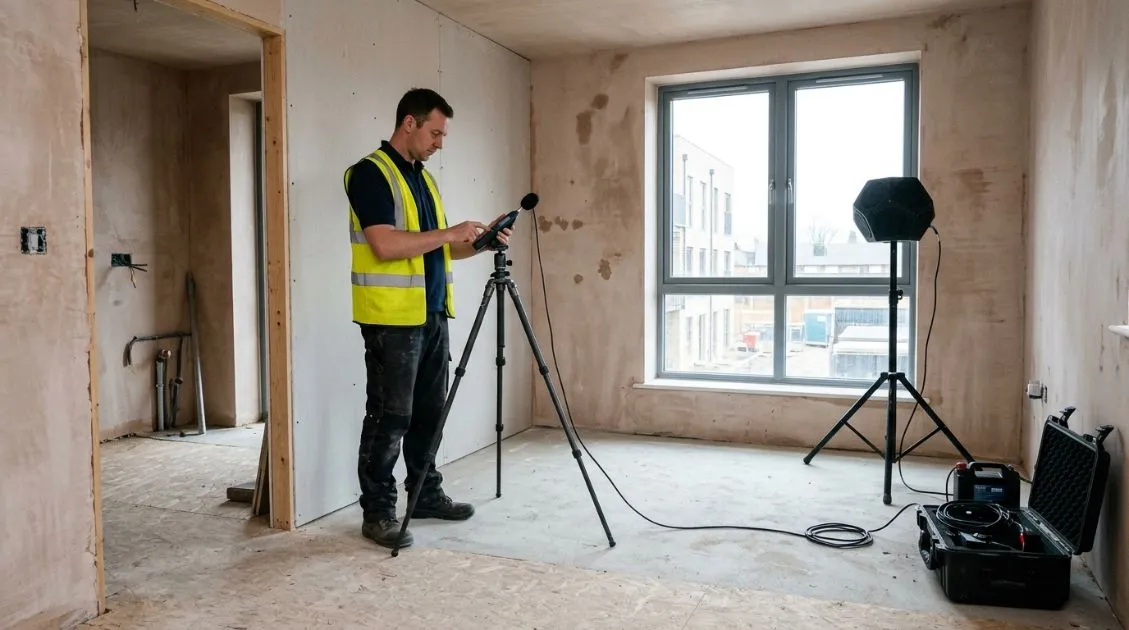
Pre-improvement sound testing gives developers, housebuilders, architects, and contractors a diagnostic check before final completion. Testing alone does not achieve compliance, but measuring real performance early lets your site team trace flanking transmission, missing insulation, and unsealed service penetrations while remedial work is still straightforward and affordable. Working with one consultant across sound insulation testing, air tightness testing, diagnostic smoke testing, and on-site compliance inspections also removes the friction of five different opinions on how to comply.
Need a Hand Checking Early Plots or Conversions?
ATSPACE supports developers, housebuilders, architects, and contractors across England and Wales with pre-improvement sound testing, site compliance inspections, diagnostic smoke testing, and formal Part E testing. Send us your drawings and construction specifications early so we can highlight acoustic risks before dry lining closes up the structure.
- Same-day quotes returned fast between 8am and 4pm (Mon–Fri)
- One dedicated account manager throughout your project
- Next-day certification delivered before 12pm the following working day
- Call 0345 6465 454 or email [email protected] (ask about our February 2027
QUIET1515% booking discount, subject to confirmation)
Why Finding Acoustic Weaknesses Early Protects Your Programme
On a drawing set, a separating wall or floor build-up looks clean and compliant. On a busy UK building site, trades cut joist penetrations, run soil stacks through risers, and board out partitions before acoustic mastic has cured. If the first time you measure acoustic performance is formal pre-completion testing, a single detailing error on plot 1 has usually been repeated across every remaining unit.
Catching defects early changes the commercial equation on site. Fixing an unsealed riser or missing mineral wool on a first-stage plot takes hours while junctions remain accessible. Discovering that same weakness across an entire completed block stalls Building Control sign-off, pushes back handovers, and forces disruptive strip-out work.
What Is Pre-Improvement Sound Testing?
Pre-improvement sound insulation testing is a diagnostic or early-stage acoustic test carried out before final completion to identify performance weaknesses and give your team time to carry out targeted remedial works. Assessments follow BS EN ISO 16283 field measurement methods, Association of Noise Consultants (ANC) guidance, and relevant acoustic good-practice guidance aligned with Approved Document E.
Unlike formal pre-completion sound testing, which provides the compliance certificates required by your Building Control Body at handover, pre-improvement testing acts as an early warning system. It checks existing structures prior to upgrade works or tests early completed plots on a larger scheme so remedial decisions rely on measured data rather than guesswork. You can also use our pre-improvement sound insulation testing checklist when preparing a site for diagnostic assessment.
| Assessment Stage | Purpose on Site | Typical Timing | Commercial Benefit |
|---|---|---|---|
| Pre-Improvement Sound Testing | Diagnostic check to measure baseline performance and locate acoustic weaknesses | Before conversion upgrades, during refurbishment, or on the first completed plots | Catches flanking paths and workmanship faults early while remedial work is still practical |
| Formal Pre-Completion Sound Testing | Statutory verification of finished separating walls and floors under Approved Document E | Once dwellings are fully finished, prior to Building Control sign-off | Produces formal compliance reports for Building Control handover |
| Site Compliance Inspections | Visual on-site check of separating build-ups, insulation, and junctions | During first fix and before plasterboard or dry lining conceals the structure | Stops detailing errors from being buried behind finishes |
| Diagnostic Smoke Testing | Non-destructive pressurisation and smoke check to trace air leakage routes | Before formal air testing, after a failure, or while junctions remain accessible | Exposes air paths around risers, skirting, and window junctions that also leak sound |
When Pre-Improvement Sound Testing Is Most Useful
Not every build carries the same acoustic risk, and no fixed number of tests applies to every development. Pre-improvement sound testing delivers the highest practical value on five project scenarios:
1. Material Change of Use Conversions
Converting commercial buildings, offices, or older houses into flats often involves unknown existing masonry, uneven timber joists, and concealed voids. Measuring the existing separating structure before specifying acoustic linings stops you from under-specifying upgrades or overspending on unnecessary build-ups.
2. Refurbishments
Refurbishment projects frequently retain existing party walls, chimney breasts, or timber floor zones with hidden bypass paths. Diagnostic testing establishes how the existing fabric actually performs so your design team targets the real weak points.
3. Unusual Constructions
Non-standard structural frames, hybrid build-ups, lightweight timber assemblies, or complex junctions do not always behave on site the way textbook models suggest. Early measurement verifies real-world attenuation before rolling the detail across the rest of the build.
4. Developments with Previous Acoustic Failures
Where an earlier phase or similar scheme has suffered failed sound insulation tests, diagnostic testing pinpoints whether the root cause sits in the specification, flanking junctions, or subcontractor workmanship.
5. First Completed Plots on a Larger Development
Testing the first completed plots or first apartment block on a multi-unit scheme validates your build-up and site trades early. Any weakness found on block 1 can be corrected before the remaining plots are closed up.
Weaknesses Pre-Improvement Sound Testing Typically Reveals
In practice, most acoustic failures come down to site detailing and workmanship rather than major structural flaws. Under BS EN ISO 16283 and ANC diagnostic testing, engineers routinely uncover seven recurring weaknesses:
- Flanking transmission: Sound travelling indirectly around a separating wall or floor via continuous perimeter structures, external walls, floor voids, or service cupboards.
- Missing insulation: Gaps, compressed batts, or omitted acoustic mineral wool inside timber floors and stud partitions.
- Unsealed penetrations: Open gaps where soil stacks, heating pipes, ductwork, or electrical cables pass through separating walls and floors without acoustic mastic or collars.
- Poor workmanship: Incomplete plastering, rushed dry lining, unsealed perimeter edges, or poorly fitted resilient layers.
- Acoustic bridging: Rigid fixings, mortar snots, or solid contact points linking independent wall linings or floating floors across an isolation gap.
- Inadequate mass: Existing conversion walls or floors that lack the density needed to resist airborne sound transfer.
- Detailing defects: Back-to-back electrical sockets, unboxed risers, or poorly detailed wall-to-floor and ceiling junctions.
For a deeper look at recurring site pitfalls, read our guide on common problems with sound insulation testing.
Where Clients Usually Make Mistakes
Experienced site teams still get caught out when acoustic compliance is treated as an afterthought. Four avoidable habits account for most late-stage programme delays:
- Assuming compliance because a drawing detail exists: A compliant drawing only performs if every junction, resilient strip, and acoustic seal is installed accurately on site.
- Covering critical details before inspection: Letting dry liners board over service risers, joist ends, and party wall junctions before anyone checks the sealing turns a ten-minute mastic fix into a full strip-out.
- Testing too late in the programme: Booking the first acoustic check days before completion leaves no float for targeted remedial works or retesting.
- Relying solely on subcontractors without checking acoustic performance: Trades focus on their own package, not how a plumbing penetration or electrical chase compromises the acoustic partition installed the week before.
How Pre-Improvement Testing Fits Into Your Build Programme
The cleanest way to protect handover dates is to embed acoustic verification across five clear programme stages rather than leaving everything to completion week.
| Programme Stage | Key Activity | Site Objective |
|---|---|---|
| 1. Design-Stage Review | Review architectural drawings, wall and floor specifications, and known risk areas | Flag high-risk junctions, conversions, and unusual build-ups before procurement |
| 2. Construction Inspection | Inspect workmanship on site while separating elements remain open | Catch missing insulation, acoustic bridging, and unsealed service penetrations before plasterboard closes |
| 3. Early Diagnostic Assessment | Complete pre-improvement sound testing on representative early units or existing structures | Measure real baseline performance and pinpoint flanking paths under BS EN ISO 16283 and ANC guidance |
| 4. Targeted Remedial Works | Carry out focused acoustic sealing, boxing, insulation, or lining upgrades | Resolve defects on early plots so errors are not repeated across later blocks |
| 5. Formal Compliance Testing | Commission formal pre-completion Part E sound testing on finished units | Issue Building Control sign-off reports on schedule without repeat visits |
Real Site Lesson: Catching Service Riser Leakage on Block 1
On a multi-unit apartment scheme, early diagnostic testing on the first apartment block identified noise transmission travelling through poorly sealed service risers. Because the weakness was found on that first block before later plots were closed up, the contractor updated the riser sealing detail across the remaining units. That single early correction prevented multiple acoustic failures across the rest of the development.
You can also see how proactive testing protects handover schedules in our pre-completion sound testing case study for flats.
Connecting Pre-Improvement Sound Testing with Air Tightness and Smoke Testing
Many acoustic failures share the exact same physical pathways as air leakage failures. Where air moves freely behind dry lining, around service risers, under skirtings, or through ceiling voids and loft hatches, airborne sound follows the same route.
Coordinating your pre-improvement sound testing alongside air tightness testing, diagnostic smoke testing, and site compliance inspections keeps your compliance package aligned under one roof. Diagnostic smoke testing pressurises the unit and uses safe artificial smoke to expose hidden leakage paths that visual checks can miss. To plan your Part L testing alongside Part E acoustics, read our guide on at what stage of the build you need an air tightness test.
Practical 5-Step Checklist for Pre-Improvement Sound Testing
Step 1 – Send Drawings and Specifications Early: Share your architectural drawings, separating wall and floor specifications, photographs where available, programme dates, and any known concerns with ATSPACE before first fix starts.
Step 2 – Inspect Workmanship Before Dry Lining Closes: Walk separating walls, timber floors, soil stacks, and service risers before plasterboard conceals the structure. Verify acoustic mineral wool continuity, perimeter isolation, and mastic sealing around every penetration.
Step 3 – Test Existing Structures or First Completed Plots: Book pre-improvement sound testing on conversions, refurbishments, unusual build-ups, or the first completed plots of a larger development so remedial decisions are based on measured results.
Step 4 – Combine Diagnostic Smoke Checks Where Air Paths Are Suspected: If early results point to hidden bypass routes around service cupboards, ceiling voids, or dry lining, pair acoustic diagnostics with smoke testing to pinpoint the exact leakage path without destructive strip-out.
Step 5 – Close Out Remedial Works Before Formal Pre-Completion Testing: Apply lessons learned from early units across every remaining plot, confirm all finishes, doors, windows, and perimeter seals are complete, and book formal Part E testing with time to spare before handover.
Frequently Asked Questions (FAQ)
What is pre-improvement sound testing?
It is an early diagnostic test. Completed before final completion under BS EN ISO 16283 and ANC guidance, pre-improvement sound testing identifies acoustic weaknesses in existing structures or early plots while remedial work is still practical and cost-effective.
Does pre-improvement sound testing replace formal pre-completion testing?
No, it serves a different purpose. Pre-improvement testing is a diagnostic check to find and fix weaknesses early, whereas Building Control requires formal pre-completion sound insulation testing on finished dwellings (unless valid Robust Details apply) to demonstrate Approved Document E compliance.
When should you book pre-improvement sound testing on a build?
Book it before finishes close up. On conversions and refurbishments, test before finalising upgrade specifications; on multi-unit new builds, schedule diagnostic testing on the first completed plots or first block so any detailing issues are fixed before rolling out to remaining units.
Can pre-improvement sound testing guarantee a formal pass?
No test can guarantee compliance. Testing alone does not achieve compliance; however, identifying flanking transmission, missing insulation, or unsealed penetrations early lets your trades correct defects before formal testing, reducing the risk of failed tests and delayed handovers.
How many pre-improvement sound tests does a project need?
No fixed number applies everywhere. Test scope depends on your development size, construction types, and high-risk areas, focusing on representative early units or suspect separating elements rather than testing every plot unnecessarily.
What information should you send ATSPACE to book an early test?
Send your drawings and programme dates. Sharing architectural plans, wall and floor construction specifications, site photographs where available, target programme dates, and any known concerns lets our engineers scope the right diagnostic plan quickly.
Getting Started with ATSPACE
Established in 2008 (Company Reg. No. 8086722, Unit 3 & 4 The Cokenach Estate, Barkway, Royston, Herts, SG8 8DL), ATSPACE brings over 15 years of hands-on UK building compliance experience across England and Wales through a team of 30+ in-house specialists. More than 12,000 clients trust our team, backed by over 1,000 five-star customer reviews and industry accreditations including SITMA, Elmhurst Energy (OCDEA), BSRIA, TrustMark, Passivhaus, and Constructionline across sound insulation testing, pre-improvement acoustic checks, diagnostic smoke testing, air tightness testing, ventilation testing, SAP and SBEM calculations, and overheating assessments.
Send us your drawings, construction specifications, photographs where available, programme dates, and details of any known concerns. You will work with one dedicated account manager who coordinates your compliance requirements from early design review through to next-day certification.
How We Work with You
- Same-Day Quotes: Fast, clear pricing returned between 8am and 4pm (Mon–Fri)
- Next-Day Certification: Test certificates issued before 12pm the following working day
- One Dedicated Contact: Coordinated sound testing, air tightness testing, diagnostic smoke testing, and site compliance inspections without conflicting opinions
- February 2027 Promotion: Ask about code QUIET15 for a 15% discount on sound insulation testing bookings confirmed during February 2027 (terms subject to confirmation)
- Get in Touch: Call 0345 6465 454, email [email protected], or visit https://atspaceltd.co.uk
