
Project Details
Service: U-value calculations
Client: UK residential developer / timber frame contractor
Project: 32-unit timber frame housing scheme (mixed semi-detached and terrace homes)
Location: Greenfield Park Development, Chelmsford, Essex CM2 (fictional)
Regulation Driver: Building Regulations Part L (energy efficiency compliance for new dwellings)
ATSPACE Team: Building energy compliance consultants, timber frame thermal performance specialists
The Headline Result
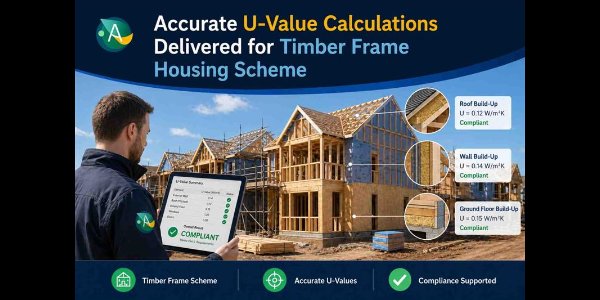
ATSPACE delivered accurate U-value calculations for a 32-unit timber frame housing scheme, achieving Part L compliance first time and supporting smooth Building Regulations approval.
The project required precise thermal performance assessment across timber frame wall systems, roof constructions, and floor build-ups. Through detailed modelling and early-stage coordination with the design team, ATSPACE confirmed compliance across all dwellings without redesign or construction delays.
ATSPACE Delivered:
Full U-value calculation set for timber frame construction
Thermal performance assessment for all building elements
Part L compliance verification across 32 homes
Review of timber frame wall build-ups and insulation layers
Building Control-ready compliance documentation
First time approval with no specification changes required
Project Overview
This project involved a large-scale timber frame housing scheme consisting of 32 new build homes, including a mix of semi-detached and terraced properties. The development was delivered using modern timber frame construction methods to improve build speed and sustainability performance.
As part of Building Regulations compliance, the developer was required to demonstrate that all building fabric elements met the energy efficiency standards set out in Part L.
Timber frame construction presents specific considerations for U-value calculations due to the combination of structural timber, insulation layers, and potential thermal bridging through studs and junctions.
ATSPACE was appointed to deliver accurate U-value calculations across all dwelling types to ensure compliance could be achieved without affecting the construction programme or requiring late-stage design changes.
Why The Service Matters
U-value calculations are a core requirement of Part L of the Building Regulations and are used to measure the thermal performance of building elements such as walls, roofs, floors and windows.
In timber frame construction, these calculations are particularly important because:
Structural timber can create thermal bridging
Insulation continuity must be carefully detailed
Performance varies depending on stud spacing and build-up design
Fabric efficiency must be verified across all dwelling types
U-value calculations ensure that:
Thermal performance targets are met
Heat loss through building fabric is controlled
Energy efficiency standards are achieved
The design complies with Building Regulations approval requirements
If U-value calculations are inaccurate or incomplete, timber frame schemes can face compliance failures, redesign of wall systems, delays in approval, or increased construction costs.
The Problem
When ATSPACE was appointed, the timber frame design had already been developed and procurement for materials was underway. However, several compliance risks were identified during initial review.
These included:
Variations in timber stud configurations across dwelling types
Uncertainty around insulation placement within wall systems
Potential thermal bridging at junctions and structural interfaces
Differences in roof insulation specifications between units
Tight programme requiring rapid compliance confirmation
There was also pressure to maintain a consistent timber frame system across the development without introducing costly changes or delays.
Without accurate U-value calculations, there was a risk that the scheme would fail Part L compliance checks, resulting in redesign or delays in Building Regulations approval.
What ATSPACE Was Asked To Do
Carry out detailed U-value calculations for all timber frame dwelling types
Confirm compliance with Part L requirements
Review timber frame wall, roof and floor build-ups
Identify potential thermal bridging risks
Provide practical guidance without requiring redesign
Support Building Control submission process
Deliver clear compliance documentation for all 32 homes
Our Approach
Step 1: Understanding The Compliance Requirement
ATSPACE confirmed the specific Part L requirements applicable to timber frame construction and defined a structured calculation methodology suitable for multi-unit housing schemes.
Step 2: Reviewing Timber Frame Build-Ups
We reviewed detailed construction drawings, timber stud layouts, insulation specifications, and junction details. This allowed us to assess thermal performance and identify any potential weak points in the fabric design.
Step 3: Practical Thermal Optimisation Advice
Before finalising calculations, ATSPACE provided targeted recommendations, including:
Optimising insulation continuity within timber frame walls
Reviewing thermal bridging at structural junctions
Confirming roof insulation consistency across dwelling types
Validating floor insulation performance assumptions
These recommendations were implemented within the calculation model without requiring redesign or material changes.
Step 4: Clear Compliance Reporting
ATSPACE completed full U-value calculations for all dwelling types and issued a structured Part L compliance report. The documentation confirmed that all 32 homes met required thermal performance standards and was suitable for Building Control approval.
Real Issues We Faced And How We Solved Them
Issue A: Thermal Bridging Through Timber Studs
Structural timber elements increased potential heat loss paths.
How ATSPACE Helped:
We accounted for bridging effects within the calculation model and confirmed compliance through refined thermal analysis.
Issue B: Variation In Wall Build-Ups
Different dwelling types used slightly different insulation configurations.
How ATSPACE Helped:
We standardised calculation assumptions to ensure consistent compliance across all units.
Issue C: Roof Insulation Performance Differences
Roof build-ups varied between terrace and semi-detached units.
How ATSPACE Helped:
We validated each configuration separately and confirmed compliance without design changes.
Issue D: Programme Pressure For Fast Approval
The project required rapid turnaround to maintain construction schedule.
How ATSPACE Helped:
We prioritised delivery of full calculation set to align with submission deadlines and avoid delays.
Results
Accurate U-value calculations completed for all 32 timber frame homes
Part L compliance achieved first time
No redesign required for timber frame system
Building Regulations approval supported without delay
All dwelling types confirmed compliant
No disruption to construction programme
Clear, consistent compliance documentation issued
What This Project Proves
This project demonstrates that accurate U-value calculations are essential for timber frame housing schemes to achieve reliable Part L compliance.
When carried out correctly, they allow project teams to:
Maintain consistency across multiple dwelling types
Control thermal bridging risks in timber construction
Avoid costly redesign of wall systems
Secure Building Control approval without delay
U-value calculations are a critical step in ensuring timber frame developments meet modern energy efficiency standards efficiently and reliably.
Mini FAQ
What Are U-Value Calculations In Timber Frame Construction?
They are thermal performance assessments that measure heat loss through timber frame walls, roofs and floors to ensure compliance with Part L.
Why Are U-Value Calculations Important For Timber Frame Homes?
Because timber elements can create thermal bridging, calculations ensure energy efficiency standards are still met.
Do All Timber Frame Housing Schemes Need U-Value Calculations?
Yes, all new timber frame residential developments require U-value calculations for Building Regulations approval.
What Happens If Timber Frame U-Values Fail?
Insulation or wall build-ups may need to be adjusted to meet compliance requirements.
Can Timber Frame U-Value Issues Be Fixed Without Redesign?
In many cases yes, through insulation specification adjustments or improved detailing assumptions.
When Should U-Value Calculations Be Done?
They should be completed during the design stage before construction or material procurement.
Call to Action
Need accurate U-value calculations for your timber frame housing scheme?
ATSPACE helps developers, contractors and architects achieve fast, reliable Part L compliance with clear technical reporting and no unnecessary delays. Send your project details and we will confirm requirements and next steps.
