
Project details
Service: PSI value calculations (thermal bridging calculations)
Client: UK residential developer
Project: 28-unit mixed housing scheme (semi-detached and terraced new build homes)
Location: Northampton NN4
Regulation driver: Building Regulations Part L (energy efficiency and thermal bridging compliance)
ATSPACE team: Building energy compliance consultants, thermal bridging specialists
The headline result
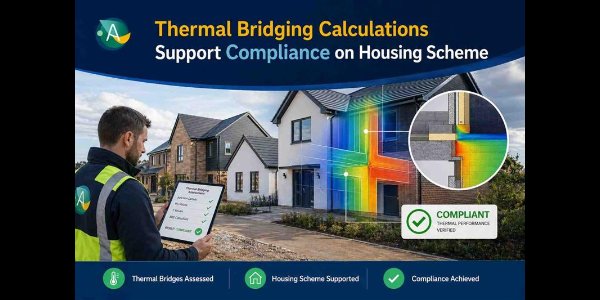
ATSPACE delivered thermal bridging calculations supporting full compliance across a 28-unit housing scheme, achieving Part L approval first time without redesign or delays.
The project required detailed PSI value analysis across all key junctions to ensure energy performance targets were met within SAP and Building Regulations requirements. Through accurate thermal bridging calculations and early design-stage input, ATSPACE helped the project team secure compliance efficiently and maintain programme certainty.
ATSPACE delivered:
Full thermal bridging (PSI value) calculation set
Assessment of all key junction details across dwelling types
Part L compliance support for housing scheme
SAP-ready thermal bridging inputs
Review of construction detailing and insulation continuity
Building Control-ready compliance documentation
Project overview
This project involved a 28-unit residential housing scheme consisting of semi-detached and terraced new build homes. The development was designed to deliver affordable housing while meeting modern energy efficiency standards under Building Regulations Part L.
As part of compliance requirements, the developer needed to demonstrate that thermal bridging had been properly assessed across all building junctions. This is essential in housing schemes where repeated detailing across multiple units can significantly affect overall energy performance.
ATSPACE was appointed to complete thermal bridging calculations using PSI values to ensure compliance could be demonstrated consistently across all dwellings without impacting the construction programme.
Why the service matters
Thermal bridging calculations assess heat loss at junctions where building elements meet, such as walls, floors, roofs, windows and doors. These junctions can significantly affect overall building performance, even when insulation levels meet regulatory standards.
Under Part L of the Building Regulations, thermal bridging must be correctly accounted for using PSI values to ensure accurate energy modelling and compliance.
This service is essential for:
New build housing schemes
Energy compliance submissions for Building Control
SAP assessments and Part L calculations
Developments using modern insulation standards
Thermal bridging calculations ensure that:
Heat loss at junctions is properly quantified
Energy efficiency targets are achieved
SAP results accurately reflect construction performance
Building Regulations compliance is demonstrated
If thermal bridging is not correctly assessed, housing schemes may face SAP failure, delayed approvals, or the need for costly design revisions at a late stage.
The problem
When ATSPACE was appointed, the housing scheme design was already well developed, with construction details largely finalised. However, several thermal bridging risks had not been fully assessed.
Key issues included:
Unverified junction details across multiple dwelling types
Inconsistent insulation continuity at key interfaces
Reliance on default PSI values in early energy models
Variations in construction detailing between house types
Tight programme requiring fast compliance confirmation
There was also pressure to maintain standardised construction methods across the scheme to control costs and ensure build efficiency.
Without accurate thermal bridging calculations, there was a risk that SAP assessments would not reflect real performance, potentially resulting in non-compliance or delays in Building Control approval.
What ATSPACE was asked to do
Carry out thermal bridging (PSI value) calculations for housing scheme
Assess all key junctions across dwelling types
Confirm Part L compliance requirements
Provide accurate inputs for SAP assessments
Identify and mitigate thermal performance risks
Support Building Control approval process
Deliver clear compliance documentation
Our approach
Step 1: Understanding the compliance requirement
ATSPACE confirmed the Part L requirements relating to thermal bridging and defined the calculation methodology required for multi-unit housing schemes. We established a structured PSI value approach to ensure consistency across all dwellings.
Step 2: Reviewing junction details and construction drawings
We reviewed architectural and construction information, focusing on key junctions including wall-to-floor connections, roof interfaces, window reveals, and party wall junctions. This allowed us to identify potential heat loss risks and inconsistencies in detailing.
Step 3: Practical thermal performance optimisation
Before finalising calculations, ATSPACE provided targeted recommendations, including improving insulation continuity at key junctions, refining window and door reveal details, reducing thermal bridging at floor slab edges, and aligning construction details across all housing types. These improvements were incorporated into the calculation model without requiring redesign.
Step 4: Clear compliance reporting
ATSPACE completed thermal bridging calculations and issued structured PSI value outputs suitable for SAP and Building Control submission. The documentation confirmed full Part L compliance across the entire housing scheme.
Real issues we faced and how we solved them
Issue A: inconsistent junction detailing across units
Different house types used slightly different construction details.
How ATSPACE helped: We standardised PSI calculation assumptions to ensure consistent compliance across all dwellings.
Issue B: reliance on default thermal bridging values
Early energy models used generic PSI values.
How ATSPACE helped: We replaced default assumptions with project-specific thermal bridging calculations.
Issue C: risk of SAP performance failure
Initial modelling showed borderline energy performance results.
How ATSPACE helped: We refined PSI inputs to improve SAP outcomes without changing design specifications.
Issue D: fast-track programme requirements
The project required rapid submission for Building Control approval.
How ATSPACE helped: We prioritised delivery of thermal bridging calculations to meet programme deadlines and avoid delays.
Results
Thermal bridging calculations completed for all 28 homes
Part L compliance achieved first time
No redesign required
SAP inputs validated and improved
Building Regulations approval supported successfully
No delay to construction programme
Consistent compliance across housing scheme
What this project proves
This project demonstrates that thermal bridging calculations are essential for achieving reliable Part L compliance in housing schemes.
When completed early and accurately, they ensure SAP assessments reflect real construction performance, reduce compliance risk across multiple dwelling types, and support smooth Building Regulations approval without delays.
Thermal bridging calculations are a critical part of delivering energy-efficient housing developments efficiently and consistently.
Mini FAQ
What are thermal bridging calculations?
They are assessments that measure heat loss at junctions between building elements using PSI values.
Why are thermal bridging calculations required?
They are required under Part L to ensure accurate energy performance modelling in SAP assessments.
Do all housing schemes need PSI value calculations?
Yes, most new build housing developments require thermal bridging calculations for compliance.
What happens if thermal bridging is not assessed?
SAP calculations may be inaccurate, leading to potential non-compliance or delays in approval.
Can thermal bridging issues be fixed without redesign?
Yes, in many cases performance can be improved through detailing or calculation adjustments.
When should thermal bridging calculations be completed?
They should be completed during the design stage before SAP submission and Building Control approval.
Call to action
Need thermal bridging calculations for your housing scheme?
ATSPACE helps developers, architects and contractors achieve fast, reliable Part L compliance with accurate PSI value calculations and clear technical reporting. Send your project details and we will confirm requirements and next steps.
