
The headline result
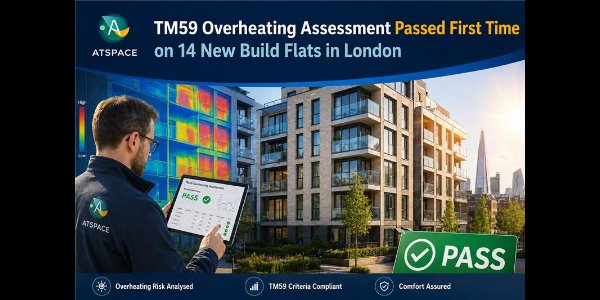
ATSPACE delivered overheating assessments that achieved TM59 and Part O compliance first time for a 14-unit residential scheme in London.
Despite tight deadlines and late-stage design coordination challenges, the project secured approval without delay. The client avoided costly redesigns and maintained programme certainty through a clear and structured approach.
ATSPACE delivered:
Pre-assessment design review
Drawing and specification checks
Pre-modelling risk identification
Practical overheating mitigation advice
Dynamic thermal modelling aligned with TM59
Clear, Building Control-ready reporting
Reduced risk of redesign, delays or resubmission
Project overview
This project involved the construction of 14 new-build flats on a constrained urban infill site in London. The development was designed to maximise internal space and daylight, resulting in significant glazing across several elevations.
By the time ATSPACE was appointed, the project was progressing through the later design stages, with construction underway. The client required overheating assessments to satisfy both TM59 guidance and Part O of the Building Regulations.
The challenge was typical of many London developments. There were limited external shading opportunities, high solar gains due to large areas of glazing, and the added pressure of the urban heat island effect. Site constraints also restricted the ability to make major design changes.
The client needed a practical and reliable overheating assessments solution that would demonstrate compliance first time, avoid disruption to construction, provide clear evidence for Building Control, and support project handover without delay.
Timing was critical. Any failure at assessment stage could result in redesign, delays to completion, and additional cost.
Why the service matters
Overheating assessments evaluate whether a building is at risk of becoming too hot during warm weather. This is typically done using dynamic thermal modelling, which simulates internal temperatures over time based on real weather data and building performance.
They are needed because modern buildings are more airtight and better insulated. While this improves energy efficiency under Part L, it can also increase the risk of overheating, particularly in urban locations.
Developers, architects, consultants and contractors usually request overheating assessments to demonstrate compliance and avoid risk.
Overheating assessments support compliance with Part O of the Building Regulations and TM59 guidance. They provide clear evidence that solar gains are controlled and that the building has adequate ventilation to remove excess heat.
If overheating assessments are left too late, projects can face failed compliance checks, redesign requirements, delays to Building Control sign-off, and increased costs. In some cases, units may not meet acceptable comfort standards, which can affect marketability and client satisfaction.
The problem
When ATSPACE was appointed, the project was already facing several practical challenges.
There were extensive areas of glazing across key elevations, increasing the risk of overheating. Design changes had been made late in the process, and not all drawings reflected the latest information. The ventilation strategy was unclear in some units, particularly regarding openable window areas.
There was also limited coordination between architectural and M&E design, which created uncertainty around how the building would perform in real conditions.
The programme was tight, leaving little room for redesign or delays. There was a real risk that overheating assessments would fail under TM59, especially for top-floor and south-facing flats.
Building Control required clear and robust evidence, and the client needed confidence that the development would meet compliance requirements without impacting the project timeline.
What ATSPACE was asked to do
Carry out overheating assessments for all 14 flats
Confirm TM59 and Part O compliance requirements
Review drawings, specifications and design information
Identify overheating risks before formal modelling
Provide practical mitigation strategies
Support the design and site team with clear guidance
Deliver a compliant, Building Control-ready report
Our approach
Step 1: Understanding the compliance requirement
ATSPACE confirmed the applicable compliance route under TM59 and Part O. Due to the building form and glazing levels, dynamic thermal modelling was required. We aligned the assessment approach with Building Control expectations from the outset.
Step 2: Reviewing the information or site readiness
We reviewed architectural layouts, glazing specifications, ventilation strategies and building orientation. Any inconsistencies or missing information were identified early and resolved before modelling began.
Step 3: Practical advice before final sign off
Before completing the overheating assessments, we provided targeted recommendations. These included improving glazing performance, introducing simple shading measures, and ensuring sufficient openable window areas. All advice was practical and aligned with the existing design.
Step 4: Clear reporting for sign off
We completed the dynamic thermal modelling and issued a clear, structured overheating assessments report. This included methodology, assumptions, results and compliance outcomes, providing a complete submission for Building Control approval.
Real issues we faced and how we solved them
Issue A: High overheating risk in top-floor flats
Top-floor units were exposed to high solar gains and roof heat.
How ATSPACE helped:
We recommended improved glazing performance and enhanced ventilation strategies, reducing overheating risk and achieving compliance.
Issue B: Incomplete ventilation data
Window opening sizes were not clearly defined in the drawings.
How ATSPACE helped:
We worked with the design team to confirm realistic opening areas, ensuring accurate modelling and compliance.
Issue C: Uncoordinated design updates
Glazing specifications differed across drawing revisions.
How ATSPACE helped:
We coordinated with the design team to confirm a consistent specification before modelling, avoiding rework.
Issue D: Tight programme deadlines
There was limited time before Building Control submission.
How ATSPACE helped:
We prioritised key risk areas and delivered the overheating assessments efficiently without compromising quality.
Results
TM59 and Part O compliance achieved
First time pass with no resubmission
No delay to construction programme
Building Control-ready overheating assessments report issued
Clear audit trail for compliance
Client confidence before sign-off
Design team supported with clear next steps
What this project proves
Overheating assessments should not be treated as a last-minute compliance task. When managed properly, they help identify risks early, reduce the need for redesign, and support smooth Building Control approval.
This project demonstrates that even under programme pressure, a structured and practical approach to overheating assessments can deliver first time compliance and keep projects on track.
Mini FAQ
What are overheating assessments?
Overheating assessments evaluate the risk of high internal temperatures in buildings using dynamic thermal modelling to meet TM59 and Part O requirements.
When do I need overheating assessments?
They are typically required for new residential developments to demonstrate compliance before Building Control approval.
Are overheating assessments required by Building Control?
Yes, they are required to show compliance with Part O and are often assessed using TM59.
Can overheating assessments delay completion?
Only if left too late. When planned properly, they help avoid delays by identifying risks early.
What information does ATSPACE need?
Architectural drawings, glazing specifications, ventilation strategy and building orientation details.
Can ATSPACE help if the project is already built?
Yes, ATSPACE can carry out overheating assessments on completed or near-complete projects and provide practical solutions.
Call to action
Need help with overheating assessments for your project?
ATSPACE helps developers, contractors, architects and consultants achieve clear compliance evidence without unnecessary delays. Send us your project details and we will confirm what is needed, what information we require and the best next step.
