
Project Details
Service: U-value calculations
Client: UK residential developer
Project: 26-unit mixed residential development (apartments and townhouses)
Location: Westfield Court Development, Milton Keynes MK9
Regulation Driver: Building Regulations Part L (energy efficiency compliance for new dwellings)
ATSPACE Team: Building energy compliance consultants, thermal performance specialists
The Headline Result
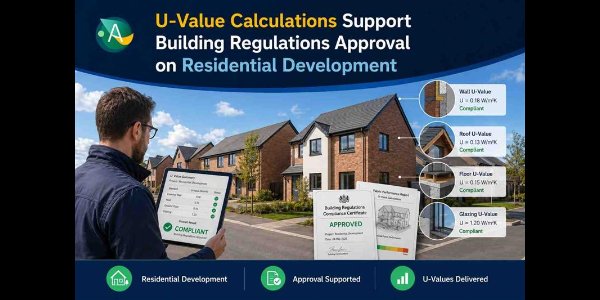
ATSPACE delivered U-value calculations that supported full Building Regulations approval for a 26-unit residential development, achieving Part L compliance first time.
The project required detailed fabric performance assessment across multiple dwelling types, including apartments and townhouses, each with different construction build-ups. Through structured U-value calculations and early-stage coordination with the design team, ATSPACE ensured all units met compliance requirements without redesign or delay.
ATSPACE Delivered:
Full U-value calculation package for all dwelling types
Fabric performance assessment for walls, roofs, floors and glazing
Part L compliance verification across the development
Early identification of thermal performance risks
Clear, Building Control-ready reporting
No redesign or programme delays required
Project Overview
This project involved a 26-unit mixed residential development comprising a combination of low-rise apartments and three-storey townhouses. The scheme was designed to meet modern energy efficiency standards while maintaining cost-effective construction methods.
As part of Building Regulations approval, the developer was required to demonstrate compliance with Part L through detailed U-value calculations for all building fabric elements.
The challenge was that the development included multiple construction types and varying specification details across units. This created complexity in ensuring consistent compliance across the entire scheme.
ATSPACE was appointed to complete U-value calculations and support Building Regulations approval by confirming that all proposed fabric elements met the required thermal performance standards.
Why The Service Matters
U-value calculations are a key part of demonstrating compliance with Part L of the Building Regulations. They measure how effectively building elements such as walls, roofs, floors and windows retain heat.
These calculations are required for most residential developments, including:
New build housing schemes
Apartment blocks
Mixed residential developments
Extensions and conversions where applicable
They ensure that:
Building fabric meets required insulation standards
Heat loss is controlled across all elements
Energy efficiency targets are achieved
Designs comply with Building Regulations approval requirements
Without accurate U-value calculations, residential developments may face delays in Building Control approval, redesign of insulation specifications, or failure to meet energy performance standards.
The Problem
When ATSPACE was appointed, the project was already at an advanced design stage with construction procurement underway. However, several compliance risks had been identified.
The development included multiple construction systems across different dwelling types, leading to variation in:
Wall construction build-ups
Roof insulation specifications
Floor slab detailing
Window and door thermal performance values
There was also limited coordination between design disciplines, meaning thermal performance assumptions were not fully aligned across all units.
Key risks included:
Potential non-compliance with Part L in certain dwelling types
Inconsistent U-value values across similar units
Uncertainty around insulation thickness in key elements
Pressure to achieve Building Control approval without redesign
Without intervention, the project risked delays in approval and potential specification changes at a late stage in the programme.
What ATSPACE Was Asked To Do
Carry out full U-value calculations for all dwelling types
Confirm Part L compliance across the residential development
Review construction specifications for thermal performance
Identify and resolve any compliance risks early
Provide structured reporting for Building Regulations approval
Support design team with practical compliance guidance
Deliver Building Control-ready documentation
Our Approach
Step 1: Understanding The Compliance Requirement
ATSPACE confirmed the Part L requirements applicable to each dwelling type and established a structured calculation approach to ensure consistency across the entire development.
Step 2: Reviewing Design And Fabric Specifications
We reviewed architectural drawings, construction details, insulation specifications and glazing performance data. This allowed us to assess thermal performance across all building elements and identify inconsistencies early.
Step 3: Practical Compliance Optimisation
Before finalising calculations, ATSPACE identified key improvements to support compliance, including:
Aligning insulation thickness across similar dwelling types
Optimising roof and floor build-up performance assumptions
Checking glazing specifications against energy targets
Standardising thermal assumptions across the development
These adjustments were implemented within the calculation process rather than requiring redesign.
Step 4: Clear Building Regulations Reporting
ATSPACE completed full U-value calculations and issued a structured compliance report covering all 26 units. The report clearly demonstrated that all dwelling types met Part L requirements and was suitable for Building Control approval.
Real Issues We Faced And How We Solved Them
Issue A: Variation Across Dwelling Types
Different construction systems created inconsistent thermal performance assumptions.
How ATSPACE Helped:
We standardised U-value inputs across comparable elements to ensure consistent compliance across the development.
Issue B: Roof Insulation Performance Variability
Some roof build-ups were close to minimum compliance thresholds.
How ATSPACE Helped:
We refined calculation inputs and confirmed compliance through detailed thermal modelling.
Issue C: Floor Detail Thermal Bridging
Complex junctions created potential heat loss risks.
How ATSPACE Helped:
We reviewed detailing assumptions and adjusted calculations to ensure compliance without design changes.
Issue D: Tight Approval Programme
The project required rapid submission for Building Control approval.
How ATSPACE Helped:
We prioritised delivery of full calculation set to meet programme deadlines and avoid delays.
Results
U-value calculations completed for all 26 units
Part L compliance achieved first time
No redesign required across any dwelling type
Building Regulations approval supported successfully
No delay to programme or submission process
All fabric elements confirmed compliant
Clear and consistent reporting issued for Building Control
What This Project Proves
This project demonstrates that U-value calculations are essential for securing Building Regulations approval on multi-unit residential developments.
When delivered early and accurately, they help project teams:
Maintain consistency across multiple dwelling types
Avoid costly redesign of insulation specifications
Secure Building Control approval without delay
Ensure compliance with Part L requirements
U-value calculations are not just a technical requirement, but a key part of delivering compliant, energy-efficient housing developments efficiently.
Mini FAQ
What Are U-Value Calculations?
U-value calculations measure how much heat passes through building elements such as walls, roofs and floors to assess thermal performance and energy efficiency.
Why Are U-Value Calculations Needed For Building Regulations Approval?
They are required under Part L to demonstrate that a building meets minimum energy efficiency standards.
Do All Residential Developments Need U-Value Calculations?
Yes, all new residential developments require U-value calculations as part of Building Control approval.
What Happens If U-Values Fail Compliance?
Insulation specifications may need to be increased or redesigned to meet required performance levels.
Can U-Value Issues Be Fixed Without Redesign?
In some cases yes, through specification adjustments or improved thermal detailing.
When Should U-Value Calculations Be Completed?
They should be completed during the design stage before submission for Building Regulations approval.
Call to Action
Need U-value calculations to support Building Regulations approval?
ATSPACE helps developers, architects and contractors achieve fast, reliable Part L compliance with clear technical reporting and no unnecessary delays. Send your project details and we will confirm requirements and next steps.
