Yes. Our work is carried out by our in house accredited team, giving our clients consistent delivery, clear accountability and reliable technical support throughout the project. We also have coverage across England and Wales, allowing us to support sites nationwide.
Yes. Repeated guidance and site experience point to plug sockets, downlights, skirting junctions, bathroom services, boiler cupboards and general service penetrations as common leakage paths in new homes. These are classic “looks finished but is not airtight” details. They are also the sort of faults that become far harder to fix once joinery, kitchens and sanitaryware are fully in, which is why early checking saves so much time later.
A house should be air tested when the airtight layer is complete and the plot is genuinely ready, not when the site is hoping it is ready. Windows and external doors need to be properly fitted, penetrations need sealing, and the common leakage points hidden behind boxing, dry-lining or bathroom units need to be dealt with before the tester arrives. Calling the tester too early is one of the biggest causes of failed first visits.
Yes. We can manage multiple compliance services under one roof, covering design, consultancy, testing and certification across residential and commercial projects. Because we keep our services together, we help reduce delays, improve coordination and make the whole process easier to manage.
Yes, it can. A lower air leakage result is usually good for energy performance, but if the dwelling becomes very airtight and the ventilation strategy does not match, indoor air quality can suffer. Approved Document F specifically treats highly airtight dwellings differently, because once infiltration is reduced enough, you can no longer rely on incidental leakage to help the ventilation strategy. Airtightness and ventilation have to be designed together, not as separate afterthoughts.
No, not as a way of manipulating the result. ATTMA’s dwelling guidance states that all internal doors to conditioned areas must remain open during the test. Closing them to create false pressure conditions can invalidate the test. For site teams, this is a useful rule of thumb: if the only way the plot “passes” is by changing the way the building is meant to be tested, it has not really passed.
No. ATTMA’s dwelling guidance is clear that access doors to areas outside the building envelope under test, such as internal doors to garages, loft hatches and storage access doors, should be airtight in their own right and should not be temporarily sealed for the test. If those details leak, they need fixing properly. Trying to mask them on test day is exactly the kind of shortcut that causes rejected results.
Yes. Smoke testing is one of the quickest ways to show where air is escaping from a plot, especially when the leak path is not obvious by eye. It is useful around service penetrations, dry-lined walls, loft details, window interfaces and boxed-in bathroom areas. On a failed or borderline plot, smoke turns a vague problem into a clear remedial list, which is why it is commonly paired with airtightness testing.
Yes, in dwellings in England and Wales trickle ventilators should be closed and temporarily sealed for the air test in line with ATTMA guidance. The same guidance also says passive ventilation openings and mechanical ventilation openings should be dealt with appropriately for testing. What matters is that the temporary sealing follows the approved rules and is declared properly, not that the tester hides leakage by making up their own approach on the day.
Yes. Detached houses and bungalows are straightforward residential air testing work and fall squarely within normal dwelling testing practice. ATTMA’s simple-building standard includes single dwellings, and current Part L guidance says every new dwelling should be pressure tested. The real challenge is not whether they can be tested, but whether the plot has been detailed and built tightly enough to hit the SAP design target without last-minute patching.
Yes. A flat is still a dwelling, so it can be air tested in the same way as a house, using the dwelling air pressure testing route rather than the commercial one. What changes is usually access, sequencing and interface control. Flats often have more service penetrations, tighter programmes and more coordination risk between trades, so plot readiness and consistent detailing matter even more than on a simple house build.
Yes. Existing homes can be air tested as a diagnostic exercise even though new-dwelling pressure testing is the main regulatory use people know about. It is useful for tracking down draughts, planning retrofit work, supporting EPC improvement strategies and avoiding guesswork before money is spent on remedials. For homeowners and landlords, that often means finding the real leakage routes instead of assuming the problem is just “poor insulation”.
Yes. A self-build home follows the same new-dwelling airtightness rules as any other new house, so it should be pressure tested and the result fed into the final SAP and compliance process. The difference is usually project style rather than regulation. Self-builders often benefit from earlier advice because one missed detail around windows, loft hatches or service routes can be harder to fix once the finishes are in and there is no big site team behind it.
Yes. The same residential air test method can be used on timber frame, SIPs and masonry homes. What changes is where leakage normally appears and how the air barrier is formed. The dwelling guidance specifically highlights airtightness detailing for cavity walls, timber frame junctions, fixings, windows and doors, which is exactly why build-system-specific detailing matters. The test method is common; the route to passing first time is not.
Yes, for a new dwelling the air test is part of the compliance evidence Building Control will rely on. The building control body may accept a pressure test certificate as evidence that the dwelling complies with the testing requirement, and the measured result also feeds the final compliance calculations. In simple terms, no valid plot result usually means no clean route to the final Part L paperwork and sign-off.
Yes. Mechanical ventilation systems in new dwellings must still be commissioned and their airflow rates measured, including intermittent extract and continuous systems such as MVHR. The air test does not replace that requirement. In practice, both pieces of evidence matter: the air test proves the dwelling envelope performance, and the airflow measurements prove the ventilation system is delivering what the design requires.
Yes, the current dwelling guidance points to every dwelling being pressure tested, so each flat should be treated as needing its own result. That is the safe approach for apartment delivery. The flat itself is a dwelling, while common areas are dealt with separately under different guidance depending on whether they are heated or unheated. For developers, that means planning the testing strategy unit by unit rather than assuming the block gets one blanket number.
Not usually. The formal dwelling pressure-testing guidance is tied to a dwelling being erected, while the extension guidance for existing dwellings focuses on thermal elements and services rather than a mandatory pressure test on the whole home. In practice, most ordinary extensions are not booked for a formal Part L air test unless the project is creating a new dwelling or extra evidence is specifically needed. Diagnostic testing can still be useful where draughts or performance are a concern.
Yes. We are proud that 91% of our business comes from returning clients and that we have an 87% first pass rate across all services. Those figures reflect the trust our clients place in us and our focus on getting things right first time wherever possible.
Yes. On a new dwelling, SAP is used both for Part L compliance and for producing the home’s EPC, so the final measured airtightness can influence the energy rating that ends up on the certificate. That makes the air test commercially important as well as regulatory. A weaker-than-expected result can affect the final paperwork handed to buyers, lenders and Building Control, not just the site file.
Yes, provided there is enough temperature difference to make the leaks visible. Thermal imaging does not replace the formal air test, but it is a very useful diagnostic tool for tracking down cold air paths, missing insulation continuity and weak details that are hard to spot otherwise. Used alongside pressurisation or depressurisation, it can help the site team fix the real causes of draughts rather than sealing randomly and hoping for the best.
You pass a residential air test first time by treating airtightness as a design-and-build issue, not a mastic exercise at the end. Define the air barrier early, brief every trade that penetrates it, inspect dry-lining and service routes before they are covered up, and use an early pre-test or advisory visit if the target is tight. The plots that pass first time are usually the ones with controlled details, not the ones with the biggest panic on test day.
We work hard to keep your project moving, which is why we aim to return certificates before 12pm the next day. Fast certification is a key part of our service and helps our clients avoid unnecessary delays at handover stage.
Residential air testing sits under Approved Document L Volume 1 and SAP, while commercial air testing sits under Volume 2 and non-domestic methods such as SBEM. Dwellings are self-contained residential units, so the compliance route, terminology and supporting paperwork are different from office, retail or warehouse projects. For builders, the practical difference is simple: houses and flats are assessed as dwellings, not as non-domestic buildings with a residential label stuck on.
A standard residential air test usually takes around 45 minutes on a ready plot, although you should allow extra time for setup, access, site briefing and any diagnostic work. The test itself is not normally the slow part. Delays usually come from unfinished plots, missing components, poor access or remedials that have to be done while the tester is on site. On a well-prepared house, it should be a quick job rather than a day-long problem.
For a straightforward new dwelling, published UK pricing suggests a typical residential air test is often marketed from around £95 to £200+VAT for a single plot, with much lower per-plot rates available on multi-unit sites. The final number depends on location, plot type, travel, urgency and whether retesting or diagnostics are needed. For developers, the cheapest quote is not always the cheapest outcome if it leads to rework or handover delay.
We understand how quickly programmes can change, which is why we focus on fast response times and practical support. We offer same day email responses, a 48 hour lead time emergency booking service, and where needed, we can put urgent enquiries straight through to a technical expert.
That depends on what is leaking, but many residential failures can be turned around quickly when the leakage paths are diagnosed properly on the day. Straightforward sealing issues around penetrations, loft details or windows can often be fixed fast, while hidden problems behind finishes take longer. The quickest route is usually a tester who can help pinpoint the real faults straight away, so the site team is not burning a day on guesswork.
Many UK providers advertise certificates within 24 hours, and some promote same-day issue when the plot passes. That speed matters because the certificate is often needed straight away for final SAP and Building Control paperwork. The regulations also require the results to be given to the local authority within a defined timeframe, so dependable reporting is part of keeping completion moving, not just a nice extra.
No. Air leakage testing measures uncontrolled leakage through the building envelope, while ventilation commissioning checks whether the installed ventilation system is delivering the required airflow. They are separate compliance tasks with separate notices and evidence. A dwelling can be airtight and still have poorly commissioned ventilation, and a commissioned ventilation system does not prove the plot’s envelope is tight enough for Part L.
No. A formal air pressure test measures the building’s airtightness result for compliance or certification, while diagnostic smoke testing is there to find the leakage paths that sit behind that result. TM23 covers the formal measurement of building air leakage, whereas smoke diagnostics are the practical site tool that helps the team understand why the building is leaking.
No. Diagnostic smoke testing in relation to air pressure testing is a building-fabric leakage tool. Smoke shaft testing and smoke-control system testing are fire-safety services dealing with smoke ventilation shafts, ducts and life-safety systems under a different standards framework. They may both involve “smoke”, but they are not the same discipline and should not be confused in the specification.
No. Building Control sign-off depends on a valid formal pressure test result and the associated compliance evidence, not on a diagnostic survey alone. Diagnostic fans and interim leak-finding tools are useful for identifying problems, but they are not a substitute for a compliant final test result. In plain terms, diagnostics help you get the pass, but they are not the pass.
No, not in itself. The legal requirement under Part E is normally the post-works route: either appropriate pre-completion testing or, in eligible new-build cases, the Robust Details route. Pre-improvement testing is optional, but it is a very practical way to inform design and avoid failed final tests on conversions and upgrades.
No. Pre-improvement sound insulation testing is mainly about how sound passes through the building fabric, whereas BS 8233 and BS 4142 are used to assess external or environmental noise conditions in different ways. ANC’s conversion guidance treats these as related but distinct workstreams: one for the internal separation strategy and one for the wider acoustic environment affecting the development.
Yes. In UK residential work, airtightness testing, air leakage testing, air pressure testing and blower door testing usually describe the same fan pressurisation method. A calibrated fan is fitted into an external opening, the dwelling is pressurised or depressurised, and the airflow needed to maintain the test pressure is used to calculate leakage. The wording changes from one contractor or consultant to another, but the core test method is the same.
No, not as a blanket rule. There is no general UK rule saying every retrofit project must have a formal air leakage test in the way new dwellings do. In practice, it becomes valuable where the work is likely to change airtightness materially, where ventilation needs to be reassessed, or where the client wants measured before-and-after evidence instead of relying on assumptions.
Not as a single standalone line that says “air test the shaft,” but in practice a shaft that forms part of the smoke control strategy is expected to be tested and accepted before handover. Approved Document B requires smoke control to common escape routes and firefighting shafts, and SCA guidance says the installer should test the system and offer it for witness testing to the authority having jurisdiction under BS 7346-8 practice.
It is a Building Regulations Part L issue, not a planning-permission test in itself. You may be under permitted development for planning and still need Building Regulations approval for the extension. In other words, a scheme can be lawful in planning terms and still need overglazed extension calculations for Building Control.
No. It is the default guidance limit, not an absolute ban. Both England and Wales provide alternative approaches that allow more glazing if the design is compensated properly. That is exactly why overglazed extension calculations exist in the first place.
No. The EPC is part of the overall energy-performance package, but it is not the same thing as full Part L compliance evidence. For non-domestic new buildings, Approved Document L requires design-stage and as-built BRUKL reports, target and building primary energy and emission rates, plus supporting specification lists. The EPC matters, but it is not the only document Building Control relies on.
Yes, much stricter. Passivhaus uses n50, based on heated internal volume, while Part L in the UK uses air permeability in m³/(h·m²) at 50Pa, so the numbers are not directly comparable. Even so, Part L’s limiting standard is far looser than Passivhaus. In practice, a building can be perfectly legal under Part L and still be nowhere near good enough for Passivhaus certification.
No single universal pass mark applies across retrofit work. Existing-home retrofit currently does not have the same across-the-board airtightness threshold that new-build Part L compliance uses, so the meaningful target is usually project-specific. A good retrofit brief sets a clear aim at the start: diagnose draughts, verify improvement, inform ventilation design, support PAS 2035, or benchmark a portfolio for future works.
No. Approved Document E is clear that the performance values already include a built-in allowance for measurement uncertainty, so if a test misses the relevant value by any margin, it is a fail. That is a crucial point for developers and contractors: there is no informal pass zone just under the line.
Yes, especially on larger plots, tighter targets or sites with repeated failure risk. An early diagnostic visit helps identify obvious leakage paths while the trades still have access to fix them properly. That is usually far cheaper than failing the formal test, rebooking the engineer and holding up SAP and Building Control paperwork. For developers chasing first-time pass rates, pre-test advice is often one of the best-value steps on the job.
Yes, on most projects you do. Hold points are the moments where airtightness work must be checked before follow-on trades cover it up. The Passivhaus Trust’s guidance says airtightness workshops should discuss hold points and the testing regime so sealing works are checked before hidden areas are allowed to proceed. On real sites, hold points are what stop airtightness becoming somebody else’s problem later in the programme.
Yes, that is best practice. Industry guidance and manufacturer commentary both point to pressure testing the builder’s work shaft before ventilation equipment or dampers are installed, because leaks are easier and cheaper to find at that stage. Once the kit is in, access gets tighter and the fault-finding gets slower.
For purpose-built dwelling-houses and flats, the usual field targets are 45 dB DnT,w + Ctr minimum for walls, 45 dB DnT,w + Ctr minimum for floors and stairs with a separating function, and 62 dB L’nT,w maximum for impact sound through floors and stairs. These are the main benchmarks developers are working to on new-build housing.
Heated common areas in buildings containing more than one dwelling are not treated as dwellings for Part L purposes. In England, the guidance says heated common areas should follow Approved Document L Volume 2, while the flats themselves follow Volume 1 as dwellings. That distinction matters on apartment schemes because the residential units and the shared heated corridors or lobbies should not be bundled into one simplified testing assumption.
PSI values are linear thermal transmittance values used to quantify the extra heat loss at a junction that is not already included in the plane-element U-values. In practical terms, they tell you how much additional heat is escaping where walls, floors, roofs and openings meet. That is why PSI values sit at the centre of thermal-bridge calculations for Part L, SAP and BRUKL work.
SAP calculations are the Standard Assessment Procedure calculations used to assess the energy performance of dwellings. In practice, they are used to show that a new home or newly created dwelling meets the relevant energy targets and to support the EPC route for that dwelling. They are the core Part L domestic calculation method, not just an admin extra at the end.
SBEM calculations are the Simplified Building Energy Model calculations used to assess the energy performance of buildings that are not dwellings. In practice, they are used to support Part L compliance, generate BRUKL reports, and feed the non-domestic EPC route where the approved methodology allows it. For most straightforward commercial projects, SBEM is the standard calculation engine behind non-domestic energy compliance.
U-value calculations are the thermal calculations used to show how much heat passes through a building element such as a wall, roof, floor, window or door. In practical terms, they are used to support Part L compliance, SAP, SBEM, BRUKL, extension trade-offs, and many Building Control submissions where the build-up is bespoke and the thermal performance needs to be evidenced properly.
Overglazed extension calculations are the Part L compliance calculations used when a domestic extension has more glazing than the default guidance allows. In practice, they show Building Control that the extra glass is being compensated for properly, either through a U-value trade-off route or a SAP / benchmark extension route, depending on the project and the jurisdiction.
The key Part L requirement is that the completed building must meet both the airtightness backstop and the project’s energy model. For new buildings other than dwellings, the limiting air permeability is 8.0 m³/(h·m²) at 50Pa, but the measured result must also keep the as-built BER/BPER no worse than the target rates in the final SBEM/BRUKL submission. As of March 2026, England is still working to Approved Document L Volume 2, 2021 edition incorporating 2023 amendments, while Wales uses its own Volume 2 guidance.
For the current live England dwelling guidance, the limiting values in Table 4.1 are 0.16 for all roof types, 0.26 for walls, 0.18 for floors, 1.6 for windows, 2.2 for rooflights and 1.6 for doors. Those are only the limiting values, though. The notional new-dwelling specification used for target setting is tighter again, with 0.18 walls, 0.13 floors, 0.11 roofs and 1.2 windows/glazed doors.
The key requirement is that the completed dwelling must meet the airtightness backstop and still comply with the SAP-based energy calculation using the measured result. In both England and Wales, the limiting air permeability for a new dwelling is 8.0 m³/(h·m²) at 50Pa, but the measured value must also not push the dwelling’s final energy metrics beyond the approved target values. In other words, passing the backstop alone is not always enough.
In Wales, Section 13 gives two optional routes for more design flexibility. The first is the U-value trade-off approach. The second is the Equivalent Primary Energy and Carbon Emissions Target approach, which uses SAP 10 and a fully compliant benchmark extension or conversion. Those are the two live Welsh routes when the default extension rules are too restrictive for the design.
In England there are two main alternative routes. The first is the area-weighted U-value route for all thermal elements in the extension. The second is the SAP / notional extension route, where the dwelling plus proposed extension is compared against the dwelling plus a compliant notional extension. Which one works best depends on how far over the default glazing limit the design has gone.
For System 1 intermittent extract, the key minimum rates are 30 l/s for a kitchen where the cooker hood extracts outside, 60 l/s where it does not, 30 l/s for a utility room, 15 l/s for a bathroom and 6 l/s for sanitary accommodation. These are the baseline Part F numbers the fan test is checking against for intermittent operation.
The usual culprits are service penetrations, window and door interfaces, thresholds, loft hatches, sockets, meter boxes, dry-lining edges, poor masonry details and awkward junctions. Recent DESNZ research also says airtightness failure points typically relate to the air barrier, junctions, window seals and door seals, with poor sealing and poor workmanship making things worse.
Water efficiency calculations are the Part G calculations used to show that a dwelling’s proposed sanitary fittings and relevant appliances do not exceed the permitted water-use limit. In practical terms, they prove whether the design of the home’s cold and hot water systems complies with the approved water-efficiency standard for that dwelling.
In England, the NPPF says major development means 10 or more homes, or a site of 0.5 hectares or more where the number of homes is unknown. For non-residential development, it means 1,000m² or more of additional floorspace, or a site of 1 hectare or more. That definition matters because many Energy Statement requirements, especially in London and in local validation lists, are triggered at the “major” threshold. (assets.publishing.service.gov.uk)
For EPC purposes, official guidance says new dwellings cover new builds as well as conversions and change of use of existing properties. The glossary gives examples such as converting a house into self-contained flats or changing a church into a dwelling. So the key question is whether you are creating a new dwelling unit, not simply working on an old house.
It means the shaft is allowed to leak no more than 3.8 cubic metres of air per hour for every square metre of shaft area when tested at a 50 pascal pressure difference. In plain English, the lower the number, the tighter the shaft. On site, this is the benchmark most teams are trying to beat before smoke-control commissioning moves on.
In London major development, it means the scheme must achieve a minimum on-site reduction of at least 35% beyond Building Regulations. Policy SI 2 also says residential development should achieve 10% through energy efficiency measures and non-residential development should achieve 15% through energy efficiency measures within that hierarchy. This is one of the core numbers most London planning officers look for first. (london.gov.uk)
It means the volume of air leaking through the dwelling envelope, per hour, per square metre of envelope area, when the building is tested at a pressure difference of 50 pascals. In plain English, lower numbers mean a tighter home. The 50Pa pressure gives a standard way to compare one dwelling with another, which is why it is the normal reporting metric for Part L residential air testing.
If a project misses 0.6 ACH, it does not meet the Passivhaus airtightness criterion and cannot be certified as Passivhaus Classic, Plus or Premium unless the issue is fixed and the building is retested. Depending on the wider project and whether it is new build or retrofit, the certifier may discuss PHI Low Energy Building or EnerPHit as alternatives, but that is not automatic and the rest of the criteria still have to stack up.
If it fails, the leakage paths have to be found, sealed and retested before the shaft can be relied on for smoke-control acceptance. In practical terms that usually means delayed commissioning, more visits, more trade coordination and a risk to handover. The earlier you diagnose the failure, the cheaper it is to recover.
The shaft may need remedial sealing or further investigation before it can be signed off.
The result can guide further investigation into fabric heat loss, air leakage or upgrade priorities.
If any individual airborne or impact result in a set misses the relevant standard, the set has failed. Approved Document E says remedial treatment should then be applied to the rooms that failed, and the developer must satisfy Building Control that the issue has been addressed. That is why a failed sound test is rarely just one room’s problem.
If you fail a commercial air test, the building air permeability has to be improved and the building retested until it meets the required criteria. Approved Document L also requires the results of all pressure tests, including failures, to be reported to Building Control. In real project terms, that can mean remedial sealing, delayed paperwork, disrupted handover and extra cost, so fast diagnosis matters just as much as the retest itself.
If a dwelling fails, the air permeability has to be improved and the home retested until it meets the relevant criteria. The guidance also says all pressure test results, including failures, should be reported to the building control body. In practical terms, that means extra sealing work, lost time, another test fee and potential delay to final SAP, EPC and handover. Failing is recoverable, but it is never programme-neutral.
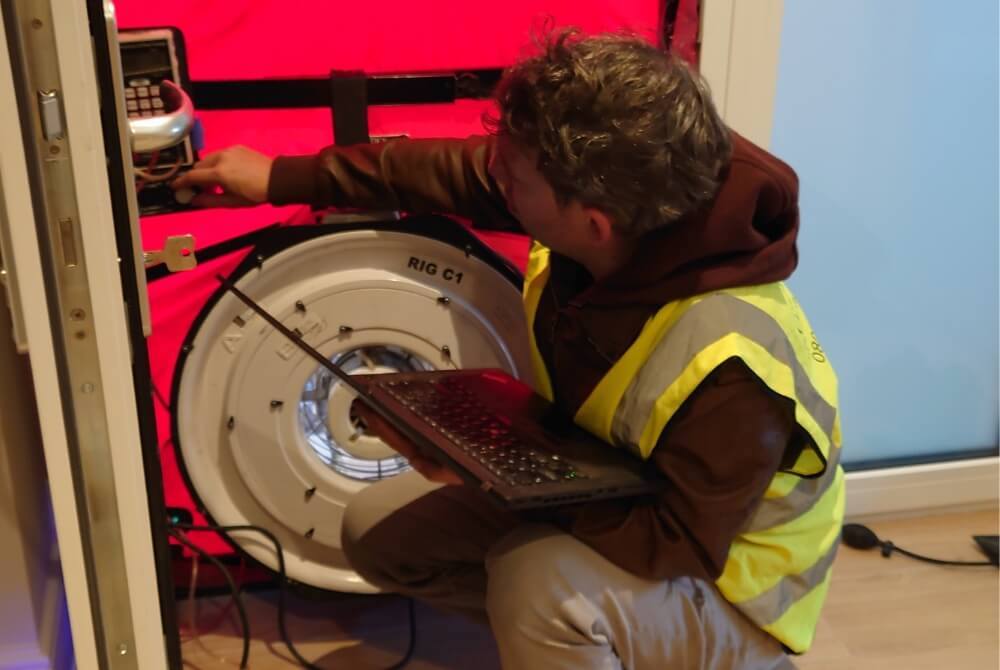
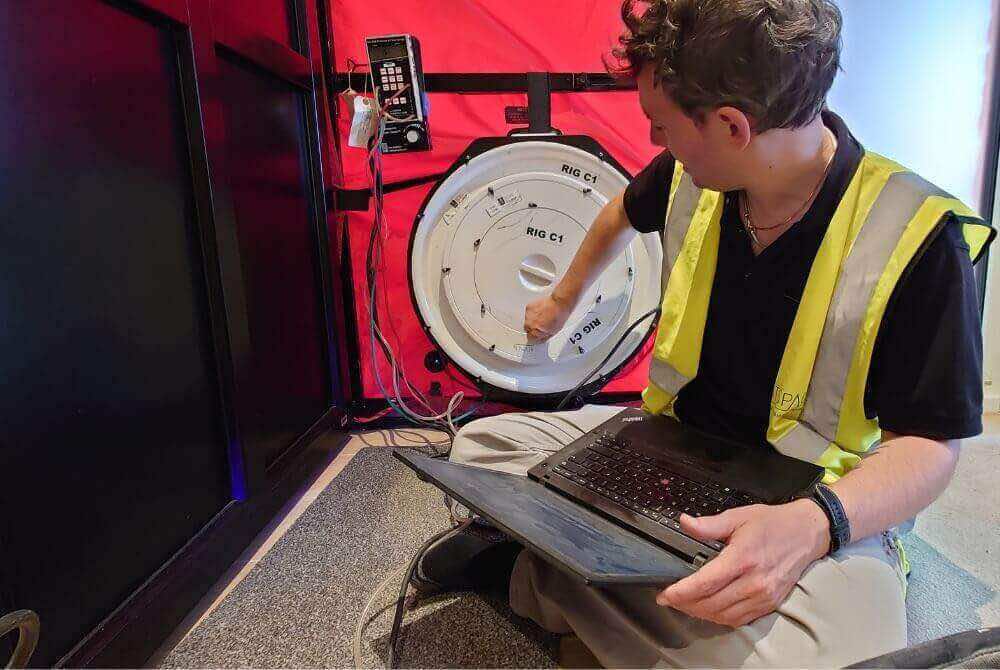
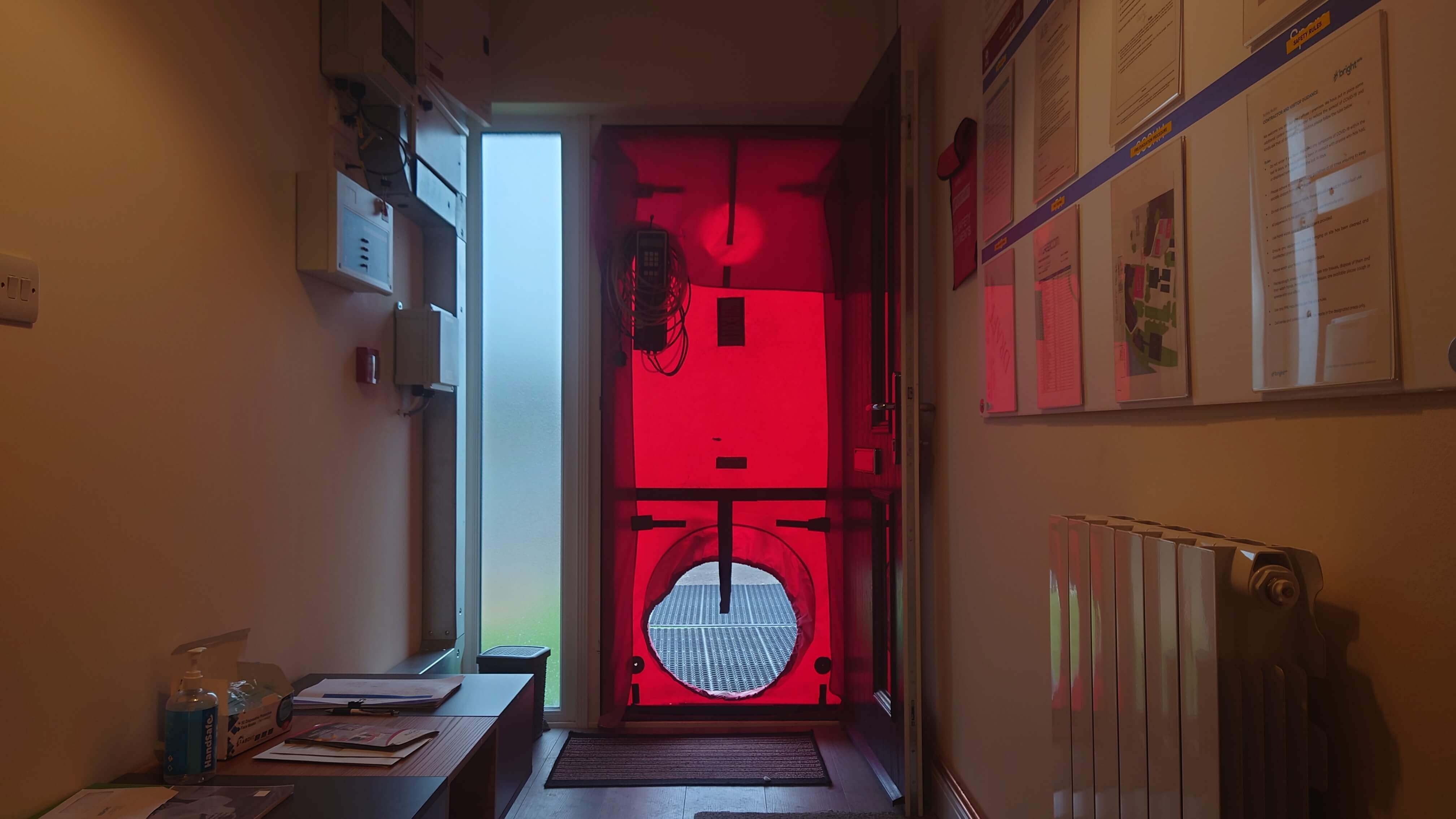
On test day, the engineer fits a calibrated fan into an external opening, prepares the dwelling in line with the approved method, runs the pressure test and calculates the air permeability result at 50Pa. If the plot is close to target or fails, many testers will also help identify leakage paths so the site team can fix the right issues instead of guessing. The aim is not just to produce a number, but to produce a usable compliance result.
For the continuous systems, the minimum high-rate extract figures are 13 l/s for a kitchen, 8 l/s for a utility room, 8 l/s for a bathroom and 6 l/s for sanitary accommodation. These are the same high-rate wet-room benchmarks used for both continuous mechanical extract ventilation and MVHR-type systems. They are the key room-by-room boost numbers the commissioning process checks.
The exact information and preparation needed depends on the project. We issue a booking checklist or information request when the job is booked, and supporting guidance is available in our knowledge hub. Final advice, readiness and outcomes depend on the information supplied, site condition and scope at the time.
ATTMA residential air testing usually means the test is being carried out by an ATTMA-registered tester under ATTMA technical standards. For typical homes and other simple buildings, ATTMA TSL1 is the standard commonly used, and it defines a simple building as including single dwellings and small buildings up to 4000m³ tested as a single entity with one blower door fan. In everyday terms, it is a recognised competence route for home air testing.
TM59 is CIBSE’s Design methodology for the assessment of overheating risk in homes. CIBSE’s Knowledge Portal still lists TM59 (2017) as active, and England’s Approved Document O says the dynamic thermal modelling route should follow CIBSE’s TM59 methodology. In practical terms, TM59 is the standard residential dynamic overheating method most teams mean when they ask for an overheating assessment.
Passive House air leakage testing is a blower door pressure test used to prove how airtight a building really is for Passivhaus certification. The result is reported as n50, which is the number of air changes per hour at a pressure difference of 50 pascals. In practical terms, it tells the project team and certifier whether the built envelope is tight enough to meet the standard, not just whether the design drawings looked good on paper.
Smart HTC is a way of measuring the real heat loss performance of a home using Heat Transfer Coefficient data.
Smart HTC is a data-led way of measuring a home’s real heat loss in use by calculating its Heat Transfer Coefficient from meter data, temperature data and weather data. In practical terms, it tells you how much heat the whole home is losing per degree of temperature difference, based on what is actually happening in the property rather than what a visual survey assumes. It is especially useful for retrofit planning, performance-gap checks and heat pump design.
A BRUKL report is the Building Regulations UK Part L compliance report used to show energy-compliance evidence for a non-domestic building. Approved Document L in England says the BRUKL report should be provided to the Building Control body and to the building owner to show that the work complies with the energy-efficiency requirements, and that SBEM produces it as a standard output.
A BRUKL report is the Building Regulations UK Part L compliance report produced from the approved software for a non-domestic building. Approved Document L says it should be provided to the Building Control body and to the building owner to show that the work complies with the energy-efficiency requirements. In practical terms, it is the core Part L reporting output behind commercial compliance.
A New Build/Conversion Commercial EPC Assessment is the non-domestic EPC assessment used for a new commercial building or a commercial building created or materially modified by conversion. In practice, it is the route used for offices, retail units, industrial units, warehouses and other buildings other than dwellings when the EPC is linked to construction completion or qualifying modification, not a routine existing-premises sale or renewal EPC.
A New Build/Conversion Domestic EPC Assessment is the SAP-based energy assessment used for a newly constructed dwelling, including a new home created by conversion or change of use. It is not the existing-house EPC route. In practice, it is the assessment used to generate the domestic EPC for a new dwelling and to support the wider energy-compliance process around that dwelling.
A U-value is the thermal transmittance of a building element. It shows the rate of heat loss through that element for each degree of temperature difference between inside and outside. BR 443 explains that the U-value multiplied by the element area gives the heat-loss rate through that component, which is why it matters so much in Building Regulations and energy calculations.
There is no one-size-fits-all “good” Smart HTC number because the result depends on the size, shape and condition of the home. In practice, a good result is one that is lower than the baseline you started with, or one that confirms the home is not losing as much heat as a conventional survey assumed. For comparing different homes, the HLP is usually more useful than raw HTC because it normalises by floor area.
A good result is one that comfortably beats your project-specific target, not just the legal limit. For most commercial schemes, 8.0 m³/(h·m²) at 50Pa is only the backstop, and better-performing projects often need materially tighter results to keep SBEM/BRUKL compliant; in England’s current NCM, notional building air permeability values are 3 or 5 depending on activity type. In practice, “good” means enough margin to protect sign-off, not just enough to survive the day.
A good result is one that comfortably beats the plot’s SAP design target, not one that merely scrapes under the legal limit. The regulatory backstop is 8.0 m³/(h·m²) at 50Pa, but current reference specifications point much tighter than that, with England’s notional dwelling and Wales’s elemental specification both using 5.0. In practice, a “good” result gives enough margin to protect compliance and avoid last-minute ventilation or SAP headaches.
A good retrofit result is one that materially improves the home against its own starting point without creating a ventilation problem. Recent DESNZ work found the GB housing stock had a mean air permeability of 8.6 m³/(h·m²) at 50Pa, with a very wide spread, so “good” in retrofit is about meaningful improvement and healthy ventilation, not blindly chasing new-build numbers on an older property.
A highly airtight dwelling is one with a design air permeability below 5 m³/(h·m²) at 50Pa or an as-built air permeability below 3 m³/(h·m²) at 50Pa. That definition matters because the ventilation guidance changes once the dwelling crosses that threshold. For designers and self-builders chasing very low test numbers, this is the point where the ventilation strategy needs real care rather than basic assumptions.
Air leakage on-site design advice is proactive airtightness support that helps the design and site team define the air barrier, review junctions and penetrations, and check workmanship before hidden defects are sealed in. In practice, it sits between pure design and the final test. The aim is simple: make the air barrier clear, buildable and continuous, so the project is not relying on last-minute sealing to hit its target.
An Energy Statement is a planning-stage report that explains how a proposed development will reduce energy demand and carbon emissions in line with the relevant planning policies. In practical terms, it shows the local planning authority how the scheme is expected to perform, what measures are being used to cut emissions, and how the project responds to the relevant policy framework before planning permission is determined. (london.gov.uk , cityoflondon.gov.uk)
An overheating assessment is a report that evaluates whether a building is at risk of becoming too hot in summer and what mitigation is needed to reduce that risk. In building-regulations terms, it is the process used to show compliance with Part O for qualifying residential buildings. In planning terms, it is often a dynamic thermal modelling exercise used to show how the scheme manages heat risk through design rather than relying on late mechanical cooling.
As-built SAP is the SAP calculation based on the dwelling as actually constructed. It has to reflect specification changes made during the build and incorporate the measured air permeability. This is the version that matters at completion, because it shows whether the finished home still meets the required performance once theory has turned into site reality.
Background ventilation testing is a service used to assess whether a dwelling has enough background air provision for healthy ventilation, usually without relying only on assumptions or product brochures. In new-build and replacement-window work, that often means verifying the correct equivalent area and installation of background ventilators. In retrofit, it more often means the IAA / TrustMark-approved dwelling assessment used to judge whether existing infiltration is sufficient or whether extra background ventilators are needed after energy efficiency works.
Commercial air leakage testing is a pressure test that measures how much uncontrolled air leaks through the envelope of a building other than a dwelling. The result is reported as air permeability in m³/(h·m²) at 50Pa, which is the standard Part L metric for commercial airtightness testing in the UK. In practice, it tells developers, contractors and Building Control whether the finished building is as airtight as the design and compliance model assumed.
Design-stage SAP is the SAP calculation based on the dwelling as designed before work starts. It is used to show the intended performance of the home and to support the first compliance submission to Building Control. In practice, this is the version you want locked down before site starts changing products and details under programme pressure.
Diagnostic air leakage testing is an investigative airtightness survey used to find where uncontrolled air is leaking, not just how much is leaking. The building is put under a pressure difference so leakage paths become easier to detect, then tools such as smoke, thermal imaging and airflow probes are used to pinpoint the problem areas. It is the practical fault-finding stage that helps teams fix leaks before or after a formal air test.
Diagnostic smoke testing is a leak-finding method used alongside air pressure testing to show exactly where uncontrolled air is moving through the building envelope. A blower door or similar fan creates a pressure difference, and smoke pencils or larger smoke generators make the airflow visible so the team can trace the leakage path rather than just read a final number.
Flanking transmission is sound travelling around the main separating wall or floor rather than straight through it. Approved Document E warns that extensive remedial work to reduce flanking may be needed in conversions, and ANC gives typical examples such as continuous ceilings, floors, voids and lined external walls undermining an otherwise good separating element. In acoustic upgrade work, flanking is often the difference between a pass and a fail.
Pre-improvement sound insulation testing is a baseline acoustic test carried out before upgrade works to measure how much sound currently passes through an existing wall or floor. In practical terms, it tells you the starting performance of the separating element so the upgrade can be designed around real evidence rather than guesswork. It is especially useful on existing flats, floor upgrades and conversion projects where the original construction is uncertain.
Residential air leakage testing is a pressure test that measures how much uncontrolled air escapes through the envelope of a dwelling. The result is reported as air permeability in m³/(h·m²) at 50Pa, which is the standard Part L measure used for new homes in England and Wales. In practical terms, it tells the builder, SAP assessor and Building Control whether the finished house or flat is as airtight as the design assumed, or whether hidden leakage is likely to cause compliance, comfort and energy-use problems.
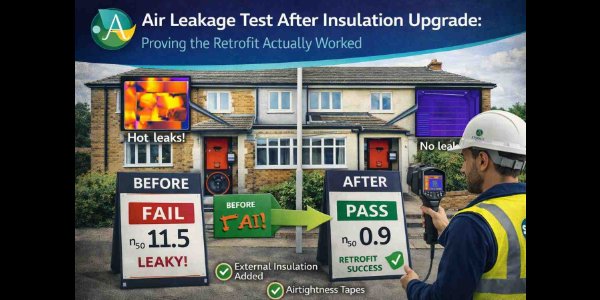
Retrofit air leakage testing is a pressure test used on existing buildings to measure how much uncontrolled air leaks through the envelope before or after improvement works. In practical terms, it gives a measured baseline, helps identify where heat is being lost through draughts and gaps, and shows whether retrofit work has genuinely improved airtightness rather than just looking better on paper.
Smoke shaft air leakage testing is a specialist pressure test that checks how airtight the builder’s work smoke shaft really is before the smoke control system is signed off. In practice, it verifies that the shaft will not leak so badly that the smoke ventilation strategy loses performance in a fire. It is a fire-safety test, not an energy-compliance test.
Sound insulation testing is the on-site measurement of how much sound passes through a separating wall or floor between dwellings or rooms for residential purposes. In practical terms, it tells you whether the completed partition is stopping enough airborne noise and, where relevant, impact noise to satisfy the required standard. On UK projects, this is the Part E acoustic test most developers mean when they ask for a sound test.
The 25% rule is the default Part L limit on the opening area of a domestic extension. In England, the total area of windows, roof windows, rooflights and doors in the extension should not exceed 25% of the floor area of the extension, plus the area of any openings that no longer exist or are no longer exposed because of the extension. In Wales, the wording is very similar but uses 25% of the internal floor area of the extension.
The London energy hierarchy is Be Lean, Be Clean, Be Green, Be Seen. London Plan Policy SI 2 defines those steps as: use less energy, exploit local energy resources and supply efficiently, maximise on-site renewable energy, and monitor and report actual energy performance. In practice, a London Energy Statement is expected to show the carbon savings achieved at each stage, not just throw a renewable technology onto the roof at the end. (london.gov.uk)
The headline Passivhaus airtightness target is n50 ≤ 0.6 air changes per hour at 50Pa. That is the threshold for Passivhaus Classic, Plus and Premium. It is a hard quality benchmark, not a vague aspiration, which is why Passivhaus projects typically plan preliminary tests, tighter site checks and more detailed airtightness coordination than standard compliance-only jobs.
It is the whole-dwelling calculation route used to show that the dwelling plus proposed extension performs no worse than the dwelling plus a compliant benchmark or notional extension. In England, this route checks the dwelling primary energy rate, dwelling emission rate and dwelling fabric energy efficiency rate. In Wales, the equivalent primary energy and carbon route compares the proposal against a fully compliant benchmark extension or conversion.
The widely used benchmark is a maximum leakage rate of 3.8 m³/h/m² at 50Pa for the builder’s work shaft. That figure appears in current SCA/LABC guidance and is the number most project teams recognise on site. However, you should still confirm the exact project specification, because some smoke-control designs set their own criteria.
It is the trade-off method that compares the average thermal performance of the proposed extension against a compliant benchmark extension of the same size and shape. In England, the extension’s area-weighted U-value must not exceed that of an extension complying with paragraph 10.7. In Wales, the U-value trade-off approach requires the proposal’s area-weighted average U-value to be no greater than that of a fully compliant benchmark.
The best way is to manage the air test as part of plot delivery, not as a last-day surprise. Book early, keep a clear design target, inspect common fault areas before finishes hide them, and use pre-test advice where the plot type or target is demanding. ATTMA guidance is blunt on this point: many failed dwelling tests happen because testers are called before the plot is truly ready. Good sequencing is what keeps handover on track.
Start early, model the real junctions rather than idealised ones, make sure the details are actually buildable, and keep the site team working to the same junction package that fed the SAP or BRUKL. Current Part L guidance in England and Wales keeps repeating the same message: drawings, buildability, inspection and correct methodology all matter. The projects that avoid rework are the ones that treat thermal bridging as a live design-and-site issue, not a spreadsheet exercise at the end.
Get the assessor involved early, complete the design-stage SAP before works begin, keep the specification under control, and update changes as they happen instead of trying to reconstruct them at the end. The official England and Wales process is built around design-stage and as-built reporting for exactly this reason. The projects that “get it right first time” are usually the ones that treat SAP as a live compliance tool, not a last-week certificate request.
Get the assessor involved early, complete the design-stage BRUKL before works begin, lock the building use and zoning assumptions down early, and keep a live record of every specification change during the build. Approved Document L is built around a design-stage and as-built process for exactly this reason. The projects that pass smoothly are the ones that treat SBEM as a live compliance tool, not a last-week certificate request.
Start early, fix the build-up before procurement starts, and make sure the person doing the calculations has the full specification rather than half-complete sketches and marketing sheets. The strongest projects are the ones that lock the thermal assumptions in early, keep substitutions under control, and use the right standard for the right element the first time. That is what keeps Building Control, SAP/SBEM and handover moving.
Set the target early, define the air barrier clearly, simplify details where you can, keep services away from the airtight layer, run an airtightness workshop, use hold points, inspect before closing up and carry out preliminary leak checks while the barrier is still accessible. That is the pattern repeated across Approved Document L, ATTMA guidance and good-practice airtightness delivery. Projects that pass cleanly usually manage airtightness as a process, not a last-day event.
Treat it as a design tool, not just a validation document. Start early, fix the policy baseline before modelling, coordinate SAP/SBEM/BRUKL inputs with the architect and M&E designer, and keep the overheating, heat-network and renewable strategy aligned with the planning narrative. The strongest Energy Statements are the ones that explain a settled design clearly, not the ones written at the last minute to rescue an application pack. (london.gov.uk , haringey.gov.uk)
Design the glazing with the calculation in mind from the start. Measure the opening area properly, count any lost openings correctly, choose the right compliance route early, and lock the glazing and build-up specifications before orders are placed. The jobs that go smoothly are usually the ones where the calculation leads the design, not the ones where the calculator is asked to rescue it afterward.
Treat overheating as an early design issue, not a late compliance add-on. The strongest approach is to review heat risk before the façade and services strategy are fixed, follow the cooling hierarchy, model the right sample units, and keep the analysis live as the design evolves. The GLA and CIBSE guidance both point the same way: early passive design decisions are what stop overheating becoming a late-stage problem.
Lock the sanitaryware and relevant white goods down early, check whether the project is working to 125, 110, or the Welsh route, and do the calculation before procurement changes start. The projects that stay on programme are usually the ones that treat Part G as a live compliance item from design stage, not a last-week Building Control notice.
Book early, group the plots properly, get the acoustic design right before site locks the details in, control flanking routes, and only test when the plots are genuinely ready. ANC says the best way to maximise the chance of passing is to seek expert guidance before construction starts, and Approved Document E says specialist advice should be sought early where extra guidance is needed. The projects that pass first time usually treat acoustics as a package, not a late certificate.
Appoint the assessor early, get the design-stage SAP done before works start, keep a tight record of specification changes, and do not leave the final as-built information until the last minute. The official process in both England and Wales is built around design-stage and as-built reporting, and new dwellings must still have an EPC once complete. Projects that treat SAP, BREL / BRWL and EPC work as a live programme item usually avoid last-week problems.
Treat it as a live compliance workstream, not a final-day certificate request. The strongest route is to appoint the assessor at design stage, complete the BRUKL submission before works start, keep use-class and zoning assumptions stable, track substitutions carefully, and finalise the as-built information before Building Control is waiting on it. The legal handover duty is tied to physical completion, so late EPC work almost always becomes a programme issue.
Treat the shaft as a handover-critical package from day one. Confirm the leakage target early, test the builder’s work shaft before dampers and fans go in, make sure penetrations and AOV frames are properly sealed, and do not wait until final commissioning to discover the shaft leaks. The projects that keep programme intact are the ones that validate the shaft early, not the ones that hope it will be fine.
Use Smart HTC early enough to influence the decision, not after the money has already been spent. The strongest route is to measure the home before major works, combine the result with airtightness, thermography or other diagnostics where needed, and then use the measured heat-loss picture to guide retrofit scope or heat-pump sizing. Government and industry evidence both point the same way: measured performance data reduces assumption risk and makes better decisions more likely.
Use it early, and use it as evidence for the ventilation strategy rather than as a late argument after works are finished. The strongest route is to assess the existing dwelling before energy-efficiency measures, use the result to decide whether background ventilator upgrades are genuinely needed, and then repeat the required evidence after installation if you are relying on the TrustMark / IAA route. That keeps the retrofit ventilation strategy evidence-led instead of assumption-led.
Use it early, use it while the air barrier is still accessible, and use it to verify real fixes rather than cosmetic sealing. The strongest approach is to carry out interim diagnostics before the formal test, target the major leakage paths, re-check the remedials and only then move to final sign-off testing. That is how teams avoid failed tests, reduce rework and keep completion moving.
Use it early, use it under meaningful pressure, and use it while the air barrier is still accessible. The strongest process is interim air pressure testing, smoke-based leak tracing, targeted remedials and then formal verification once the defects are fixed. That approach gives the clearest route to first-time pass success, lower rework and a cleaner handover.
Use it before the upgrade design is locked, while the existing construction is still intact enough to tell you something useful. The strongest route is baseline testing or inspection, then acoustic design focused on the real weak points, then final post-works testing to verify the completed build. That sequence gives the design team evidence, reduces guesswork and makes first-time pass success far more realistic.
Use it early, use it in stages where needed, and use it alongside ventilation review rather than after the fact. The strongest retrofit process is baseline test, targeted design, interim checks where details are still accessible, then post-works verification to prove the result. That approach reduces wasted remedials, protects indoor air quality and gives the project team evidence they can actually build decisions around.
The cooling hierarchy is the policy sequence used to reduce heat risk before falling back on active cooling. The GLA guidance sets it out as: reduce heat entering the building, minimise internal heat generation, manage heat within the building, provide passive ventilation, provide mechanical ventilation, and only then provide active cooling systems. In practical terms, it is a design-first approach, not an air-conditioning-first approach.
The current standard in England is 125 litres per person per day for a new dwelling, unless the optional tighter requirement applies. Where planning permission specifies and conditions the optional requirement, the limit becomes 110 litres per person per day.
In Wales, the current standard is 110 litres per person per day where a dwelling is erected, and 125 litres per person per day where a dwelling is formed by material change of use within regulation 5(a) or (b). That is one of the clearest current differences between England and Wales.
The default y-value in current England and Wales dwelling guidance is 0.20 W/(m²K). Both live dwelling routes state that this can be used as the default whole-dwelling thermal-bridging allowance where more detailed junction inputs are not being used. It is simple, but it is also usually conservative compared with a well-detailed bespoke design.
SAP is the government-approved methodology for producing an EPC for a newly constructed dwelling, while RdSAP is the simplified method used for existing dwellings where less information is readily available. In simple terms, SAP is the detailed new-build/conversion route; RdSAP is the existing-home route built around assumptions.
SAP is the approved methodology for producing an EPC for a newly constructed dwelling, while RdSAP is the reduced-data method used for existing dwellings. In practical terms, SAP uses detailed plans and specifications, whereas RdSAP uses an on-site survey plus conventions because much less is known about the existing home.
SBEM is the standard simplified modelling route for many non-domestic buildings, while a DSM is a more detailed Dynamic Simulation Model. Official guidance says DSMs may be used where SBEM is not sophisticated enough to provide an accurate assessment. In practice, straightforward buildings often suit SBEM, while more complex buildings or servicing arrangements may justify DSM instead.
A U-value describes heat loss through a plane element such as a wall, roof or floor. A PSI value describes the extra heat loss at a junction between elements or around openings. BR 443 makes that split clear: repeating thermal bridges are dealt with in the U-value of the element, while non-repeating junction losses are dealt with separately using linear thermal transmittance values.
A PSI value is the heat-loss figure for one specific junction, expressed in W/m·K. A y-value is an area-normalised thermal-bridging factor, expressed in W/m²K, derived by spreading the total junction heat loss across the exposed area of the dwelling. SAP explains that where a y-value is used, it is derived by dividing the calculated thermal-bridge heat loss by the total exposed area.
The design-stage SAP is based on the dwelling as designed before work starts, while the as-built SAP is based on the dwelling as actually constructed. Approved Document L in both England and Wales requires two versions of the compliance report: first the design-stage report, then the as-built report with any changes to the specification captured. That is why late changes matter so much.
Limiting air permeability is the worst value the regulations allow, design air permeability is the target set at design stage, and assessed air permeability is the value used for final compliance based on the dwelling actually tested. That difference matters because a plot can beat the legal backstop and still miss the design value assumed in SAP. For site teams, the number that matters day to day is the design target, not just the absolute limit.
The simplified method is the prescriptive Part O route based on glazing, location, shading and free-area limits. Dynamic thermal modelling is the performance route using a simulated building model to predict overheating risk. England’s Approved Document O says compliance can be demonstrated by either the simplified method in Section 1 or the dynamic thermal modelling method in Section 2. Wales also offers the same two broad routes.
It is the approved calculation methodology set out in Appendix A in England and Annex 2 in Wales. It is used to assess whole-house potable water consumption in new dwellings and qualifying dwelling conversions for compliance against the water-use targets in Regulation 36.
Ventilation flow rate testing is the on-site measurement of how much air a mechanical ventilation system is actually moving at each terminal or fan. In practical terms, it checks whether the installed system is delivering the airflow rates required by Part F, rather than just relying on what the product label or design intent said. On most residential jobs, it is the test people mean when they say a Part F ventilation test or extractor fan flow test.
The approved route is the National Calculation Methodology (NCM) for buildings other than dwellings, implemented through SBEM or an approved Dynamic Simulation Model (DSM). The 2026 England notice of approval says the energy performance of a building that is not a dwelling must be calculated using an approved implementation of the NCM, i.e. SBEM or an approved DSM, and the Welsh notice says the same for new buildings other than dwellings in Wales.
TrustMark’s retrofit design guidance says that, to demonstrate there is sufficient air infiltration so that background ventilation upgrades are not warranted, the IAA route requires a whole-house result of at least 1.0 ACH @ 4Pa and bedroom results of at least 1.5 ACH @ 4Pa where the bedroom test is required. These are the key benchmark numbers behind the service.
Current non-domestic guidance does not mirror the dwelling four-way route exactly. Approved Document L Volume 2 says thermal bridging should be addressed either by using construction joint details calculated by a suitably competent person following BR 497 and a defined process flow sequence, or by using generic IP 1/06 values increased by 0.04 W/(m·K) or 50%, whichever is greater. That is the current live non-domestic position.
Before the tester arrives, the plot should have fitted windows and external doors, sealed penetrations, installed sockets and switches, working power, and accessible rooms and cupboards. Common problem areas such as bath panels, loft hatches, access doors and service holes should already be sorted. The more a site relies on snagging airtightness on the morning of the test, the more likely it is to waste time, miss target or need a retest.
For dwelling-houses and flats formed by material change of use, the usual field targets are 43 dB DnT,w + Ctr minimum for walls, 43 dB DnT,w + Ctr minimum for floors and stairs with a separating function, and 64 dB L’nT,w maximum for impact sound. The conversion targets are slightly less demanding than purpose-built new build, but they are still easy to miss if flanking and retained fabric are not controlled.
It is useful when you want to compare real world performance against design assumptions or understand whole house heat loss better.
For most England projects, not yet. The new 2026 Approved Document L for dwellings was published in March 2026 but generally takes effect on 24 March 2027, with a later date for work in connection with higher-risk building work. That means most live English residential air testing still sits under the 2021 edition incorporating 2023 amendments for now. Wales is separate again, with its own current dwelling guidance and its own consultation timetable.
Book the residential air test as soon as the build programme and likely completion window are clear, then lock in the exact slot once the plot is genuinely close to ready. Leaving it until the last minute is one of the easiest ways to create avoidable delays. Providers commonly offer quick appointments and fast certificates, but late booking gives the site team no breathing space for remedials, retesting or final SAP updates.
A shell-and-core unit should be tested when the base-build envelope is complete enough to represent the landlord handover condition and before tenant works change the compliance picture. Approved Document L recognises shell-and-core situations and requires reasonable assumptions about later services at the early stage, while the as-built calculations at practical completion are based on the building and systems actually constructed. In simple terms, test the shell when it is a real shell, not while scopes are still moving.
Test it when the builder’s work shaft is complete and airtight enough to represent the finished shaft, ideally before the smoke-control equipment is installed and certainly before commissioning becomes critical-path. That gives the team a clean read on the shaft itself and keeps remedials far simpler than trying to work around installed dampers, fans and controls later.
Diagnostic air leakage testing should be used before the formal test if you want the best chance of a first-time pass, and immediately after a failed test if you need targeted remedials fast. It is also useful during retrofit planning, on existing buildings with draught complaints, and on complex sites where airtightness details are hard to verify visually. The earlier it is used, the easier the fixes usually are.
For separating elements between dwellings and flats, Approved Document E Table 0.1a sets 45 dB DnT,w + Ctr and 62 dB L’nT,w for purpose-built dwellings, and 43 dB DnT,w + Ctr and 64 dB L’nT,w for dwellings formed by material change of use. For rooms for residential purposes, Table 0.1b uses 43 dB for walls and 45/62 or 43/64 for floors depending on whether the building is purpose built or formed by change of use.
As at March 2026, England’s approved methodology notice for new dwellings has been updated from SAP 10.2 to SAP 10.3, while Wales continues to use SAP 10.2 under its current approval. That matters because the measured air test result is entered into the approved dwelling energy methodology, so assessors need to be working to the right version for the jurisdiction. The site testing method itself does not suddenly change, but the compliance modelling around it can.
For most UK projects the core references are BR 443, BS EN ISO 6946 for opaque elements, BS EN ISO 13370 for floors and other elements in contact with the ground, and BS EN ISO 10077 for windows and doors. Hot-box measurement is covered by BS EN ISO 12567. That is the standards framework most compliant UK U-value work now sits inside.
In practical residential terms, this service mainly covers System 1, System 3 and System 4. Those are the fan-based dwelling systems most clients mean when they ask for ventilation flow rate testing: intermittent extract with background vents, continuous mechanical extract, and MVHR. The current Approved Document guidance is written in functional rather than numbered language, but those industry labels are still widely used and still useful for booking and scoping the right test.
A residential air pressure test should be carried out by someone who has appropriate training and is registered to test that class of building. The guidance also allows Building Control bodies to accept a certificate from an authorised registered person as evidence that the testing procedure has been followed properly. In practice, most developers and self-builders look for testers registered with a recognised scheme such as ATTMA or Elmhurst.
The tester measures and certifies the result, but Building Control signs off the overall compliance evidence. In practice, the air test certificate is reviewed alongside the SAP and other completion information, and the building control body decides whether the plot has the evidence needed for compliance. That is why a fast certificate matters, but accurate reporting matters even more. The number alone is not the whole sign-off.
Homeowners, developers, retrofit teams, product manufacturers and performance focused consultants may use it.
Clients choose ATSPACE because we make compliance straightforward from design through to completion. We provide a same day response, one point of contact, and clear support throughout the process to help keep projects moving and achieve Building Regulations sign off with less stress.
New homes usually fail air tests because of ordinary leakage points that were missed or left too late: poorly sealed penetrations, leaky windows and doors, gaps behind dry-lining, downlights, bathroom boxing, loft access details and weak junctions around skirtings or reveals. The main problem is normally build quality and coordination, not the test itself. Most failures are predictable once you know where leakage tends to appear on a plot.
Most smoke shafts fail because the shaft was never truly airtight in the first place. Typical problems are unfinished builder’s work, poorly sealed AOV frames, unsealed joints, penetrations and awkward interfaces between trades. Smoke control designers work to strict leakage assumptions, so even small defects that look minor to a site team can be enough to blow the result.
We work hard to stay competitively priced without compromising on service. Our pricing is regularly reviewed against the market so that our clients receive strong value, expert support and dependable delivery all in one place.
It gives a clearer picture of actual thermal performance and can help identify a performance gap.
A residential air test is required because Part L is not just about insulation on paper; it is about proving the built home limits uncontrolled heat loss in reality. The measured result is used to demonstrate compliance with the air permeability requirement and to support the final dwelling energy calculations. On site, that means the air test is not a box-ticking extra. It directly affects whether the plot is ready for final compliance paperwork and sign-off.
Sound insulation testing is required because Part E is there to ensure reasonable resistance to the passage of sound between homes and similar residential spaces. Approved Document E says compliance with Requirement E1 is normally demonstrated through on-site pre-completion testing carried out as part of the construction process. In simple terms, the design may look fine on paper, but the test proves what was actually built.
It is required because Part F is about proving adequate ventilation in the building that was actually installed, not just the one shown on drawings. Approved Document F says mechanical ventilation systems must be commissioned and, for the relevant work, measured so the results show the system is achieving the required flow rates. On site, that makes ventilation flow rate testing a sign-off issue, not a paperwork extra.
Because when time matters, speaking to us directly can help move things forward faster. We are set up to provide quick answers, instant quotes or practical advice, and for urgent enquiries we can connect you with a technical expert straight away.
Because airtightness problems are far cheaper to solve on drawings than on finished plots or completed façades. ATTMA’s guidance is clear that the earlier problems are identified in design, the more cost-effective the remedies are, and Approved Document L also expects critical details to be checked before they are concealed. On site, that means fewer nasty surprises at handover and less chance of remedial sealing becoming a programme issue.
Clients trust ATSPACE because we combine experience, accreditation and dependable service. We are committed to delivering compliance properly, clearly and professionally, giving our clients confidence that their project is in safe hands.
Yes. We give our clients one dedicated point of contact throughout the job. That means clearer communication, quicker decisions and a simpler process from initial enquiry through to final certification.
Videos for air leakage testing
Explore our videos for quick, engaging insights on building compliance. From step-by-step guides to expert advice, our video library simplifies complex topics, making it easier for you to take action and stay informed. Perfect for when you need clarity in minutes!