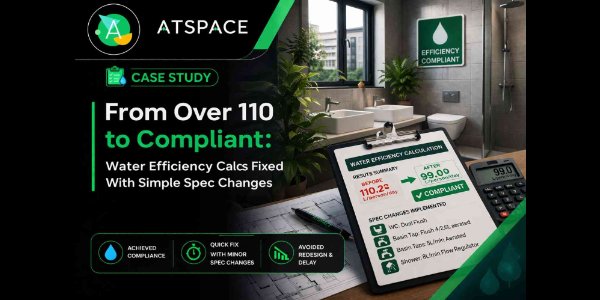
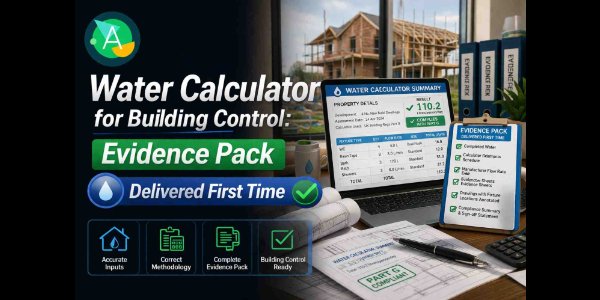
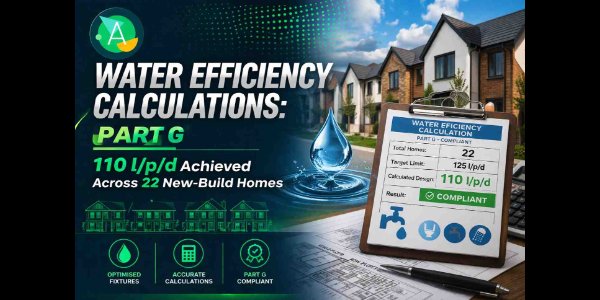
Water efficiency calculations are the Part G calculations used to show that a dwelling’s proposed sanitary fittings and relevant appliances do not exceed the permitted water-use limit. In practical terms, they prove whether the design of the home’s cold and hot water systems complies with the approved water-efficiency standard for that dwelling.
Yes. In UK building-control language, water efficiency calculations and Part G water calculations usually mean the same thing. Both refer to the approved method for demonstrating compliance with Requirement G2 and Regulation 36 for qualifying dwellings.
They are used to show that a qualifying dwelling meets the required litres per person per day target under Part G. In practice, they are submitted as part of the Building Regulations process so Building Control can see the calculated water-use figure for the completed dwelling.
Yes, in the normal domestic Part G sense. In England, Requirement G2 applies only when a dwelling is erected or formed by a material change of use within regulation 5(a) or (b). Wales applies the same basic scope. That means the service is mainly for new-build dwellings and qualifying conversion-created dwellings.
Yes. New dwellings fall directly within the Part G water-efficiency regime. In England, that means complying with the 125 litres/person/day standard unless the optional 110 litres/person/day requirement has been imposed. In Wales, newly erected dwellings are set at 110 litres/person/day.
Yes, where the conversion creates a dwelling that falls within the relevant material-change-of-use route. England’s Approved Document G applies G2 where a dwelling is formed by material change of use under regulation 5(a) or (b), and Wales does the same. In practice, a qualifying conversion still needs a Part G water-use calculation.
Yes, if the work creates new self-contained dwellings. Material change of use includes cases where a building is used as a dwelling where previously it was not, or contains a flat where previously it did not. That makes house-to-flats and many commercial-to-residential dwelling schemes standard Part G calculation jobs.
Not usually. The mainstream Part G water-efficiency calculation route is tied to erected dwellings and certain material-change-of-use dwellings. A normal extension or bathroom upgrade to an existing home does not normally trigger the full dwelling water-efficiency calculation in the same way.
No, not normally. If the loft conversion is just enlarging the existing home and does not create a separate dwelling unit, it does not usually fall into the G2 water-efficiency calculation route. If it creates a new flat or separate dwelling, that changes the position.
In England, the mainstream Part G2 water-efficiency calculation service is a dwelling service. Wales is more nuanced because its guidance also contains G2A for certain buildings other than dwellings and healthcare buildings, but the standard “water efficiency calculator for new dwellings” still applies to the dwelling side. For most UK search intent, this service means the domestic dwelling calculation route.
The current standard in England is 125 litres per person per day for a new dwelling, unless the optional tighter requirement applies. Where planning permission specifies and conditions the optional requirement, the limit becomes 110 litres per person per day.
In Wales, the current standard is 110 litres per person per day where a dwelling is erected, and 125 litres per person per day where a dwelling is formed by material change of use within regulation 5(a) or (b). That is one of the clearest current differences between England and Wales.
No. In England, 110 litres/person/day is an optional requirement, not the national default. The live national standard is 125 litres/person/day, and the tighter 110 only applies where planning permission specifically requires it as a condition.
Yes. Government planning guidance says local planning authorities can set the tighter 110 litres/person/day standard where there is a clear local need, through local plan policy and the planning process. Regulation 36 then makes that optional requirement bite where planning permission specifically includes it as a condition.
No. Government consulted in September 2025 on possible changes to strengthen the standard, including an option to move from 125 to 105 litres/person/day, but the current live England standard remains 125, with optional 110 where the planning condition applies.
It is the calculated amount of wholesome water the dwelling is expected to use per occupant per day under the approved methodology. It is a standardised compliance metric, not a promise of what any particular household will really use once living in the home.
Yes. The approved guidance says the water-use figure includes a fixed factor of 5 litres/person/day for outdoor use. That applies within the normal total target, so the indoor fittings and appliance choices have to work around that allowance.
It is the approved calculation methodology set out in Appendix A in England and Annex 2 in Wales. It is used to assess whole-house potable water consumption in new dwellings and qualifying dwelling conversions for compliance against the water-use targets in Regulation 36.
No. The approved methodology expressly says it is not a design tool for water supply and drainage systems. It is a compliance assessment method used to test the proposed dwelling against the relevant water-performance target.
No. The approved methodology says it is not capable of calculating the actual potable water consumption of a new dwelling and notes that behaviour can affect real use. In simple terms, it is a standardised compliance model, not a future utility bill forecast.
The fittings approach is the simplified compliance route that lets certain dwellings show compliance by keeping the installed fittings within set maximum consumption values, rather than completing the full calculator in every case. It is still based on the water-efficiency-calculator methodology, just applied through specified fitting limits.
In England, the fittings approach can be used as an alternative to the full water calculator for both the 125 litres/person/day route and the optional 110 litres/person/day route, provided the installed fittings stay within the relevant table limits. If they do not, the full water-efficiency calculator must be completed.
In Wales, the fittings approach can be used for newly erected dwellings, using one of the accepted fitting-performance options in Table 2.1. It is a recognised alternative to the full calculator on those new-build dwellings, provided the fittings stay within the stated performance levels.
No. The Welsh guidance says the fittings approach may be used other than for a dwelling formed by a material change of use of a building. So for that conversion route, the full water-efficiency calculator is the safer assumption.
The full calculator must be completed where the proposed fittings exceed the permitted fittings-approach values, and also where certain circumstances make the simplified route inappropriate. In England and Wales, that includes cases where a shower is not provided or where a waste disposal unit, water softener or water re-use is proposed.
Yes. The approved guidance says the water used by sanitary appliances and relevant white goods should be calculated using the manufacturer’s declared value for water consumption. That is why getting the right product data sheets early matters so much.
Yes. The approved guidance says that where alternative sources of water are to be used in the dwelling design, this should be reflected in the estimate of water use. In practice, properly designed rainwater or greywater reuse can help a scheme meet the required target.
The calculation covers the sanitary appliances and relevant white goods used in the dwelling. The published fitting tables and guidance specifically refer to WCs, showers, baths, basin taps, sink taps, dishwashers and washing machines. Those are the core items most teams need to pin down early.
For the standard England fittings approach, the maximums are WC 6/4 litres dual flush or 4.5 litres single flush, shower 10 l/min, bath 185 litres, basin taps 6 l/min, sink taps 8 l/min, dishwasher 1.25 l/place setting, and washing machine 8.17 l/kg. If the proposed fittings exceed these, the full calculator must be completed.
For the tighter optional route in England, the maximums are WC 4/2.6 litres dual flush, shower 8 l/min, bath 170 litres, basin taps 5 l/min, sink taps 6 l/min, dishwasher 1.25 l/place setting, and washing machine 8.17 l/kg. These are the benchmarks used when the 110-litre planning condition applies.
Wales gives two fittings-performance options for erected dwellings. Option 1 includes WC 4/2.6 litres dual flush, shower 8.0 l/min, kitchen tap 6.0 l/min and bath 170 litres. Option 2 includes WC 4.5/3.0 litres dual flush, shower 9.0 l/min, kitchen tap 5.0 l/min and bath 170 litres, with the same washbasin, dishwasher and washing-machine limits.
Yes. Bath capacity is explicitly part of the fittings limits. The England standard fittings route allows 185 litres, while the tighter England optional route allows 170 litres. Wales also uses 170 litres in its published fitting options. So bath choice can materially affect whether a scheme stays inside the simplified route.
Yes. The approved guidance says that where a shower is not provided, or where a waste disposal unit, water softener or water re-use is specified, the full water-efficiency calculator must be used rather than relying on the simple fittings approach. These details often catch projects out late if the specification has drifted.
Yes. The approved guidance says that where a building consists of more than one dwelling, such as a block of flats, it should be designed so that the estimated wholesome-water consumption for each individual dwelling is no greater than the target. It is not a block-wide average pass.
Where Regulation 36 applies, a notice has to be given to the Building Control Body stating the calculated potential consumption of wholesome water per person per day for the dwelling as constructed. In England, the notice also states whether the dwelling is being assessed against the 125 or 110 route.
In most cases, the notice must be given to the Building Control Body no later than five days after completion of the building work. Both England and Wales state this timing in their guidance, with special timing rules where an approved-inspector route ends earlier because of occupation or notice changes.
Yes. The approved guidance says local authorities are unlikely to be able to give a completion certificate until the required notice has been received, and the equivalent applies to the final certificate under the approved-inspector route. On real projects, leaving the calculation until the end can therefore directly delay sign-off.
The approved guidance says records of the sanitary appliances and white goods used in the water-consumption calculation should be provided, with enough information to enable owners or occupiers to maintain the building and its services so as to maintain water efficiency. Where alternative water sources are used, records of those should also be provided.
Approved Document G puts the formal notification duty on the person carrying out the work, but it does not create a separate assessor title equivalent to the domestic EPC route. In practice, the calculations are usually prepared by a building-regulations consultant, SAP/Part G assessor or designer who understands the approved water calculator and the product data behind it. The key is competence and accuracy.
Not in the same way as there is for on-construction EPC work. Approved Document G refers generally to competence and to water-efficiency-related competent person schemes, but the regulation 37 process is built around the required notice to Building Control rather than a separate named assessor class. In practical terms, you need someone competent with Part G, even if the regime is not branded like OCDEA.
No. Water efficiency calculations deal with Part G water use, while SAP calculations deal with Part L energy performance for dwellings. They often sit on the same new-build or conversion project, but they are separate compliance workstreams with different methods, targets and notices.
No. The EPC is an energy-performance certificate, while water efficiency calculations are a separate Part G compliance exercise for qualifying dwellings. A project can need both, but one does not replace the other.
Yes. Because the calculation uses the manufacturer’s declared values for the actual fittings and relevant white goods, changing a WC, shower, tap or bath late in the project can change the result. This is one of the most common reasons teams have to revisit the calculation close to completion.
Yes. The approved methodology is sensitive to individual fitting performance, and the simplified fittings route is built entirely around maximum consumption values for those components. On tighter schemes, especially 110 litres/person/day, one poorly chosen fitting can be enough to push the dwelling out of the simple route or into failure.
You need the proposed sanitaryware and relevant appliance schedule with reliable manufacturer water-consumption data, plus clarity on whether alternative water sources, waste disposal units, water softeners or unusual layouts are being used. The approved methodology depends on those declared values, so vague schedules create avoidable delay.
They should be done early enough to influence the sanitaryware and appliance specification, and then updated if products change before completion. Because the final Building Control notice is tied to the dwelling as constructed, leaving the calculation until the end is when unnecessary redesign and sign-off delay usually start.
Yes, if the self-build is a qualifying new dwelling. Part G does not carve out a separate exemption for self-build homes. If the project is an erected dwelling, the same water-efficiency rules and notice requirements still apply.
Historic buildings are not automatically exempt. Approved Document G says the work it covers may include historic buildings, and it is appropriate to take conservation advice before work begins. However, any building that is a scheduled monument is exempt from all Building Regulations requirements, including Part G.
Turnaround and cost are usually driven by scope and information quality: number of dwellings, whether it is England or Wales, whether the job is new build or conversion, whether each flat needs separate results, and whether the simple fittings route works or the full calculator is needed. The more product uncertainty and late changes there are, the more time the service usually takes.
Lock the sanitaryware and relevant white goods down early, check whether the project is working to 125, 110, or the Welsh route, and do the calculation before procurement changes start. The projects that stay on programme are usually the ones that treat Part G as a live compliance item from design stage, not a last-week Building Control notice.
Videos for water calculations
Explore our videos for quick, engaging insights on building compliance. From step-by-step guides to expert advice, our video library simplifies complex topics, making it easier for you to take action and stay informed. Perfect for when you need clarity in minutes!