Commercial air leakage testing is a pressure test that measures how much uncontrolled air leaks through the envelope of a building other than a dwelling. The result is reported as air permeability in m³/(h·m²) at 50Pa, which is the standard Part L metric for commercial airtightness testing in the UK. In practice, it tells developers, contractors and Building Control whether the finished building is as airtight as the design and compliance model assumed.
Yes, in most UK commercial contexts, commercial airtightness testing and a blower door test mean the same basic fan pressurisation method. On larger buildings, the setup may use multiple fans and a more involved testing strategy, but the principle is unchanged: create a pressure difference, measure air flow, and calculate leakage through the building envelope. The test checks uncontrolled leakage, not the performance of the planned ventilation system.
A commercial air test is required because Part L is designed to limit uncontrolled heat loss and verify that the as-built building performs close to the design. For most new non-domestic buildings, the measured result is used in the completion-stage compliance calculation, so poor airtightness can affect both the air test result and the final BER/BPER. On site, that means air leakage is not just a technical issue; it can become a sign-off and programme issue very quickly.
No, but most do. In both England and Wales, buildings other than dwellings generally have to be pressure tested unless they fall into a specific permitted route, such as the sub-500m² default-value route, a large complex building strategy, or representative-area testing for compartmentalised buildings. The safest assumption on a new commercial project is that an air test will be needed unless the compliance route has been agreed early.
Not always. For a non-domestic building with less than 500m² total useful floor area, the developer can avoid testing if the compliance calculation uses an air permeability of 15 m³/(h·m²) at 50Pa. That sounds convenient, but 15 is a weak default and can make SBEM compliance harder, so small offices, retail units and light industrial shells are often better off being tested properly. There is also a separate data-based route for some factory-made modular buildings under 500m².
The key Part L requirement is that the completed building must meet both the airtightness backstop and the project’s energy model. For new buildings other than dwellings, the limiting air permeability is 8.0 m³/(h·m²) at 50Pa, but the measured result must also keep the as-built BER/BPER no worse than the target rates in the final SBEM/BRUKL submission. As of March 2026, England is still working to Approved Document L Volume 2, 2021 edition incorporating 2023 amendments, while Wales uses its own Volume 2 guidance.
Limiting air permeability is the worst value the regulations allow, design air permeability is the target set during design, and assessed air permeability is the value used at completion based on the building actually tested. That distinction matters on commercial jobs because a building can beat the limiting value and still miss the design target assumed in SBEM. Site teams should build to the design target, not just aim to scrape under the backstop.
It means the volume of air leaking through the building envelope, per hour, per square metre of envelope area, when the building is tested at a pressure difference of 50 pascals. In plain terms, lower numbers mean a tighter building. The 50Pa test pressure gives a consistent basis for comparing results and is the standard reporting method used for non-domestic Part L air testing.
A good result is one that comfortably beats your project-specific target, not just the legal limit. For most commercial schemes, 8.0 m³/(h·m²) at 50Pa is only the backstop, and better-performing projects often need materially tighter results to keep SBEM/BRUKL compliant; in England’s current NCM, notional building air permeability values are 3 or 5 depending on activity type. In practice, “good” means enough margin to protect sign-off, not just enough to survive the day.
No. A commercial building can beat 8.0 and still fail the overall Part L compliance check if the measured air permeability is worse than the value assumed in the as-built model and the BER/BPER ends up above the target. This is a common commercial trap: the air test looks acceptable in isolation, but the full compliance package still fails. Always check the SBEM/BRUKL target, not just the limiting standard.
Commercial air testing is more model-driven and more varied in methodology than residential air testing. Non-domestic projects use Approved Document L Volume 2 and SBEM or other approved NCM software rather than SAP, and they can involve routes such as large complex building strategies or representative-area testing for compartmentalised buildings. On site, commercial testing is also more likely to involve multi-fan setups, shell-and-core boundaries, phasing and live-trade coordination.
SBEM is the compliance calculation method behind many commercial Part L submissions, so the air permeability target in the model and the result from the site test have to align. The design-stage value affects the early BRUKL, and the measured result from the finished building is then used in the as-built BER/BPER calculation. That is why commercial air leakage testing should never be treated as a last-minute bolt-on; it needs to be coordinated with the energy assessor from the start.
A commercial air leakage test must be carried out by someone with appropriate training who is registered to test that class of building. Building Control may accept the pressure test certificate as evidence of compliance, but it can also expect proof of tester competence and evidence that the equipment has been properly calibrated. On larger projects, experience with buildings of the same scale matters just as much as turning up with the right fan.
ATTMA commercial air testing usually means the work is being carried out by an ATTMA-registered tester under ATTMA technical standards. In the market, ATTMA registration is a strong sign of competence, and ATTMA’s levels distinguish simpler buildings from larger or more complex non-domestic projects. The regulations themselves do not say ATTMA is the only route, but they do require appropriate training and registration for the relevant class of building.
CIBSE TM23 is the approved airtightness testing methodology referenced by Part L for non-domestic air pressure testing. It matters because it sets the framework for preparation, testing, reporting and leakage diagnostics, which is especially important on large, complex or unusual commercial projects. If Building Control is reviewing a strategy route or a difficult testing setup, TM23 is the document that underpins whether the approach looks credible.
The tester measures and certifies the result, but Building Control signs off the overall compliance package. In practice, the air test certificate is reviewed alongside the as-built BRUKL/SBEM evidence and the rest of the Part L documentation, and the Building Control Body decides whether the evidence is sufficient. That is why fast, accurate reporting matters just as much as the raw test number.
You normally need the air test certificate or report, the measured air permeability value for the completion-stage calculation, and the resulting as-built BRUKL/SBEM evidence for Building Control. In England and Wales, the as-built submission is what links the site result to the BER/BPER compliance check. If there has been a failure and retest, all pressure test results, including failures, should still be reported.
Book the commercial air test as soon as the target and likely completion window are clear, then confirm the site date once the envelope is genuinely close to ready. Providers commonly advertise fast booking and 24-hour certification, but late booking leaves no room for remedials, retesting or paperwork delays. On multi-site or regional programmes, using one tester with consistent coverage and reporting can also take friction out of the handover process.
Carry out the test when the airtight layer is complete and the building is actually ready to be tested. In practical terms, windows and external doors should be in, penetrations sealed, power available, and access sorted so the engineer is not losing time to unfinished works. On shell-and-core projects, the test should reflect the agreed landlord handover condition, not a moving target halfway through fit-out.
A straightforward commercial air pressure test often takes around 2 to 4 hours on site, but large or complex buildings can take much longer. The real time driver is not just the pressure sequence itself; it is access, fan setup, zoning, temporary sealing, diagnostics and any remedial work carried out during the visit. Simple units can be quicker, while warehouses, offices and multi-fan jobs can take much of the day.
Commercial air test cost in the UK depends mainly on size, complexity and how much equipment or labour the building needs. Published provider pricing shows simple single-fan commercial tests starting from around £450 + VAT, while larger or more complex buildings are often priced per engineer per day, with examples around £650 to £850 per engineer per day. Pre-test inspections, diagnostics, travel, out-of-hours work and retests usually change the number.
Many UK providers advertise certificates within 24 hours, and some offer same-day issue when needed. That speed matters because the result often feeds straight into the final Part L paperwork and practical completion process. On a live commercial site, the real win is dependable turnaround: clear onsite feedback, a certificate that arrives when promised, and no chasing when the energy assessor needs the final number.
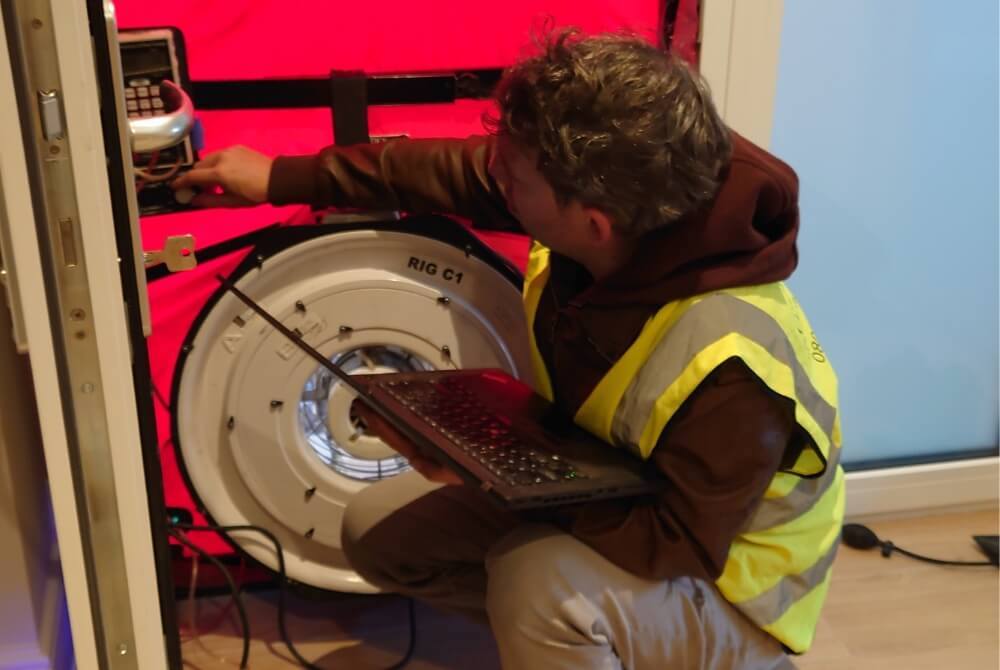
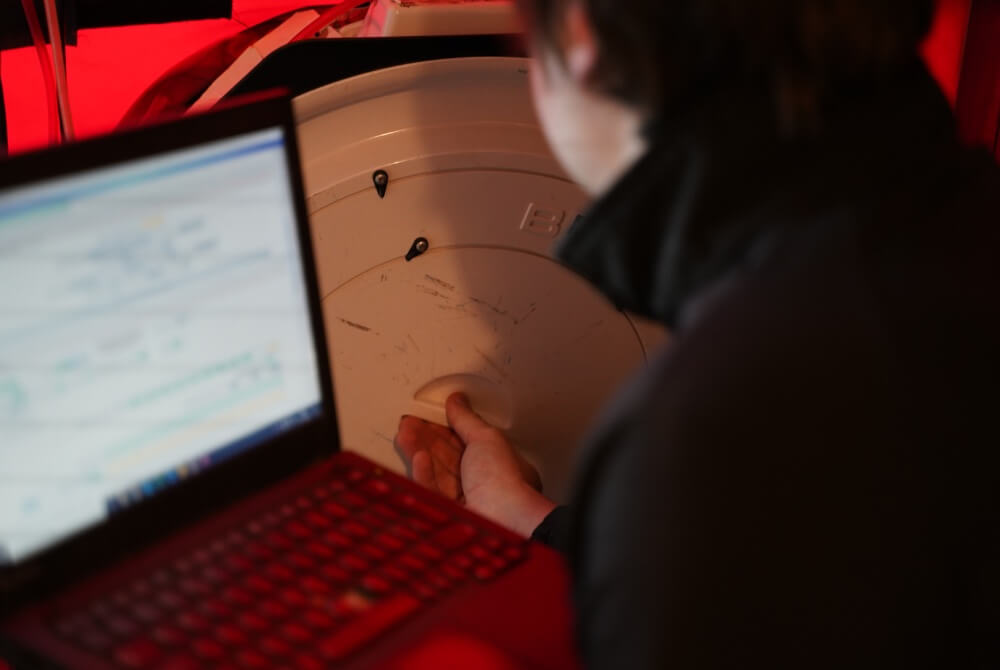
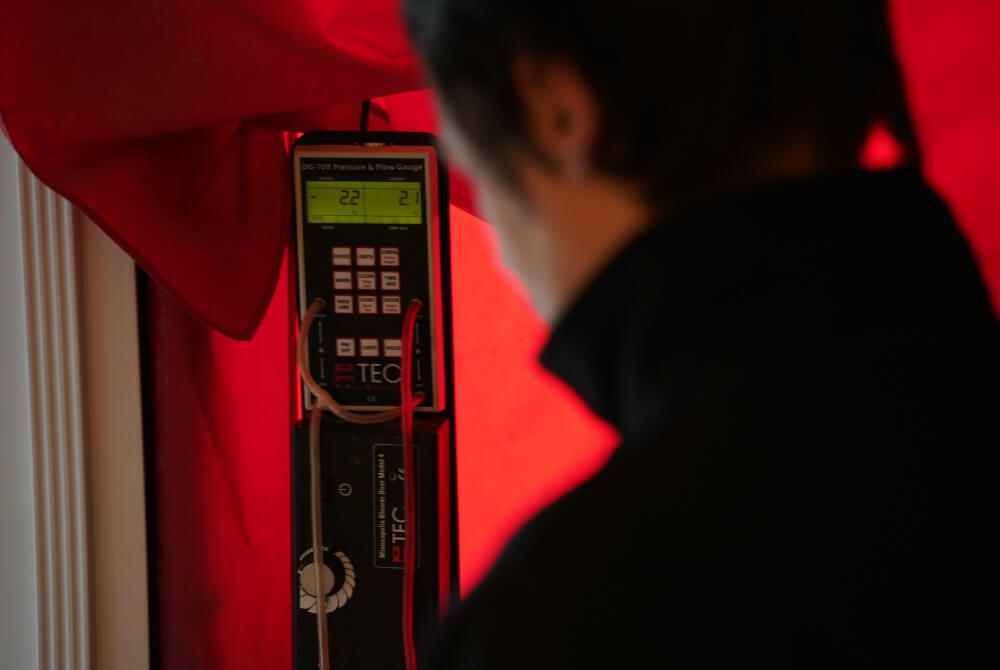
On the day, the engineer installs one or more calibrated fans in an external opening, prepares the building in line with the approved method, runs the pressure sequence and calculates the resulting air permeability at 50Pa. On commercial projects, the visit often also includes site checks and leakage diagnostics if the result is close or the building fails. The aim is not just to produce a number, but to produce a result that stands up for compliance.
The day before the test, check that windows and doors are fitted, service penetrations are sealed, power is available, all relevant areas are accessible, and drainage or soil traps are dealt with in line with the tester’s instructions. This is where avoidable delays usually start. A 20-minute pre-test walk-round with the site manager can save hours of wasted attendance or a failed readiness visit the next day.
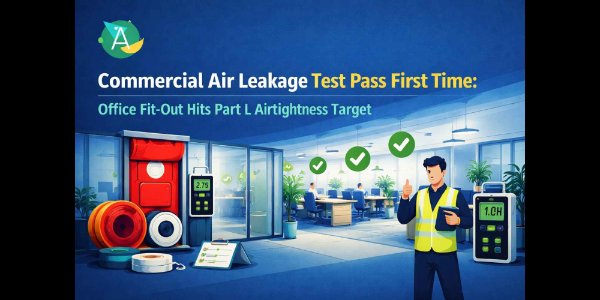
You pass a commercial air test first time by treating airtightness as a build-quality issue, not a last-day certificate issue. Set a realistic design target in SBEM, define the air barrier early, brief every trade that penetrates it, inspect sealing before finishes hide defects, and use a pre-test check before the formal visit. The sites that “get it right first time” are usually the ones that control interfaces and late changes, not the ones that rely on panic sealing at the end.
Commercial buildings usually fail because the airtight line has been broken in ordinary places: service penetrations, windows and doors, junctions, shutters, loading bay details and high-level interfaces. The cause is normally coordination and workmanship, not mystery. On live sites, late M&E or fit-out changes are a frequent culprit because the building looked complete until somebody cut through the air barrier after the main envelope was finished.
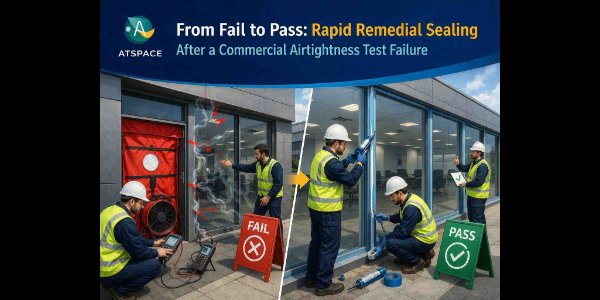
If you fail a commercial air test, the building air permeability has to be improved and the building retested until it meets the required criteria. Approved Document L also requires the results of all pressure tests, including failures, to be reported to Building Control. In real project terms, that can mean remedial sealing, delayed paperwork, disrupted handover and extra cost, so fast diagnosis matters just as much as the retest itself.
That depends on what is leaking, but many commercial failures can be turned around quickly if the leakage points are diagnosed properly on the day. Straightforward issues around penetrations, shutters or perimeter seals can sometimes be fixed during the visit or shortly after, while bigger envelope defects take longer. The quickest route is a tester who can diagnose and guide remedials, not just read out a fail number and leave site.
Yes, on most commercial projects a pre-test inspection is worth it. It gives the site team a chance to spot obvious leakage paths, incomplete sealing and coordination issues before the formal air permeability test becomes a critical-path event. On offices, warehouses, retail units and mixed-use schemes, that early check is often cheaper than a failed test, a retest fee and a handover delay.
Yes. Smoke testing is one of the quickest ways to show site teams exactly where air is escaping during or after a commercial air test. It is especially useful around service penetrations, shutters, roof-to-wall junctions and awkward interfaces where the defect is hard to see but easy to demonstrate once the building is under pressure. That turns a vague failure into targeted remedial work.
Yes, thermal imaging can be very effective, especially when there is a usable temperature difference between inside and outside. It does not replace the formal air permeability test, but it is a strong diagnostic tool for tracing leakage paths and insulation discontinuities before or after a failed test. On large commercial envelopes, combining thermal imaging with pressure testing usually speeds up remedials because the sealing team can see where to focus.
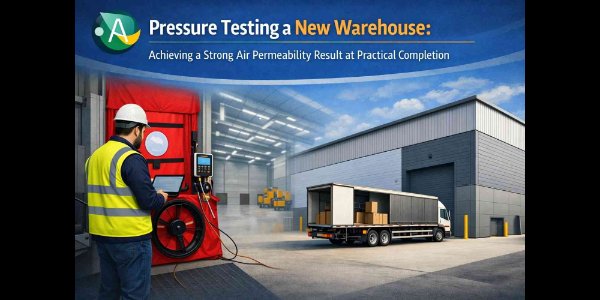
Yes, warehouses and industrial units can absolutely be air tested, and many do need a warehouse air test or industrial air leakage test for Part L compliance or project diagnostics. The main challenge is usually scale: large doors, big envelope areas, roof penetrations and high-level junctions all make detailing more important. On simple units the process is straightforward; on very large sheds or phased industrial projects it often needs a more considered testing strategy.
No, not automatically. The exemption in Approved Document L is for low-energy-demand industrial sites, workshops and non-residential agricultural buildings, and the wider low-energy-demand guidance still distinguishes between exempt and non-exempt cases. A warehouse with only frost protection may fall into low-energy-demand treatment, but that does not mean every warehouse is exempt, and any normally heated office area inside it should be treated as a separate building or zone under the normal procedures.
Yes, office air tightness testing is routine under non-domestic Part L. Offices often look simple on paper but become tricky on site because curtain wall interfaces, risers, suspended ceilings, landlord-and-tenant boundaries and late M&E penetrations can all undermine the airtight layer. On shell-and-core offices, the key is agreeing the base-build boundary early so the test supports handover rather than becoming an argument at the end.
Yes. A retail unit air pressure test is common on single units, shopping parades and shell retail space, and the details that matter most are usually the shopfront, rear service penetrations, roller shutters and back-of-house interfaces. Small units under 500m² may choose the default-value route, but that often gives away too much in compliance terms. For repeated unit types, consistent detailing is what usually drives first-time pass success.
Yes. Schools, leisure buildings and healthcare-type buildings sit within normal non-domestic air testing practice where they are new buildings or relevant new-building work. What changes is not the principle, but the complexity: sports halls, plant-heavy roofs, treatment spaces and multiple interfaces make airtightness coordination more demanding. The earlier airtightness is tied into design, sequencing and site QA, the smoother the compliance process usually is.
A shell-and-core unit should be tested when the base-build envelope is complete enough to represent the landlord handover condition and before tenant works change the compliance picture. Approved Document L recognises shell-and-core situations and requires reasonable assumptions about later services at the early stage, while the as-built calculations at practical completion are based on the building and systems actually constructed. In simple terms, test the shell when it is a real shell, not while scopes are still moving.
Often, yes. If the occupier’s first fit-out provides or extends heating, hot water, air-conditioning or mechanical ventilation into that space, a new Part L submission is required for the relevant part of the building. Even where those systems are not extended, other compliance obligations can still apply. That is why shell-and-core air testing, landlord assumptions and tenant fit-out scope all need to line up before anyone starts relying on the original paperwork.
Sometimes. If pressure testing is genuinely impractical because of the size or complexity of the building, Approved Document L allows a strategy-based route instead of a full whole-building pressure test. That is not an easy opt-out: the developer needs a detailed justification and a detailed strategy showing how a continuous air barrier will be achieved, and Building Control has to accept it.
The large complex building strategy route is the alternative compliance path for buildings that cannot be pressure tested practically. The strategy has to justify why testing is impractical, explain how airtightness will still be controlled, and align with CIBSE TM23. Approved Document L also makes clear that under this route it is not reasonable to claim better than 5.0 m³/(h·m²) at 50Pa, so the compliance model needs to be realistic from the outset.
Yes. If a building is divided into self-contained units with no internal connections, Building Control may accept a pressure test on a representative area as evidence of the building’s air permeability. This can work well on repeated commercial units, some industrial schemes and certain mixed-use layouts. The catch is that the sample has to be genuinely representative, so repeated details and consistent workmanship are essential.
For this route, a compartmentalised commercial building is one split into self-contained units with no internal connections between them. Think repeated retail units or similar business units where one tested area can fairly represent the next. If the internal layout changes, the details vary, or the units connect internally, representative testing becomes harder to justify and Building Control may want a different approach.
Sometimes. A commercial extension is treated as a new building, and therefore follows the new-building route, if its total useful floor area is both greater than 100m² and greater than 25% of the total useful floor area of the existing building. Once it is treated as a new building, the normal pressure-testing rules apply unless a specific alternative route is accepted. Smaller extensions still need Part L compliance work, but they are not all treated the same way.
Approved Document L provides a route for that. If Building Control agrees that sealing off and testing the extension separately is impractical, a large extension can be treated as a large complex building and follow the strategy-based route instead. The important part is agreeing that approach early, with evidence, rather than discovering too late that the extension cannot be isolated for testing.
Not always, and you should never assume they can. In mixed-use developments, Approved Document L Volume 2 applies to the non-dwelling parts, while Volume 1 applies to the dwellings, so the testing and compliance strategy must follow those boundaries. Retail space, offices and heated common areas sit on the non-domestic side; the flats do not. Getting those zones agreed early avoids late arguments about what was actually tested.
Yes. Heated common areas in buildings containing multiple dwellings are treated under Approved Document L Volume 2 as buildings other than dwellings. That means lobbies, corridors and similar shared spaces can sit within the non-domestic air test and compliance strategy even where the main accommodation is residential. On mixed-use schemes, those boundaries need to be fixed early so the right spaces are included in the testing plan.
Air leakage testing measures unwanted air escaping through the building envelope, while ventilation testing or commissioning checks whether the designed ventilation systems deliver the airflow and control performance they are supposed to provide. They are separate disciplines. A building can be very airtight and still have poor ventilation, and a well-commissioned ventilation system does not prove the envelope is airtight. Commercial projects usually need both managed properly.
Not as a blanket rule. Approved Document L Volume 2 covers both new buildings and work to existing buildings, but the main mandatory air testing provisions sit around buildings treated as new buildings, including qualifying extensions. Outside that, existing commercial buildings are often tested voluntarily for diagnostics, retrofit planning or refurbishment risk reduction. The real question is what regulated work is being done and what evidence the project needs.
Yes. Commercial air testing is useful well beyond simple Part L sign-off, including diagnostics, refurbishment planning, BREEAM or planning-related evidence, and targeted improvement work on existing stock. A measured air permeability result, especially when paired with smoke testing or thermal imaging, helps owners and project teams identify real leakage paths instead of throwing money at blanket remedials. That makes it valuable for building owners as well as developers.
The best way is to treat the commercial air test as a managed work package, not a last-day formality. Freeze the target early, book the test in advance, walk the building before the visit, stop late penetrations through the air barrier, and line up diagnostics or retest support just in case. Most air test delays at practical completion come from coordination failures, not from the test itself, so the teams that plan early usually keep handover on track.
Videos for commercial air leakage testing
Explore our videos for quick, engaging insights on building compliance. From step-by-step guides to expert advice, our video library simplifies complex topics, making it easier for you to take action and stay informed. Perfect for when you need clarity in minutes.