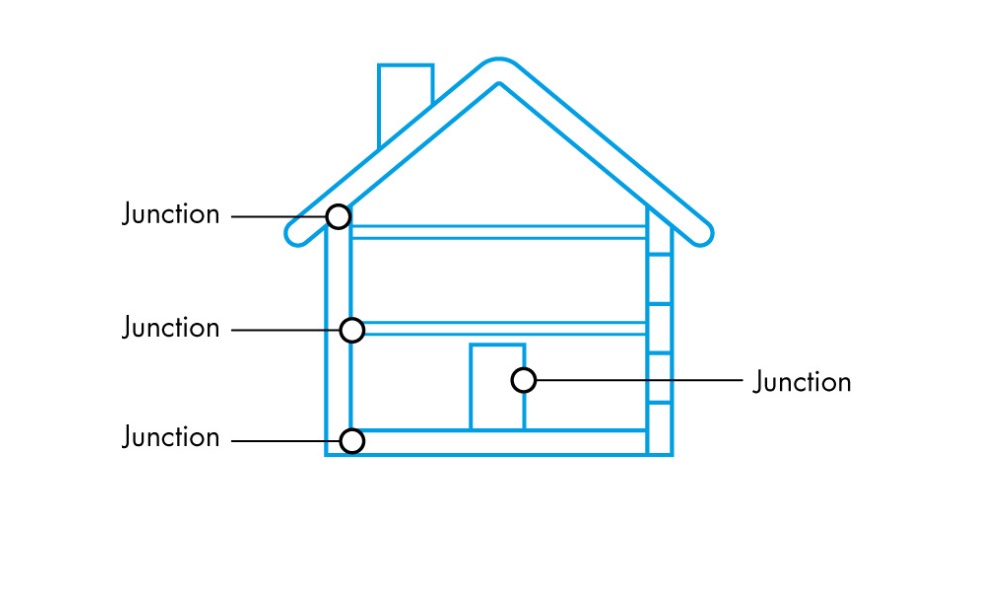
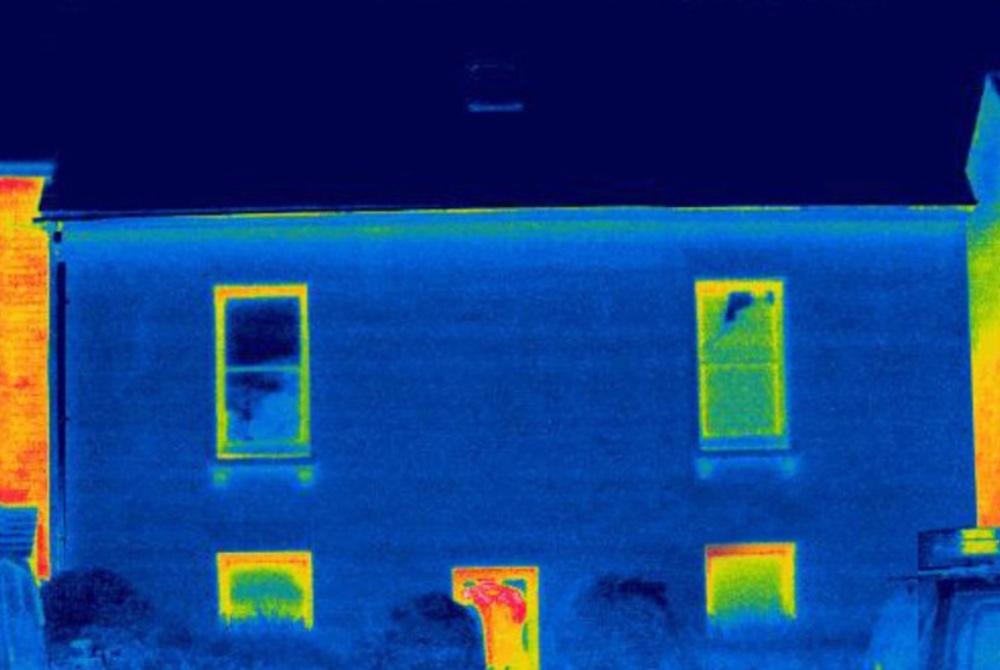
PSI values are linear thermal transmittance values used to quantify the extra heat loss at a junction that is not already included in the plane-element U-values. In practical terms, they tell you how much additional heat is escaping where walls, floors, roofs and openings meet. That is why PSI values sit at the centre of thermal-bridge calculations for Part L, SAP and BRUKL work.
In building physics, Psi (Ψ) is the symbol used for linear thermal transmittance. It describes the rate of heat flow per degree of temperature difference and per metre length of the junction that is not accounted for in the U-values of the surrounding plane elements. In simple terms, it is the heat-loss number for a junction detail.
Linear thermal transmittance is the additional heat flow through a junction per unit length and per degree temperature difference. BR 443 says non-repeating thermal bridges are included in a building’s total heat transmission coefficient by using a linear thermal transmittance for the junction, representing the extra heat flow not already counted in the plane-element U-values. That is exactly what a PSI value expresses.
PSI values are measured in W/m·K — watts per metre per kelvin. That unit reflects three things at once: the amount of heat flow, the length of the junction, and the temperature difference driving the heat loss. It is different from a U-value, which is measured per square metre rather than per metre of junction.
Yes. A lower PSI value means the junction is losing less additional heat. In practical terms, lower PSI values mean a better-detailed junction, lower fabric heat loss, and usually a lower risk of cold spots around that detail. That is why well-designed junctions can materially improve SAP, BRUKL and overall compliance performance.
A thermal bridge is an area of the building where heat transfer is significantly higher than in the surrounding construction. Current Approved Document L guidance in both England and Wales defines thermal bridging in those terms and says the building fabric should be constructed so that thermal bridging is reasonably limited. On site, that usually means junctions, penetrations, weak insulation continuity and awkward geometry.
A U-value describes heat loss through a plane element such as a wall, roof or floor. A PSI value describes the extra heat loss at a junction between elements or around openings. BR 443 makes that split clear: repeating thermal bridges are dealt with in the U-value of the element, while non-repeating junction losses are dealt with separately using linear thermal transmittance values.
A PSI value is the heat-loss figure for one specific junction, expressed in W/m·K. A y-value is an area-normalised thermal-bridging factor, expressed in W/m²K, derived by spreading the total junction heat loss across the exposed area of the dwelling. SAP explains that where a y-value is used, it is derived by dividing the calculated thermal-bridge heat loss by the total exposed area.
Repeating thermal bridges occur at regular intervals within an element, such as studs, joists or similar repeating components, and are normally included in the U-value of that element. Non-repeating thermal bridges occur at junctions between different elements and around openings, and they are normally handled separately using PSI values. That split is fundamental to how UK thermal calculations are assembled.
Yes. Current Approved Document L guidance in England and Wales says thermal bridging should be reasonably limited, and both routes provide recognised ways to assess it. In practical terms, PSI values are part of showing that the building fabric is continuous, heat loss is being controlled at junctions, and the design is not quietly losing performance where the main U-values look good on paper.
Yes. SAP Appendix K says non-repeating thermal bridges are not included in the element U-values and should therefore be explicitly included in the heat-loss calculation using either Σ(L × Ψ) or a suitable y-value method. On domestic projects, this means PSI values directly affect the dwelling’s heat-loss picture and therefore the wider SAP result.
Yes. Current non-domestic Part L guidance says thermal bridging should be addressed in the design and construction of a building, and that suitable junction details can then be used in the building primary energy rate and building emission rate calculations. So on commercial jobs, PSI values feed directly into BRUKL/SBEM performance, not just into a separate detail pack.
Yes. Current England and Wales dwelling guidance both say thermal bridging in new dwellings should be addressed using recognised methods, including bespoke BR 497 calculations, reputable detail libraries, SAP defaults or a default y-value route. In practice, every new-dwelling SAP assessment needs a thermal-bridging approach, whether bespoke or default.
Yes, often they do. Current England dwelling guidance makes clear that new elements in existing dwellings, including extensions, sit under Section 10, while material change of use and change to energy status sit under Section 11. That means extension work, house-to-flats work, and loft or garage conversions that become heated space can all trigger the need to address thermal bridging properly.
Yes. Current Approved Document L Volume 2 says thermal bridging should be addressed in the design and construction of a building, and it gives recognised methods for doing so. On non-domestic projects, PSI values are part of the same compliance story as U-values, airtightness and fixed building services.
Yes. Current Approved Document L says that in a mixed-use development, each individual dwelling follows Volume 1, while the non-dwelling parts such as heated common areas and commercial or retail space follow Volume 2. In practical terms, the dwellings may use SAP-style thermal-bridge inputs, while the non-domestic parts use the BRUKL/SBEM route.
The core UK references are BR 497 for linear thermal transmittance and temperature factors, BRE Information Paper 1/06 for thermal-bridge effects and acceptable temperature-factor performance, and BS EN ISO 10211 for detailed numerical modelling of thermal bridges. Current Approved Document L routes in England and Wales still reference BR 497 and IP 1/06 directly.
Because BR 497 is the document current Part L guidance points to for consistent, reproducible thermal-bridge modelling. BRE says the conventions should be followed by thermal modellers to assess the “as designed” thermal performance of junction details, products or elements, and current Approved Document L routes in England and Wales still point directly to it.
IP 1/06 is the BRE guidance that sits alongside BR 497 and is still used in current Part L routes to judge acceptable temperature-factor performance. England and Wales both require bespoke thermal-bridge details to follow BR 497 and the temperature factors set out in IP 1/06. In practical terms, it is one of the documents that links thermal-bridge calculations to condensation-risk control, not just heat-loss accounting.
Yes, they can and often should. Current England and Wales guidance links bespoke thermal-bridge calculations not only to BR 497 but also to the temperature factors in IP 1/06, and non-domestic guidance says the specified details, as constructed, should provide adequate protection against surface condensation using IP 1/06 and BR 497. So a good PSI calculation is not just about watts — it is also about whether the junction stays warm enough.
A temperature factor is the part of thermal-bridge assessment that looks at how warm the internal surface of a junction remains relative to inside and outside conditions. Current Part L guidance in England and Wales requires bespoke details to follow BR 497 and the temperature factors set out in IP 1/06. In practical terms, it is the part of the analysis that helps judge mould and surface-condensation risk at the junction.
The main ones are the non-repeating junctions between different elements and the details around openings. BR 443 describes these as including junctions such as floor and roof with the external wall and details around window and door openings. On most projects, that means the wall/floor, wall/roof, jamb, sill, lintel and similar interface details deserve attention.
No. PSI values are the heat-loss figures; detail libraries are one route to obtaining acceptable junction values without modelling every junction from scratch. Current England and Wales dwelling guidance both allow the use of reputable non-government databases containing independently assessed thermal junction details, and BR 443 notes that Accredited Construction Details provide examples of details where thermal bridging is limited to a reasonable level.
Yes. Current England and Wales dwelling guidance both allow more than one route: bespoke BR 497 calculations, independently assessed detail libraries, the default SAP Table K1 values, or a default y-value route. That means you do not always need bespoke modelling on every dwelling, but you do need to choose a recognised route and apply it correctly.
SAP Table K1 is the table of default linear thermal transmittance values for recognised dwelling junction types. SAP explains that the junctions in Table K1 should be used where present in a SAP assessment and that default values may be used where specific Ψ-values are not available. In practice, Table K1 is the default-junction library inside the SAP route.
Yes. Current England and Wales dwelling guidance both say a mixture of known and default values may be used, and they also note that different approaches may be used for different elements on the same dwelling. That is useful on real projects where some junctions have been modelled properly and others still rely on accepted defaults.
The default y-value in current England and Wales dwelling guidance is 0.20 W/(m²K). Both live dwelling routes state that this can be used as the default whole-dwelling thermal-bridging allowance where more detailed junction inputs are not being used. It is simple, but it is also usually conservative compared with a well-detailed bespoke design.
Yes. SAP says it is permissible to use a y-value that has been calculated for a particular house design from individual Ψ-values, provided documentary evidence of that calculation is available. It also says that such a y-value is applicable only to a dwelling of the size, configuration and construction for which it was calculated. So it is a project-specific shortcut, not a universal one.
Yes. SAP says the Ψ-values in Table K1 are conservative defaults and recommends deriving values by numerical modelling, which will be more accurate. That is why bespoke PSI values can often improve SAP performance compared with a default-only approach, provided the details are genuinely buildable and delivered on site.
Current England and Wales dwelling guidance both allow four main routes: bespoke junction values calculated by a suitably competent person following BR 497 and IP 1/06, reputable non-government detail libraries, SAP Table K1 values, or a default y-value of 0.20 W/(m²K). On dwellings, that is the live menu of recognised Part L approaches.
Current non-domestic guidance does not mirror the dwelling four-way route exactly. Approved Document L Volume 2 says thermal bridging should be addressed either by using construction joint details calculated by a suitably competent person following BR 497 and a defined process flow sequence, or by using generic IP 1/06 values increased by 0.04 W/(m·K) or 50%, whichever is greater. That is the current live non-domestic position.
Yes. Current non-domestic Part L guidance says construction joint details calculated by a person with suitable expertise and experience can be used directly in the building primary energy rate and building emission rate calculations. In practice, that means properly modelled commercial Ψ-values can feed straight into the BRUKL/SBEM route.
Then the current non-domestic guidance gives a fallback. Approved Document L Volume 2 says that where there is no specific quantification of the thermal-bridge values, the generic linear thermal bridge values in BRE IP 1/06, increased by 0.04 W/(m·K) or 50%, whichever is greater, should be used in the building primary energy rate and building emission rate calculations.
Yes. Target-setting for dwellings does not ignore thermal bridging. Current England guidance points the notional dwelling to SAP Appendix R, and the SAP 10.2 notional specification uses y = 0.05 where thermal-bridge lengths are not specified. Current Welsh dwelling guidance is even more explicit, saying the notional dwelling is based on Option 2 Ψ-values in SAP Table R2, except use y = 0.05 if the actual building uses default y = 0.20.
Yes. SAP Appendix K gives the formula for non-repeating thermal bridges as HTB = Σ(L × Ψ). That is a direct heat-loss term, not a secondary note. It means the PSI value and the junction length together create a measurable share of the building’s transmission heat loss, which is why junction detailing matters so much on paper and on site.
Yes, unless you are using the default y = 0.20 shortcut. The current SAP Conventions say that the lengths of all junctions must be entered into the software to allow calculation of the target emission rate, except when the default y-value is used. On detailed domestic jobs, this is why good junction schedules and measured lengths matter.
In current SAP 10 conventions, the shared Ψ-value is allocated between the relevant dwellings rather than being counted in full for each one. The conventions say that if a junction from Table K1 or a modelled junction is shared between two or more dwellings, use the value divided by the number of dwellings involved and apply the calculated proportion to each dwelling.
Yes, on the dwelling side. Current England guidance expressly allows a reputable non-government database of independently assessed thermal junction details, giving Local Authority Building Control’s Construction Details library as an example. Wales current guidance allows the same type of route. This is often the most efficient middle ground between full bespoke modelling and blunt defaults.
Yes. Current England and Wales dwelling guidance says drawings should be provided for junctions and reviewed to check that the details are buildable and properly sequenced, and that when using bespoke or database-based approaches an appropriate system of site inspection should be in place. The non-domestic route says the same in substance. Good modelling without site verification is not enough.
A suitably competent building-physics or energy-compliance specialist should calculate them. Current dwelling guidance refers to a suitably competent person following BR 497, and the non-domestic guidance talks about a person with suitable expertise and experience. In practice, that means someone who understands junction modelling, current standards and how the values will be used in SAP or BRUKL.
Current non-domestic guidance gives the clearest benchmark: suitable expertise can be shown where the person has been trained in the software used, has applied the model to the example calculations in BR 497, and has achieved results within the stated tolerances. That is a much stronger test than just saying someone has used thermal software before.
There is no single national named assessor class for PSI calculations in the way there is for some EPC work. However, third-party competence evidence can still matter. Hertfordshire Building Control, for example, says calculations supporting its published elemental guidance should have appropriate third-party accreditation under the BBA Competency Scheme for U-Values or an equivalent standard. So it is not always mandatory, but it is often commercially useful.
You need enough information to understand the junction as designed: detailed drawings, build-ups, insulation continuity, opening geometry and how the detail is intended to be built. Current Approved Document L guidance says drawings should be provided for junctions and reviewed for buildability and sequencing, and BRE says BR 497 is used to assess the as-designed thermal performance of junction details, products or elements.
Yes, they can. A PSI value is only valid for the detail actually modelled and the way it is actually built. Current guidance links bespoke values to buildability and site inspection, which means changing insulation lines, cavity closers, structural penetrations or opening details late can make the earlier thermal-bridge work unreliable. This is one of the most common reasons projects have to revisit the junction package late in the programme.
No. Standard PSI values are usually obtained by numerical modelling, with BR 443 and SAP pointing to BR 497 and BS EN ISO 10211 for that route. BR 443 also notes that in-situ measurement is possible for some non-regulatory purposes, but that is a different exercise and not the normal compliance route for junction calculations.
Yes. One poor junction by itself may not always sink a project, but multiple weak junctions or one major recurring detail absolutely can. SAP shows that thermal-bridge losses are added directly into the heat-loss calculation, and current non-domestic guidance says bespoke or fallback thermal-bridge values are used in the building primary energy and emission calculations. In practical terms, bad junctions can move the energy model enough to matter.
Yes. Current England and Wales dwelling guidance both say care should be taken to reduce unwanted heat loss through thermal bridging in existing dwellings, and both point toward using reputable independently assessed detail libraries where appropriate. Non-domestic guidance also requires a signed report for replaced or renovated thermal elements confirming that the specified details, as constructed, provide adequate protection against surface condensation using IP 1/06 and BR 497.
They usually get queried because the calculation route is unclear, the detail is not obviously buildable, the inspection trail is weak, or the junctions used in the energy model do not match the drawings or specification. Current guidance in England and Wales is very clear that drawings should be provided for junctions, buildability should be reviewed, and appropriate inspection systems should back up bespoke or database-driven values.
Turnaround and cost are mainly driven by the number and complexity of junctions, the quality of the drawings, and whether the work is a simple dwelling set, a mixed-use scheme, or a large commercial package. Current guidance makes clear that junction drawings, sequencing, inspection and correct route selection all matter. The more incomplete the information, the slower and more expensive the exercise usually becomes.
Start early, model the real junctions rather than idealised ones, make sure the details are actually buildable, and keep the site team working to the same junction package that fed the SAP or BRUKL. Current Part L guidance in England and Wales keeps repeating the same message: drawings, buildability, inspection and correct methodology all matter. The projects that avoid rework are the ones that treat thermal bridging as a live design-and-site issue, not a spreadsheet exercise at the end.
Videos for PSI values
Explore our videos for quick, engaging insights on building compliance. From step-by-step guides to expert advice, our video library simplifies complex topics, making it easier for you to take action and stay informed. Perfect for when you need clarity in minutes!