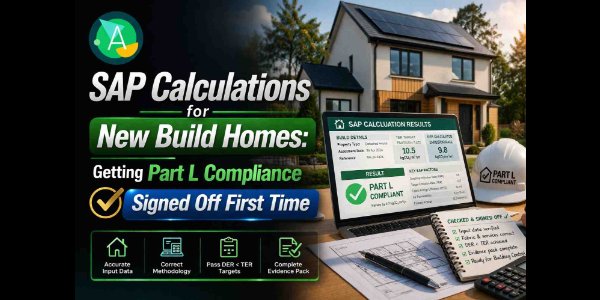
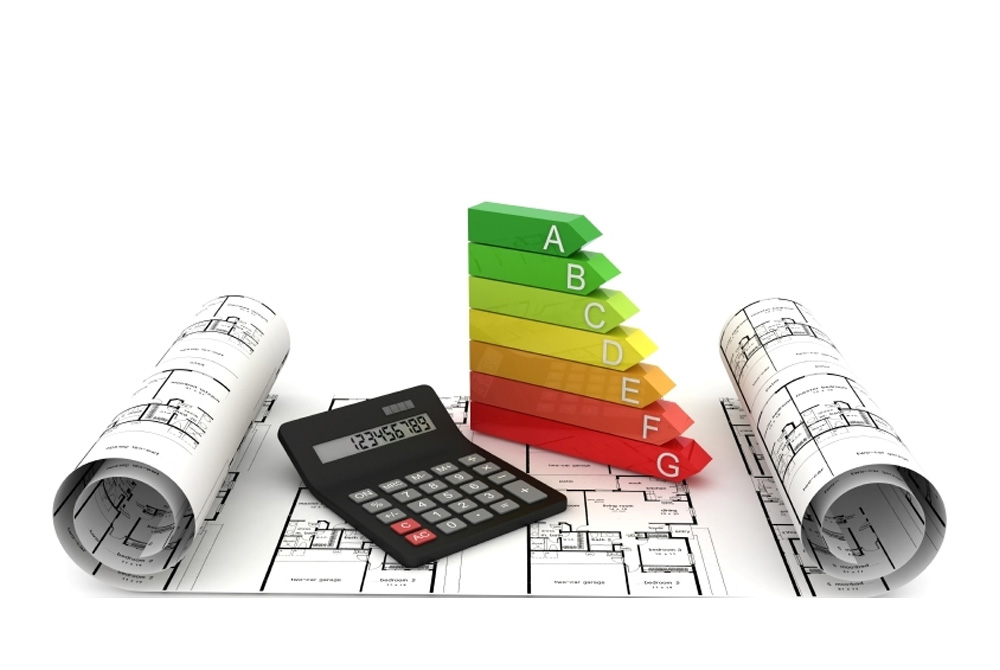
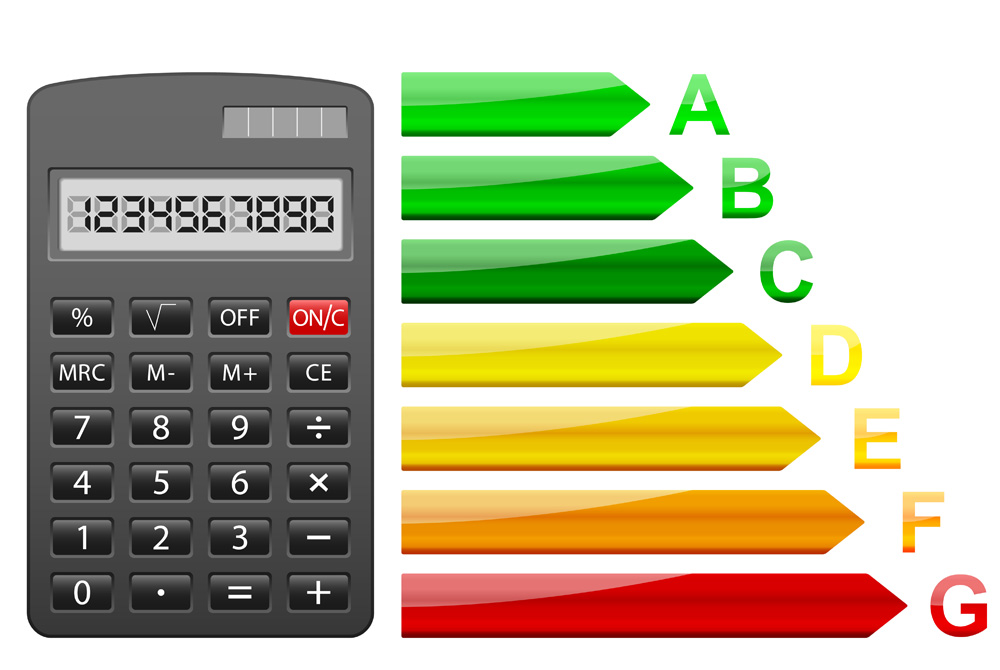
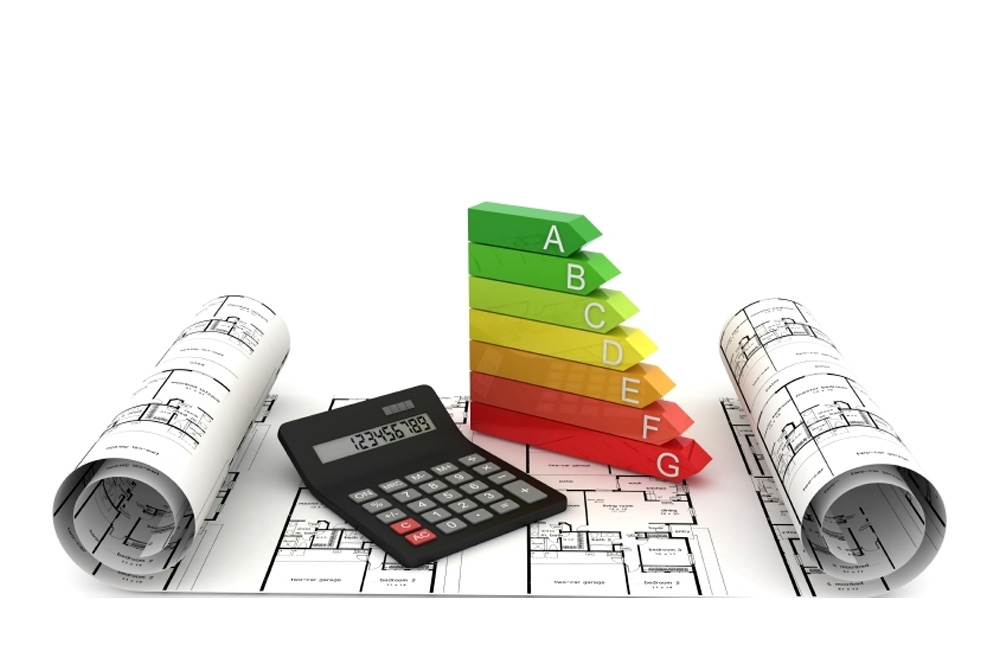
SAP calculations are the Standard Assessment Procedure calculations used to assess the energy performance of dwellings. In practice, they are used to show that a new home or newly created dwelling meets the relevant energy targets and to support the EPC route for that dwelling. They are the core Part L domestic calculation method, not just an admin extra at the end.
SAP calculations are mainly used for two things: demonstrating compliance of new homes with Part L, and generating the energy-performance outputs that support the domestic EPC for a newly constructed dwelling. On real projects, that means SAP sits at the heart of both planning the spec early and proving the as-built home later.
No, not entirely. SAP is the approved methodology for new dwellings, including dwellings created by conversion or change of use, but Approved Document L also allows SAP-style calculation routes for certain extension and existing-dwelling compliance scenarios where a simple elemental approach is not enough. That is why SAP calculations are broader than just “new build houses”.
SAP is the approved methodology for producing an EPC for a newly constructed dwelling, while RdSAP is the reduced-data method used for existing dwellings. In practical terms, SAP uses detailed plans and specifications, whereas RdSAP uses an on-site survey plus conventions because much less is known about the existing home.
Yes. SAP remains the approved methodology for new dwellings, and government guidance says it is used to demonstrate compliance of new homes with Part L. Whether the project is a single self-build house or a multi-flat scheme, the domestic dwellings sit on the SAP side of the regime.
Yes. Official EPC guidance treats new dwellings as including new builds, conversions and change of use of existing properties. If the work creates a new dwelling unit, SAP is the correct domestic calculation route rather than the ordinary existing-house EPC method. That makes SAP calculations a core service on conversion-led residential projects.
Yes. A house-to-flats project is one of the clearest examples of a scheme creating new dwellings, and official guidance explicitly treats subdivision into flats as part of the new-dwelling EPC category. In practice, each new self-contained dwelling needs to be handled through the proper SAP-based route, not a simple existing-house EPC shortcut.
No, not always. Straightforward extensions can often comply by following the standard elemental route in Approved Document L, but SAP-style calculations become useful where the design needs more flexibility, such as higher glazing or compensation elsewhere in the build-up. In other words, not every extension needs a full SAP trade-off, but plenty do.
They are commonly used when an extension goes beyond the simple default opening-area rules and needs a compensatory calculation route. Approved Document L allows an extension to be shown compliant by comparing the proposed extension against a notional extension, rather than relying only on the default elemental recipe. This is the route often used when a client wants more glass without losing compliance.
The basic rule is that the total area of windows, rooflights and doors in an extension should not normally exceed 25% of the floor area of the extension, plus any openings that disappear because of the extension. If the design goes beyond that, a compensatory route is usually needed. This is one of the most common triggers for SAP-style extension calculations.
A notional dwelling is the theoretical reference dwelling used to test whether the real design is good enough. Approved Document L says it is the same size and shape as the actual dwelling but with standardised fabric and services. In simple terms, your SAP result is judged by comparing the actual home against that benchmark, not by looking at the actual home in isolation.
These are the main performance targets the actual dwelling has to beat or match under current Part L-style SAP compliance. The notional dwelling is used to set the target primary energy rate, target emission rate and target fabric energy efficiency rate, and the actual dwelling is then checked against those targets at design stage and again as built. This is the backbone of modern domestic Part L compliance.
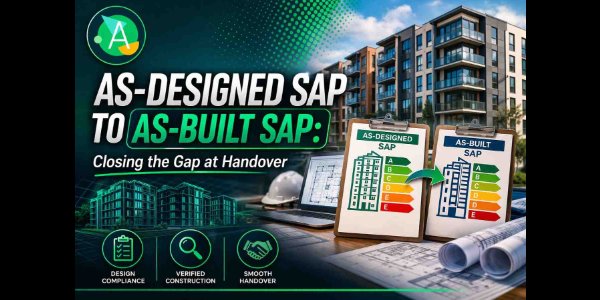
Design-stage SAP is the SAP calculation based on the dwelling as designed before work starts. It is used to show the intended performance of the home and to support the first compliance submission to Building Control. In practice, this is the version you want locked down before site starts changing products and details under programme pressure.
As-built SAP is the SAP calculation based on the dwelling as actually constructed. It has to reflect specification changes made during the build and incorporate the measured air permeability. This is the version that matters at completion, because it shows whether the finished home still meets the required performance once theory has turned into site reality.
Because Part L is about both intent and delivery. The design-stage SAP shows what the team planned to build, while the as-built SAP proves what actually ended up on site. Approved Document L in both England and Wales requires this two-stage approach so Building Control can compare the early design with the final dwelling and see whether key changes have affected compliance.
A BREL report is the Buildings Regulations England Part L report for a new dwelling. Approved Document L says SAP produces it as a standard output, and that both a design-stage BREL and an as-built BREL should be produced. On English jobs, the BREL report is one of the main compliance documents sitting alongside the SAP calculation and EPC workflow.
A BRWL report is the Buildings Regulations Wales Part L report for a new dwelling. The Welsh guidance says approved SAP software should produce it as a standard output and that both design-stage and as-built BRWL reports may be produced. On Welsh projects, it is the equivalent reporting route to England’s BREL workflow.
Yes. The final SAP calculation has to incorporate the measured air permeability. Approved Document L in England says the dwelling primary energy rate, dwelling emission rate and fabric energy efficiency rate must be recalculated using the measured air permeability, and the Welsh guidance says the same basic thing. That is why air testing and SAP should never be treated as separate workstreams.
Yes. Approved Document L says the relevant dwelling calculations should be carried out at both stages using the same calculation tool. That matters because changing software or methodology halfway through makes comparison harder and creates avoidable compliance arguments. On live projects, consistency of tool and dataset matters more than people sometimes realise.
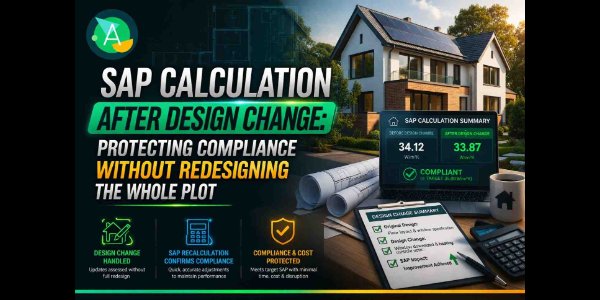
Yes, very easily. The as-built BREL or BRWL report has to capture the final specification list and any changes from design stage, so substitutions to insulation, glazing, heating systems, controls or PV can all move the final result. This is one of the main reasons SAP calculations drift late in the programme.
Yes. One late product swap can be enough to change the SAP result and, in turn, the compliance picture. Official guidance in England and Wales requires the as-built report to show the final specifications and highlight changes from design stage. In practice, a window, heating or fabric substitution that looked harmless on site can be exactly what tips the final SAP the wrong way.
You need the dwelling layout, detailed floor plans and specifications. Official EPC glossary guidance says SAP for a newly constructed dwelling is usually carried out off site using the home’s detailed floor plans and specifications, because that information is normally available on new-build and conversion projects. The cleaner the input data, the cleaner the SAP output.
For new dwellings, they are mainly drawings-and-specification led. Official guidance says a SAP EPC assessment for a newly constructed dwelling is carried out off site using the dwelling’s detailed plans and specifications. That is one of the big differences between SAP calculations and an existing-house RdSAP assessment, which relies much more on an on-site survey.
Yes, each dwelling still needs to be properly represented in the compliance process. Approved Document L says that in a building containing more than one dwelling, each individual dwelling must still meet the relevant fabric standard, even where some averaging routes are allowed for other metrics. In practice, apartment blocks are not one single SAP number with all the details blurred out.
Yes, in some circumstances. Current guidance allows certain primary energy, emission and fabric metrics to be handled by using floor-area-weighted averages across the dwellings in a building, but that is not a licence to ignore the individual units altogether. The block still needs to be modelled properly, and the averaging methodology has to be applied consistently.
No. SAP is the calculation methodology; the EPC is the certificate output. SAP is used to demonstrate compliance of new homes and to generate the energy-performance information behind the EPC, but the EPC is the finished certificate that the buyer, tenant or owner sees. On site, confusing the two is one of the most common causes of scope confusion.
Yes. Official guidance says SAP is the approved methodology for producing an EPC for a newly constructed dwelling. That is why SAP calculations and new-dwelling EPC work are so closely linked in practice. If the SAP data changes late, the final EPC can change with it.
Not on their own. SAP is central to domestic Part L compliance, but the wider compliance package also includes the relevant BREL or BRWL report, supporting specifications, and the as-built evidence required by the Approved Document. In other words, SAP is the engine room of domestic compliance, but it is not the whole compliance file by itself.
A SAP calculation is the technical energy model, while the new-build EPC assessment is the wider service that turns that model into the registered certificate and associated outputs. The two sit very close together, but they are not identical in scope. On a practical project, SAP calculations usually come first and the EPC is then produced from the approved on-construction route using that information.
In practice, SAP calculations for compliance and on-construction EPC work are normally carried out by a qualified On-Construction Domestic Energy Assessor (OCDEA). The official EPC guidance says that for newly constructed buildings, the EPC can only be produced by an accredited on-construction domestic energy assessor, and Welsh guidance also refers to SAP assessments being carried out by a qualified OCDEA.
For formal new-dwelling EPC production and normal on-construction SAP work, yes, that is the recognised route. Official domestic EPC guidance says newly constructed buildings can only have their EPC produced by an accredited on-construction domestic energy assessor, and current Welsh Part L guidance also points to a qualified OCDEA for SAP energy rating assessments.
Yes. England and Wales are not identical now. Wales currently uses SAP 10.2 and its current live guidance includes a minimum SAP rating of 81, while England’s live 2021/2023 guidance is framed around target primary energy, emissions and fabric energy efficiency, and England has also now published SAP 10.3 as part of the 2026 package. Cross-border projects need the right route from day one.
Yes. Government has updated the approved methodology from SAP 10.2 to SAP 10.3, and its SAP guidance says SAP 10.3 will initially be the sole approved methodology while the Home Energy Model is delayed. At the same time, the wider 2026 Future Homes Standard regulations generally take effect from 24 March 2027, so project timing and transitional arrangements still matter.
No, not right now. Government says it has delayed the launch of the Home Energy Model (HEM) and that SAP 10.3 will initially remain the approved methodology. HEM is still the intended future replacement, but as at March 2026 SAP remains the live domestic route you actually work with.
Yes. Approved Document L treats a material change of use to a dwelling as a recognised compliance scenario, including where a building becomes a dwelling, contains a flat where it did not before, or ends up with a greater or lesser number of dwellings. In practical terms, that makes SAP calculations central to a wide range of residential conversion work.
Yes, sometimes. If a conservatory or porch is thermally separated from the dwelling and the heating system is not extended into it, it is treated more like an extension. But if that separation is removed, or the dwelling heating is extended into it, the guidance says it should be treated as part of the dwelling and the whole-dwelling calculation route should be followed.
A live/work unit can still be treated as a dwelling in the right circumstances. Approved Document L says a building containing both living accommodation and commercial space should be treated as a dwelling if the commercial part can be reverted to domestic use, including where there is direct access between the spaces and both sit within the same thermal envelope. This is one of those edge cases worth getting right early.
The residential parts and the non-domestic parts are treated under different guidance. Approved Document L Volume 1 applies to the individual dwellings, while Volume 2 applies to the non-dwelling parts such as heated common areas, retail space or commercial space. In simple terms, the flats use SAP; the non-domestic parts do not.
Yes. A self-build is still a new dwelling, so the same SAP-based compliance route applies. The advantage on self-builds is that the design team usually has direct access to the floor plans and specifications early, which is exactly the information SAP calculations need. The risk, as ever, is leaving the final updates until the end when site changes have already happened.
Sometimes, but with care. Current guidance says certain listed buildings, conservation-area buildings and scheduled monuments do not need to comply fully with the energy-efficiency requirements where doing so would unacceptably alter their character or appearance. Even then, the work should still comply to the extent that it is reasonably practicable. On historic projects, SAP and Part L need a more considered approach, not a copy-and-paste one.
They should start before works begin and then be updated again when the dwelling is complete. Both the England BREL route and the Wales BRWL route are built around this two-stage process. The earlier the design-stage SAP is done, the more chance the team has to fix the specification before it becomes a site problem.
They help by exposing compliance problems while the design is still flexible. The official process is explicitly split into design-stage and as-built reporting, and both England and Wales require the as-built report to record specification changes. In practical terms, that means early SAP work is what stops last-minute substitutions, air-test surprises and completion-week rewrites from turning into programme pain.
Turnaround is usually driven by the quality of the information, not by the software itself. SAP for a newly constructed dwelling is based on detailed floor plans and specifications, and the process then has to be repeated at as-built stage with changes captured properly. So the main delays usually come from incomplete drawings, missing specs and late revisions, not from the calculation engine.
Cost is usually shaped by scope rather than one flat fee. A single self-build, a multi-plot housing scheme, and a conversion creating several flats all generate different levels of modelling, revision control and as-built reporting. That is an inference from the official two-stage reporting structure and the need to hold accurate per-dwelling information as the design evolves.
Most failures happen because the as-built dwelling no longer matches the design-stage assumptions. The usual culprits are poorer measured air permeability, downgraded fabric or service specifications, or undocumented substitutions during construction. Approved Document L in England and Wales is built to catch exactly that drift by forcing the final report to reflect the real specification and the measured air test result.
Yes. The actual dwelling does not have to copy the notional dwelling detail for detail. Approved Document L says the specification of the actual dwelling may vary from the notional dwelling, provided it still meets the relevant target primary energy, target emission and target fabric performance requirements. That is why good SAP work is about balanced design choices, not blindly matching a recipe.
For new dwellings in England, the owner should receive the signed BREL report and photographic evidence of build quality, and the operating and maintenance information should signpost the as-built BREL report and the recommendations report generated with the on-construction EPC. This is wider than handing over the EPC alone.
For new dwellings in Wales, the homeowner should receive the signed BRWL report and photographic evidence of build quality, and the operating and maintenance information should signpost the as-built BRWL report plus the recommendations report generated with the on-construction EPC. The Welsh handover logic closely mirrors England, but the report name changes.
No, not normally. Ordinary EPC work on an existing dwelling sits on the RdSAP side of the regime, not the new-dwelling SAP route. That is why this service should not be confused with a standard landlord EPC renewal or a resale EPC on an existing house. Booking the wrong route usually means extra delay and duplicated work.
Get the assessor involved early, complete the design-stage SAP before works begin, keep the specification under control, and update changes as they happen instead of trying to reconstruct them at the end. The official England and Wales process is built around design-stage and as-built reporting for exactly this reason. The projects that “get it right first time” are usually the ones that treat SAP as a live compliance tool, not a last-week certificate request.
Videos for SAP calculations
Explore our videos for quick, engaging insights on building compliance. From step-by-step guides to expert advice, our video library simplifies complex topics, making it easier for you to take action and stay informed. Perfect for when you need clarity in minutes!