
Smart HTC Knowledge Hub
Frequently asked questions
Smart HTC is a data-led way of measuring a home’s real heat loss in use by calculating its Heat Transfer Coefficient from meter data, temperature data and weather data. In practical terms, it tells you how much heat the whole home is losing per degree of temperature difference, based on what is actually happening in the property rather than what a visual survey assumes. It is especially useful for retrofit planning, performance-gap checks and heat pump design.
HTC stands for Heat Transfer Coefficient. It is the rate at which heat is lost from a building for each degree Celsius difference between inside and outside temperature, and it is normally expressed in W/K. The lower the HTC, the lower the rate of heat loss and the better the building is performing thermally in broad whole-house terms.
A Heat Transfer Coefficient is the whole-home heat loss number. It captures heat loss through the fabric and through ventilation and infiltration, then expresses that as watts per degree difference between inside and outside. In plain English, it answers the question: “How leaky is this home thermally when it is being lived in?” That is why it is so useful for real-world retrofit and heating decisions.
Not exactly. SMETER is the government umbrella term for technologies that use smart meter and other data to measure the thermal performance of homes, while Smart HTC is the market term many people use for a measured HTC service of that kind. In everyday use they overlap heavily, but SMETER is the broader policy and innovation-programme label.
Not quite. SmartHTC is the name of a specific commercial method and software platform from Build Test Solutions, while Smart HTC is often used more loosely in the market to describe this type of measured Heat Transfer Coefficient service. For SEO and user intent, they are closely related, but technically one is a named product and the other is commonly used as a generic service label.
Smart HTC works by combining measured energy use, internal temperature data and weather data to estimate the home’s in-use Heat Transfer Coefficient. Government describes SMETER methods as analysing the relationship between metered gas and electricity consumption and indoor/outdoor temperature differences, while SmartHTC-type services add practical data collection and processing to turn that into a usable whole-home heat loss result. The key advantage is that the home can usually stay occupied and be monitored as normal.
Smart HTC normally uses a combination of energy consumption, internal temperature readings and local weather data, plus basic information about the home. Build Test Solutions says SmartHTC can use smart meter data or manual meter readings, while government’s SMETER work describes the broader approach as using metered gas or electricity data and temperature differences. The service is built around measured inputs, not just assumed construction values.
No, not always. UK policy work on SMETER is built around smart meter and other data, but SmartHTC-type services can also work with manual service-meter readings where the method allows it. In practice, a smart meter usually makes data collection cleaner and less admin-heavy, but it is not the only possible route on every project.
Yes, some Smart HTC services can. Build Test Solutions’ published technical information says required measurement data can include energy consumption at the service meter using smart meter data or manual meter readings. That means manual reads are still a workable option on some homes, although they usually create a bit more coordination and less convenience than half-hourly smart-meter data.
Usually, yes, if you want a stronger individual-home result. Government’s Green Homes Grant SMETER work distinguishes between Type A methods using remote-only data and Type B methods that include internal temperature data; the Type B methods were more plausible overall. SmartHTC also states that it needs 21 days of internal temperature readings, either from compatible existing devices or discreet temporary sensors.
Yes. That is one of the main selling points. SmartHTC says the test is designed for occupied homes and that the property can continue to be lived in as normal during the monitoring period. Government’s SMETER work also treats the result as an in-use HTC, meaning it reflects the actual home as occupied, including how it is heated and operated.
Most SmartHTC-style services work over about three weeks of monitoring. Build Test Solutions states that SmartHTC requires 21 days of internal temperature readings and that the house can remain occupied throughout. In practical terms, that means Smart HTC is not an instant test-day service like a blower door test, but it is far less disruptive than vacating a home for a traditional co-heating-style assessment.
Smart HTC is generally best carried out during the colder months, when there is a useful temperature difference between inside and outside. Build Test Solutions says SmartHTC is typically carried out from October to March in the UK because a positive internal-to-external temperature difference is needed for a reliable reading. That is why seasonal planning matters on live retrofit and heat-pump programmes.
Cold weather matters because the method needs a meaningful inside-to-outside temperature difference to extract a credible heat-loss signal from the data. Build Test Solutions says SmartHTC is carried out in colder months for that reason, and government’s GHG-SMETER work found better plausibility when the temperature difference and heating signal were strong enough. In simple terms, weak winter signal means weak measurement quality.
For sensor-based Type B methods, government’s GHG-SMETER summary says a minimum internal/external temperature difference of 7°C leads to higher plausibility rates. That is not a universal guarantee of success, but it is a very useful rule of thumb. Homes with regular heating patterns and a steady winter temperature difference tend to give cleaner data and stronger results.
HTC is the whole-home heat loss figure in W/K, while HLP means Heat Loss Parameter and is the HTC divided by the home’s floor area, usually shown in W/m²K. HLP makes comparison between homes easier because it normalises the result by size. Government’s HEM technical paper says HLP is simply HTC divided by total floor area, and Build Test Solutions says it helps different buildings be compared.
Yes. A lower HTC means the building is losing less heat for each degree of indoor/outdoor temperature difference, which indicates better overall thermal performance. Government’s SMETER evaluation is explicit on this point: a lower HTC shows a lower rate of heat loss and therefore better performance. That is why retrofit teams and heating designers care about it so much.
There is no one-size-fits-all “good” Smart HTC number because the result depends on the size, shape and condition of the home. In practice, a good result is one that is lower than the baseline you started with, or one that confirms the home is not losing as much heat as a conventional survey assumed. For comparing different homes, the HLP is usually more useful than raw HTC because it normalises by floor area.
Yes, but usually through HLP rather than HTC alone. Raw HTC is a whole-home number, so larger homes often have larger heat loss figures simply because they are larger. Build Test Solutions says HLP is the normalised metric that enables buildings to be compared, although it is still influenced by built form as well as actual thermal performance. That makes it a better cross-home comparison tool than HTC on its own.
No. Smart HTC is a measured in-use heat-loss result, while EPC, SAP, RdSAP and HEM are modelled assessment methods. Government’s January 2026 HEM consultation says both measured SMETER methods and simulated SAP/HEM methods can produce an HTC figure, but they get there differently: one from real data, the other from assumptions and calculations. That distinction is exactly why Smart HTC is useful in performance-gap work.
No, not today. Government has explored HTC as a possible fabric metric within EPC reform, but it has also said that directly incorporating SMETER outputs into HEM inputs is not straightforward or appropriate in many cases. So Smart HTC is valuable for design, retrofit and verification work now, but it is not currently a straight substitute for the regulated EPC process.
No. Smart HTC and Part L air testing answer different questions. Smart HTC gives you a whole-home heat-loss figure in W/K, while Part L air pressure testing measures air permeability in m³/(h·m²) at 50Pa and is formal compliance evidence for new dwellings. Smart HTC can support better design decisions, but it is not a substitute for the pressure-test route set out in Approved Document L.
No. Smart HTC is an in-use measurement method for occupied homes, while co-heating and the newer aggregate heat loss test are standardised tests on unoccupied buildings using installed heaters and fans. Government’s GHG-SMETER work says the in-use HTC includes the occupied home’s actual behaviour and systems, whereas aggregate heat loss testing focuses on standardised fabric performance without deliberate ventilation. They are related, but not interchangeable.
Yes. Government’s SMETER evaluation says HTC includes heat loss through the fabric and by infiltration and ventilation. That is a major strength of the metric because it captures the home’s real measured state, not just nominal U-values. It also explains why Smart HTC is broader than a simple insulation check: it reflects the building envelope plus how air is actually moving through and out of the home.
No, not on its own. Smart HTC is a whole-home metric, so it tells you the overall rate of heat loss rather than isolating one wall, one window or one junction. It is brilliant for showing whether the house is performing as hoped, but if you want to know exactly which element is causing the problem, you normally need supporting diagnostics such as thermography, airtightness testing or in-situ U-value measurement. No, not on its own. Smart HTC is a whole-home metric, so it tells you the overall rate of heat loss rather than isolating one wall, one window or one junction. It is brilliant for showing whether the house is performing as hoped, but if you want to know exactly which element is causing the problem, you normally need supporting diagnostics such as thermography, airtightness testing or in-situ U-value measurement.
Yes, very often. Smart HTC tells you how much heat the home is losing overall, while air leakage testing, thermography and similar surveys help show where that loss is happening and why. Historic England and wider building-performance guidance treat these as complementary survey tools, not competitors. In practice, Smart HTC is strongest when it sits inside a broader evidence-led building performance package.
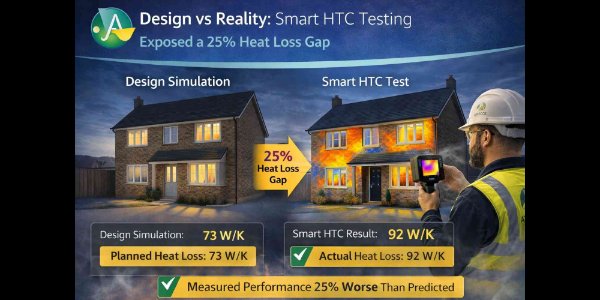
Yes. That is one of its strongest use cases. Government’s Heat Pump Ready thematic report says SmartHTC was used across more than 50 properties and found that traditional SAP-based assessments aligned with measured heat loss values in only 30% of cases, with SAP over- or under-estimating the rest. That is exactly the kind of design-versus-reality gap Smart HTC is good at exposing.
Yes, and it should be where the objective is to prove whether retrofit work has actually improved the home. Government’s GHG-SMETER project was specifically set up to investigate retrofit performance and change in performance using SMETER methods, and it recommends using the same methodology before and after the intervention. That makes Smart HTC a very practical baseline-and-verification tool.
Yes. PAS 2035 is built around whole-dwelling retrofit planning, and Approved Document F says that when energy-efficiency work is carried out to an existing dwelling, the ventilation assessment may involve expert advice, while following PAS 2035 is considered an adequate means of demonstrating compliance. Smart HTC adds measured evidence about how the home is performing in use, which makes retrofit decisions more grounded and less assumption-heavy.
Yes, very much so. Government’s GHG-SMETER summary says SMETERs are promising for large-scale retrofit evaluation and policy support, and its Type A methods are particularly useful when looking at cohorts rather than one-off homes. For landlords and housing associations, that makes Smart HTC attractive for baseline studies, post-works verification and portfolio prioritisation where relying on EPC assumptions alone can be risky.
It can support both, but the best route depends on the method. Government’s GHG-SMETER work says Type A remote-only approaches were not suitable for evaluating individual homes but were effective for cohorts of 50 or more homes, while Type B methods with internal temperature data achieved higher plausibility and are better suited to single-home work. That distinction matters when choosing the service scope.
Type A methods use remote-only data such as smart meter plus weather data, while Type B methods also include internal temperature data. Government’s GHG-SMETER summary says Type A is cheaper and more scalable but less suitable for single-home evaluation, whereas Type B is more intrusive but achieved better plausibility rates. In practical terms, Type B is the stronger route when you need a defensible result on one dwelling.
The ideal home for Smart HTC is one with metered heating energy, regular heating patterns, a useful winter temperature difference, and limited unmetered gains distorting the picture. Government’s GHG-SMETER findings say larger, older, lower-EPC-rated homes with regular heating patterns tended to produce higher plausibility, especially when the temperature signal was strong enough. That is why screening and setup matter before the service is sold in.
Homes are harder to assess accurately when they are underheated, have irregular heating patterns, or rely on unmetered heating sources such as solid fuel, oil or biomass. Government’s GHG-SMETER summary says SMETERs were less accurate for underheated homes and those with unmetered heating, and that regular heating patterns and a stronger temperature difference improved plausibility. In short, messy inputs produce messier outputs.
Yes, often it does, but data quality still matters. Government’s GHG-SMETER summary says no significant change in plausibility rates was observed for heat-pump-heated homes in that project, and multiple Heat Pump Ready case studies use measured temperature and meter data to estimate heat loss and HTC. For live retrofit and low-carbon heating projects, that makes Smart HTC highly relevant rather than a niche extra.
Yes, potentially, but the data needs to be understood properly. Government’s GHG-SMETER summary says no significant change in plausibility rates was observed for homes with solar PV in that project, although the methods and assumptions still matter. In practical terms, the service works best where the energy inputs and exports are being interpreted by a method that understands what the home is actually doing.
These cases are harder. Government’s GHG-SMETER findings say reduced credibility was observed for homes with other unmetered heating, and its headline limitations also flag underheated or unmetered-heating homes as less accurate. That does not make Smart HTC useless on those buildings, but it does mean the service should be sold and interpreted more carefully.
Yes, and this is one of the most commercially useful applications. Government’s Heat Pump Ready case studies show that using measured temperature and smart-meter data to determine a property’s heat-loss characteristics can improve sizing accuracy and support lower upfront and running costs. Smart HTC is especially valuable where conventional survey assumptions are likely to overstate the real heat load.
No, not at present. Government’s Heat Pump Ready case study notes that most domestic heat pumps installed through grant schemes such as BUS still require installers to carry out a BS EN 12831 calculation through the current MCS route. Smart HTC can improve understanding and support better design decisions, but it is not yet a straight replacement for the incumbent compliance workflow.
Yes, that is one of the strongest arguments for it. The Right Sizing Heat Pumps project found that a measured-data tool could size heat pumps 15–20% smaller than the incumbent MCS calculator approach, because it replaced broad survey assumptions with house-specific measured data. On real jobs, that can mean lower capital cost, lower running cost and less cycling risk.
Yes, in many cases, provided the dwelling boundary and energy data are clear enough. UK government documents consistently describe SMETER and HEM approaches in terms of dwellings and homes, not just detached houses. In practice, flats can be suitable, but shared systems, communal gains and unclear metering need to be understood upfront so the result is telling you something real about that dwelling.
Yes, and those are often the homes where measured performance is most useful. Older and traditional buildings are exactly where survey assumptions can go badly wrong, which is why government and industry keep pushing toward measured-data approaches. The core point is not that Smart HTC magically solves every heritage issue, but that it gives you a real whole-home heat-loss figure instead of relying entirely on model assumptions.
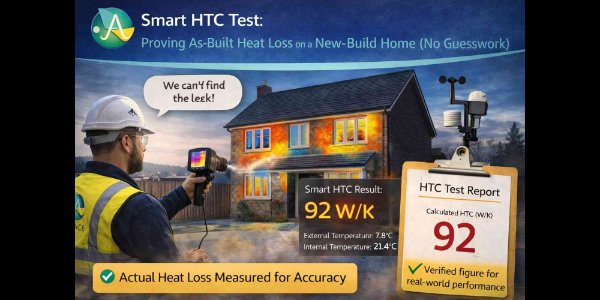
Yes. Smart HTC is not limited to retrofit stock. It can be used on new homes and self-build projects where the team wants to compare measured performance with the design expectation and check whether the as-built result looks believable. That is particularly useful where the client wants evidence on the performance gap rather than just paperwork showing what the model predicted.
Usually not as the standard mainstream route, at least not in the way UK policy currently treats it. Government’s SMETER work and HEM consultation are both focused on homes and dwellings, not the non-domestic stock. For commercial buildings, other building-performance and commissioning routes are still more typical. So unless a provider has a separate methodology, Smart HTC should be treated as primarily a dwelling-focused service.
You should get a measured thermal-performance result showing the home’s HTC, and often its HLP as well, plus enough context to compare that result with what was expected. Build Test Solutions presents this as a thermal performance rating and whole-building heat-loss calculation via a web portal. On a serious retrofit or heat-pump job, that output should feed directly into design decisions rather than sit in a PDF and get ignored.
Yes, the wider field is evidence-based and has been independently scrutinised. Government funded the TEST project to evaluate SMETER technologies, and the National Physical Laboratory later published a dedicated SMETER validation methodology. Separately, government’s Heat Pump Ready thematic report says the SmartHTC method had been validated against co-heating tests. That does not remove the need for quality assurance, but it does show this is not a made-up metric.
Cost is driven less by one headline price and more by the delivery model: single home or portfolio, smart-meter access or manual reads, sensor deployment, number of visits, and whether the service includes interpretation for retrofit or heat-pump design. Build Test Solutions says SmartHTC can be cost-comparable to EPC lodgement at volume, but individual projects are usually shaped more by logistics and technical support than by the raw algorithm cost alone.
The main limitations are that it is an in-use metric, so occupant behaviour and heating patterns influence the result; some methods are less suitable for single homes; and underheated or unmetered-heating homes can be problematic. Government’s GHG-SMETER work also stresses the need for consistent before-and-after methodology and stronger validation and data-sharing protocols. Smart HTC is powerful, but it is not magic and it is not context-free.
Smart HTC is most useful for homeowners planning a serious retrofit, self-builders checking the performance gap, housing associations and local authorities running upgrade programmes, Retrofit Coordinators needing measured evidence, and heat-pump designers trying to avoid oversizing. In short, it suits people making real spending decisions who want a better evidence base than EPC assumptions alone. That is exactly where government-backed case studies have found value in measured-data approaches.
Use Smart HTC early enough to influence the decision, not after the money has already been spent. The strongest route is to measure the home before major works, combine the result with airtightness, thermography or other diagnostics where needed, and then use the measured heat-loss picture to guide retrofit scope or heat-pump sizing. Government and industry evidence both point the same way: measured performance data reduces assumption risk and makes better decisions more likely.
HTC stands for Heat Transfer Coefficient. It measures how much heat a building loses through its fabric and air leakage for every degree of temperature difference between inside and outside. HLP stands for Heat Loss Parameter. It is the HTC divided by floor area, which makes it easier to compare homes of different sizes. In simple terms, lower HTC and lower HLP usually mean better thermal performance.
In a full SAP calculation, the design HTC is already included as part of the assessment. SmartHTC is most useful as a way to compare designed performance with measured performance, much like comparing designed airtightness with a test result. A measured HTC can be used to explore how performance changes, but it does not usually replace the formal value used for an official lodged EPC.
A measured HTC helps show the building’s real heat loss. The report can also provide a peak heat load figure, which gives a useful basis for sizing an air source heat pump more accurately. This helps reduce the risk of oversizing, although the confidence interval and full system design should still be considered.
It does not need to be perfect. The estimate is there to provide a reasonable benchmark so the recipient can compare expected performance with measured performance. It does not change the measured result. For existing homes, some details may be unknown, so a sensible professional estimate is usually enough.
This is not normally needed. The estimate is only there as a benchmark for comparison. The measured HTC itself carries the confidence interval, which is shown in the final report. Even if the estimate is not exact, it can still highlight whether the building is performing broadly as expected or falling short.
This usually happens because the building volume has not been entered. To use AP50 correctly in the report, you need both the measured air permeability value and the building volume. If the volume is missing, the AP50 line may not populate.
There is no separate lodgement fee. SmartHTC works on a building credit model. One house or address counts as one credit, usually for a 12 month period. That means you can run multiple calculations on the same building within that period and still use one credit. Each new building or address counts as another credit.
Pricing varies depending on plot numbers, location, access, travel time, and whether the service is bundled with airtightness, ventilation, or other testing. As a rough guide, many providers charge around £200 to £500 per building, although this can vary. The right price usually depends on how efficiently the work can be planned and grouped.
Yes. A permanent heating system is not essential, but the building still needs to be heated enough to create the required temperature difference. This can often be done using portable electric heaters. The practical cost will depend on the size of the building and how well insulated it is. Ideally, the heaters should be powered from the building’s own mains supply so the energy use can be measured accurately.
Peak heat demand is directly linked to HTC. The higher the HTC, the more heating power the building will need on a cold day. A simple way to think about it is to multiply the HTC by the difference between the design internal temperature and the design external temperature. This gives a useful estimate of the building’s peak heat demand.
Use the HTC figure shown in the SAP compliance calculation, usually from the section covering dwelling emissions for regulations compliance. This gives the correct design benchmark when comparing expected and measured performance.
Yes. Elmhurst Design SAP allows a measured HTC to be entered manually so you can explore how actual performance affects the rating, emissions, and running costs. This can be useful for reporting and comparison, but it is not the same as producing an official lodged EPC using a measured HTC.
An EPC, or Energy Performance Certificate, is the official document used for selling, renting, and new build compliance. It is the legally recognised certificate.
An EPR, or Energy Performance Report, is an informational report. It can be useful for showing likely energy performance and exploring measured outcomes, but it is not a legal substitute for an EPC.

Latest from the blog
No posts found for this configuration.
